Delaying Puppy Shots: What Vaccine Skepticism Actually Costs Your Puppy
Published on September 23, 2026
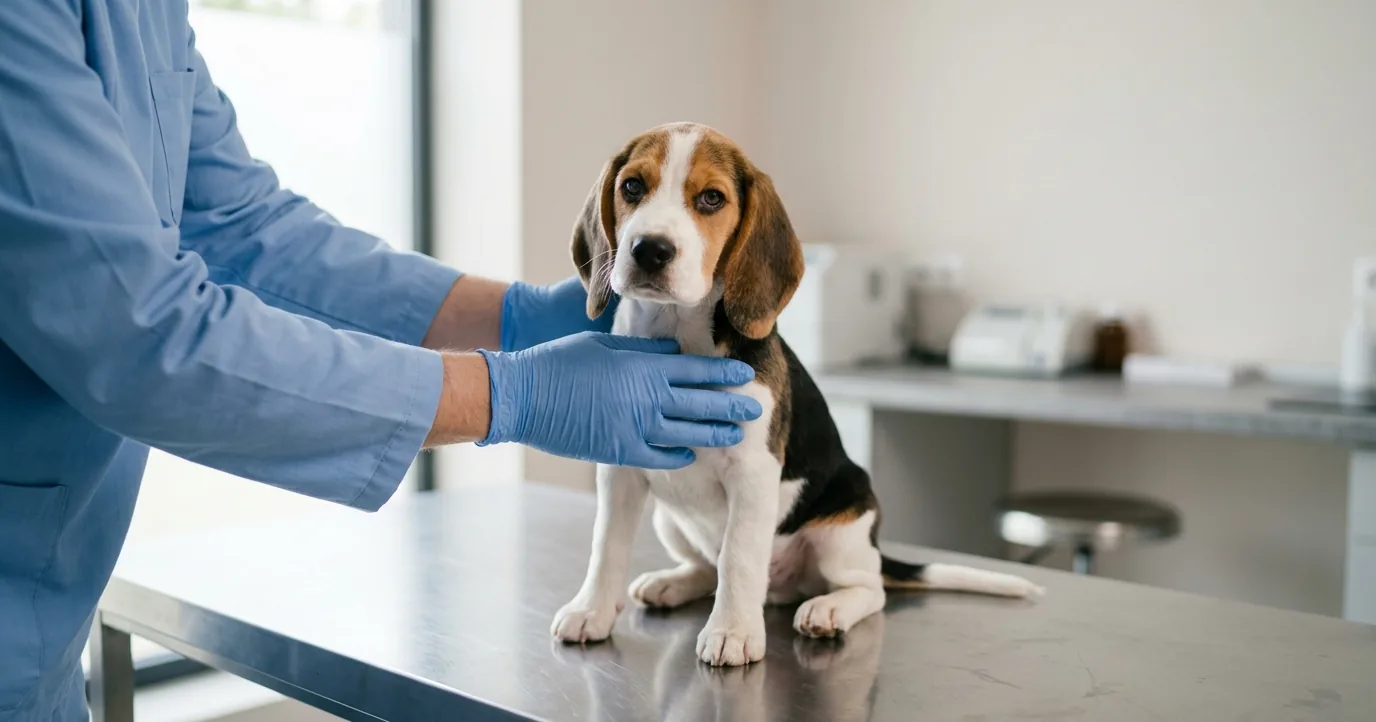
The enrollment form for puppy class usually has a line nobody used to think twice about: date of first vaccination. More owners now hesitate over it. Sometimes they have read something online. More often the doubt comes from someone at the kitchen table. Our dogs growing up never had all these shots. He’s too small for that many needles. Why not wait until he’s bigger and do them all at once?
Veterinarians are hearing the same questions in the exam room. In March, ABC7 in Los Angeles reported that vets were seeing a drop in pet vaccination as skepticism about human vaccines spilled over into pet care.
For an adult dog, a late booster is a conversation. For a puppy, it is a scheduling problem with two clocks on it. A puppy’s vaccine series and a puppy’s socialization window run on the same handful of weeks. Push one back and the other goes with it, and only one of them can be caught up later.
Where the Doubt Is Coming From
In 2023 a team led by Boston University’s Matt Motta ran the first survey built to measure what they called canine vaccine hesitancy. In a nationally representative survey of 2,200 people that spring, more than half of the dog owners expressed some hesitancy. Nearly 40 percent believed canine vaccines are unsafe, 30 percent believed they are medically unnecessary, and about 37 percent believed vaccination could give a dog autism, a claim with no scientific evidence behind it in dogs or in people. The doubt tracked attitudes toward human vaccines, and it went hand in hand with dogs going without a rabies shot.
Two caveats keep this honest. In 2023 the researchers did not think hesitancy was yet widespread enough to threaten US public health, though they warned that could change. And the skeptics are right about one thing: the World Small Animal Veterinary Association, which flags vaccine hesitancy as a real concern in its 2024 guidelines, also says an adult dog who responded to their puppy shots needs core boosters no more often than every three years, not the yearly round many dogs once got. The mistake is carrying that argument back to the puppy series, the one part of a dog’s vaccine history the evidence says not to trim.
What the Core Vaccines Actually Prevent
Most owners have never seen these diseases, and that is the vaccines’ doing. As a government veterinarian in Singapore wrote this year, vaccines work so well that these diseases have become uncommon in vaccinated populations, which is not the same as gone. That success is what makes the shots feel optional.
Parvovirus. Parvo attacks a dog’s white blood cells and gut, and in puppies it can damage the heart muscle. The American Veterinary Medical Association lists puppies between 6 and 20 weeks old among the most at risk, which is exactly the age range of a puppy class. Trace amounts of infected feces can pass it on, the virus travels on leashes, hands and clothing, and it survives in the environment for long periods. Severe cases need intensive care, often several days in hospital, and the AVMA is candid that it can be very expensive.
Distemper. About one in two dogs that catch distemper die of it, and the ones that survive usually have permanent nervous system damage. There is no cure and no approved antiviral. It spreads through the air when an infected dog coughs, sneezes or barks, and raccoons, skunks and foxes carry it too, so a fenced yard is not a barrier.
Adenovirus. The combination shot your vet may call DAPP or DA2PP bundles distemper, adenovirus and parvovirus into one injection. The adenovirus part protects against infectious canine hepatitis.
Rabies. Nearly always fatal, and required by law for dogs in almost every US state. The CDC advises against giving it before 12 weeks and counts a dog as immunized 28 days after the first dose. The part that matters for a hesitant household is exposure. Under CDC guidance, a dog who is current on rabies and tangles with a bat or raccoon gets a booster and 45 days of observation under the owner’s supervision. An unvaccinated dog faces euthanasia or, if the owner declines, four months of strict quarantine: four months cut off from the people, places and dogs a young dog’s first year is for.
Leptospirosis. The American Animal Hospital Association moved the lepto vaccine from non-core to core in a 2024 guideline update, reasoning that any dog who goes outdoors, in city or country, can be exposed. It is also zoonotic, so it can pass from the dog to the family.
Why a Puppy Needs So Many Shots
A puppy is born borrowing immunity. Antibodies from the mother’s first milk protect the puppy for the first weeks of life and then fade. While they are still around, they also cancel the vaccine, neutralizing it before the puppy’s own immune system can respond. The WSAVA guidelines call the dangerous stretch in the middle, when maternal antibodies are too low to protect the puppy but still high enough to block a vaccine, the window of susceptibility. Nobody can predict when that window opens or closes for a given puppy without a blood test, because the level of maternal antibody varies widely between litters and even between littermates.

So the series is not a pile of doses building up in a small body. It is a set of attempts. The WSAVA recommends core vaccines every two to four weeks, with the last one at 16 weeks of age or older, precisely so that one of them lands soon after each puppy’s borrowed protection runs out. Some of the early shots may not take, and that is expected. They are there to keep the gap between borrowed and earned immunity as short as possible.
That is also why “spacing them out” backfires. Stretching the time between puppy shots does not give the immune system a rest. It widens the window during which the puppy is protected by nothing at all.
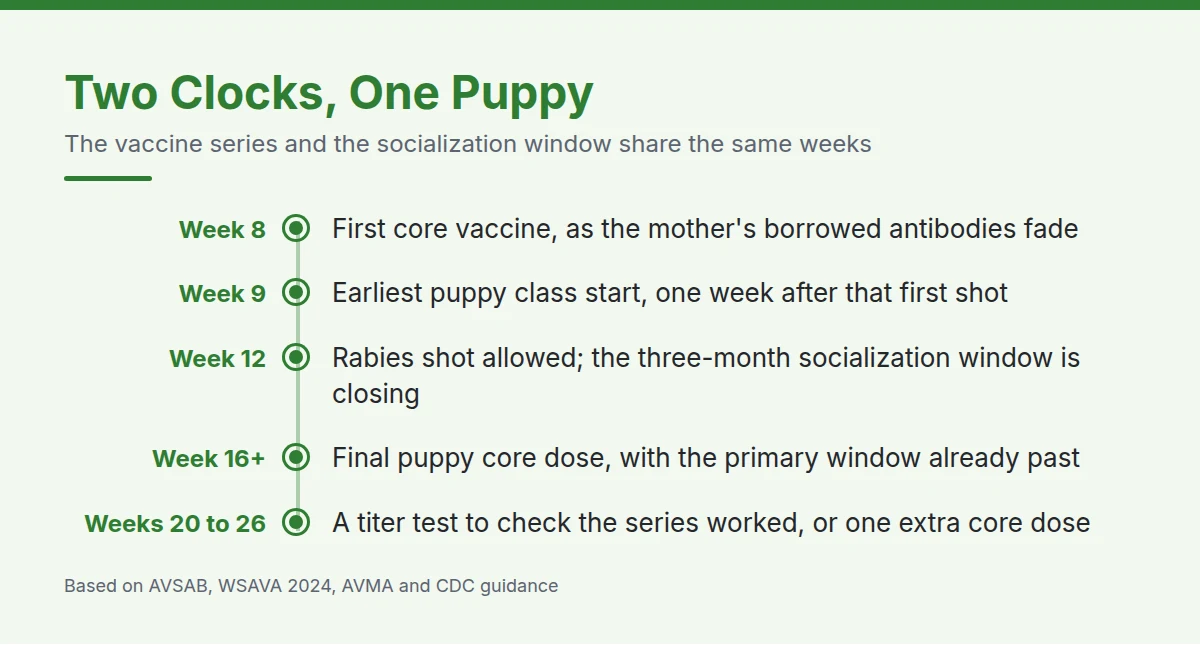
Two Clocks, One Puppy
The socialization window runs on the same weeks. The American Veterinary Society of Animal Behavior calls the first three months of life the primary and most important time for socialization, the period when a puppy’s sociability outweighs fear. The vaccine series ends at 16 weeks or later. Wait for the series to finish before your puppy meets the world, and the window has closed.
That is why AVSAB takes the position that socializing puppies before they are fully vaccinated should be the standard of care, and why the WSAVA agrees that careful socialization can start before the series is complete. AVSAB’s reasoning is blunt: behavioral problems, not infectious diseases, are the number one cause of death in dogs under three years old.
Read how AVSAB gets there, though. The risk of infection is small, it says, because of the combination of maternal immunity, primary vaccination and appropriate care. Take the vaccination out and the case for early class loses one of its three legs. The practical rule follows from it: at least one set of vaccines a week or more before the first class, a first deworming, and shots kept current for the length of the course.
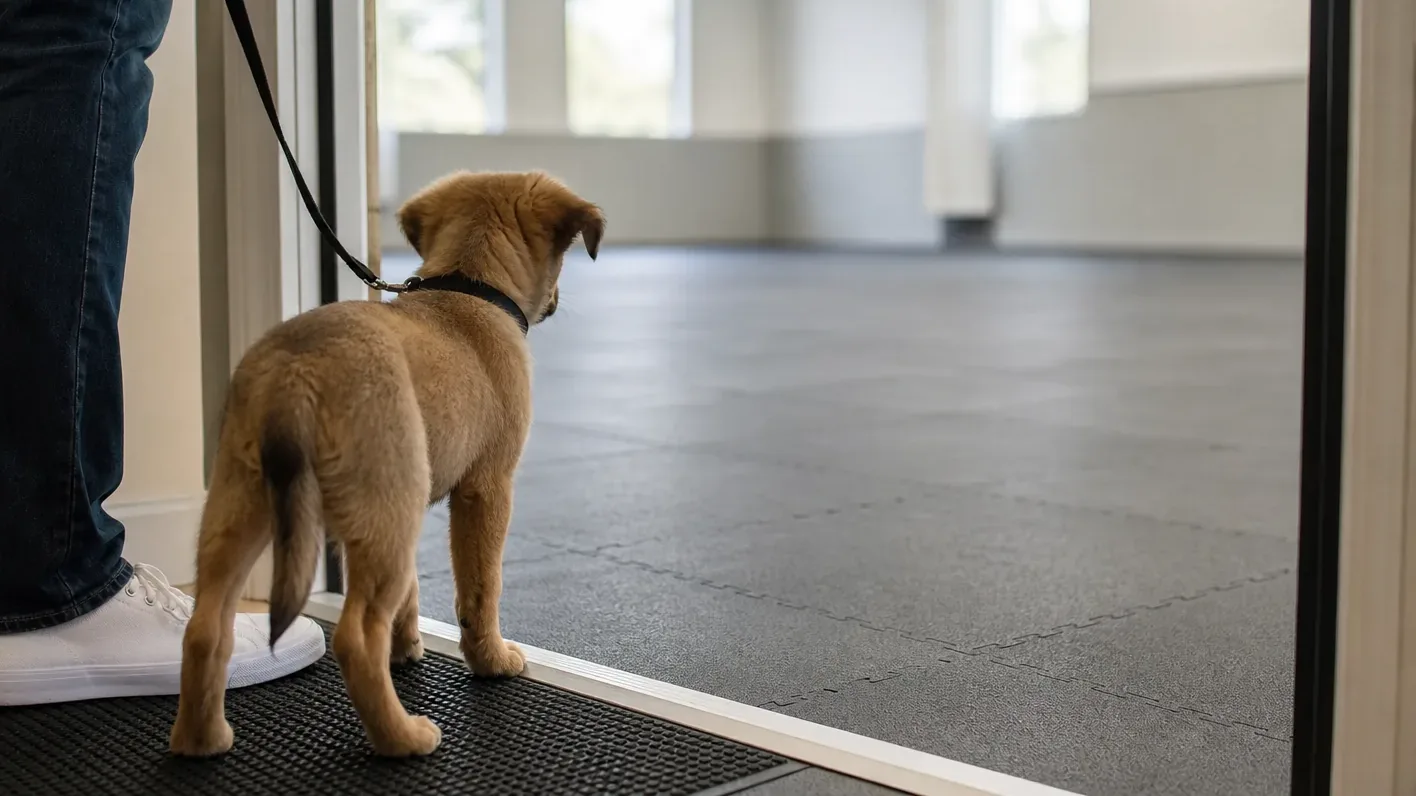
The best evidence that this works comes from a 2013 study out of UC Davis. Stepita, Bain and Kass gathered records on puppies up to 16 weeks old from 21 veterinary clinics and 24 trainers in four US cities. Of the 279 puppies who attended socialization classes, not one was suspected of or diagnosed with parvovirus, and vaccinated puppies who went to class were at no greater risk than vaccinated puppies who did not. The study looked specifically at puppies vaccinated by a veterinarian at least once. The safety record of early puppy class is the safety record of vaccinated puppies.
Here is what delay looks like on a calendar. A puppy vaccinated at eight weeks can walk into class at nine. A puppy whose first shot slips to twelve weeks walks in at thirteen, just as the three-month window is closing. A puppy whose owners wait for the whole series before doing anything starts class at 17 weeks at the earliest, after spending the most formative weeks of their life at home. And a puppy with no vaccines should not be accepted by any class that follows AVSAB guidance. For what those weeks are actually for, see how puppy class builds socialization and confidence and the week-by-week milestones from 8 to 16 weeks.
The Puppy Next to Yours
If you are on the other side of this, worried about an unvaccinated puppy sitting beside yours, the same logic tells you what to ask. A class is only as protected as its entry rule and how seriously it enforces it. The AVMA’s advice for anywhere puppies gather is to choose places that require up-to-date vaccinations, health checks and good hygiene, and that keep sick dogs away. In practice, ask:
- Do you check the vet record yourself, or take the owner’s word for it?
- How long after the first vaccine do you accept a puppy?
- What happens when a puppy turns up with diarrhea or vomiting?
- What do you clean the floor with between classes, and does it kill parvovirus?
Dog training is unregulated in most of the United States, so each class writes its own rules. An instructor who asks for the record, and turns away a puppy without one, is showing you a green flag, not red tape. Add it to the other things worth checking when you choose a puppy class.
There is one more reason to ask. The AVMA notes that even vaccinated puppies can occasionally become infected, because maternal antibodies can blunt the early shots. That is not an argument against class. It is why the entry rule, the cleaning routine and the sick-puppy policy matter as much as your own paperwork.
What to Say to the Family Member Who Thinks It’s Overkill
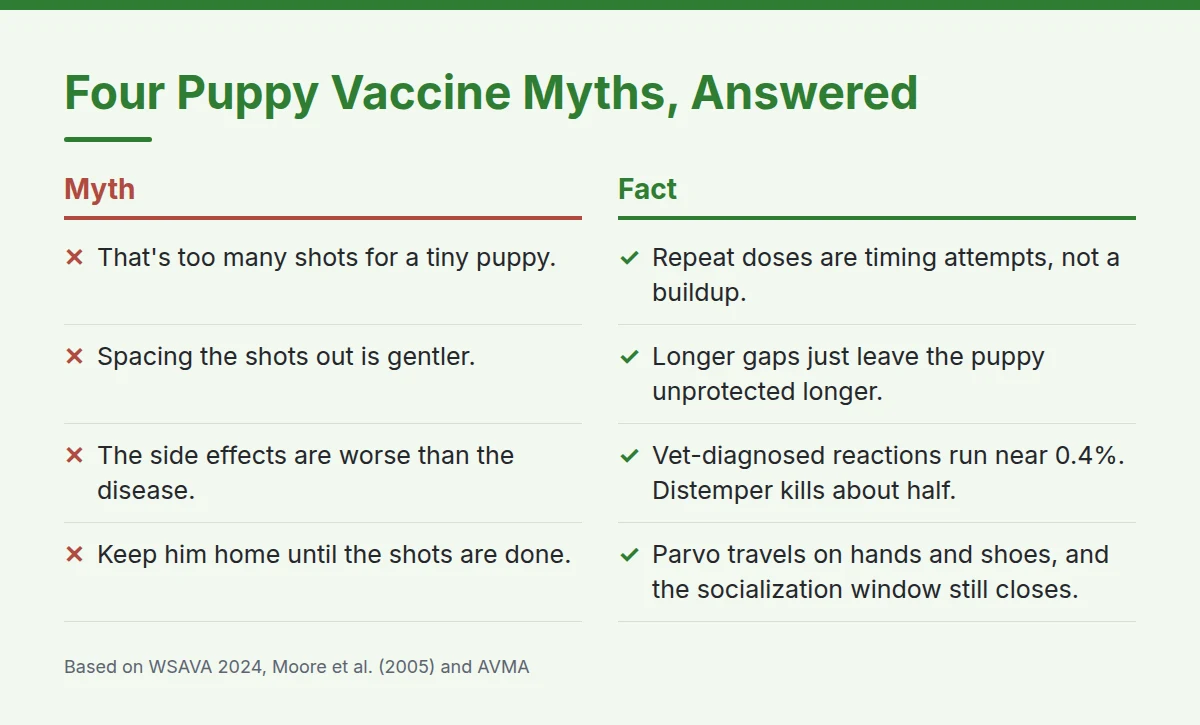
“Our dogs never had all these shots, and they were fine.” Some were, and the ones who were not are not part of the family story. Parvo still circulates, it hits puppies your puppy’s age hardest, and distemper kills about half the dogs it infects.
“That’s too many needles for a dog that small.” Vaccine doses are not scaled to body weight. Each contains the amount needed to trigger protective immunity, in a Chihuahua and a golden retriever alike. There is a grain of truth in the worry, though. In a study of more than 1.2 million vaccinated dogs, Moore and colleagues found reactions were more common in smaller dogs and rose with each extra vaccine given at the same visit, by 27 percent per vaccine in dogs of 10 kilograms (22 pounds) or less. That supports asking your vet to split the shots due at one appointment across two visits. It does not support delaying the series or dropping core shots.
“The side effects are worse than the disease.” In that same study, adverse events diagnosed within three days of vaccination came to 38 per 10,000 dogs, a little under 0.4 percent. Dogs aged two to nine months actually had fewer reactions than young adults. The American Society for Microbiology describes the common ones as soreness at the injection site, tiredness, a mild fever and a dip in appetite, usually gone within 24 hours. Set that against a disease that kills one dog in two.
“He’s an indoor dog. We’ll keep him home until he’s older.” Parvo travels on hands, clothing and shoes. And keeping a puppy in until the series is done means spending the socialization window indoors. That is both costs at once: a puppy who is unprotected and one who is unsocialized.
“Isn’t there a middle ground?” There is, but not where most people look. A middle ground deserves the same scrutiny with vaccines as in training, where the “balanced” label turns out to be less of a compromise than it sounds. The real vaccine middle ground is in adulthood. Once a puppy has responded to the series, the WSAVA says core boosters are needed no more often than every three years. A titer test (a blood test for antibodies) taken at least four weeks after the last puppy shot, so from about 20 weeks, can confirm the series worked, as an alternative to an extra dose at around 26 weeks. Non-core vaccines should match how your dog actually lives. What has no evidence behind it is starting late or stretching out the puppy series.
If Your Puppy Is Already Behind
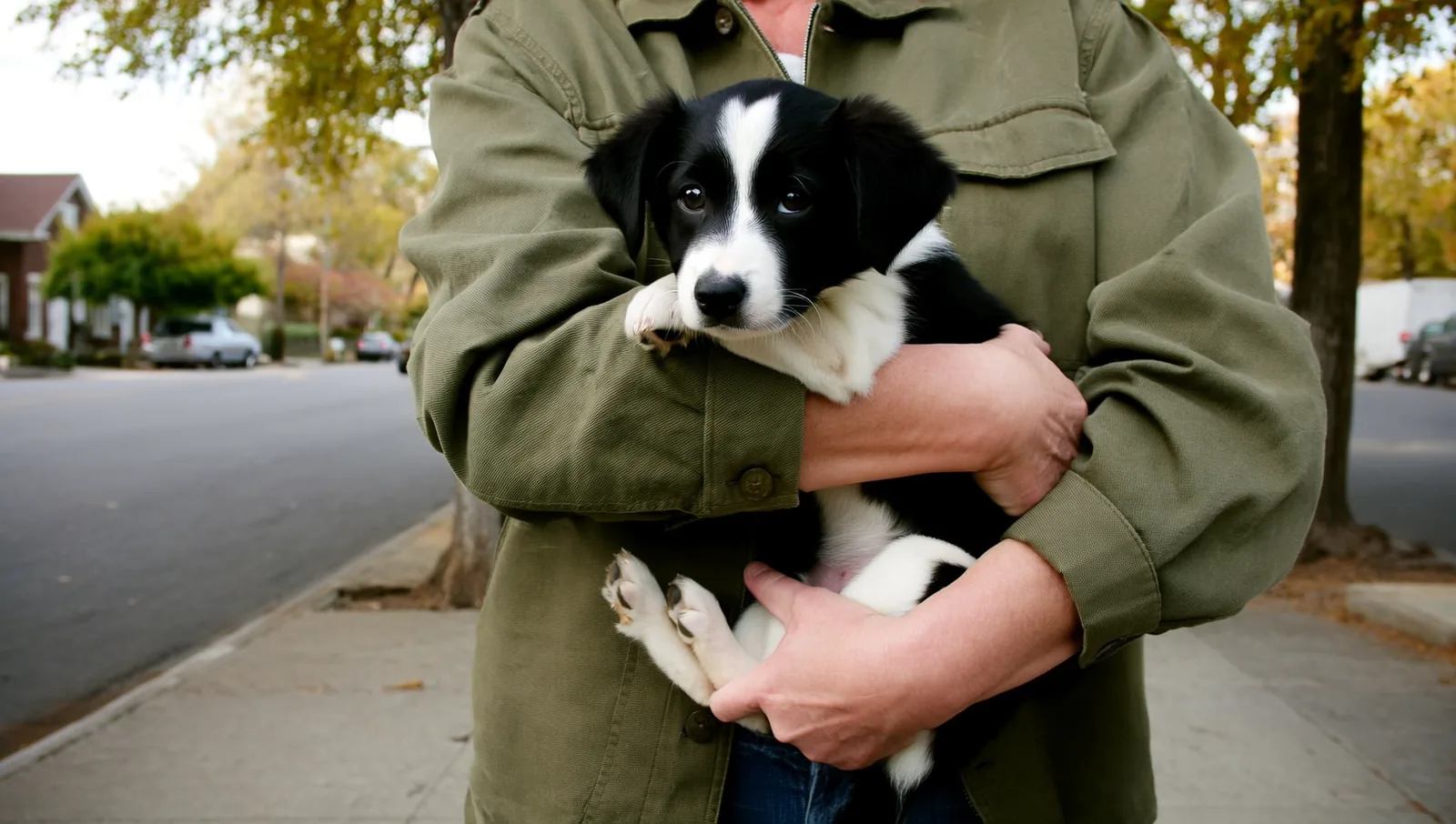
It is not too late, and it is not a reason to give up on class. Book the vet now. A class that follows AVSAB guidance can take your puppy seven days after the first set of vaccines. In the meantime, socialize at home and in places without dog traffic: visitors, new sounds, new surfaces, car rides, carried trips down a quiet street, gentle handling. AVSAB advises avoiding dog parks and other spots heavily used by dogs of unknown vaccination status.
If your puppy came from a breeder or shelter, ask for the record of any shots given before pickup. Many puppies come home with a first dose already on board, which moves up the date they can start class. It is one of the questions worth asking about the weeks before you brought your puppy home.
A genuine medical reason to delay, such as illness or a severe reaction to an earlier dose, is your vet’s call. AAHA recommends core vaccines for every dog barring a specific medical reason, and that exception exists for cases like these.
And if the delay has already cost you weeks and your puppy is now wary of new people or dogs, do not wait for it to pass. Fear in a young puppy is a job for a qualified behavior professional, and a puppy showing fear-based aggression should see a board-certified veterinary behaviorist.
The Bottom Line
Doubt about puppy shots usually comes from a decent place: a small dog, a lot of needles, and a wish not to overdo it. But the puppy series is not where overdoing it happens. It is a run of timed attempts to close the gap between borrowed and earned immunity, and it shares its weeks with the socialization window. Delaying it leaves your puppy unprotected for longer and out of class during the weeks that matter most. Save the middle ground for adult boosters and titer tests, and keep the puppy series on time.
Further reading (sources)
- Boston University on the first survey to measure canine vaccine hesitancy
- ABC7 Los Angeles with veterinarians reporting a drop in pet vaccination
- Squires and colleagues (WSAVA) for the 2024 global vaccination guidelines and the window of susceptibility
- The Straits Times on a government vet explaining why doses are not scaled to size
- American Veterinary Medical Association with which puppies parvovirus hits hardest and how it spreads
- American Veterinary Medical Association for distemper’s death rate and lasting nerve damage
- Centers for Disease Control and Prevention on rabies vaccine timing and what follows an exposure
- American Animal Hospital Association on moving the leptospirosis vaccine to core
- American Veterinary Society of Animal Behavior for its position that puppies should socialize before full vaccination
- Stepita, Bain and Kass on parvovirus in 279 vaccinated puppies who attended class
- Moore and colleagues for reaction rates across 1.2 million vaccinated dogs
- American Society for Microbiology with how animal vaccines work and their common mild side effects