Desensitization and Counterconditioning for the Fearful Puppy: A Class-Friendly Protocol
Published on May 27, 2026

The Puppy That Will Not Come Through the Door
You will know the puppy on sight. The class is twenty minutes old, the other six are happily working for cheese, and one is wedged behind its owner’s calf with its tail tucked, refusing every treat on offer. Sometimes the owner has dragged the puppy in by the leash. Sometimes the puppy has shut down so completely it looks asleep. Either way, the standard class plan (sit, down, name game, mat work) is no longer the relevant plan for this puppy.
What this puppy needs is the technique veterinary behaviorists treat as the gold standard for canine fear: a structured combination of desensitization and counterconditioning, almost always written together as DS and CC. It is not a fancy intervention. Done patiently, it is something an owner can run as a parallel track alongside the group class, week by week, until the puppy can rejoin the curriculum. Done impatiently, it backfires. The difference is mostly in the details.
What the Two Words Actually Mean
The behavior literature is unusually crisp on this one. A 2018 review in Veterinary Clinics of North America: Small Animal Practice defines desensitization as a gradual, controlled exposure procedure: the patient is “taught to relax as it is exposed to anxiety-provoked stimuli in a gradual fashion,” starting with a muted version of the trigger and working up in tiny increments while staying calm at every step. Counterconditioning is the partner technique: you pair each exposure with something the puppy already loves (typically food) so that the emotional association with the trigger flips from “uh oh” to “oh good.”
Run separately, each is weaker. Desensitization without counterconditioning can produce a puppy that tolerates the trigger but never enjoys it. Counterconditioning without desensitization (food at full-intensity exposure) usually fails because a frightened puppy will not eat. Run together, they reinforce one another, which is why the literature almost always lists them as a single protocol.
The same logic appears in adjacent research. A 2016 study in Behavior Analysis in Practice used a graded distance hierarchy with reinforcement to reduce dog phobia in children, and the improvements held up in follow-up and in generalization tests. The mechanics are symmetric: shrink the distance to the scary thing slowly, reward calm engagement at every step, never push past the point where the subject loses composure.
Find the Threshold First
Every DS and CC protocol starts at the threshold: the closest your puppy can get to the scary thing while still able to eat, take a cue, sniff the ground, look at you, or otherwise behave like a puppy that is not in crisis. Above threshold, the brain is in a fear state and is not learning anything you would want it to learn. Below threshold, it can.
Signs your puppy is at threshold rather than over it: ears soft, body loose, willing to take a low-value treat, willing to glance at you, willing to break eye contact with the trigger. Signs it has tipped over: hard stare, frozen body, refusing food, tucked tail, lip licking, yawning out of context, trying to leave. The phrase trainers repeat (with reason) is if the puppy won’t eat, you are too close. That is not always literally true, since some puppies stop eating from over-arousal rather than fear, but as a first-pass rule for owners it is a remarkably reliable signal.
For a class-door puppy, threshold might be twenty feet from the entrance with the door closed, or in the parking lot, or in the car with a window cracked. For a puppy that freezes around other dogs, it might be on the other side of a fence, or with the other dog behind a visual barrier. The job is to find that distance honestly, not to find the distance that lets you keep your class enrollment.
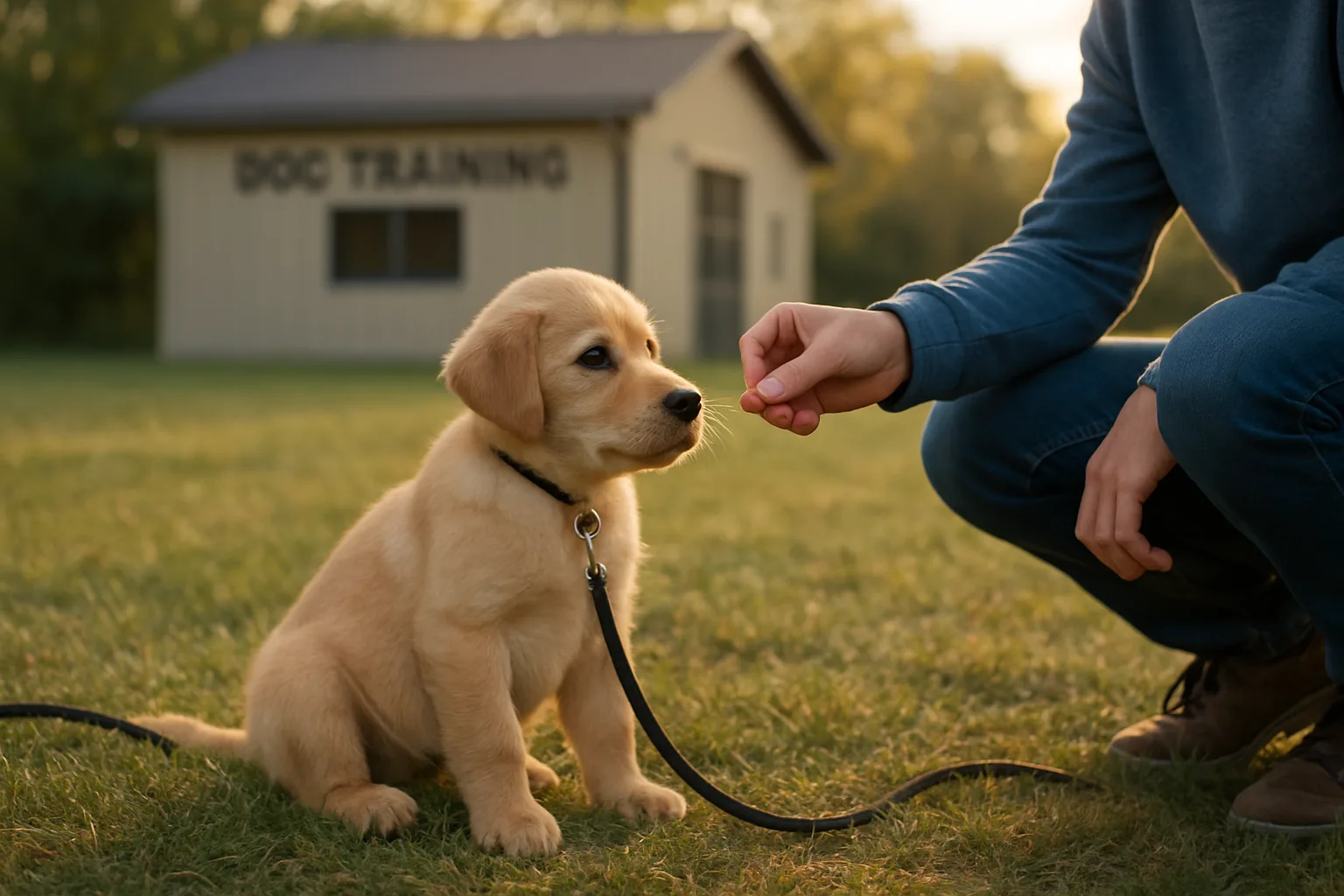
Build the Ladder
Once you have a threshold, you build a hierarchy of small steps between it and the eventual goal. The exposures research is consistent on this: the steps need to be small enough that the puppy stays under threshold at every tier, and you only move up when the current tier feels boring. Boring is good. Boring means the puppy has learned that this version of the scary thing predicts cheese, and there is nothing left to feel anxious about.
A class-door ladder for a typical fearful puppy might look like this:
- Tier 1: car parked across the lot, windows down, watch dogs and owners arrive from inside.
- Tier 2: out of the car on a long line, twenty-five feet from the building, sniffing the grass while class goes on inside.
- Tier 3: walk past the building once, in the direction the puppy wants to walk, then back to the car.
- Tier 4: stand in the lobby for thirty seconds with the training room door closed.
- Tier 5: sit on a mat in the back corner of the training room, ten feet from the nearest other dog, with a visual barrier (a chair or a screen) between you.
- Tier 6: same corner, no barrier.
- Tier 7: working alongside the rest of the class on simple cues.
Each tier wants three to five reps across one or two sessions before you climb. Skip a tier and the puppy tells you immediately; the food refusal returns, the body stiffens, you are back to square one. Drop a tier in that case and try again next session at the lower step.

Pair Each Tier With the Right Food
This is the counterconditioning half, and it is where reward selection earns its keep. The classic mistake is using kibble for DS and CC work. Kibble is not paying enough to flip an emotional association, especially in an environment that already smells like other dogs. The treat at threshold needs to be the puppy’s actual top-tier reinforcer, the thing it would mug your pocket for at home. If you have not yet figured out what that is for your puppy, the ten-minute kitchen-table preference test is genuinely worth doing before you start a DS and CC plan, because the rest of the protocol stands or falls on the reward.
Delivery matters too. The food appears the instant the trigger appears (dog walks into view, treat hits the puppy’s mouth) and disappears the instant the trigger leaves. This sequencing is what does the actual conditioning work; the trigger predicts the food, not the other way around. Owners frequently get this backward, dispensing treats to soothe a worried puppy and accidentally training the puppy that worry is what gets cheese. Reverse the order and the effect reverses with it.
For tiers one through four, expect to use your absolute best food: poached chicken, a soft cheese, a smear of plain yogurt on a spoon. Once the puppy is reliably calm in the training room itself, you can step down to your middle-tier rewards for routine class work and save the premium stuff for new triggers. Reward value is one of the practical skills a good class instructor coaches owners on directly, and a competent trainer will not flinch if you bring poached chicken to week three.
What Counts as Progress
DS and CC progress is not linear and not fast. A reasonable benchmark is one tier up per week, sometimes two, sometimes none. A puppy that climbs four tiers in a single session and then falls apart at tier five has not really climbed; it has been pushed, and you will pay for that on the next session.
You are also building a side-effect that is arguably more valuable than tolerance of the original trigger: an emotional template the puppy can apply to the next worrying thing. The early socialization window is the most efficient time to install that template, which is one of the strongest arguments for getting fearful puppies into class early rather than waiting until they grow out of it. They usually do not grow out of it.
Red Flags That Need a Veterinary Behaviorist
DS and CC is a powerful protocol but it is not the right protocol for every fearful puppy. Refer up the chain when you see any of the following, even if class is going otherwise well:
- The puppy panics at low-intensity exposures (large distance, brief duration, mild stimulus) and cannot recover within a few minutes.
- Fear generalizes faster than you can desensitize, with new triggers appearing weekly.
- There is growling, snapping, or air-biting when the puppy is cornered or approached, especially toward household members.
- The puppy shows fear responses to its owners, not just to outside triggers.
- Body-language signs of chronic stress (lip licking, yawning, panting, trembling) persist outside the trigger context.
- Class makes the behavior reliably worse rather than better across two or three sessions of careful threshold work.
These signs sit outside the scope of group puppy class and outside the scope of most pet-dog trainers. A board-certified veterinary behaviorist (a DACVB) can rule out medical contributors, evaluate whether anxiolytic medication should be part of the plan, and design a protocol specific to the puppy. In some states the cost of one consult is comparable to a few months of group classes; weighed against the cost of an adult dog with entrenched fear, it is usually money well spent. If your trainer is not actively pushing you toward that referral when these signs appear, that itself is information about your trainer.
For most fearful puppies, though, the picture is more ordinary: a sensitive temperament, a slightly rough start, and a class environment that is just a bit too loud, too fast, or too close. DS and CC, run patiently and paired with the right food, is what turns those puppies into the ones standing happily in the middle of the room by week eight, working for cheese alongside the rest of the class.
Further reading (sources)
- Peer-reviewed research on when and how to apply desensitization and counterconditioning
- Behavior Analysis in Practice with graded contact desensitization plus reinforcement for dog phobia
- American College of Veterinary Behaviorists for finding a board-certified veterinary behaviorist
- AAHA on recognising and handling an anxious patient
- Peer-reviewed research for desensitization and counterconditioning, when and how
- Peer-reviewed research with how handling technique changes a dog’s physiological stress response