Too Much Dog Advice: What the Research on Where Owners Learn Training Says About Your Feed
Published on October 11, 2026

It is twenty to midnight. The puppy has finally fallen asleep against your leg, and you are on your fortieth video. The first trainer said to ignore the nipping. The second said to yelp like a littermate. The third clamped a hand around a puppy’s muzzle, and the fourth said the first three were ruining their dogs. Your puppy is sleeping fine. You are not.
You have company. In May 2026 The Telegraph ran a first-person piece under the headline “I got hooked on dog-training videos. It sucked the fun out of having a puppy.” Back in 2023, a New York Times opinion essay was titled “My Year of Being Very Online About Dogs.” This article will not add another resource to your pile. It is about filtering the pile: where owners actually get their training information, why the feed tilts toward dramatic fixes, a thirty-second check you can run on any tip, and why the contradictions end up landing on your puppy.
Where Owners Actually Learn Training
In 2021, Arizona State University psychologists Anamarie Johnson and Clive Wynne surveyed nearly 800 undergraduates who had dogs about how those dogs were trained and where the advice came from. Asked in general whom they would turn to, 36 percent said online sources, 32 percent a veterinarian, 24 percent friends or family, and about 5 percent a dog trainer. Seventy percent had either trained the dog themselves or done no formal training at all.
The revealing answers came when the questions got specific. Asked how they handled eight concrete problems, from barking to resource guarding, respondents named friends and family as their most consistent source; for barking, about half did. Veterinarians, named by nearly a third in the general question, came up only 3.5 percent of the time once a real problem was on the table, roughly a tenth as often.
Methods slipped the same way. In general terms, most respondents described their training as reward-based. Asked about the specific problems, 57 percent said they would use a verbal or physical correction. Asked which television show they used for advice, nearly a quarter named the same one: a pack-leadership makeover show whose original run had ended in 2012. The same celebrity trainer wrote the most-named books. Social media was rarely anyone’s main source in 2021, though when respondents picked an app, TikTok and Instagram led.
Students are not typical owners, and many were not their dog’s main caregiver, which the authors acknowledge; they also note that their results line up with earlier surveys of other owners. The pattern is the useful part. The qualified people drop out of the loop exactly when a real problem shows up, and whatever is nearest fills the gap. Keeping a qualified person in that loop is one of the more realistic things a puppy class offers, and it is a different promise from the one classes are usually sold on. Before you enroll, it is worth reading what the follow-up studies say classes can and cannot prevent.
Why the Feed Favors the Dramatic Fix
Nobody built a feed to promote bad dog training. It promotes what people watch, share and rewatch, which is a different thing.
When marketing researchers Jonah Berger and Katherine Milkman studied which New York Times articles readers emailed most, the winners provoked high-arousal emotions such as awe, anger and anxiety, while content that evoked low-arousal feelings such as sadness spread less. A training clip runs on the same fuel. A puppy lunging and screaming, a confident stranger stepping in, instant stillness: that is arousal and resolution inside thirty seconds. The reward-based answer to the same problem is a dozen repetitions of a puppy sitting for kibble while the bar creeps up a little each day. It works, and it makes terrible content.
Popularity is no filter for the animal’s welfare, either. Researchers at the University of Veterinary Medicine Hannover analyzed 162 pet videos posted to be funny. They saw stress reactions in 82 percent and a risk of injury in about half, yet nearly 94 percent of the clips cleared the study’s benchmark for a successful video.
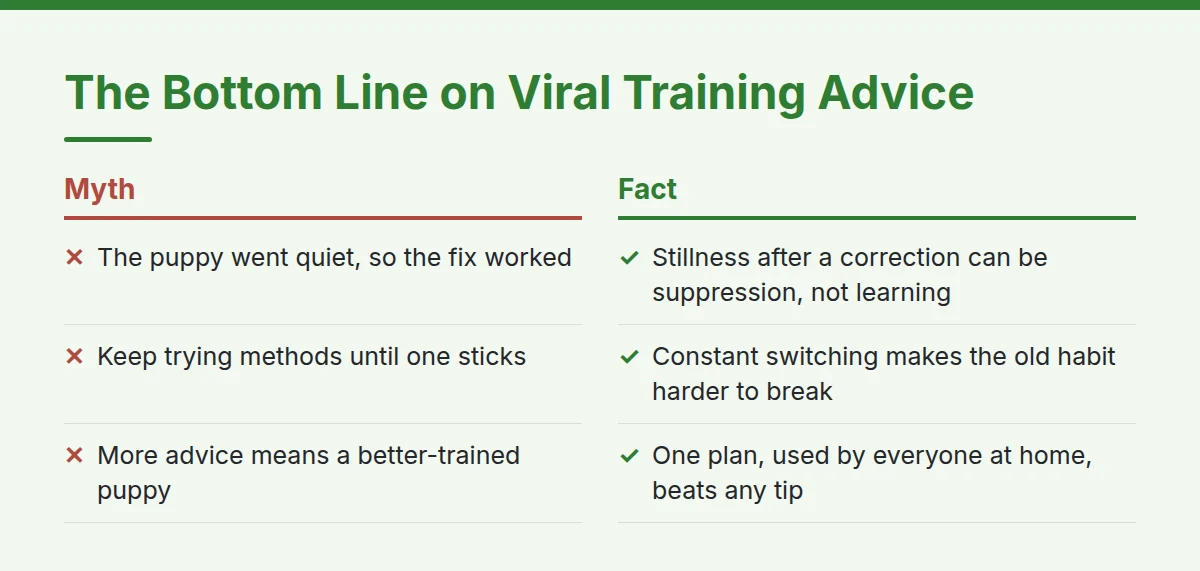
Then there is what a short clip cannot show. A correction often does stop a behavior in the moment, which is exactly why it looks like magic on camera. What it costs happens off screen. When University of Porto researchers filmed 92 companion dogs in training, dogs from schools that leaned heavily on aversive methods showed more stress behaviors such as lip licking and yawning, spent more time tense, panted more and had larger cortisol rises after class than dogs from reward-based schools. In a separate test away from training, they were also more “pessimistic.” A dog that goes still after a correction may simply have stopped offering anything, and a quiet puppy can be a shut-down puppy rather than a trained one.
Pack-leader language deserves its own flag. Emmanuelle Titeux, a board-certified European veterinary behaviour specialist practicing in Singapore, put it plainly to The Straits Times in August 2026: “As soon as a professional uses the theory of dominance, it is difficult to avoid coercive methods.” If the explanation in a video starts with who is the alpha, expect the fix to involve force.
None of this began with phones. When researchers compared five best-selling dog training books, they found marked differences across all of them, down to recommending starkly different methods. The feed just delivers the contradictions faster, and at midnight.
The Thirty-Second Check for Any Viral Tip
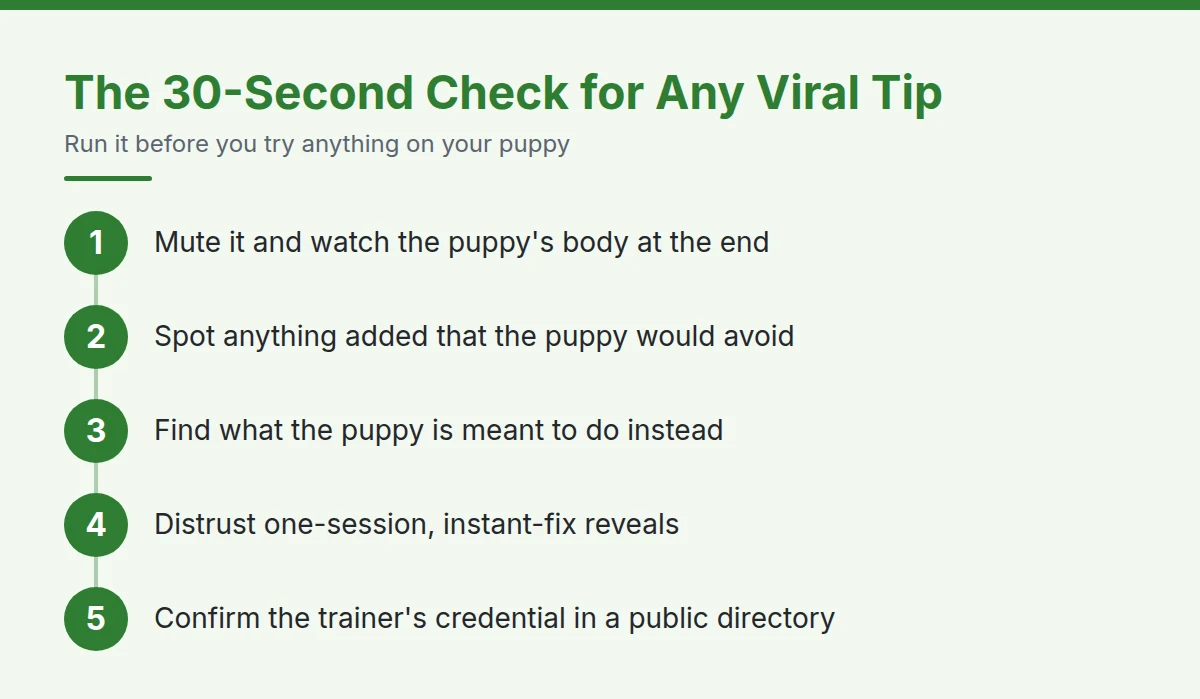
You do not need a behavior degree to filter your feed. Run these five questions before you try anything on your puppy. Most bad tips fail at least one of them inside half a minute.
1. Mute it and watch the dog. A voiceover tells you what to see. With the sound off, watch the puppy in the last few seconds: lip licks, yawns, ears pinned back, a tucked tail, a frozen body, a head turned away, the whites of the eyes. If the “fixed” puppy looks like that, you watched a puppy being suppressed, not a puppy learning. Our guide to reading your puppy’s body language in class shows what each signal means.
2. Ask what was added. Did the fix depend on something the puppy would work to avoid? The American Veterinary Society of Animal Behavior (AVSAB) names squirt bottles, shaker cans, compressed air, shouting, leash jerking, physical force and “alpha rolls” among the techniques a trainer should avoid. It recommends reward-based methods only, for all dog training, including behavior problems.
3. Look for the “instead.” Good advice tells you what the puppy should do (four paws on the floor, a sit to greet, a chew in the mouth) and how to pay for it. AVSAB’s position statement makes the same point: training works best when it teaches the animal what to do rather than punishing what it got wrong. A tip that only stops a behavior leaves the puppy guessing.

4. Distrust the one-session reveal. Learning shows up across many short repetitions spread over days. A dramatic before and an instant after shows you the edit, not the process, and nobody posts the takes where the trick failed.
5. Check the person in one search. In the United States no license is required to call yourself a dog trainer, so the word in a bio means nothing on its own. Look for a credential you can confirm in the issuing body’s public directory (the CCPDT, the Karen Pryor Academy and the IAABC each run one), and notice whether the video ends in a link to buy a tool. A product is not disqualifying by itself, but it raises the bar.
Conflicting Advice Is a Training Problem, Not Just a Stress Problem
Here is what the scroll hides. Your puppy never sees the videos. It sees only what happens after it does something, and when the advice changes every few days, so do the consequences.
Take jumping up. On Monday you turn away, because one trainer said to. On Wednesday a different video says to knee the puppy in the chest. On Friday you ask for a sit and pay it. Over the weekend a visitor laughs and scratches its ears mid-jump. You tried four methods. Your puppy lived in one world, where jumping sometimes pays off big, and a habit that pays off unpredictably is one of the hardest kinds to break.

The research points the same way. In a survey of 1,276 dog owners, Christine Arhant and colleagues found that owners who were more consistent in how they treated their dogs had more obedient small dogs (under 20 kilograms, about 44 pounds), and that more frequent punishment went with more aggression and excitability in small and large dogs alike. It is a correlation, not proof, but it matches what instructors see every week.
Mixing methods carries its own cost. In the Porto study, even dogs from schools that used aversive techniques sparingly showed more stress behaviors and spent more time tense than dogs from reward-based schools. That mix is exactly where the Arizona survey found most owners living: rewards in principle, corrections in practice. The research on so-called balanced training goes deeper on what the mix does.
The household multiplies all of it. If one adult follows a creator who says “off” and another follows one who says “down,” while “down” also means lie down, the puppy is learning two dialects at once.
And then there is you. A feed full of contradictions feeds the anxious, nothing-is-working feeling so many new owners describe in the first weeks, the strain researchers now call the puppy blues. Closing the app is a legitimate part of the training plan.
Build a Filter, Not a Library
The fix is not finding the one perfect account. It is deciding in advance how new information gets into your house.
- Appoint one primary source. For a young puppy, the best one is a qualified, reward-based instructor who can watch your dog. Everything else is an idea you bring to that person, not a change you make on a Tuesday night.
- Give each plan a fair run. Pick one approach per behavior and have everyone use it for at least a couple of weeks before you judge it. Switching every few days guarantees you never find out what works.
- Watch on purpose. Search for the skill you are working on this week, watch one or two explanations, then close the app. Feeds take their cues from what you watch to the end, so finishing the dramatic clips tends to bring you more of them.
- Mute anything that fails the check, however many followers it has.
- Write the household sheet. One cue word per behavior, what earns a reward, and how you manage the problem in the meantime (a gate, a leash, a chew). Stick it on the fridge so everyone works from the same page.

When to Stop Searching and Call Someone
Some problems are not information problems. Growling or snapping, guarding food or toys, panic when left alone, or a puppy that cannot settle anywhere new all call for a professional who can see the dog, not a better search term. AVSAB’s guidance is that fear, aggression and anxiety need a treatment plan built on management, behavior modification and sometimes medication, and that the dog should always be evaluated by a veterinarian so medical causes can be ruled out. Start with your vet, and for fear or aggression, ask for a referral to a board-certified veterinary behaviorist (DACVB).
The Bottom Line
Your puppy does not need the internet’s best idea. It needs one clear plan, applied the same way by everyone in the house, for long enough to work. The feed will always have another trick. Your puppy only has you.
Further reading (sources)
- Johnson and Wynne on where nearly 800 US dog guardians get training advice, and what they actually do
- Kühnöhl and colleagues for stress and injury risk in 162 popular funny pet videos
- Berger and Milkman with why high-arousal content gets shared more
- Vieira de Castro and colleagues on stress behaviors and cortisol in dogs from reward, mixed and aversive schools
- Arhant and colleagues for owner consistency, punishment and behavior in smaller and larger dogs
- Browne and colleagues on how five best-selling dog training books disagree
- American Veterinary Society of Animal Behavior with its position statement on humane dog training
- The Straits Times for a veterinary behaviour specialist on why dominance thinking leads to coercion
- The Telegraph on a puppy owner who got hooked on dog-training videos
- The New York Times with an opinion essay on a year of being very online about dogs