Raising a Future Hunting Retriever Force-Free: Puppy Foundations Before Field Work
Published on November 6, 2026
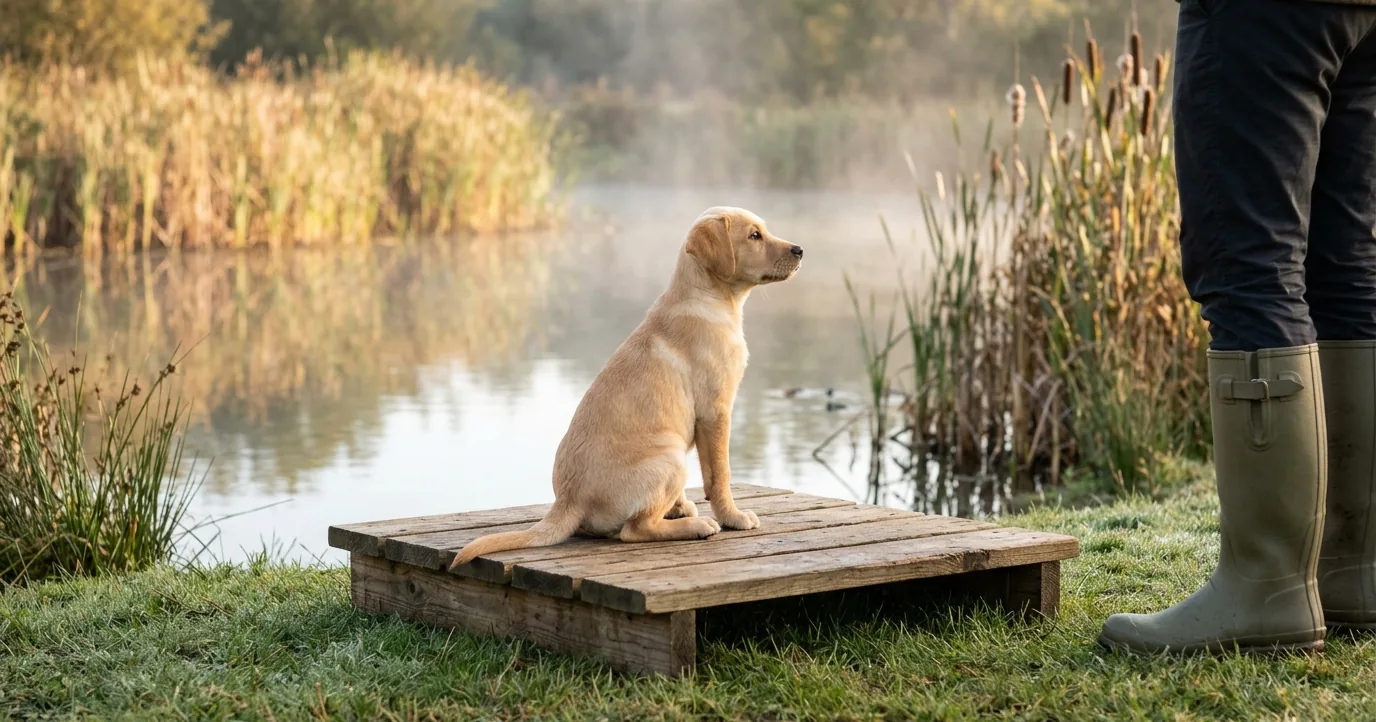
Bring home a Labrador puppy with duck season in mind and the advice arrives before the crate is unpacked: collar-condition early, get it force-fetched before its first season, keep tug toys away or you will ruin its mouth. Most of that advice was written for an older dog in a formal program. Almost none of it is about the puppy in your kitchen, nine weeks old, asleep most of the day, and taking in more about the world each week than it will at any later point in its life.
This guide covers the puppy months for a Lab, Golden or spaniel headed for upland fields or a duck blind: a retrieve that comes all the way back to your hand, a marker word, steadiness built as everyday impulse control, and calm first meetings with water and gunfire. It also explains why the ear pinch and the e-collar have no job to do yet. None of this replaces field training. It is what field training is built on.
The Job You Are Raising a Puppy For
Ducks Unlimited summed up a retriever’s job in a training piece built around Robert Milner, who has worked with retrievers since he was nine: sit calmly in the blind and bring back the birds that have been shot. To do that, Milner says, the dog “must be steady, calm, and obedient in a high-distraction environment.”
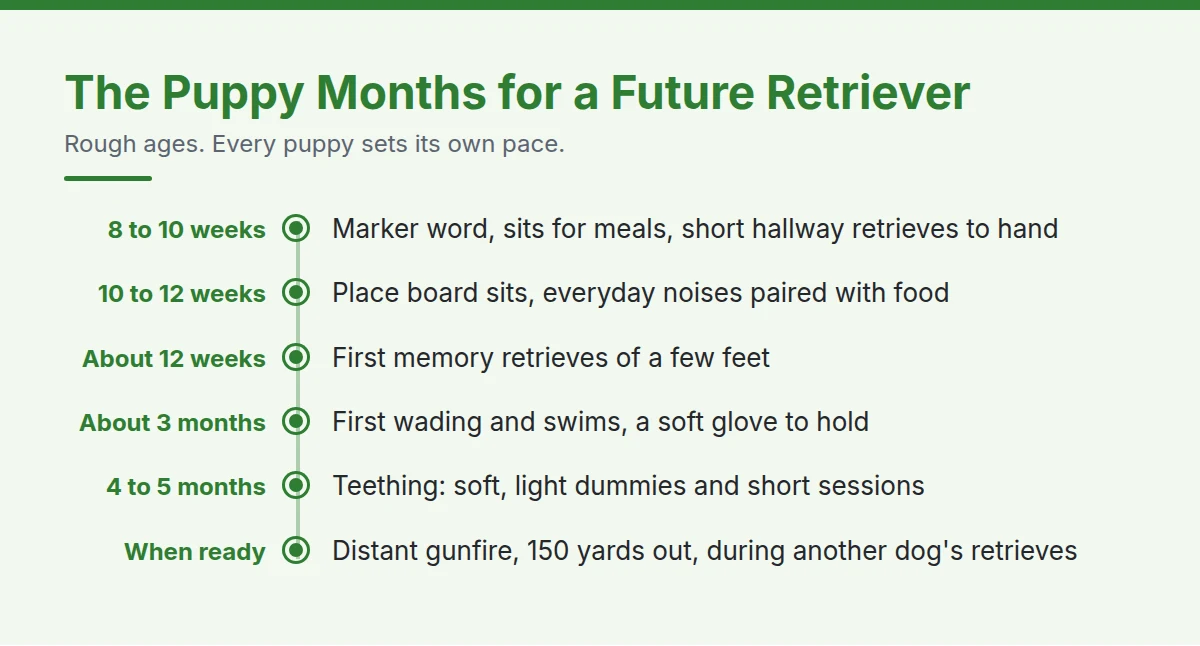
Milner’s foundation has five parts: a recall, a sit and stay, a memory retrieve (going back for a dummy the puppy watched you put down, rather than one it saw fall), a stop and look back at the whistle, and delivery to hand. Read with a puppy class in mind, that is come, sit, stay, attention and a polite trade. Every one of them starts as a skill a good class already teaches with food.
Gun dog professionals say much the same. In a Gun Dog magazine piece on common puppy mistakes, a Georgia trainer admitted that “we often focus on pulling hunting skills and a love of the game out too early with our pups,” when in a well-bred dog those skills arrive on their own timeline. The article’s verdict is that there is no need to be hyper-focused on hunting skills in a puppy when there is so much manners work to do.
Timing matters too. The American Veterinary Society of Animal Behavior treats the first three months of life as the primary window for socialization, the period when sociability outweighs fear. Boats, decoys, waders, the truck crate, other dogs working, sudden bangs: whatever a puppy meets then gets filed away. That is the case for starting early and gently, and the case against anything that hurts.
Start With a Marker Word (Not the Duck-Blind Kind of Mark)
Hunters and puppy instructors both talk about marks, and they mean different things. In the field, a mark is a bird or dummy the dog watched fall. In class, a marker is a click or a crisp “yes” that tells the puppy the exact instant it got something right and that a reward is coming. Teach it in your first week home: say “yes,” hand over a piece of kibble, and repeat until the word alone turns your puppy’s head. Then use it to catch the first sit, the first glance back at you, the first toy carried in your direction. Our article on click-then-treat timing explains why every marker should still be followed by the reward.
Keep sessions tiny. Even the traditional five-month bird dog program Dave Carty laid out for Gun Dog runs on two sessions a day, and in the first weeks a session may last only five or six minutes. For a nine-week-old, two or three minutes is plenty.
The Retrieve: Protect What the Puppy Already Has
Retrievers are bred to bring things back, and Milner’s view is that delivery to hand is something a puppy is born with, so the trainer’s main job is not to break it. Punish the puppy that proudly carries in an expensive shoe and you teach it that bringing you things is a mistake. The better fix, he says, is to change where the shoes are kept. A few habits protect that instinct:
- Make a hallway your first field. Sit at one end with the doors closed and roll a soft toy a few feet. The only way out is back past you.
- Kneel instead of reaching. Milner advises against stepping toward an incoming puppy. Get down on one knee and slip a hand under the jaw to take the dummy.
- Trade, never chase. Swap the toy for a treat or a second toy, as in Milner’s two-ball game, where bringing back the first tennis ball makes the second one fly. Chasing a puppy who has something teaches it to run.
- Keep punishment away from your feet. Milner warns that punishing a retriever near you creates a “punishment zone” where the dog is likely to spit out the dummy.
- Quit early. Too many retrieves in one session wear down natural delivery, he says. Stop after two or three, while the puppy still wants more.
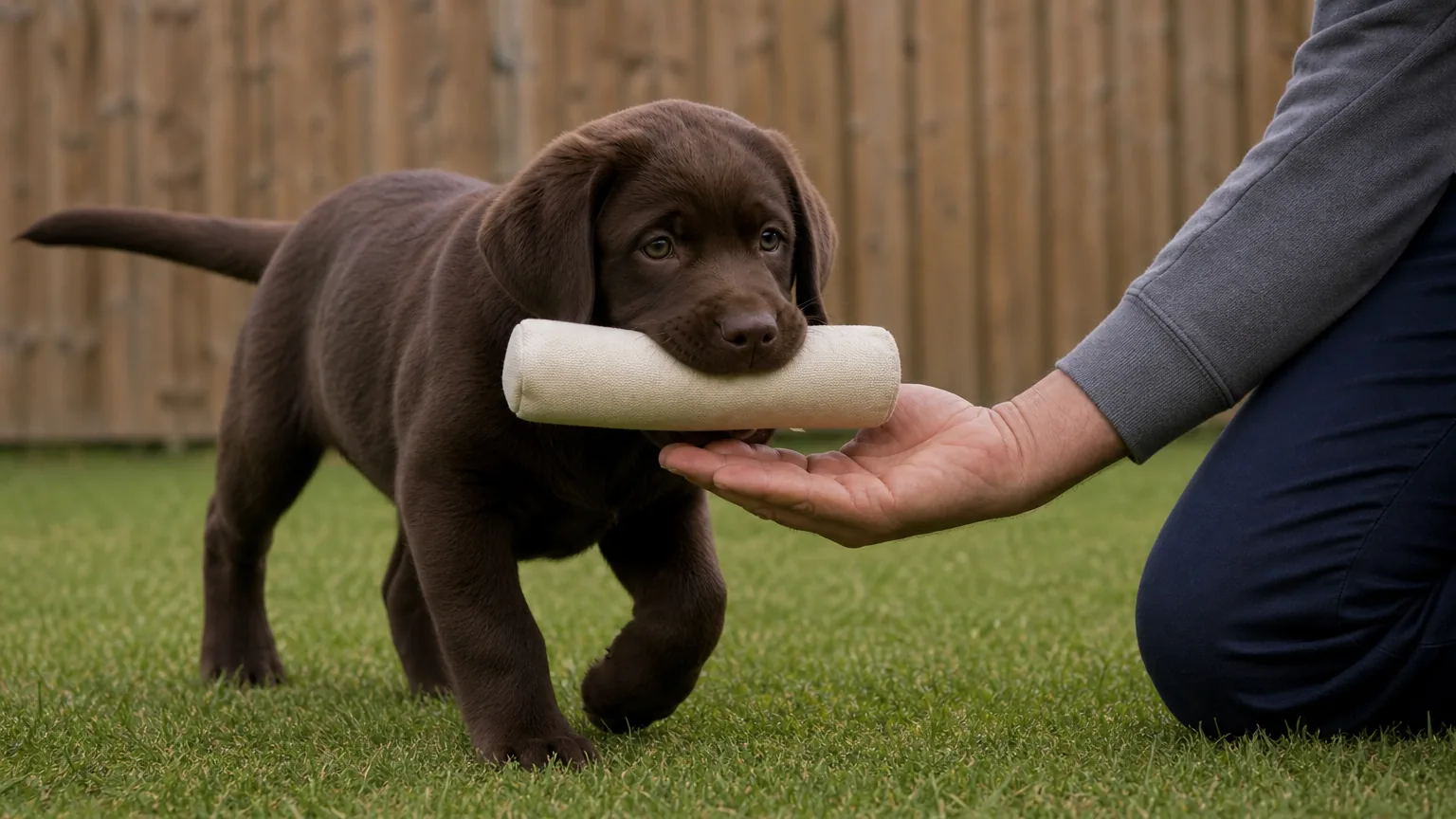
Watch the weight, too. A Texas retriever trainer told Delta Waterfowl that many growing puppies are not coordinated enough to sit while holding a bumper, largely because of its weight, so he tosses a light paint roller instead. From about three months he teaches the hold with a leather gardening glove, which is less likely than a bumper to irritate puppy gums. Lab puppy teeth loosen and fall out at around four to five months, AKC notes in its Labrador puppy timeline, so keep retrieving objects soft and light through teething.
Steadiness Is Impulse Control, Started at the Food Bowl
A steady retriever sits in the blind while guns fire, birds fall and other dogs work, and goes only when sent. A steady flushing spaniel sits when the bird lifts instead of chasing it over the next hill. Both are the impulse control a puppy class builds with “wait,” “leave it” and settling on a mat, with more temptation added.
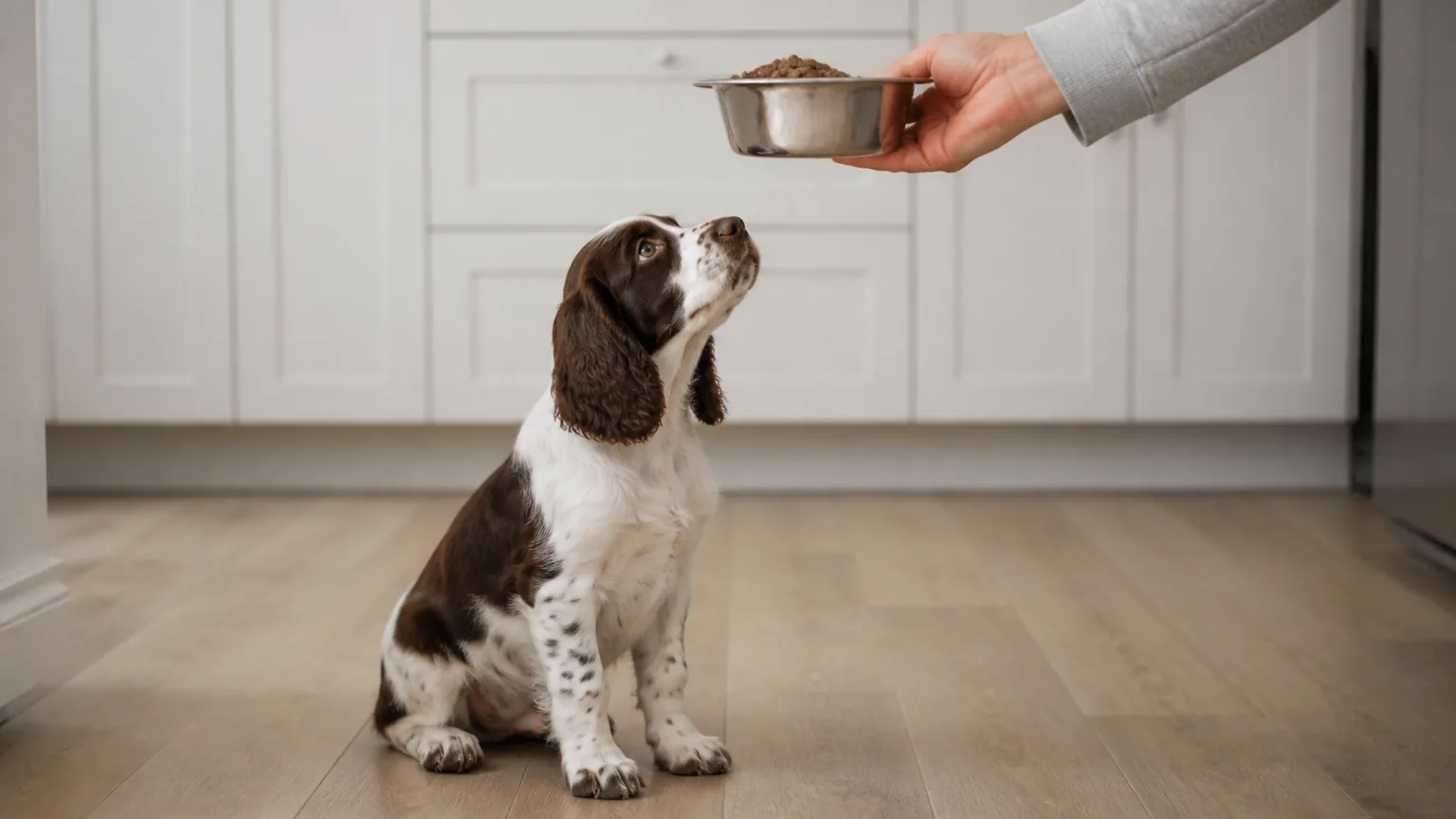
Milner starts at mealtimes. Hold the food bowl above the puppy’s head and wait: the nose goes up, the rear goes down, and the bowl goes to the floor. After four or five days of meals the puppy starts sitting on its own, and that is when he adds the word “sit.” Then he moves the sit onto a place board, a low platform, and builds it like any stay: a little longer, then a half step back, then distractions such as walking around the board or tossing dummies while the puppy holds position.
Once the puppy holds its sit while dummies fly, the retrieve becomes the reward, but Milner lets the dog pick up only one dummy in every four thrown. “The more dummies that you, the trainer, pick up, the steadier he’s going to be.” He also warns against throwing mark after mark, because watching something fall excites a retriever “almost to the point of intoxication.” A puppy that chases fifty tennis balls a day is practicing the opposite of steadiness fifty times.
His recall needs no gadget either. Call the puppy often around the house and reward it every time. Outdoors, in a safe fenced area, if it does not come, stop calling and walk away without looking back, then pay the puppy when it catches up. Never punish a puppy for failing to come. And if sits started early, Milner expects a puppy to be ready for simple memory retrieves at about 12 weeks: drop the dummy while the puppy watches, walk back about six feet and send it, adding distance slowly and aiming for about nine successes in ten.
Water: Let the Puppy Set the Pace
Labs are water dogs, but nobody should assume a puppy can swim. One of the longtime Lab breeders AKC interviewed for its puppy timeline starts swimming at about three months and puts it bluntly: puppies “do have to be taught to swim, so they can’t just be thrown in a pool with no way shown to them to get out safely.” A gentle first swim looks like this:
- Pick a warm, calm day and a gently sloping bank with firm footing, not a dock or a steep drop.
- Wade in yourself and let the puppy follow at its own speed. Paddling around your knees is a good first session.
- Throw a floating dummy only a few feet at first, so early retrieves end close to shore.
- Show the way out every time, and stop after a few minutes while the puppy is still keen.
- Never throw, carry or push a puppy into deep water.
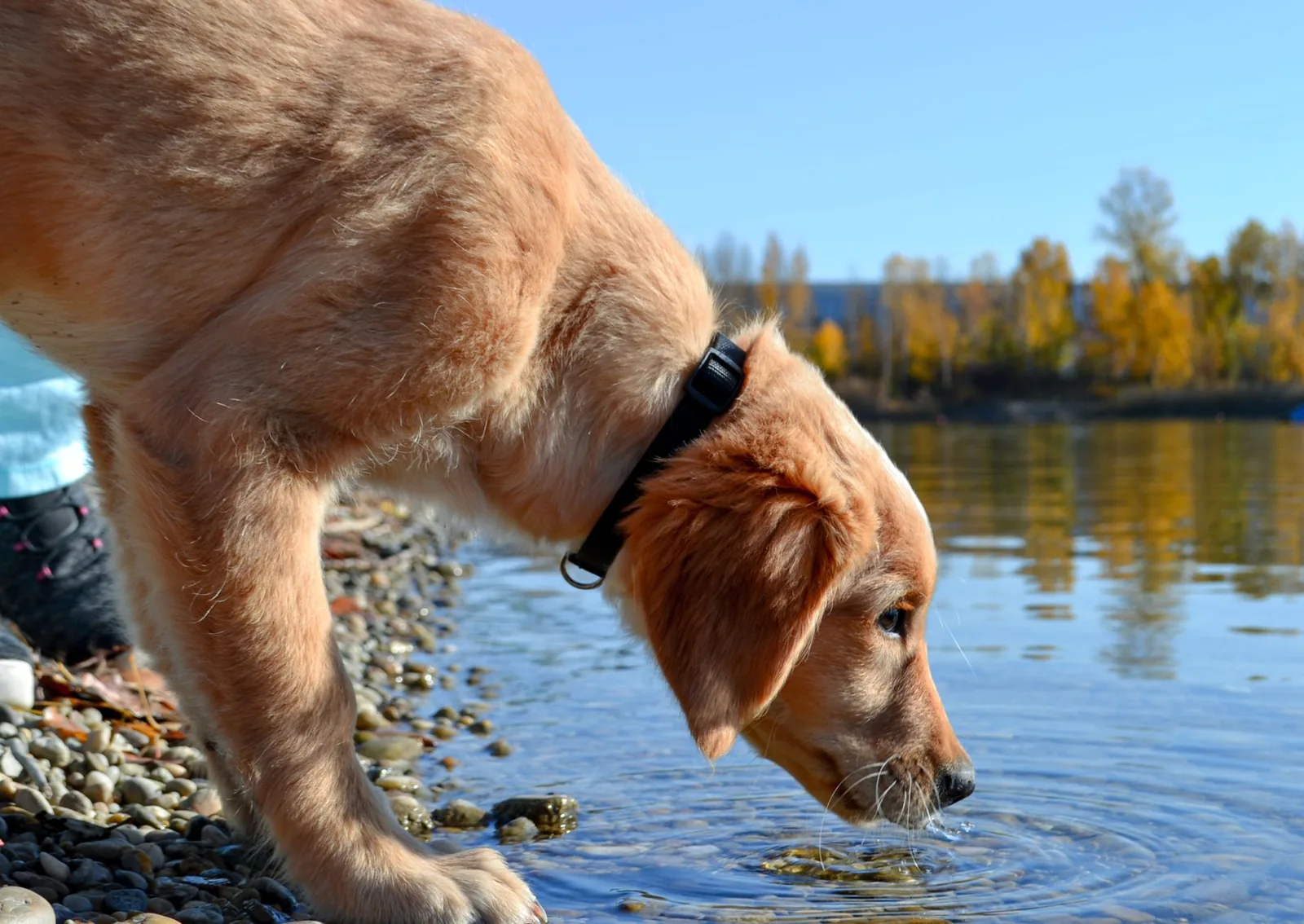
Two water risks are worth knowing. Whole Dog Journal warns that dogs retrieving toys from the water can easily swallow enough to cause water intoxication, a dangerous drop in blood sodium. Lethargy, weakness, stumbling, vomiting or confusion after a swim mean a vet visit right away.
The other is limber tail, a painful, limp tail that typically affects larger working breeds. In the Dogslife project, which follows UK Labradors through owner reports, almost one in ten had an episode. Swimming raised the odds nearly fivefold (though it was not required), and working dogs had about five times the odds of non-working ones. First episodes came at a median age of about 20 months, so this is more a first-season worry than a puppy one. It usually passes on its own, but a sudden limp tail after a swim deserves a vet check and rest.
Gunfire: Distance, Excitement and Patience
Gun shyness is the fear every hunter dreads, and part of it is inherited. In a Swedish analysis of behavior tests on 1,813 Labrador Retrievers, gun shyness was the most heritable of all the traits measured, with a heritability of 0.56. Ask the breeder how both parents react to gunfire. Then do the prevention anyway.
The best evidence on prevention comes from fireworks. In an international online survey of owners of 1,225 dogs, Stefanie Riemer of the University of Bern found that just over half the dogs were at least partly afraid of fireworks, most affected dogs developed the fear in their first year, and firework fear went hand in hand with fear of gunshots and thunder. The 228 dogs whose owners had trained them as puppies to associate the noise with something good had the lowest possible median score for fireworks affecting their welfare. Dogs with no preventive training had a median of 4 on the same five-point scale. It is owner-reported survey data, not a trial, but it points one way.
So start sound work early and keep it boring. In the socialization weeks, let the puppy hear everyday noises at a low level, a pan lid dropped in the next room or a door closing, and follow each one with a treat. A glance toward the sound and straight back to the food is exactly right.
The gun itself comes later. Milner’s method waits until the puppy is working well on marked retrieves and has done some water work. You and the puppy stand at least 150 yards away while a friend’s dog makes two or three short water retrieves. When the puppy is thoroughly excited by the throws and the splashing, the friend fires one shot with a light field load as he throws the dummy. If the shot does not bother the puppy, you move closer at whatever rate it stays comfortable. The bang arrives as part of the most exciting thing the puppy has ever watched.
Three rules keep it safe:
- Back up at the first sign of worry. A flinch, a freeze, refusing food or heading for the truck means you are too close. Return to the last easy distance and end on a good retrieve. Owners in Riemer’s survey often saw noise fears get worse over time, so never push through with more shots. This is desensitization and counterconditioning in field clothes.
- Do not stack it. Hold gun sessions on quiet days, not after a long drive and a busy morning, because stress earlier in the day lowers a puppy’s threshold for what comes next (trainers call it trigger stacking). If your puppy is in a fear period, wait.
- Protect the ears. Milner warns that a dog caught in front of the muzzle blast gets hurt, and that it “will certainly contribute to early deafness.” He says a properly introduced dog that later turns gun-shy has probably had its ears rung by muzzle blast. Never fire over or beside a puppy’s head.
If a shot genuinely frightens your puppy, stop the gun work and ask your veterinarian about a referral to a board-certified veterinary behaviorist.
Why Force-Fetch and the E-Collar Have No Job Yet
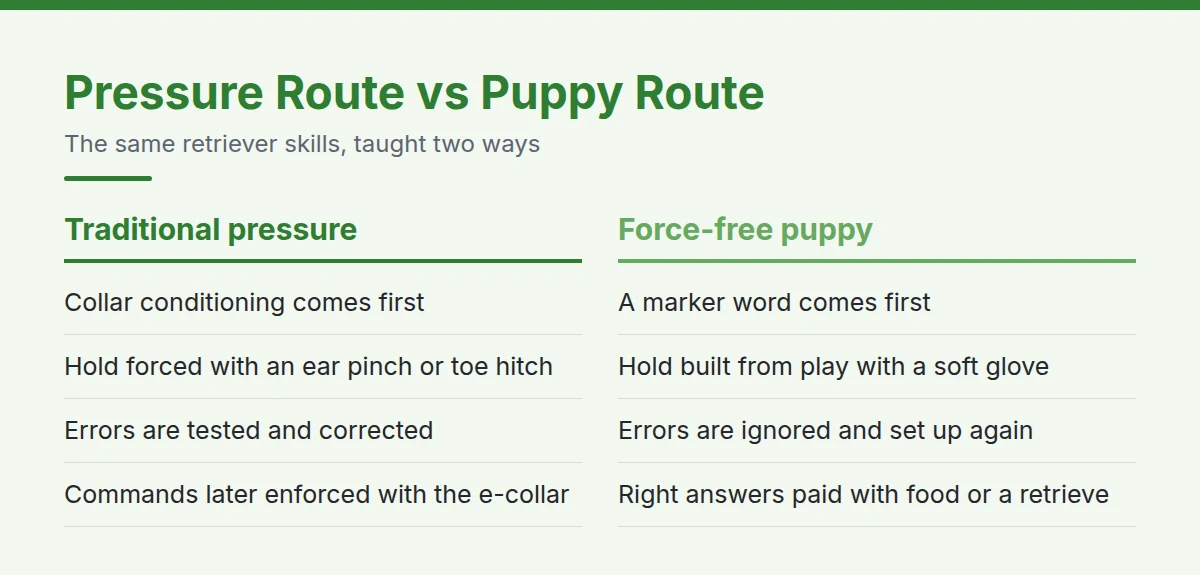
Force-fetch, also called force breaking or the controlled retrieve, is still widely treated as a standard step in retriever programs. Delta Waterfowl describes the conventional method as “harsh negative reinforcement”: an ear pinch, toe hitch or e-collar stimulation applied until the dog holds a bumper and later fetches it, usually over two to four weeks, after which the commands may be enforced with an e-collar. In Dave Carty’s Gun Dog program for a young bird dog, collar conditioning is the first formal training, and force breaking follows “as often as not.”
At the puppy stage there is nothing for that pressure to fix. A nine-week-old that drops a dummy is not refusing a command it understands. It is a baby with a small mouth, a heavy object and a short attention span, and pressure applied now lands in the socialization window, while it is deciding how it feels about water, birds, guns and you.
Even trainers who still use force are rethinking it. The Texas trainer in the Delta piece calls himself a former “old-fashioned, ear-pinch guy” who got to the point where, if he had to pinch another ear, he was going to quit. Old-school force breaking, he warns, is easily misapplied by the inexperienced and can have lasting consequences for meek dogs. His gentler system is not force-free (a low e-collar “nick” comes later, once the commands are understood), but its puppy months run on play.
The e-collar research points the same way. Lucy China and colleagues at the University of Lincoln assigned 63 dogs with off-lead problems such as poor recall to trainers nominated by e-collar manufacturers, to the same trainers working without the collar, or to independent trainers focused on positive reinforcement. After up to 150 minutes of training over five days, the reward-focused group got significantly better responses to “sit” and “come” on a single cue, and responded faster than the e-collar group. The authors found no evidence that e-collar training is necessary, even for recall, its most widely cited use. An earlier paper from the same team, with the same three-group design, found the e-collar dogs spent more time tense, yawned more and explored less than dogs in the reward-based group. These were adult pet dogs in a short trial, but the American Veterinary Society of Animal Behavior reaches the same conclusion across the wider literature: “There is no evidence that aversive training is necessary for dog training or behavior modification.” Our article on balanced training covers that evidence in more detail.
Reward-based gun dog training is not a fringe idea. Milner’s first book, in 1980, taught standard compulsion methods. He later rebuilt his program around operant conditioning, calling the traditional “test and correct” approach “a backwards way to train.” In his system the trainer rewards the right behavior when it happens and simply ignores the wrong one. If your dog later needs a formal trained retrieve, with a hold firm enough for a crippled bird, it can be built in small rewarded steps (pick up, hold, carry, deliver) like any other chain of behaviors.
Choosing Classes and Trainers
A good puppy class is the right first step even for a dog bound for the marsh, as long as you know what it is for: socialization and foundation manners, not field work. Obedience comes next, field training after that. A puppy that is genuinely afraid of people, dogs or noises needs behavior modification, which is a separate discipline, so start with your veterinarian and ask about a board-certified veterinary behaviorist.
Dog training is unregulated in most states, gun dog training included. Look for CCPDT, KPA or IAABC credentials in a puppy instructor, and ask any retriever trainer three questions before handing over a young dog: How do you teach the hold? When, if ever, does an e-collar go on? What happens when a puppy gets it wrong?
The Short Version
A hunting retriever’s education starts in the kitchen, not the marsh. Teach a marker word. Protect the urge to bring things back by kneeling, trading and quitting early. Build steadiness at the food bowl and on a place board, and keep marked retrieves rare. Let water happen at the puppy’s pace. Introduce the gun from far away, during the most exciting thing the puppy knows, and back off at the first flinch. None of it needs an ear pinch or a shock, and what you eventually hand a field trainer is a keen, confident puppy that already loves the work.
Further reading (sources)
- Ducks Unlimited on Robert Milner’s five reward-based retriever basics
- Robert Milner with a gun introduction that starts 150 yards away
- Gun Dog for Dave Carty’s five-month bird dog program
- Tony J. Peterson on why pros say not to rush hunting skills in puppies
- Delta Waterfowl with how force-fetch works and a gentler alternative
- American Kennel Club for Lab breeders on swimming and teething milestones
- Van der Waaij, Wilsson and Strandberg on the heritability of gun shyness in Swedish-tested Labradors
- Riemer with how firework fears develop and how early training prevents them
- Pugh and colleagues on limber tail in the Dogslife Labrador cohort
- Whole Dog Journal for water intoxication in swimming and retrieving dogs
- China, Mills and Cooper with e-collar versus reward-based recall training
- Cooper and colleagues on the welfare side of e-collar training
- American Veterinary Society of Animal Behavior for its puppy socialization position statement and its humane dog training position statement