Balanced Training Is Not a Middle Ground: What the Research Says About Mixing Rewards With Corrections
Published on September 20, 2026

There are two puppy classes within driving distance. One website says force-free and positive reinforcement. The other says balanced, and explains it as reward-based with corrections added when the dog needs them. To a first-time owner, the second one often sounds like the grown-up option, because “balanced” is a word doing a lot of quiet work. It implies the other trainer has picked a side and this one has not.
The claim deserves to be taken seriously rather than waved away. Most trainers who use the word are not cruel, and the argument they make (rewards for teaching, a correction for the moment a dog blows you off near a road) is coherent on its face. It is also testable. Researchers have compared reward-based, aversive-based and mixed protocols directly, measuring both what the dogs learned and what it cost them. So the question is not whose values you prefer. It is where the middle option actually lands when somebody measures it.
It does not land where the label suggests.
What a Trainer Means When They Say “Balanced”
Behavior science gives a trainer four levers. You can add something the dog likes (a treat for sitting). You can take away something the dog likes (the ball goes in your pocket when teeth touch skin). You can add something the dog dislikes (a leash pop, a prong collar tightening, a static pulse). You can take away something the dog dislikes once the dog complies (pressure on the collar that stops when he sits).
A force-free or LIMA trainer works in the first two and treats the second two as a last resort that a well-designed plan should not reach. A balanced trainer keeps all four on the table. In practice the added ingredient is the third one, and in a puppy class it usually arrives as a leash correction, a spray bottle, a shaker can, or the low setting on an e-collar for adolescent recall.
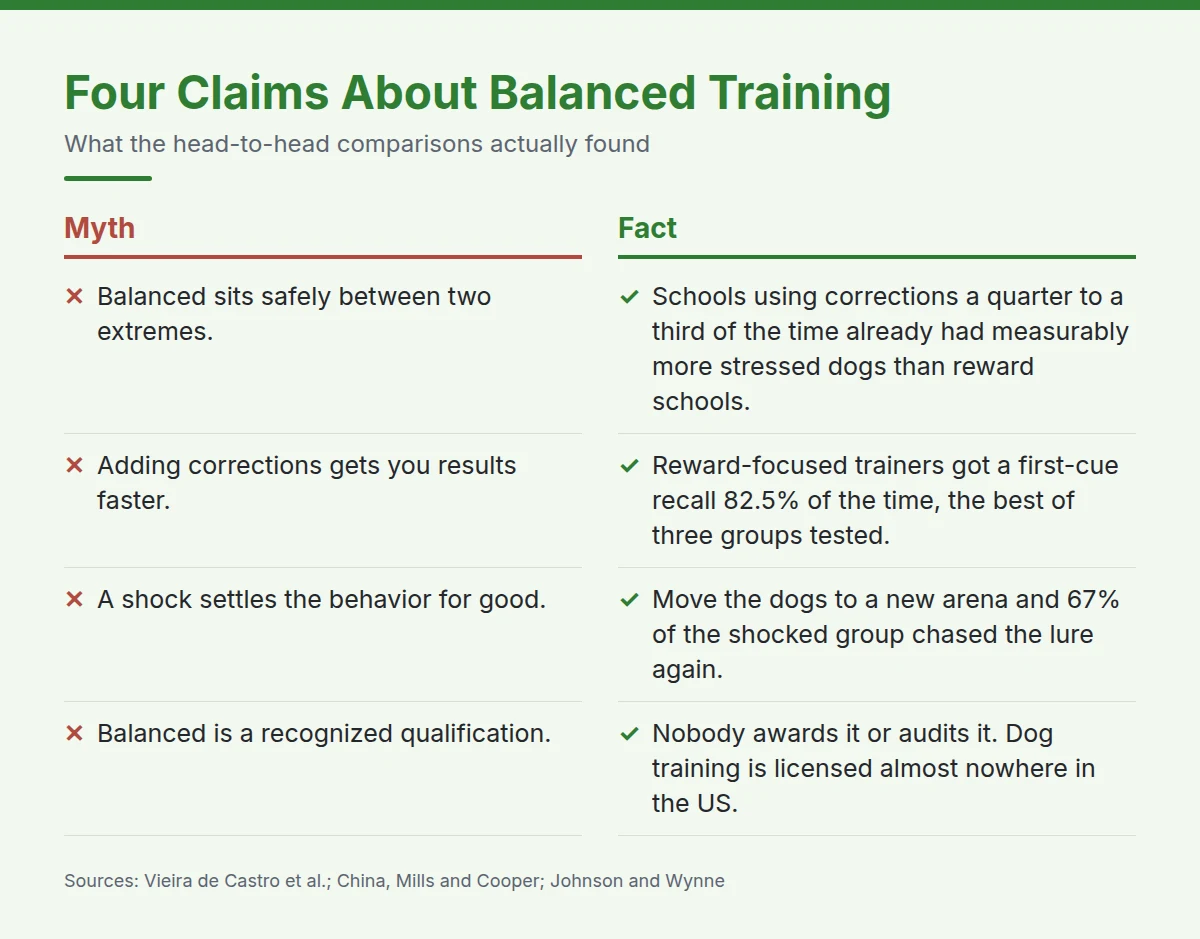
Worth knowing before you go further: “balanced” is not a credential. Nobody awards it, nobody audits it, and dog training is licensed almost nowhere in the United States, so the word describes only what the person writing the website wanted to say about themselves.
The Study That Put a Middle Group in the Middle
The most useful piece of evidence here is one nobody designed as a debate-settler. Vieira de Castro and colleagues recruited 92 companion dogs from seven training schools in Portugal and sorted them by what the schools actually did, not by what they called themselves. Forty-two dogs came from three reward-based schools. Twenty-eight came from two schools using a high proportion of aversive techniques. And 22 came from two schools in between, which used aversive techniques in less than 40% of their intended methods, averaging 0.22 and 0.37. That middle group is, in effect, the balanced class.
Every dog was filmed across three sessions, gave six saliva samples for cortisol, and later ran a cognitive bias task well away from the training hall, which measures whether a dog treats an ambiguous situation as probably good or probably bad.
Against the reward-based dogs, the mixed-school dogs performed more body turns, crouches, yawns and lip licks, panted more, and spent more of each session in tense and low behavioral states. Against the high-aversive dogs, they came out better: the aversive group yawned and lip-licked more still, and was in tense and low states more often.
So yes, mixed sat in the middle. The finding that matters is where the middle sits. These were schools reaching for a correction in roughly a quarter to a third of their work, which is exactly the dose a balanced trainer describes as “only when needed,” and the dogs in those rooms were already measurably more stressed than the dogs down the road. The welfare cost did not switch on at some threshold of severity. It scaled with the dose from the first rung.
One honest caveat, because the study is more careful than the argument usually is. On the two measures taken outside the training context, the post-session rise in cortisol and the pessimism score, the mixed group did not differ from the reward group, and did not differ from the aversive group either. With 22 dogs in that cell, that is a study that could not separate them, which is not the same as proof that nothing happened. What it measured cleanly was behavior in the room, and in the room the difference was there. If you want to know what it looks like when that pressure goes past stressed and into stopped, that is the quiet puppy who has given up offering behavior, and it is the failure mode instructors see most often in dogs arriving from a correction-based program.
But Does Adding Corrections Make It Faster?
This is the actual sales pitch, and it deserves a direct answer. Rewards are slow, the pitch goes, and a correction is quick, so a bit of both gets you there sooner.

China, Mills and Cooper ran the comparison on the behavior the e-collar industry cites most: recall in dogs with known off-lead problems. Sixty-three dogs, three groups of 21, up to 150 minutes of training over five days. The first group was trained with e-collars by trainers nominated by the collar manufacturers. The second was trained by those same trainers with the collars withheld. The third went to independent reward-focused trainers from the UK Association of Pet Dog Trainers.
The reward-focused group won on every measure reported. They came on a single cue 82.5% of the time, against 71.0% for the e-collar group and 72.4% for the same trainers without collars. They sat on a single cue 83.5% of the time, against 76.8% and 72.7%. They were also quicker: 1.36 seconds to sit against 1.67 and 1.81, and 1.13 seconds to come against 1.35 and 1.24. The authors concluded that an e-collar is unnecessary for effective recall training.
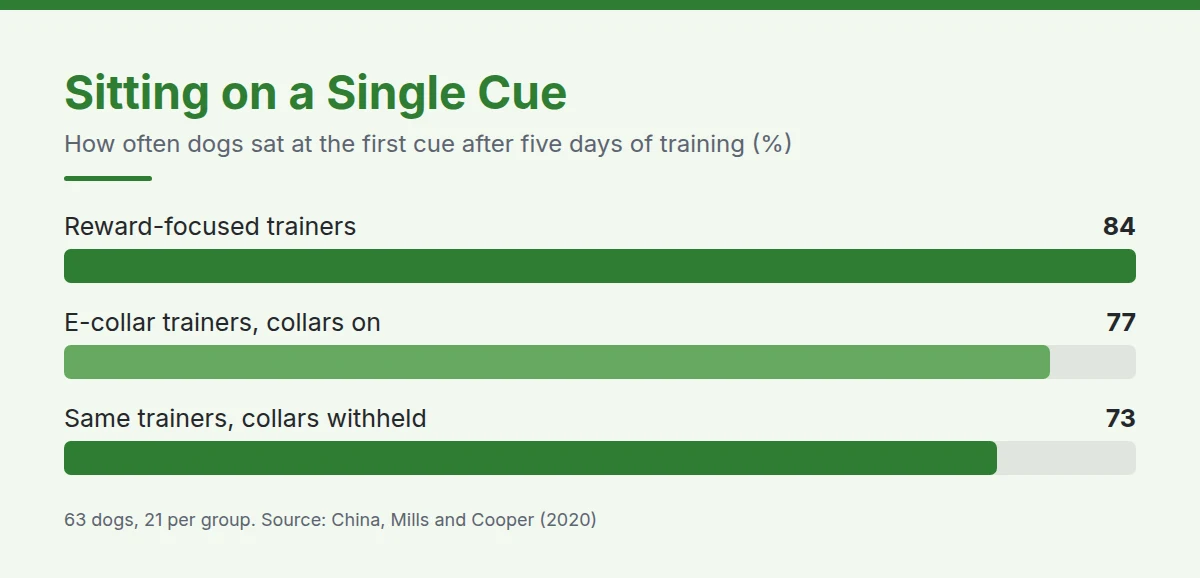
Read that middle group again, because it is the honest complication. The manufacturer-nominated trainers did get slightly slower sits when their collars were taken away, so it is not true that corrections do nothing. What is true is that the best result in the study came from the people who never used one, on the exact task the tool is sold for.
It is also fair to say the efficiency literature is thinner than either camp admits. When Vieira de Castro’s team set up a randomized trial of reward versus mixed methods with Portuguese military and police dogs, timing how long each group took to learn tasks like food refusal and interrupted recall, they opened by stating plainly that the published evidence on efficacy and efficiency is scarce and inconsistent. That is the researchers testing the speed claim, not the opposition.
The Strongest Study for the Other Side
Good faith means presenting the best counter-evidence, and it exists. Johnson and Wynne trained dogs over six sessions to stop chasing a fast-moving mechanical lure. Every dog in the e-collar group stopped within one or two sessions. In the two reward-based groups, including one where the lure started slow and sped up gradually, not a single dog refrained from chasing, in training or in any test. Video coding found few stress-related behaviors in any group.
Take that seriously, then read the fourth test. Moved to a novel arena, 67% of the e-collar dogs chased the lure again. The suppression held in the room where it was installed and largely dissolved when the room changed, which is the same generalization problem every trained cue has, and a weak foundation for a tool sold on reliability in emergencies.
Bastos, Warren and Krupenye published a response in Learning and Behavior questioning whether the comparison was fair. The food-trained dogs were never taught a specific alternative behavior to perform instead of chasing, so there was nothing for the reward to build, and the authors challenged the conclusion that the collars imposed minimal welfare impact. The study is real evidence. It is evidence that a shock reliably suppresses a behavior in one room, which nobody disputed.
Why the Sum Is Different for a Puppy
Even an owner who reads the adult-dog evidence as genuinely split should notice that a twelve-week-old is not the animal most of it was gathered on. A puppy in the socialization window is writing durable first drafts about what people, hands, leashes and training halls predict. A correction landing at the wrong second does not get filed as “not that behavior.” It gets filed against whatever the puppy was looking at, which in a class is usually another puppy or a stranger. There is also the plain mechanical problem: you cannot correct a puppy into a skill it does not yet have, and at this age almost nothing is a skill yet.

Hiby, Rooney and Bradshaw saw the same split in a survey of 364 owners twenty years ago. Obedience ratings tracked the number of tasks trained with rewards and not the number trained with punishment, while the count of reported problem behaviors tracked the punishment tasks and not the reward ones. Most of those owners were using both. The rewards were carrying the learning and the punishments were carrying the side effects, in the same households.
Six Questions for a Trainer Who Uses the Word
- Which tools do you use, and at which week of a course? “Only when needed” is not an answer. Ask what “needed” looked like the last time it happened.
- What do you do with a puppy who is not ignoring you but is frightened? Anything that involves pushing through is the wrong answer.
- What is your plan if the correction does not work? Listen for whether the next step is a rethink or a higher setting.
- Can I watch a full class before enrolling, including the last ten minutes when everyone is tired?
- What certification do you hold, and whose code of ethics binds you? CCPDT, KPA and IAABC all require education and can act on complaints.
- What would make you refer my puppy to a veterinary behaviorist rather than keep them in class?
A good instructor answers all six without tensing up. If you want the longer version of this conversation, our guide to choosing the right puppy class covers what to watch for in the room, and the safety questions for any trainer who takes custody of your dog matter even more for day-training and board-and-train.
The Bottom Line
“Balanced” promises a trade: accept a modest welfare cost, collect a speed benefit. The measurements do not show that trade being made. The welfare cost turns up at the low dose that balanced trainers describe, and the speed benefit fails to appear in the head-to-head comparisons on the very behavior it is most often invoked for. Where an aversive does produce a fast result, as in the chasing study, the result did not travel to a new room. That is not a middle ground between two extremes. It is the cost of one approach paid without the return it was supposed to buy. If you want the wider picture of how trainers themselves reason about this, the ethics and evidence behind the method divide is worth reading before you put down a deposit.
Further reading (sources)
- Vieira de Castro and colleagues on what a middle-of-the-road school did to 22 dogs’ stress behavior
- China, Mills and Cooper for recall latency and first-cue compliance across three training groups
- Vieira de Castro, Araújo, Fonseca and Olsson with the registered protocol for a reward versus mixed methods trial
- Johnson and Wynne on how quickly shock stopped lure chasing, and what happened in a new arena
- Bastos, Warren and Krupenye challenge whether those training protocols could validate anything
- Hiby, Rooney and Bradshaw for obedience tracking rewards while problems tracked punishment
- American Veterinary Society of Animal Behavior on its 2021 position that training should be reward-based only