Reading Your Puppy's Body Language During Training Class
Published on June 24, 2026

The Class Is Going Fine. Is Your Puppy?
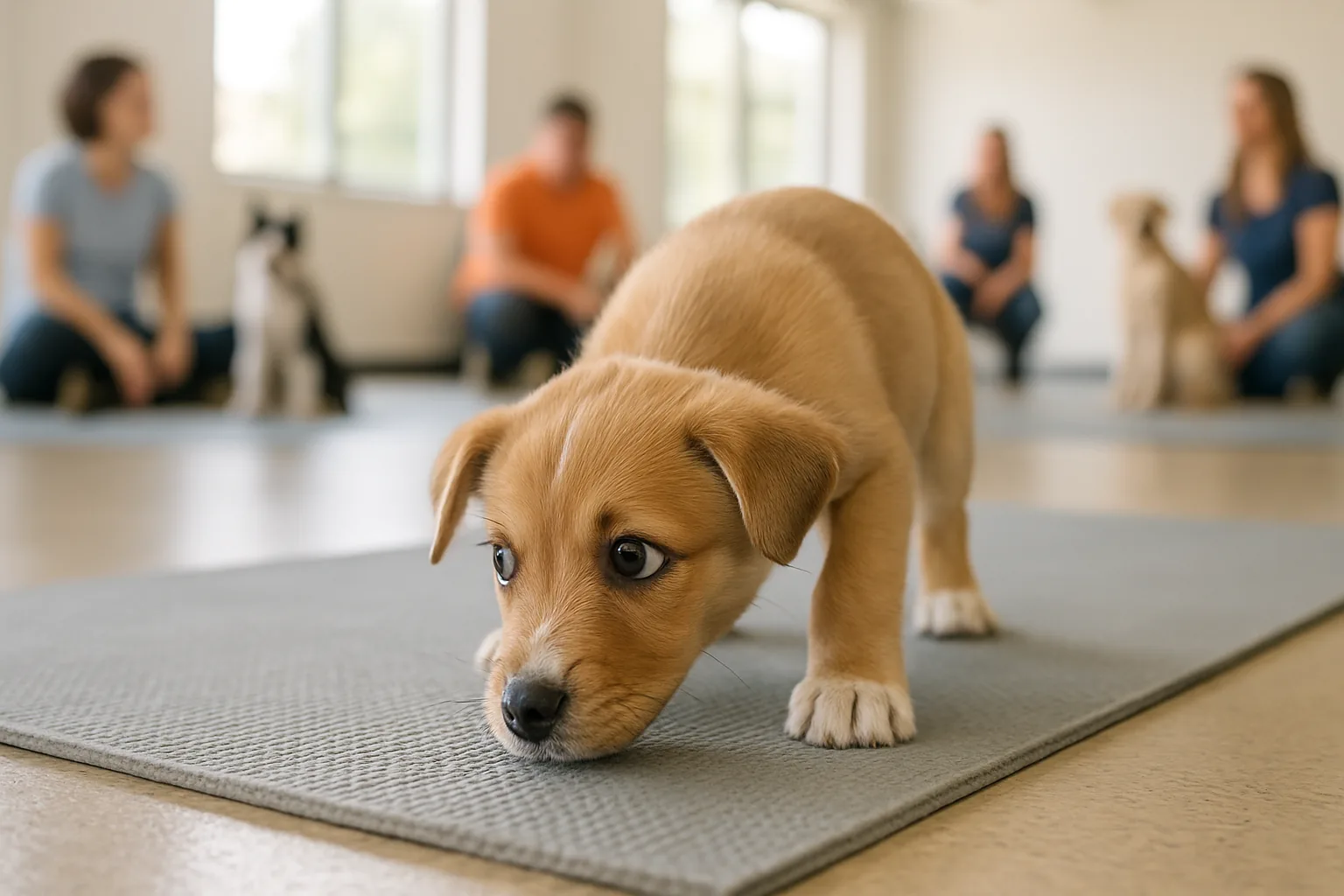
It is week three. The instructor is talking, the other puppies are working for cheese, and yours keeps dropping its nose to the mat and sniffing like there is a sandwich buried under it. A minute later it yawns. Then it scratches. You start to wonder if your puppy is bored, distracted, or just being difficult.
It is probably none of those. The skill that gets you the most out of every remaining session is not another cue. It is learning to read the puppy in front of you in real time. Most of class teaches your puppy to communicate with you. This part is about you learning to hear it. (A companion guide covers reading the other dog during play; this one is about your own puppy, the one you can actually do something for in the moment.)
Read the Whole Picture, Not One Behavior
The first rule is that no single behavior means anything on its own. A yawn is not automatically stress. A wagging tail is not automatically joy. Researchers have found that people tend to judge how a dog feels from the situation around it rather than from the dog itself, and we get it wrong often enough to matter. One study found humans regularly mistake fear for happiness and appeasement for happiness, which are exactly the misreads that get a puppy pushed past its limit.
So you stack signals instead of trusting one. Read the face, the body, and what just happened together, and the picture gets reliable. The other half of this is knowing your own puppy’s relaxed baseline, because a behavior only becomes a stress signal in context. Sometimes a puppy scratches because it is itchy. Other times the same scratch is a puppy that does not know what to do with itself. You cannot tell from the scratch alone.
The Small Stuff: Displacement Behaviors
Displacement behaviors are ordinary, everyday actions performed out of context, and they show up when a puppy feels unsure or in conflict. In a class setting they look like sniffing the floor when there are no crumbs, licking the lips or nose with no food around, yawning when the puppy is not tired, shaking off as if wet when it is bone dry, a sudden scratch, a turned-away head, or a lifted front paw.
The floor-sniffer is the classic. Many puppies spend their first few sessions nose-down on the mat instead of engaging with their owner, and it is rarely the previous class’s crumbs. It is usually a puppy that is unsure about all the new dogs and people and is buying itself a moment. None of this is disobedience. These are coping skills, and the guidance from the behavior side is blunt: never correct them. Punishing a puppy for the quiet signal only teaches it to skip the quiet signal, which removes your early warning and leaves you with the loud one.
The Face Tells You First
The face often shifts before the body does, so it is worth learning a handful of expressions cold.

Whale eye is the one to memorize. When a puppy holds its head still but you can see the whites at the corner of the eye, it is past its comfort line, and it is one of the clearest “please back off” signs a dog gives. Pinned-back ears signal fear or stress, or sometimes appeasement, while ears held hard forward mean the puppy is aroused and alert, which can tip toward frustration. Eyes that look soft, a little squinty, and blink easily belong to a relaxed puppy. A hard stare or rapid blinking does not. A puppy that keeps looking away from the thing you are asking it to face is not blowing you off either. In dog language, looking away is a polite request to slow everything down. And watch the mouth: loose and open is comfortable, while a mouth that snaps shut and goes tight is a puppy that just stopped having fun and started worrying.
What “Engaged” Actually Looks Like
Stress signals are only half the read. The other half is recognizing a puppy that is doing well, so you know when to keep going. An engaged puppy carries a loose, wiggly body with its weight spread evenly, soft eyes, and an easy open mouth.
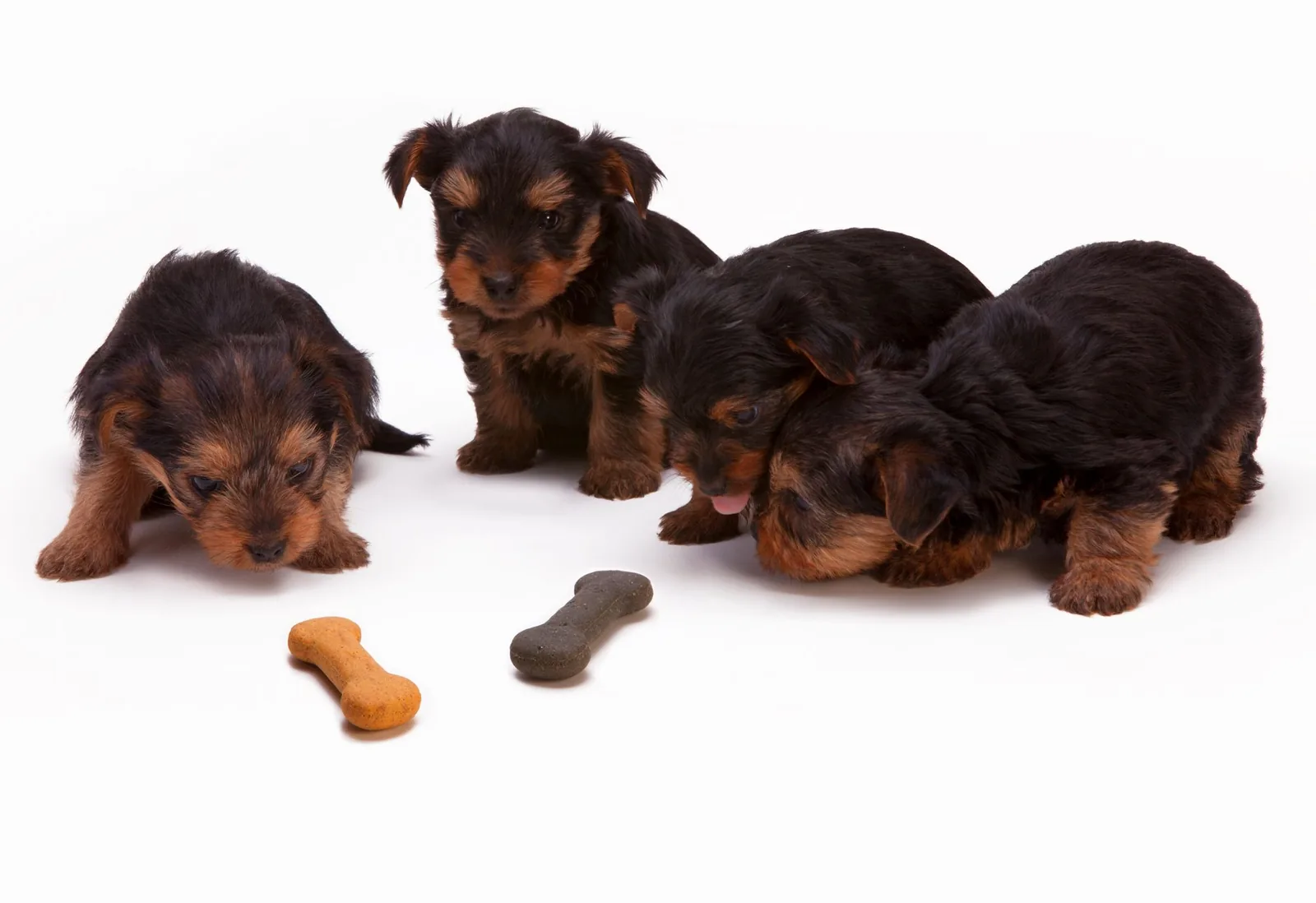
The single best real-time gauge is whether your puppy will take food. A puppy that takes a treat gently and comes back for more is under its threshold and learning. A puppy that suddenly will not eat the chicken it would happily mug you for at home is telling you the room is too much right now. That is why figuring out your puppy’s top-tier reward before class pays off; the treat doubles as a stress gauge. Engagement also shows up as the check-in: a puppy that can glance at a distraction and then choose to look back at you is working with you, not just near you. A genuine play bow during a class play break, front end down and rear end up with a little bounce into it, is another good sign. That is a puppy inviting fun, not a puppy coping.
Your Breed Reads Differently
Not every disengaged puppy is a stressed puppy. Research comparing cooperative and independent breeds found that herding and gun-dog types, like Border Collies and Labradors, are more tuned in to attention-getting human speech such as “watch me,” while breeds developed to work away from a handler, like Huskies, many terriers, and some hounds, are simply less wired to hang on your every word.
So a terrier puppy that tunes out the instructor’s running commentary may be perfectly relaxed, just independent. This is exactly why you read the body rather than the responsiveness, and why knowing your own puppy’s neutral signals matters more than any breed generalization. Every dog holds its ears, eyes, and weight a little differently at rest. Learn yours.
When to Give a Break, and When to Push On
Here is where reading the puppy turns into a decision. Mild displacement with a quick bounce-back is not a reason to pack up. Support the puppy and carry on: offer a sniff break, add a little distance from the busiest corner, make the exercise easier for a rep or two, then re-engage.
Stacked signals are different. Whale eye plus a frozen body plus refused food, or signals that keep coming and never settle, mean stop. Increase the distance, step into the hallway, and let the puppy decompress. Reading this early is the whole point, because it lets you exit before a puppy ever escalates to lunging, snapping, or a bite. The two things you never do are push a shut-down puppy “through it” and punish a growl. A growl is information, and a punished growl becomes a bite with no warning attached.
Track the pattern across weeks, not just minutes. A puppy that recovers quickly is fine. Stress that is chronic, intense, or getting worse session over session is your cue to talk to your trainer, run a gentler threshold-based plan, and, if it persists, loop in a veterinary behaviorist.
The Payoff: Class Becomes a Conversation
Once you can read your puppy, every session gets better. You stop drilling a puppy that has checked out and start advocating for the one in front of you. This is also the one thing a screen cannot do for you: an app can coach a cue, but it cannot watch your puppy’s face and tell you it needs a break. The socialization weeks are short, and you want them to land as good experiences rather than endured ones. So when you are choosing a class or sizing up an instructor, watch whether they coach owners to read their dogs in real time. The good ones narrate body language the whole hour.
Further reading (sources)
- American Kennel Club on the out-of-context behaviors that signal a stressed dog
- American Kennel Club for decoding a dog’s ears, eyes, and whale eye
- American Veterinary Society of Animal Behavior with the position statement on humane, reward-based training
- Peer-reviewed research for rough-and-tumble play as a window on animal communication