Click Then Treat, Always? What the Partial-Reinforcement Research Means for Puppy Class
Published on August 30, 2026
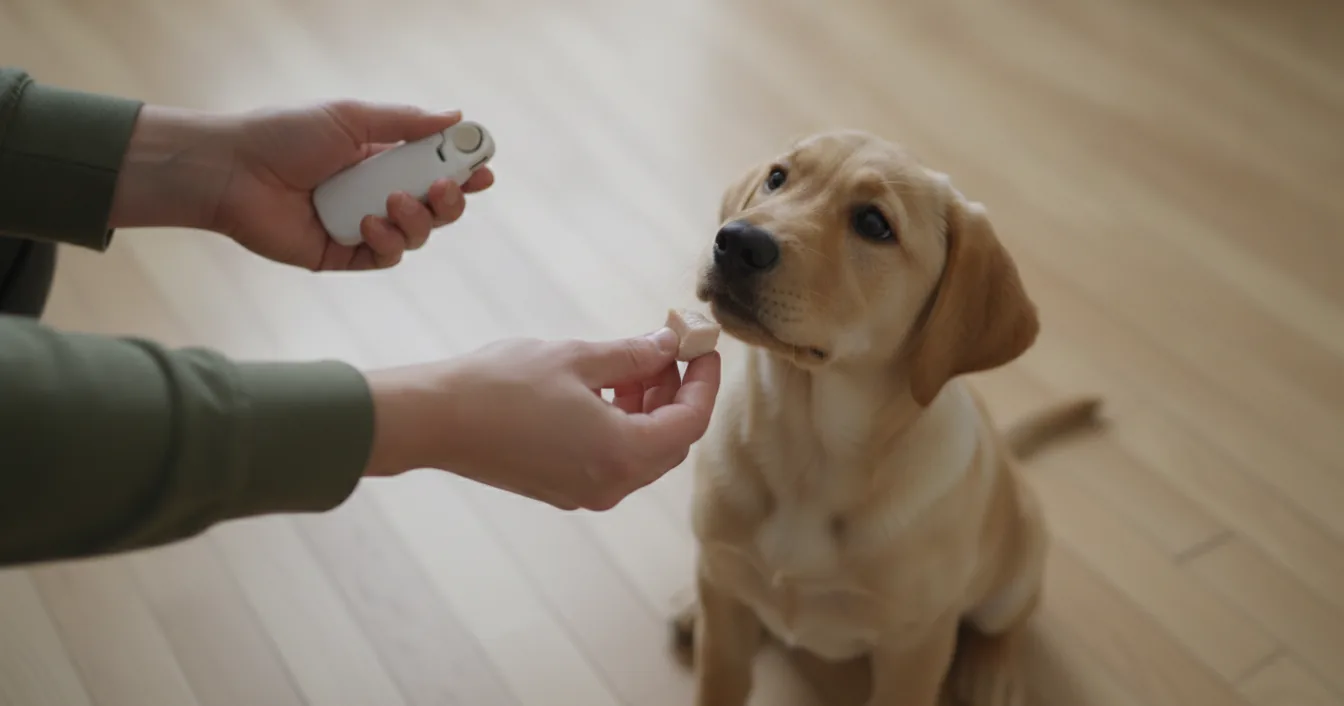
Somewhere around week two or three of a group class, an owner asks the question every instructor has fielded a hundred times: do I have to give a treat every single time? And somewhere in the room, someone always offers the folk answer. No. Keep her guessing. Slot machines work because you never know when you are going to win.
It is a satisfying answer, and it turns out to be wrong in the specific form most owners hear it. A study published in the Journal of the Experimental Analysis of Behavior in 2022 took the question into a lab and tested it directly, and the results ran the other way.
What the Study Actually Did
Lucia Peiris and Jesús Rosales-Ruiz ran two dogs through a within-subject reversal design, which is the standard way to isolate one variable in behavior analysis. You establish a baseline, change one thing, change it back, and watch performance follow the switch. Each dog acts as its own control.
The variable was the reliability of the click. In one condition, every click was followed by food. In the other, a single click meant “correct” with nothing after it, and a second click was the signal that food was actually on its way. Same trainer, same behaviors, same treats. The only thing that moved was whether the marker could be trusted.
Under the sometimes-food arrangement, the dogs got worse on three separate measures at once. Frequency dropped, so they worked less. Accuracy dropped, so they got it wrong more often. And topography degraded, which is the technical way of saying the behavior itself went sloppy: a square sit softening into a half-crouch, a crisp nose touch becoming a vague swipe past the target. Noncompliance rose alongside it, and so did the assorted sniffing, wandering and self-interrupting that any instructor recognizes as a dog quietly leaving the conversation.
Switch the condition back and the behavior recovered. That reversal is what makes the finding hard to wave away.
Why “Keep Them Guessing” Sounds So Right
The slot-machine story is not nonsense. It is a real effect applied to the wrong relationship.
There are two separate contracts running in any clicker session, and they are easy to blur together.
The first is between the behavior and the reinforcement. Here, intermittent payment genuinely does build durable responding. A dog paid for roughly one sit in three keeps sitting, and keeps going longer once payment stops, than a dog who has been paid for every single one. That is the partial reinforcement effect, it is about a century old, and nobody in this argument disputes it.
The second contract is between the marker and the food. The click is not the reward. It is a sound that meant nothing at all until you gave it meaning by pairing it with food, over and over, until your puppy learned it predicts food. That relationship is Pavlovian, and its entire value rests on being reliable.
The folk advice takes a rule that works on the first contract and applies it to the second. The 2022 study is a picture of what happens when you do.
The Click Is Information, Not Payment
The authors explain their result through the discriminative properties of the marker, and that phrase is worth unpacking because it is the whole practical lesson.
A conditioned reinforcer does two jobs. It reinforces, and it also informs. It tells the dog what is coming next. Once a single click sometimes means dinner and sometimes means nothing, the dog is being asked to work for a signal that has become genuinely ambiguous, and dogs respond to ambiguous signals exactly the way people do. They hedge. They put in less. They start checking other options.
There is a second cost that owners rarely intend. For a puppy who confidently expected food, a click followed by nothing is a small disappointment, and small disappointments stack up across a session. That is a plausible part of why the unwanted behaviors climbed in the study rather than the dogs simply working a bit less.
The Rule, in Plain Language
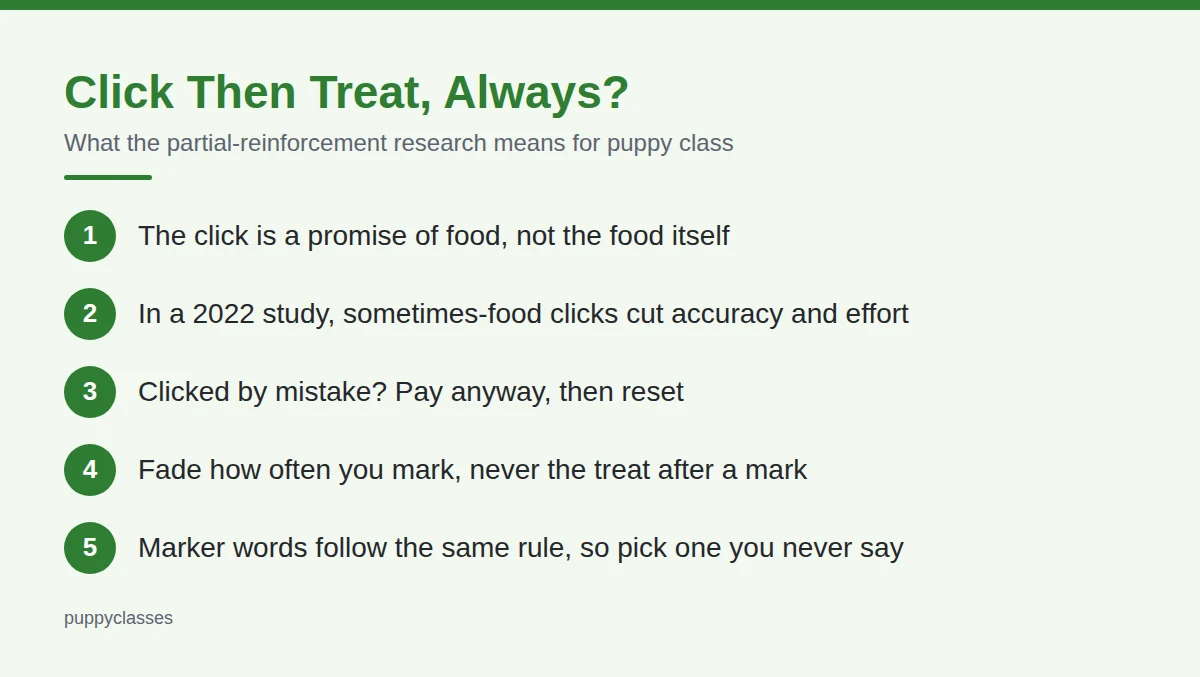
Click, then treat. Every time. Including the ones you did not mean.
That last clause is where most of the damage actually happens in a puppy class, so a few specifics:
- Clicked by accident? Pay anyway. Your thumb slipped, or you clicked at the exact moment your puppy stood up. You have lost one repetition. Paying costs you a piece of kibble. Not paying costs you a piece of the marker’s meaning.
- Marked the wrong behavior? Pay anyway, then reset and get the next rep right. Never try to take a click back.
- Do not click to get attention. The click means “that thing you just did earned food.” Using it as a recall or a “look at me” teaches the puppy it can also mean nothing in particular.
- One behavior, one click. Clicking twice for enthusiasm makes the number of clicks meaningless.
- Do not click if your hands are empty. No food available means no marking. Praise instead, and be honest that praise is doing a different job.
What You Actually Fade
Here is the part that resolves the whole argument, because owners asking “do I have to treat every time?” usually want something reasonable. They do not want to be handing out chicken at this rate in a year.
You can still thin the reinforcement schedule. You just fade the marking, not the pairing.
Early on, while a behavior is new, mark and pay every repetition. Once the behavior is fluent, stop marking every repetition. Ask for a sit, get a sit, say nothing at all, and move straight into the next rep. Mark maybe one in three, then one in five, unpredictably. When you do mark, you pay.
That gives you a variable ratio schedule on the behavior, which is the durable thing the slot-machine advice was reaching for, with none of the cost to your marker. The unpredictability lives in your decision to click, not in your decision to feed.
Three things make the thinning go smoothly. Keep paying generously for hard reps in hard places, because a recall away from another puppy is not the moment to economize. Use the occasional jackpot, several treats in a row for something genuinely excellent, so the average payout stays interesting. And lean on life rewards, the door opening, the leash unclipping, permission to go and sniff, which cost nothing and are worth more to most puppies than anything in your pouch.
It is worth separating this from the other fade that happens around the same time. Getting the treat out of your hand before you cue is a different problem entirely, about what the puppy sees before it acts rather than what happens after. Owners often try to do both at once and conclude that reward-based training does not work.
Marker Words Follow Exactly the Same Rule
Most owners never buy a clicker. They use a word, usually “yes,” and everything above applies to it without modification.
A marker word has real advantages: it is free, it is always with you, and it leaves both hands available. Its weakness is that it is easy to contaminate. Nobody clicks a clicker by accident in conversation. Everyone says “yes” fifty times a day, and a word that gets used constantly without food quietly stops predicting anything.
So pick a marker you do not otherwise say. “Yep,” “nice,” “click,” a tongue click. Keep it short and always deliver it the same way, because a puppy hears a bright rising “yes!” and a flat conversational “yes” as two different sounds. And top the pairing up for the life of the dog: twenty or thirty free pairings across a few days, word then food, whenever the marker starts feeling weak.
There is an easy test. Say the marker in a neutral moment when your puppy is doing nothing in particular. A live marker gets an instant head snap and a dog coming toward you. Nothing much means the pairing has gone stale.

Two Places This Rule Does Not Apply
Owners over-correct on this, so it is worth naming the exceptions.
Praise is not a marker. Telling your puppy she is wonderful while she dozes on your foot is not a broken contract, because ambient affection was never a promise of food. Only the one designated marker carries the always-pay rule. Everything else in your voice stays free.
Counterconditioning runs on different rules. When you are changing how a puppy feels about a trigger rather than reinforcing something she did, food follows the scary thing regardless of behavior and no marker is involved at all. If you are working a graded exposure plan for a worried puppy, keep the food flowing and do not go looking for a behavior to mark first.
The opposite case is conditioning a puppy to a basket muzzle, where the marker is doing precise work across a shaping ladder and every single marker needs to be paid. Fine-grained shaping is exactly where an unreliable click does the most damage, because the puppy has almost nothing else to go on.
Two Dogs Is Two Dogs
To be straight about the evidence: this was two dogs, adult rather than puppies, and it tested one particular version of partial pairing. It does not settle every question about markers, and single-subject designs are built for showing that an effect exists rather than for measuring how big it is across a population.
What it does do is remove the comfortable assumption that clicking without treating is harmless, or that it makes behavior tougher. The asymmetry is what should decide it for you. Always paying costs you a few extra pieces of kibble and a slightly heavier pouch. Getting it wrong costs accuracy, willingness and the reliability of the one signal your whole training system is built on. If your puppy is not enthusiastic about the food you are carrying, the fix is a better paycheck, not a less reliable promise.
When you are comparing puppy classes, this is a quietly useful thing to listen for. An instructor who tells the room to click and always pay, and who then teaches you how to thin the marking as behaviors get solid, has read past the folk wisdom. One who tells you to keep your puppy guessing has not, and it is a fair proxy for how current the rest of the curriculum is.
Further reading (sources)
- Journal of the Experimental Analysis of Behavior on what happened when a click stopped reliably predicting food
- Peer-reviewed research on what a clicker does and does not add to acquisition
- PLOS ONE for the welfare evidence against aversive-based methods
- Peer-reviewed research with how marker training performs in working-dog studies
- American Veterinary Society of Animal Behavior on the position statement on humane training methods
- Certification Council for Professional Dog Trainers for checking that your instructor holds a real credential