Shut Down, Not Trained: Learned Helplessness and the Quiet Puppy Everyone Praises
Published on September 18, 2026
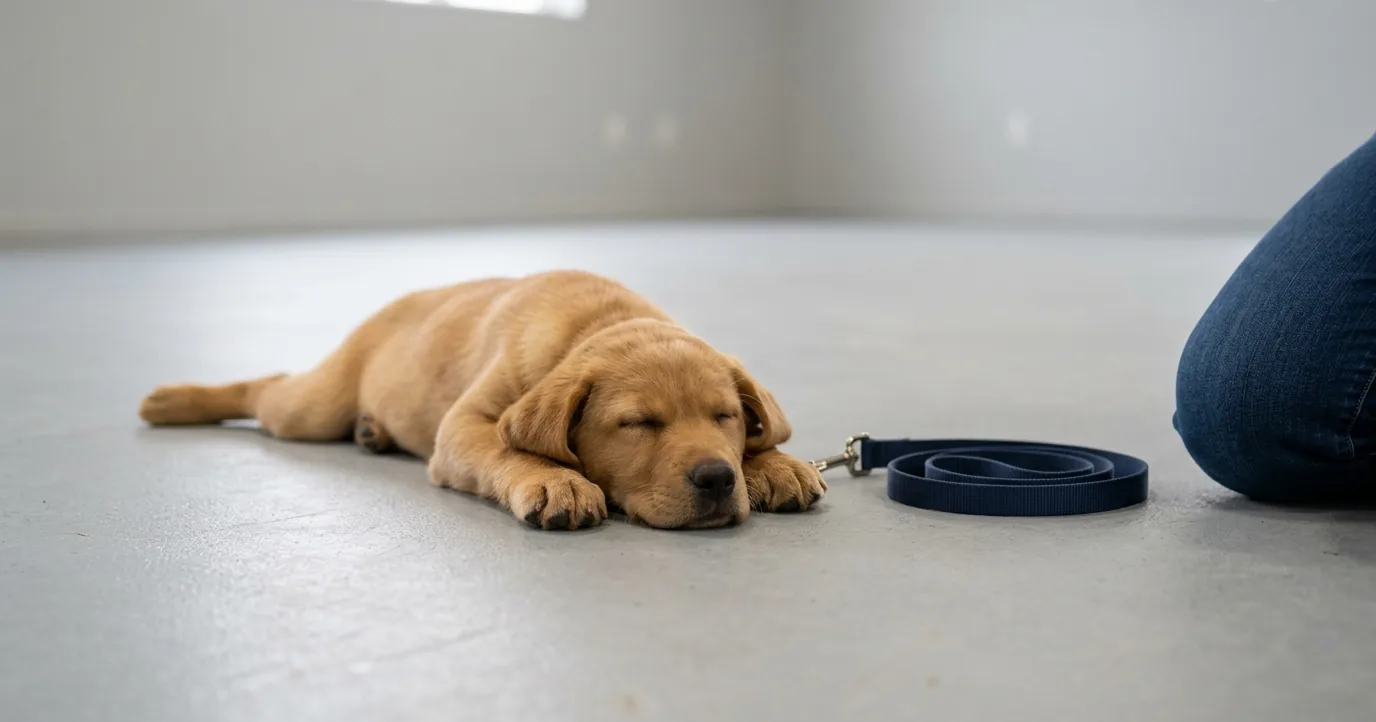
The message usually arrives around week three. The puppy who spent the first two classes shrieking at the end of the leash and body-slamming the golden retriever is, the owner writes, finally calm. Finally settled. Finally respectful. Something clicked over the weekend.
Sometimes something did click. Often, from where the instructor is standing, something else happened. A puppy who used to throw behavior at the world has stopped throwing it, and the reason is not that they learned what to do instead. It is that they stopped expecting anything they did to change the outcome.
That difference is invisible if you only measure how much the puppy is doing. It is fairly easy to see once you know what else to look at.
The Term Everyone Uses, and What the Research Actually Found
“Learned helplessness” gets thrown around in dog training to mean roughly “a dog who has given up.” The phrase has a specific and uncomfortable origin. Seligman and Maier coined it in 1967 after experiments in which dogs were given shocks they could not escape, and who then, placed in a box where escape was possible, did not try.
Half a century later the same two researchers published a reassessment, and the headline is worth reading twice: the original theory got it backward. Passivity, they concluded, is not learned. It is the default, unlearned response to prolonged aversive events, running on serotonergic activity in a brainstem structure called the dorsal raphe nucleus. What an animal actually learns, when circumstances allow it, is that it has control, and that learning is what switches the passivity off.
For a puppy owner, that revision changes the prescription. If shutting down were a lesson the puppy had absorbed, the job would be unteaching it. If passivity is instead the default that takes over when nothing works, then the job is to hand control back deliberately and fast, because control is the off switch.
The second useful idea comes from work on horses. Reviewing the evidence for learned helplessness outside the laboratory, Hall and colleagues put their finger on the conditions that produce it: procedures that are repeatedly unpleasant, and in which there is no clear association between what the animal does and what happens next. That is two ingredients, not one. Unpleasant on its own does not do it. Unpleasant plus unpredictable does.
One honest caveat before we go further. Nobody diagnoses learned helplessness in a pet puppy. There is no test for it, and the laboratory version involved conditions no puppy class resembles. What instructors actually see, and what the rest of this article is about, is behavioral suppression: a puppy who has stopped offering behavior. It sits on the same spectrum, and it responds to the same fix.
Relaxed or Suppressed? Four Things to Watch
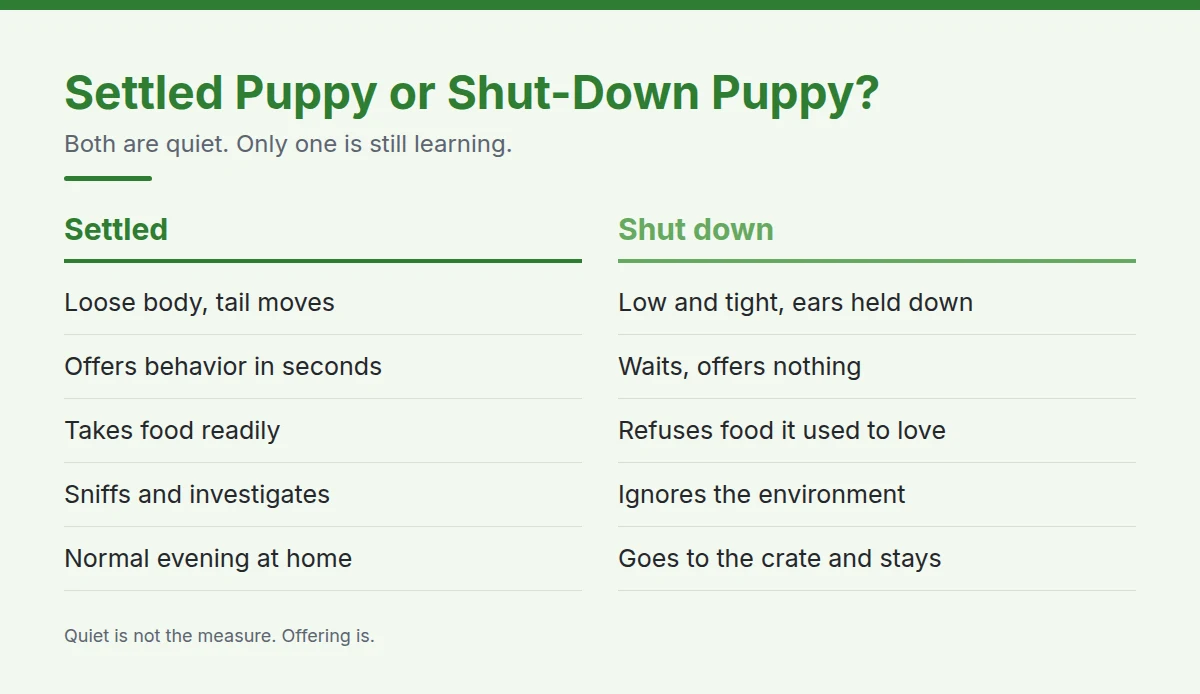
A genuinely relaxed puppy and a shut-down puppy can both be quiet, still and easy to handle for ten minutes. They differ on four things you can watch without any training expertise.
Body carriage. Relaxed is loose. Weight spread evenly over four feet, mouth slightly open, ears in whatever their neutral position is, a tail that moves. Suppressed is low and tight. When Schilder and van der Borg compared 32 German shepherds, half of whom had been trained with shock collars, the shocked dogs held lower ear positions than the controls, and not only on the training ground. They did it walking freely in a park as well. That is the tell: a posture that does not come back up once the pressure is off.
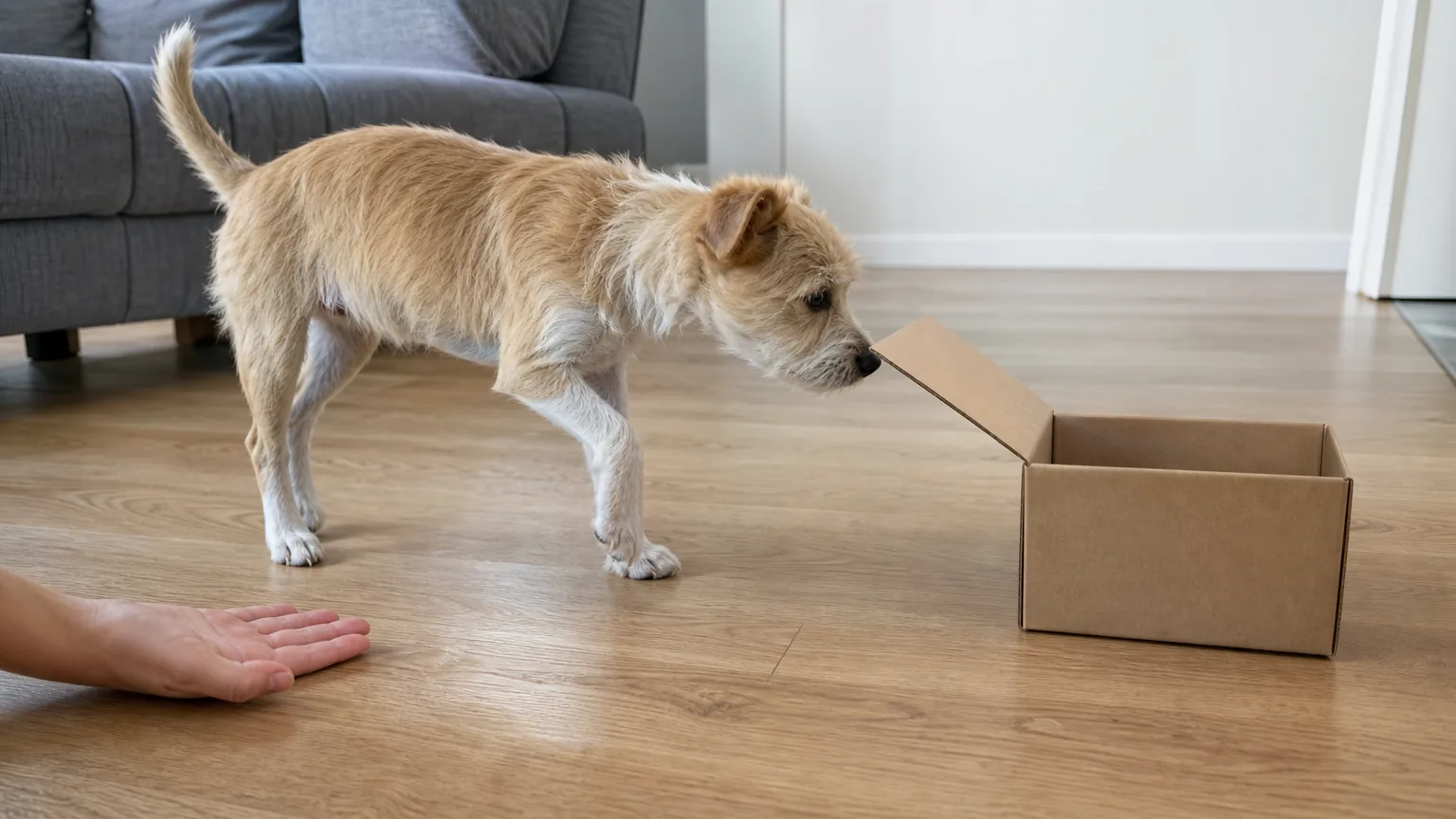
Latency to offer. Give a relaxed puppy a quiet minute and a reason, and something happens within seconds. A sit, a nose bump, a paw, a look at your face, a trot over to investigate a box. A suppressed puppy waits. Ten seconds, thirty, a whole minute of nothing. Offering behavior is the most sensitive measure you have, because it is the first thing pressure takes away and the first thing to come back.
Willingness to eat. Eating is incompatible with a certain level of stress. A puppy taking chicken in the class room is not shut down in that moment, whatever else is going on. A puppy who took chicken last month and turns his head away from it today has told you something specific. Before you conclude the treats have gone boring, rank what your puppy actually values, so you know whether you are looking at a motivation problem or a stress problem.
Environmental interaction and recovery time. This is the most underrated marker of the four. In a controlled field study of 63 pet dogs referred for recall problems, Cooper and colleagues found that the dogs trained with electronic collars spent significantly more time tense, yawned more often, and engaged in less interaction with their environment than dogs trained by reward-based trainers. Less interaction with the environment means less sniffing, less looking around, less investigating. A calm dog is still curious. A suppressed dog has switched the world off. Then watch the hour after class. A relaxed puppy comes home, drinks, plays for five minutes and sleeps normally. A suppressed one goes straight to the crate and stays there, or sleeps hard and wakes up flat.
None of this requires you to know which tool did it. Suppression follows pressure of any kind, including the ordinary kind: a class that ran forty minutes too long, an instructor who leaned over a small puppy, a rough first trip to a busy street, a family member who shouted once and meant it.
A Ten-Minute Check You Can Run Tonight
Pick your quietest room. Bring something your puppy genuinely likes, and an empty cardboard box.
- Sit on the floor and do nothing for two minutes. No cues, no talking, no encouragement. Just watch, and note how long it takes your puppy to do anything deliberate near you.
- Put the box down and go back to doing nothing. Time how long until they touch it with nose or paw. A confident puppy investigates a novel object within about half a minute. A puppy who looks at it, looks at you, and lies down is telling you something.
- Offer food from your hand, then drop a piece on the floor. Refusing food in your own living room, with no distractions and a hungry puppy, is a red flag by itself.
- Run the whole thing three evenings in a row and write the numbers down. One flat evening means nothing. A flat week is data.
Read what you see alongside the everyday stress signals in reading your puppy’s body language during class. If the numbers get faster and the body gets looser across the week, you are watching normal variation. If nothing moves at all, treat it as a shut-down puppy and work the plan below.
Why This Reads as Good Training
Suppression is convincing because it deletes precisely the behaviors owners complained about. The jumping stops. The barking stops. The lunging at the door stops. Nothing has replaced them, but an absence is hard to notice, and a still puppy in a room full of noisy ones looks like the trained one.
Owner satisfaction is a poor detector here. In the Cooper study, 92 percent of owners across all three groups reported that their dog’s referred problem had improved, with no significant difference between groups. The owners of the electronic collar dogs were as pleased with the result as everyone else, while their dogs were the ones spending more time tense and yawning more.
There is also a cost that shows up later and does not look connected. Vieira de Castro and colleagues followed 92 companion dogs recruited from reward-based and aversive-based schools, filming sessions and sampling saliva. Dogs from the most aversive schools showed more stress-related behaviors, were more often in tense and low behavioral states, panted more, and had larger post-training rises in cortisol. They also behaved differently in a cognitive bias task run away from the training context, judging ambiguous situations more pessimistically. Casey and colleagues found the same pattern in a matched-pair study in the UK: dogs whose owners used two or more punishment-based techniques were slower to ambiguous locations than reward-trained dogs. That is a mood travelling home with the dog, not just a bad hour in a training hall. If you are weighing what a class does to your puppy rather than only what it teaches, the ethics and the evidence behind different training methods are worth reading before week two.
Rebuilding a Puppy Who Has Gone Quiet
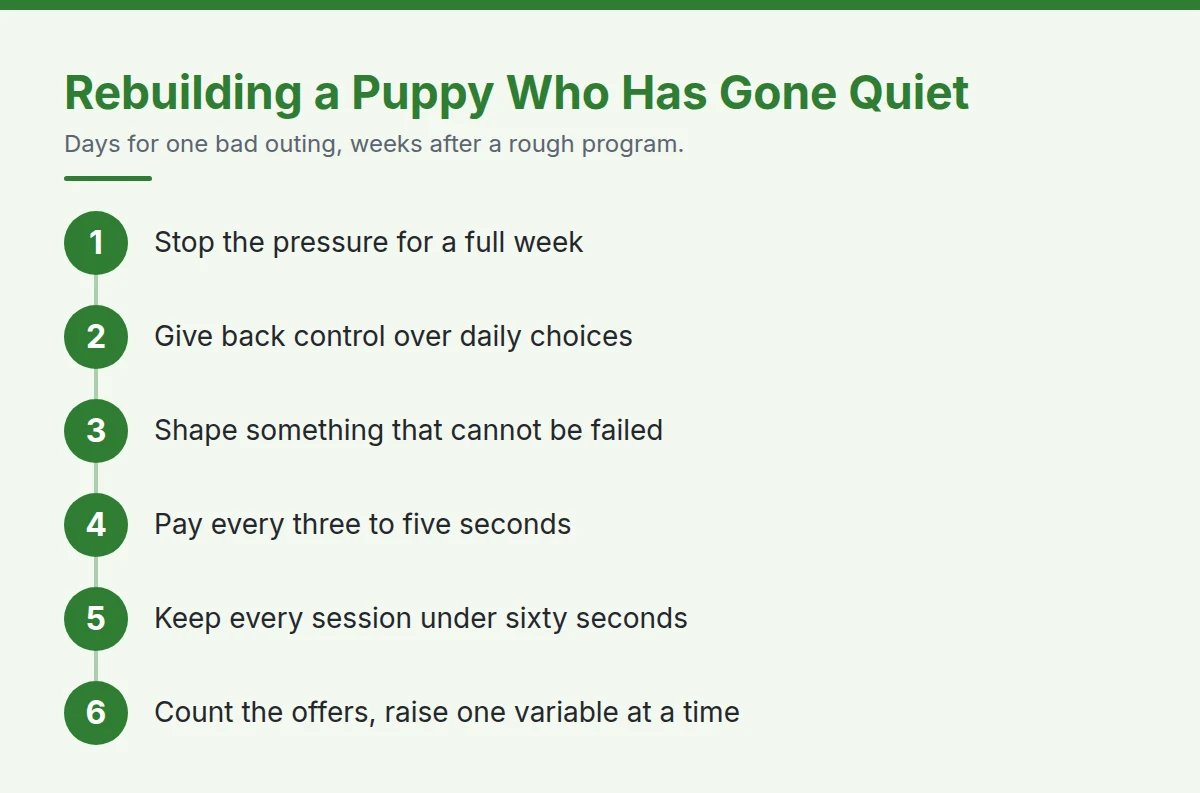
Stop the input first. Whatever produced it, pause it. No corrections, no class, no busy outings, for a week. This is not lost training time. You cannot rebuild offering behavior while something is still suppressing it.
Hand control back on purpose. This is the active ingredient, and it follows straight from the neuroscience above: detecting control is what turns passivity off. In practice it means letting the puppy decide things all day. Which way the sniffing walk goes. Whether to come out of the crate. Whether to approach the visitor. Whether to keep going with a session or wander off mid-rep. A puppy who is allowed to end things relearns that its behavior moves the world.
Make the first sessions impossible to fail. Put the box on the floor and mark and pay any interaction with it. A glance counts. Then a step toward it, then a nose touch, then a paw. Free shaping is the right tool precisely because there is no wrong answer, so there is nothing to get right or get wrong, only things to try.
Pay generously and pay early. Rate of reinforcement is the dial that moves latency. Aim for something payable every three to five seconds at first, and use the good food rather than kibble.
Keep sessions to sixty seconds. End while the puppy is still trying. Three tiny sessions a day beats one long one, and it removes the moment where your enthusiasm runs out and pressure quietly creeps back in.
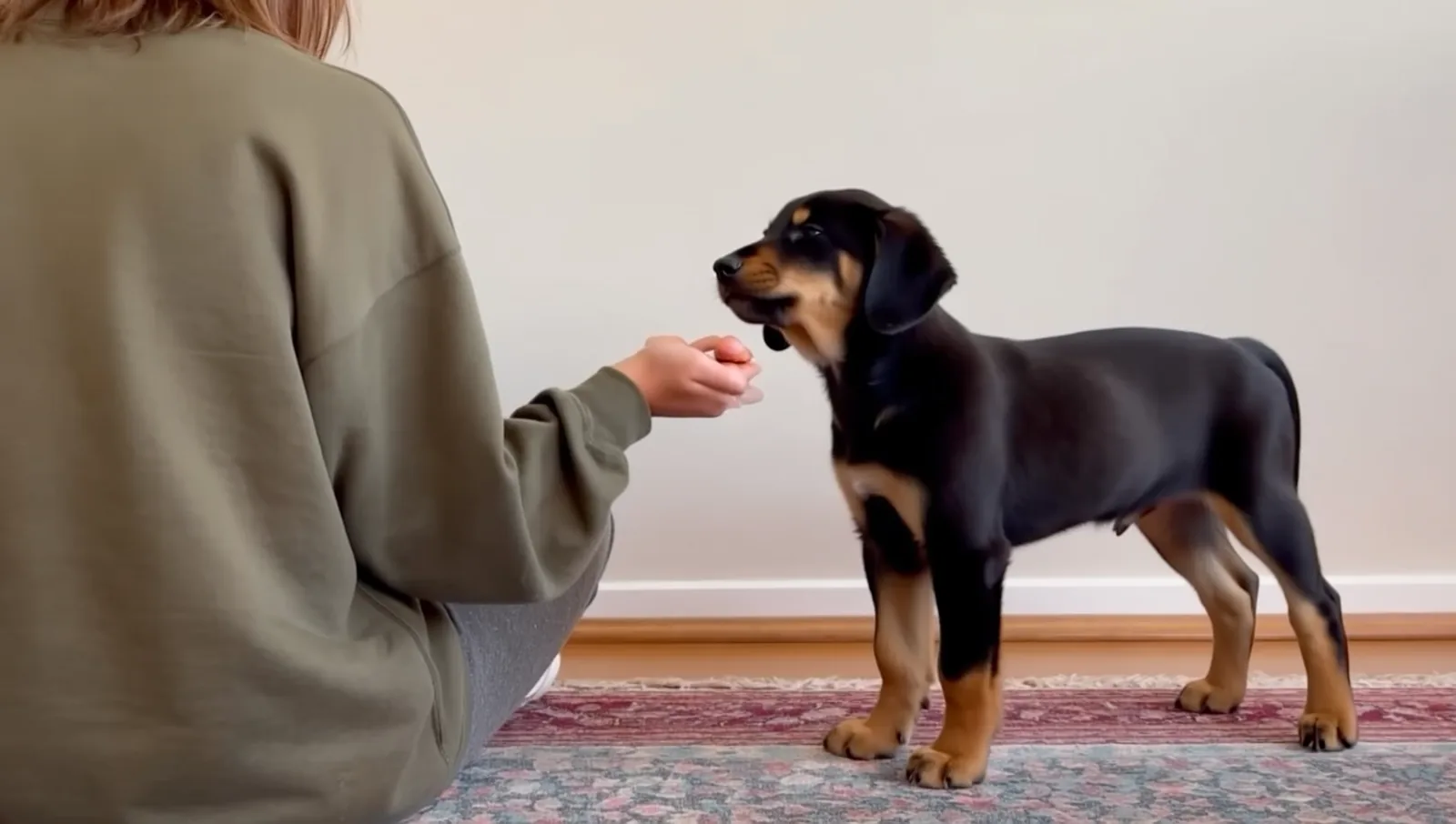
Track the number, not the feeling. Once a day, run the two-minute floor test and count the offers. Owners consistently underestimate progress here, because they are watching for a personality to come back. Counts move days before the vibe does.
Raise difficulty one variable at a time. New room, then mild distraction, then the parking lot of the class venue, then the doorway, then the far corner of the room while a class runs. If offering drops off at any step, you moved too fast, so go back one.
Expect days for a puppy who had one bad outing, and several weeks for a puppy who spent a month in a correction-based program. And do not re-run the thing that caused it to find out whether it still causes it.
When It Is Not a Training Problem
Rule out pain and illness before you conclude anything at all. A puppy who goes flat may be sore, nauseous, running a temperature or reacting to a vaccine, and lethargy plus a drop in appetite is a veterinary question first and a behavior question second.
Rule out development next. A confident puppy who turns cautious for a week or two, startles at familiar objects and then recovers, may simply be in one of the normal fear periods rather than shut down. The giveaways are the pattern and the recovery: fear periods are trigger-specific and self-limiting, while suppression is global and does not lift on its own.
If fear is what remains once you have ruled those out, the work is a structured desensitization and counterconditioning plan, ideally with a qualified professional running it. A puppy showing panic, growling or snapping during handling, or any aggression, needs a board-certified veterinary behaviorist rather than another training class. And when you choose what comes next, note where the veterinary behavior profession stands: the American Veterinary Society of Animal Behavior’s 2021 position statement recommends reward-based methods exclusively, and warns that aversive methods carry a risk of fear, anxiety and aggression. Dog training is licensed almost nowhere in the United States, so ask a prospective trainer the safety questions before you hand your puppy over again.
The Bottom Line
A puppy who has gone quiet is not necessarily a puppy who has learned something. Before you accept calm as progress, check the four markers: how the body is carried, how quickly behavior is offered, whether food still works, and what the hour after class looks like. Quiet plus loose plus curious plus hungry is a settled puppy. Quiet plus low plus still plus uninterested in food is a puppy who has stopped trying, and the answer to that is not more training. It is less pressure and more control, given back a little at a time until the offers return.
Further reading (sources)
- Seligman and Maier on the 1967 experiments the phrase comes from
- Maier and Seligman with the fifty-year reassessment that reversed the original theory
- Hall and colleagues for what makes an animal stop connecting its behavior to outcomes
- Schilder and van der Borg on ear and body posture in shocked dogs long after the session ends
- Cooper and colleagues for tension, yawning and reduced environmental interaction in a field trial
- Vieira de Castro and colleagues with cortisol and pessimism measured in 92 companion dogs
- Casey and colleagues on how two or more aversive techniques shifted judgement bias
- American Veterinary Society of Animal Behavior for its 2021 position that training should be reward-based only