Muzzle Training Before You Need It: A Force-Free Puppy Protocol
Published on August 26, 2026
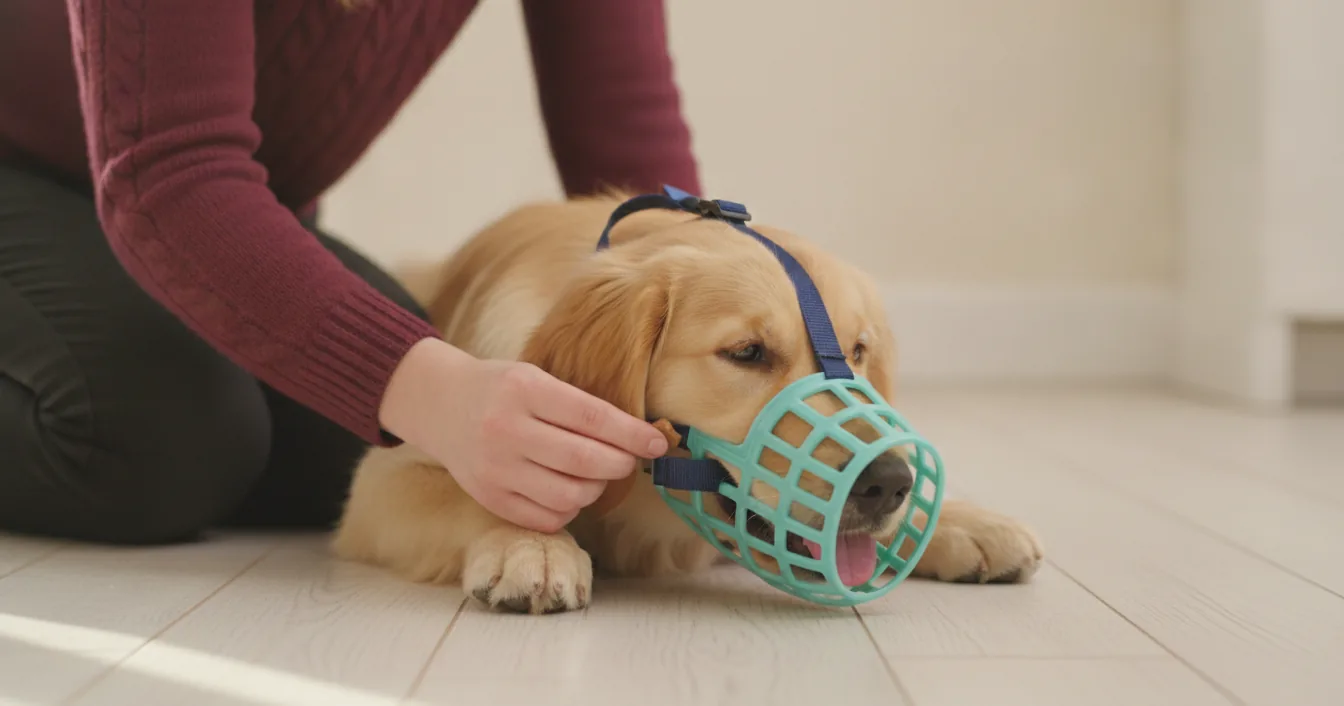
Picture the worst version of the day this matters. It is nine at night, your dog has torn a nail down to the quick or been clipped by a car, and a stranger in scrubs is coming toward the face of an animal in pain. Nobody has time for a training plan. Somebody reaches for a nylon sleeve, loops it over your dog’s snout, and pulls it tight.
That is how most dogs meet their first muzzle: at the worst moment of their life, from an unfamiliar person, while already frightened. Whole Dog Journal made the argument plainly in its recent training-muzzle guide, and it is one of the least controversial claims in the field. Every dog should own a muzzle that fits, and every dog should already be comfortable wearing it, because even the gentlest dog can bite when injured or terrified.
Most puppy owners never consider it. The word carries a weight the equipment does not deserve, and the assumption underneath is that muzzles are for other people’s dogs. That assumption is the reason so many dogs meet one for the first time under fluorescent lights on a stainless table.
The Stigma Is the Real Obstacle
Ask an owner why they have not muzzle trained and you rarely hear a training objection. You hear a social one. Walking a muzzled dog feels like wearing a sign that says something has gone wrong.
It helps to be blunt about what a muzzle actually is. It is a piece of equipment that prevents a specific outcome, in the same category as a seatbelt, a bike helmet, or the harness you already clip on without a second thought. It says nothing about the dog’s character. A muzzle on a dog with a bite history is management. A muzzle on a sweet golden retriever in an emergency room is basic first aid. A muzzle on a puppy in your kitchen on a Tuesday afternoon is a party trick with a treat attached.
Advocacy groups like the Muzzle Up! Project have spent a decade trying to shift this, and the practical version of that shift starts in your own house. If you want the stigma gone, the fix is more well-adjusted dogs wearing bright, cheerful basket muzzles in public and looking entirely unbothered, not fewer.
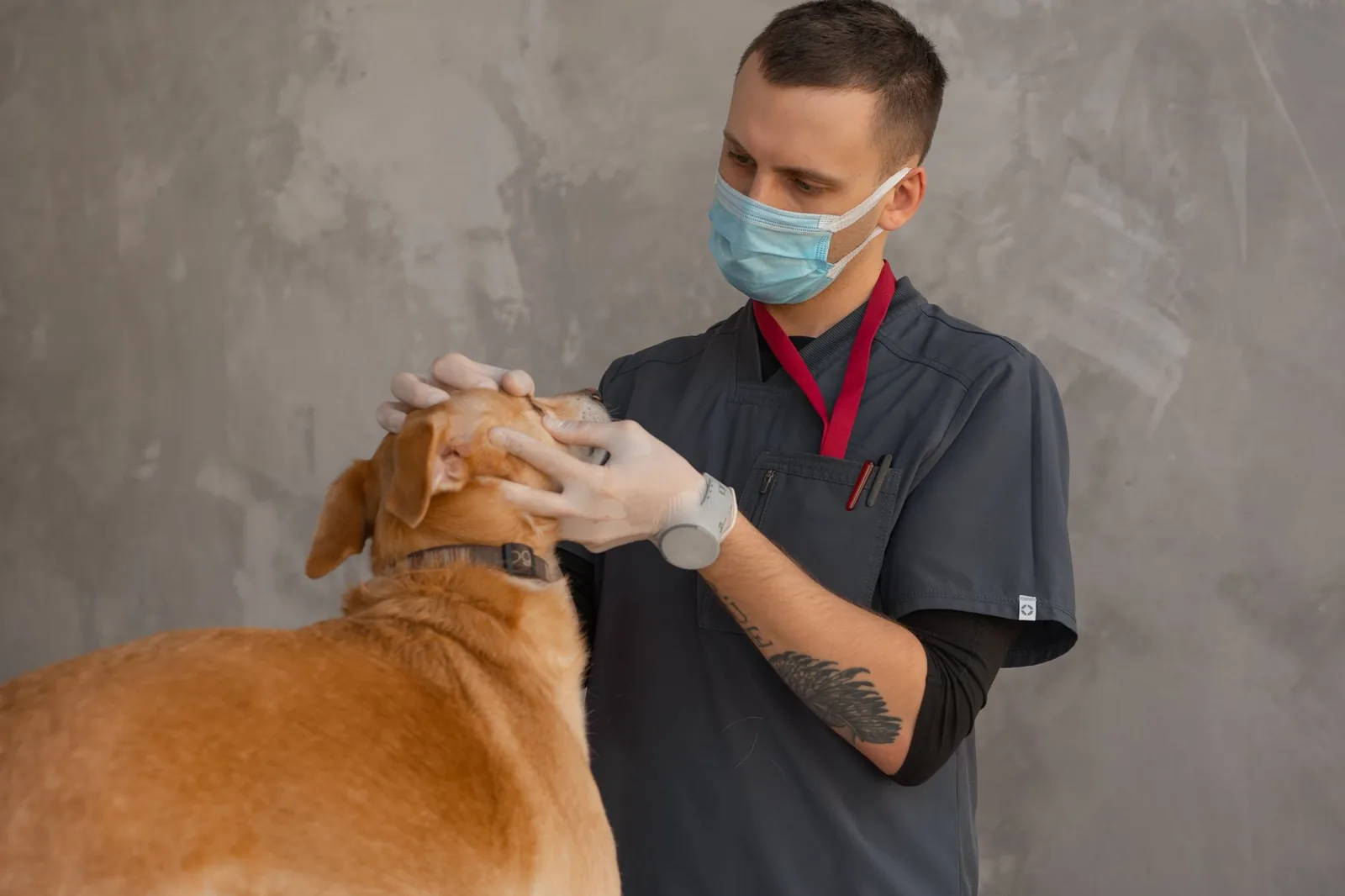
There is also a bonus most owners do not anticipate. Muzzle-trained dogs get better veterinary care, because a vet who is not worrying about the business end of a frightened patient can take longer, be gentler, and skip the sedation a snapping exam would otherwise require.
Why the Socialization Window Is the Moment
The developmental argument is the strongest one, and it is the reason this belongs in puppy class rather than in a remedial program at three years old.
Between roughly three and fourteen weeks, a puppy’s brain is unusually willing to file novel objects as neutral. A weird plastic cage that goes on the face is exactly the sort of thing a twelve-week-old accepts with a shrug and a nine-month-old finds deeply suspicious. Teaching muzzle acceptance during the window is teaching it on easy mode. Wait until adolescence and you are doing the same protocol against a rising tide of neophobia.
There is a second reason, and it is about association. A puppy trained now learns that the muzzle predicts chicken. A dog trained at three, after the vet incident, learns that the muzzle predicts the vet, and that is a much harder association to overwrite. Behavior people call this a poisoned cue, and it is why timing beats technique here.
Muzzle work slots in nicely around week eleven or twelve, once the puppy is confident with general handling. Our week-by-week roadmap from 8 to 16 weeks has the surrounding sequence, and the case for front-loading novelty is covered in why puppy classes matter for socialization.
Basket or Sleeve: Only One Is a Training Muzzle
This is the single most common gear mistake, and it is worth getting right before you spend anything.
Sleeve muzzles (also called grooming muzzles) are a fabric or mesh tube that clamps the snout shut with a strap behind the ears. The dog cannot open its mouth, which means no panting, no drinking, and no treats. Dogs thermoregulate almost entirely by panting, so a sleeve muzzle in a warm room is a genuine welfare risk rather than a theoretical one. They earn a place in a first aid kit or glovebox for a two-minute nail trim, and nowhere else. A well-fitted one still leaves room for a nip, so it is not the security blanket people imagine.
Basket muzzles are a structured cage of plastic, rubber, leather, or wire that sits around the snout with room to spare. The dog can open its mouth, pant freely, drink, and take food through the gaps. That last point is the whole ballgame: if you cannot deliver a treat through the muzzle, you cannot condition the muzzle, and you certainly cannot use it during behavior work. Plastic is the sweet spot for a growing dog, cheap and easy to hose out, and it does not bruise your shins the way wire does when a puppy swings its head.
Buy a basket muzzle. A decent one runs somewhere between fifteen and thirty dollars, which is less than one bag of the treats you will spend on it.
Fitting a Muzzle That the Puppy Will Outgrow
Fit is where good intentions usually fall apart, because a muzzle that pinches teaches the puppy the equipment hurts, and you cannot train your way out of that.
Take three measurements with a soft tape: the circumference of the snout just below the eyes, the length from the tip of the nose to just below the eye line, and the neck circumference for the head strap. Most brands publish a chart against all three. When your puppy falls between sizes, size up.
What a correct fit looks like on the dog:
- The basket ends about half an inch past the tip of the nose, so the nose is not pressed against the front.
- There is clear space above the snout, enough that the dog can open its mouth fully and pant with the tongue extended.
- The sides do not squash the lips or cheeks, but the gaps are small enough that a paw cannot wedge in and lever it off.
- The head strap sits snugly behind the ears. Two fingers should slide under it and no more.
- A forehead strap, if the model has one, keeps the basket from tipping down and adds real security against pawing.
Head shape drives brand choice more than weight does. A greyhound’s narrow snout and a bullmastiff’s blocky one need different geometry, and flat-faced breeds like French bulldogs and pugs need a purpose-built short-snout model rather than a downsized standard basket.
Then accept the annoying part. A puppy will outgrow two or three muzzles before adulthood. Buy cheap and adjustable in the early months, re-measure monthly through the fast growth phase, and save the expensive custom-fit purchase for the fully grown dog. The training transfers fine, and reintroducing a fresh muzzle to a trained dog usually takes one session.
The Five-Stage Ladder
The protocol is straightforward desensitization and counterconditioning. Sessions run two or three minutes, once or twice a day, and you end while the puppy still wants more. The muzzle lives out of sight between sessions rather than sitting in the hallway where it can quietly become wallpaper.
Pay well. This is a job for whatever ranks at the top of your puppy’s list rather than kibble, and if you are unsure what that is, a ten-minute preference test will tell you in one sitting.
Stage 1: The muzzle makes food appear. Hold it behind your back. Bring it out, feed, put it away. Repeat ten or fifteen times. The puppy does not touch it, wear it, or do anything at all. You are building one prediction: this object means chicken. In the same session, buckle and unbuckle the strap a few times while feeding, so the click stops being a surprise later.
Stage 2: Nose touch. Hold the basket in one hand and post a treat through it from the outside with the other, so the puppy has to reach in slightly to eat. Start with the nose barely breaking the plane of the opening. Over several reps, hold the treat further back so the puppy pushes deeper. Never push the muzzle onto the face. The puppy’s nose goes to the muzzle, not the other way around, and that direction of travel is what makes the whole thing hold up under stress later.
Stage 3: Snout in and hold. Now the puppy puts its whole snout in to reach the treat, then keeps it there for one second, then two, then five, feeding continuously through the front. When it is offering that eagerly, add your cue word just before each rep. Say “muzzle,” present it, feed. Keep the straps hanging loose and untouched.
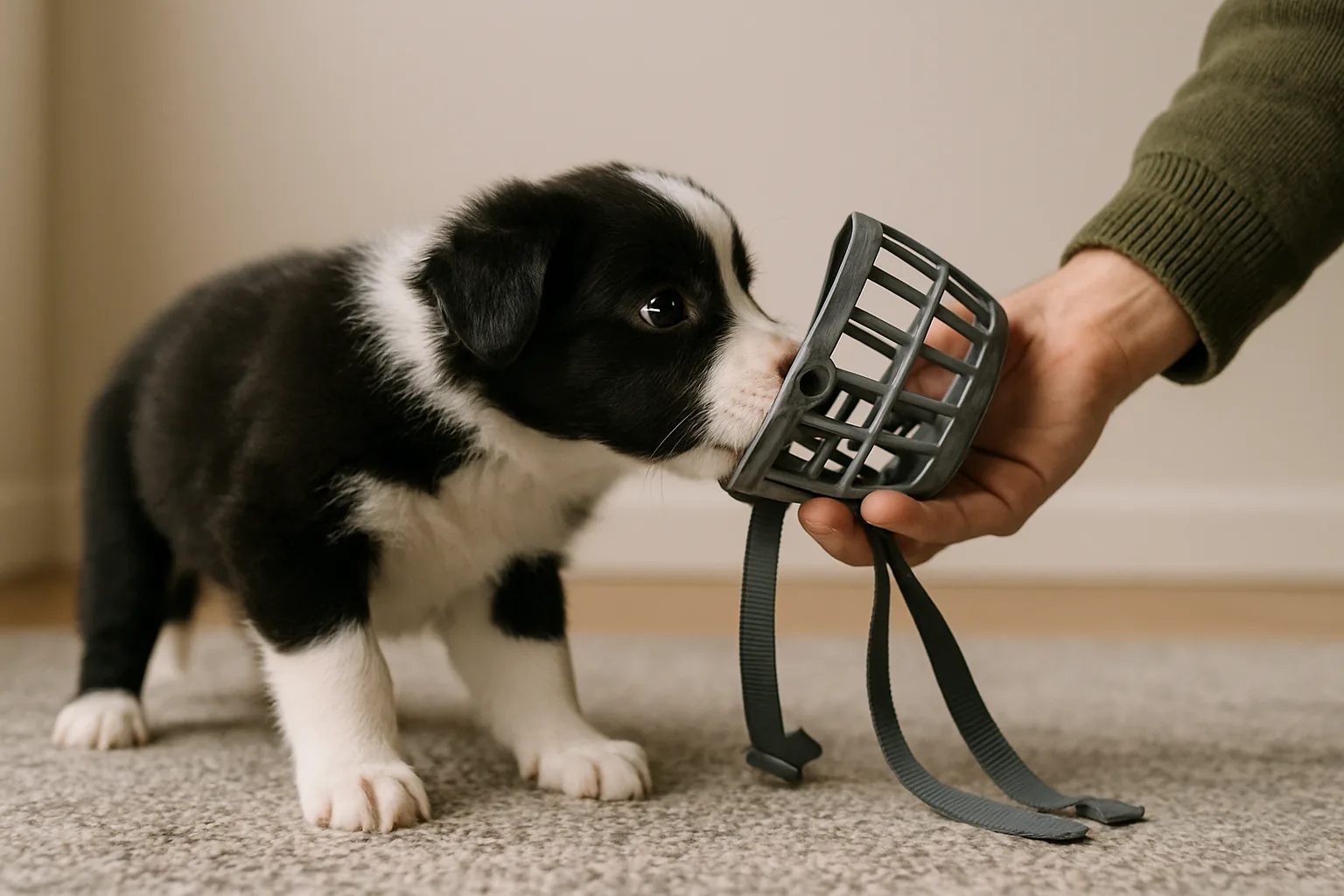
Stage 4: Buckle and release. Snout in, fasten the strap, feed one treat, unfasten, off. Three seconds total. The fastening sound is a new element, so treat it as one and go back a step if the puppy backs off. Repeat until the buckle is boring.
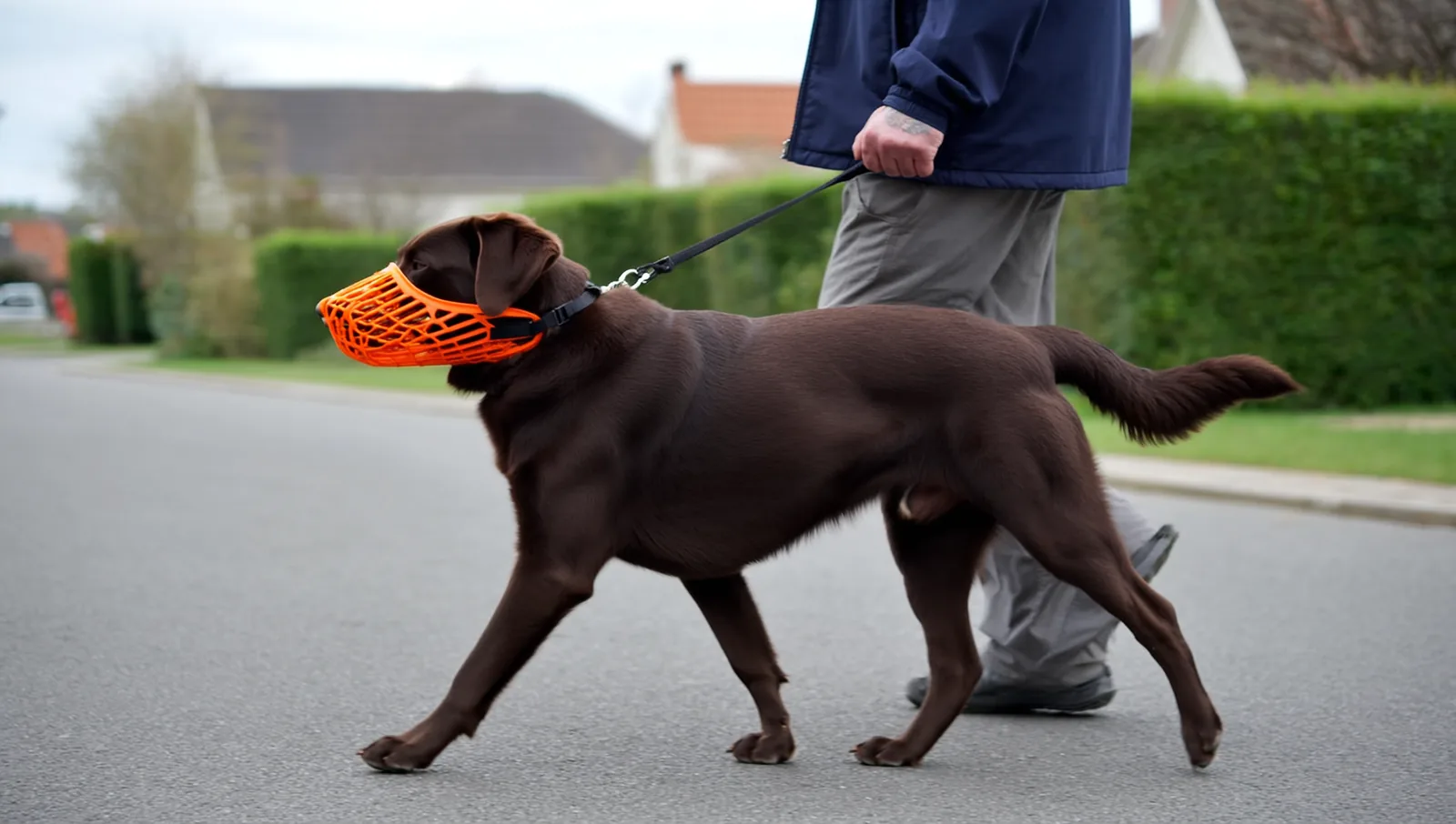
Stage 5: Duration and movement. Build the time worn from seconds to a minute to several minutes, feeding through the basket at a decreasing rate. Then add motion, because a dog standing still in a muzzle and a dog walking in one are different pictures. Walk a few steps, feed, take it off. Move to the garden, then the pavement, then somewhere busier, and expect to lose ground each time the location changes. This is also where muzzle work and loose-leash walking practice start sharing a session, since a puppy fighting the leash while wearing a new muzzle is being asked for two hard things at once.
Throughout, the puppy’s body tells you the pace. Voluntary approach, soft face, and a wagging back end mean carry on. Turning away, lip licking, a lowered head, or a sudden interest in sniffing the floor mean you moved too fast, and the answer is always to drop back a stage rather than push through. The stress signals worth knowing in class are the same ones that matter here.
The Mistakes That Create a Muzzle-Hating Dog
Four errors account for most failures, and all four are avoidable.
Strapping it on at the first attempt is the big one. It usually works exactly once, in the sense that the muzzle goes on, and it poisons the object for months afterward.
Using the muzzle as a consequence is the second. A muzzle that appears after the puppy chews the skirting board becomes a punishment marker, and everything you built collapses.
Only bringing it out before something unpleasant is the third, and it is the quiet one. If the muzzle predicts the vet and nothing else, it becomes a warning signal in its own right. Wear it for good things too: a car trip to the park, nose games in the garden, five minutes before dinner.
Ignoring the pawing is the fourth. A dog scrabbling at its face is telling you the fit is wrong or the rep is too long. Take it off, check the fit, shorten the rep. Waiting it out only teaches the dog that struggling is the one response available.
What a Muzzle Does Not Do
Be clear about the limits, because this is where owners occasionally get themselves into trouble.
A muzzle prevents a bite. It does not change how the dog feels, and a frightened dog in a muzzle is still a frightened dog, now with less ability to communicate and less ability to eat the food you would use to counter-condition. It buys safety while the real work happens. It is not the real work.
A muzzled dog should also not be left alone, crated in one, or allowed to play rough with other dogs while wearing one. Basket muzzles can catch on things, and a dog cannot free itself.
If your puppy is showing genuine fear or aggression rather than ordinary novelty caution, the muzzle is step one of a plan that needs a professional attached to it. Work through a graded exposure protocol with a credentialed trainer, and ask for a referral to a veterinary behaviorist if there are real threat displays, a bite history, or fear that is not improving. Dog training is unregulated in most states, so check for CCPDT, KPA, or IAABC credentials before you hand anyone your puppy’s difficult behavior.
Keep It Alive
Trained is not permanent. Run a few reps once a month for the life of the dog, re-check the fit every time the collar needs loosening, and keep the current muzzle somewhere you would actually find it in a hurry: the car, the walking bag, the first aid kit.
The whole point is that the day you need it, nothing about it is new. Your dog is in pain, the room smells wrong, and a stranger is reaching for its face. The one part of that scene your dog already understands is the thing you taught in the kitchen, three minutes at a time, when nothing was wrong at all.
Further reading (sources)
- Whole Dog Journal on why every dog should own a muzzle that fits
- AAHA on cooperative care and why it beats restraint
- AAHA for the humane restraint position and what it rules out
- American Veterinary Society of Animal Behavior on the socialization window and why early exposure matters
- Peer-reviewed research with how handling technique changes canine stress physiology