The Flat-Faced Puppy in Class: Breathing, Heat, and Session Design for Bulldogs, Pugs, and Frenchies
Published on October 14, 2026
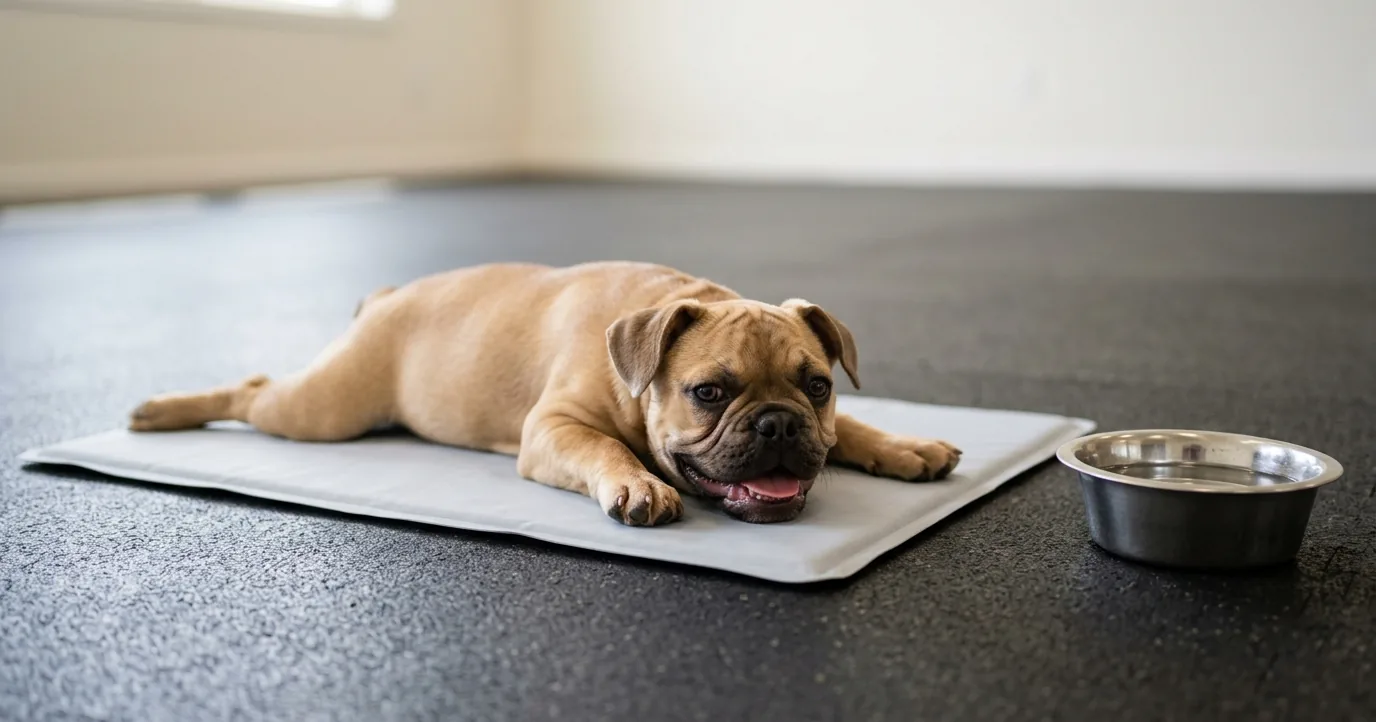
Every puppy class seems to have one. Ten minutes in, while the retriever puppies are still bouncing off the walls, the French Bulldog is flat out on the cool floor by the door, sides heaving, snoring like a small diesel engine. Somebody laughs. Somebody says that is just Frenchies. The owner, who heard the same thing from the breeder, laughs along.
That noise is the airway. Bulldogs, Pugs, French Bulldogs and Boston Terriers are brachycephalic, the veterinary word for short-skulled, and the soft tissue of a long muzzle is packed into a much shorter one. It gives these puppies a hard ceiling on heat and excitement that has nothing to do with brains or willingness, and most group curricula are written as if that ceiling were not there. It is not a rare problem, either: the French Bulldog has topped the AKC’s registration rankings four years running.
None of this is a reason to skip class. A flat-faced puppy needs the socialization window as much as any other puppy, and a well-run class is still the best place to spend it. What changes is the design of every session: shorter sets, cooler rooms, calmer games, a harness instead of a collar, and an owner who knows which noises mean stop. This guide covers all of that, plus a realistic timeline and the airway signs that call for a vet rather than a trainer.
Why a Short Face Changes the Session
The medical name for the problem is brachycephalic obstructive airway syndrome, or BOAS. A review of the condition by Packer and Tivers describes it as a mismatch between the skull and the soft tissue held inside it. The nostrils are often narrow, the soft palate is too long and thick for the space, and the extra tissue partly blocks the airway on every breath.
Two things follow for a puppy class. The first is heat. Panting is a dog’s main way of cooling down, as Whole Dog Journal puts it, and panting depends on moving a lot of air. A narrowed airway makes every breath harder work, and the review notes that affected dogs are prone to heatstroke because their heat exchange is impaired.
The second is excitement. The same review lists arousal as something that makes the breathing worse, and it is explicit that the positive kind counts: exercise and excitement as well as stress. A tug game your puppy adores loads the airway as surely as a scary new room does, and that is the whole puppy class problem in one sentence.
The heat numbers are stark. A team led by Emily Hall, working with VetCompass records from more than 900,000 UK dogs, found that compared with Labrador Retrievers, Bulldogs had about 14 times the odds of heat-related illness, French Bulldogs about 6.5 times and Pugs a little over 3 times. Flat-faced dogs as a group had about twice the odds of dogs with medium-length muzzles. A companion paper found that three quarters of cases were triggered by exercise, not by hot cars. Where the activity was recorded, two thirds of those cases came after a walk and about one in seven after play. Cases turned up in every month of the year, and dogs under two had higher odds of overheating through exercise than dogs over eight.
In other words, the ordinary stuff is where these dogs overheat: a walk, a romp, a class.
”Normal for the Breed” Is Not the Same as Normal
The snoring gets laughed off because it is so common in these breeds that it sounds like part of the package. In a 2012 study of dogs seen at the Royal Veterinary College’s referral hospital, Packer and colleagues found that 58 percent of the owners of dogs with BOAS said their dog did not have a breathing problem, even as their own answers described frequent, severe signs. The authors’ worry was simple: a dog whose owner sees nothing wrong does not get treated.
The breathing assessment developed by the University of Cambridge and the UK’s Royal Kennel Club, now offered in North America through the Orthopedic Foundation for Animals (OFA), gives you a useful yardstick. A trained vet listens to the airway at rest, sends the dog on a brisk three-minute walk, and listens again. Grades 0 and I count as clinically unaffected, because any noise is faint enough to need a stethoscope. A dog whose snort or wheeze you can hear without a stethoscope lands in Grade II or III, which the scheme treats as clinically affected, with signs that touch quality of life.
Common is not the same as harmless. Cambridge researchers found that narrow nostrils were linked to BOAS in all three breeds they studied (Pugs, French Bulldogs and Bulldogs), and that carrying extra weight raised the risk in Pugs and Bulldogs. Your vet can check the first, and the second is in your hands.
Reading the Breath: The Noises That Mean Stop
You do not need a stethoscope to run a safer session. You need to know what ordinary panting looks like, and what the warning versions sound like.
Ordinary panting is fast and regular, with an open mouth and a loose, relaxed body. Whole Dog Journal notes that it takes little effort and usually settles within five to fifteen minutes.
Stertor is the low snoring or snorting vibration from the nose and throat, above the voice box. Most owners of flat-faced puppies know it well. Notice when you hear it: only after effort, or at rest too.
Stridor is a higher-pitched sawing or wheezing noise from the larynx itself. The Packer and Tivers review links it to restricted airflow at the voice box and to laryngeal collapse. It is the one to take most seriously, and it ends the session.
Labored breathing has a look as well as a sound. Whole Dog Journal describes a dog stretching its neck out as if gulping air, elbows pushed out at the sides, nostrils flaring, ribs visibly working and a worried expression. Dogs in that state tend to avoid lying down, or stay propped on the chest if they do. Gums turning blue or gray make it an emergency.
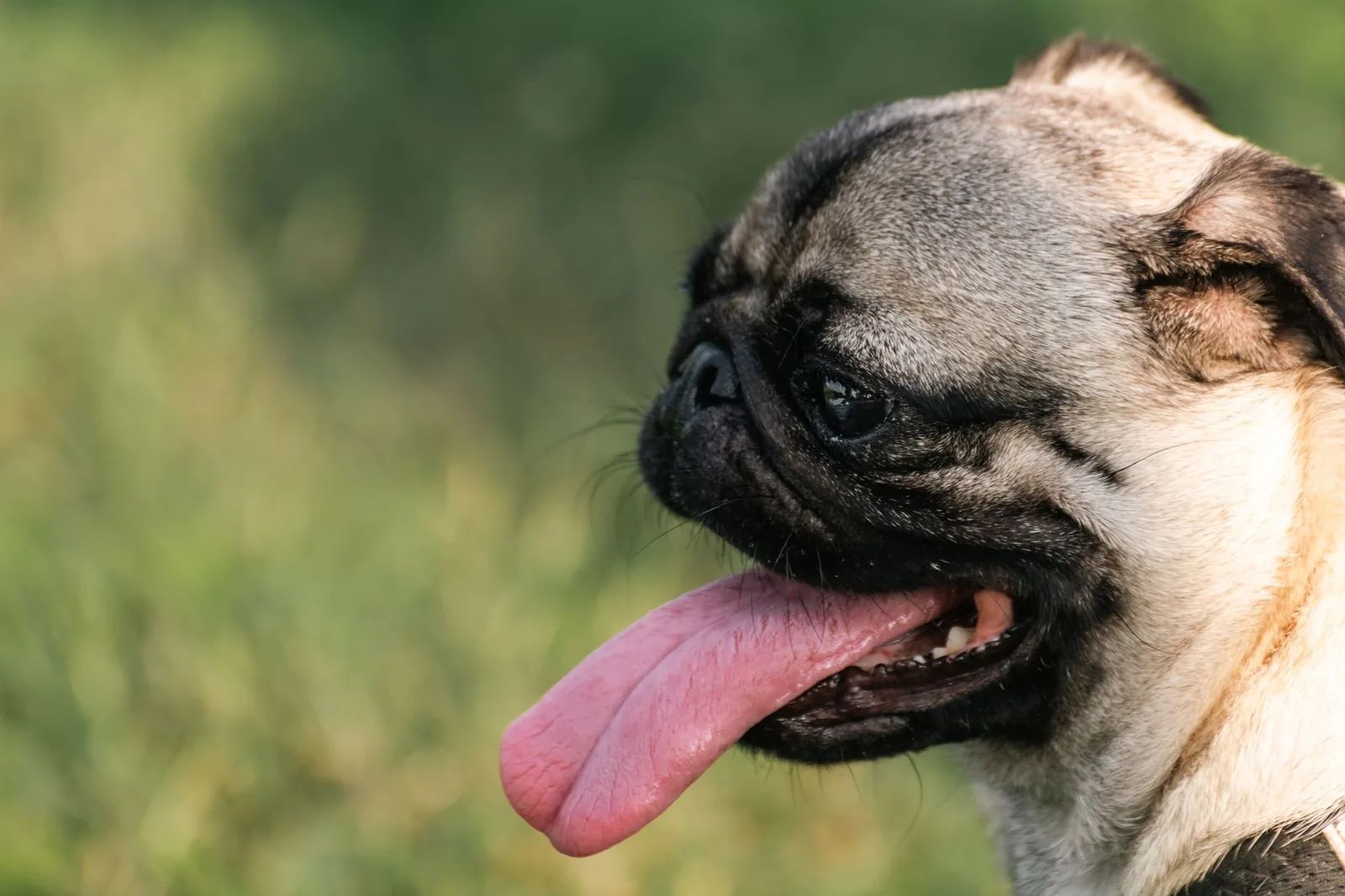
Not all panting in class is heat. Stress makes puppies pant too, drawing on the same overworked airway, and our guide to reading your puppy’s body language in class covers the stress signals that travel with it.
My working rule for class: if the noise or the effort is still climbing after you have stopped working, or the puppy cannot settle on a cool mat, the session is over for today. Nobody wins a prize for the last three reps.
Designing the Session: Short, Cool and Calm
The AKC’s Bulldog training timeline, written with a Bulldog breeder and a trainer, gives the baseline rule: when your puppy is panting a lot, take a break and cool down. Everything below is about building those breaks in before your puppy needs them.
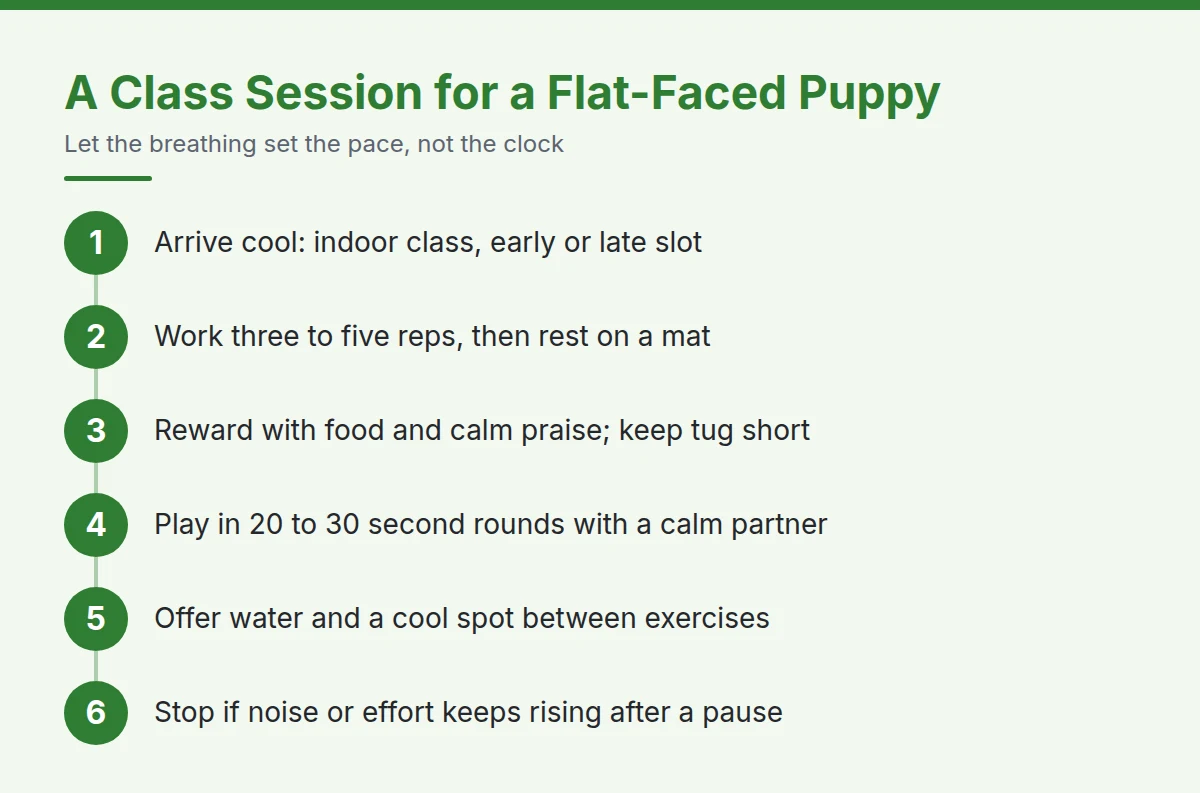
- Arrive cool, not warmed up. In warm months, choose an air-conditioned indoor class at the earliest or latest slot, pre-cool the car, and park close. Even the vets who grade these airways insist that their three-minute walk test happen somewhere climate-controlled.
- Work in short sets. Three to five repetitions, then a break on a mat. Let the breathing set the pace rather than the clock: when the panting gets louder or the mouth opens wide, pause before the puppy has to ask.
- Choose calm reinforcers. Food and quiet praise keep arousal low, while tug and chase spike it. Tug is not banned, but keep it to a few seconds and end it with a trade. The AKC’s trainer recommends exactly that for teaching Drop It to a breed with a strong grip: never simply take the toy, trade up for something better.
- Play in short rounds. Twenty or thirty seconds with a calm, well-matched partner, then a breather, and never two minutes as the one being chased. Our complete guide to puppy play covers the consent test and building an off switch, both of which matter more for these puppies than for most.
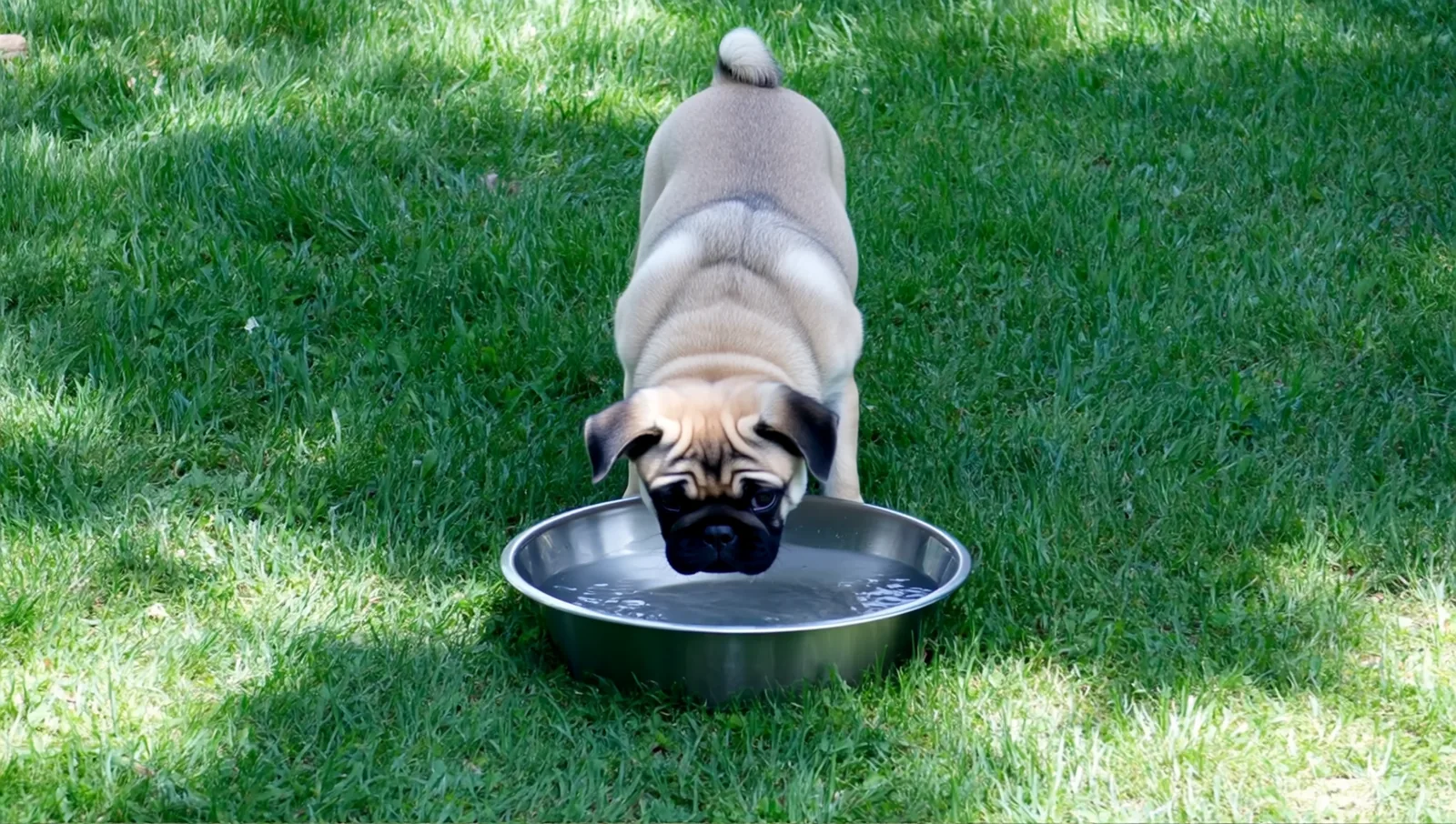
- Set up a cooling station. A wide, shallow water bowl, a cooling mat or a cool patch of floor, and shade if you are outdoors. A small fan helps if the class allows one.
- Count the treats. Extra weight raises BOAS risk in Pugs and Bulldogs, and in the UK heatstroke study, dogs at or above the average weight for their breed and sex had higher odds of heat illness. Pay from the daily ration and use tiny pieces.
- Pace the summer. The AKC’s Bulldog breeder recommends exercising very early or late in the day, and the same article flags hot, humid days as the hard ones. Train indoors on those days; our guide to how much exercise a puppy needs has an activity budget that works inside.
Harness Fit Around a Barrel Chest
Keep the collar for ID tags. The Packer and Tivers review recommends a harness for dogs with BOAS so that nothing presses on the upper airway, and a puppy who lunges at a classmate on a collar is pulling against its own throat at the worst possible moment. Slip leads and collar corrections have no place in a force-free class, and with this airway they are a particularly bad idea.
The catch is that most harnesses are cut for a different dog. A Bulldog or Frenchie puppy is a wide chest and broad shoulders on short legs, with a short neck and a narrower waist, and that shape causes three common faults:
- The neck loop rides up onto the throat. Look for a Y-shaped front where the chest piece sits low on the breastbone, well below the windpipe.
- The girth strap rubs the armpits. Short legs put the strap right where the elbow moves. Check for redness or thinning hair after the first few walks, and adjust it or choose a design with the strap set farther back.
- The harness spins or slips off. A barrel chest tapering to a narrower waist lets a loose harness rotate, or lets the puppy back straight out of it. You should fit two fingers flat under each strap, and no more.
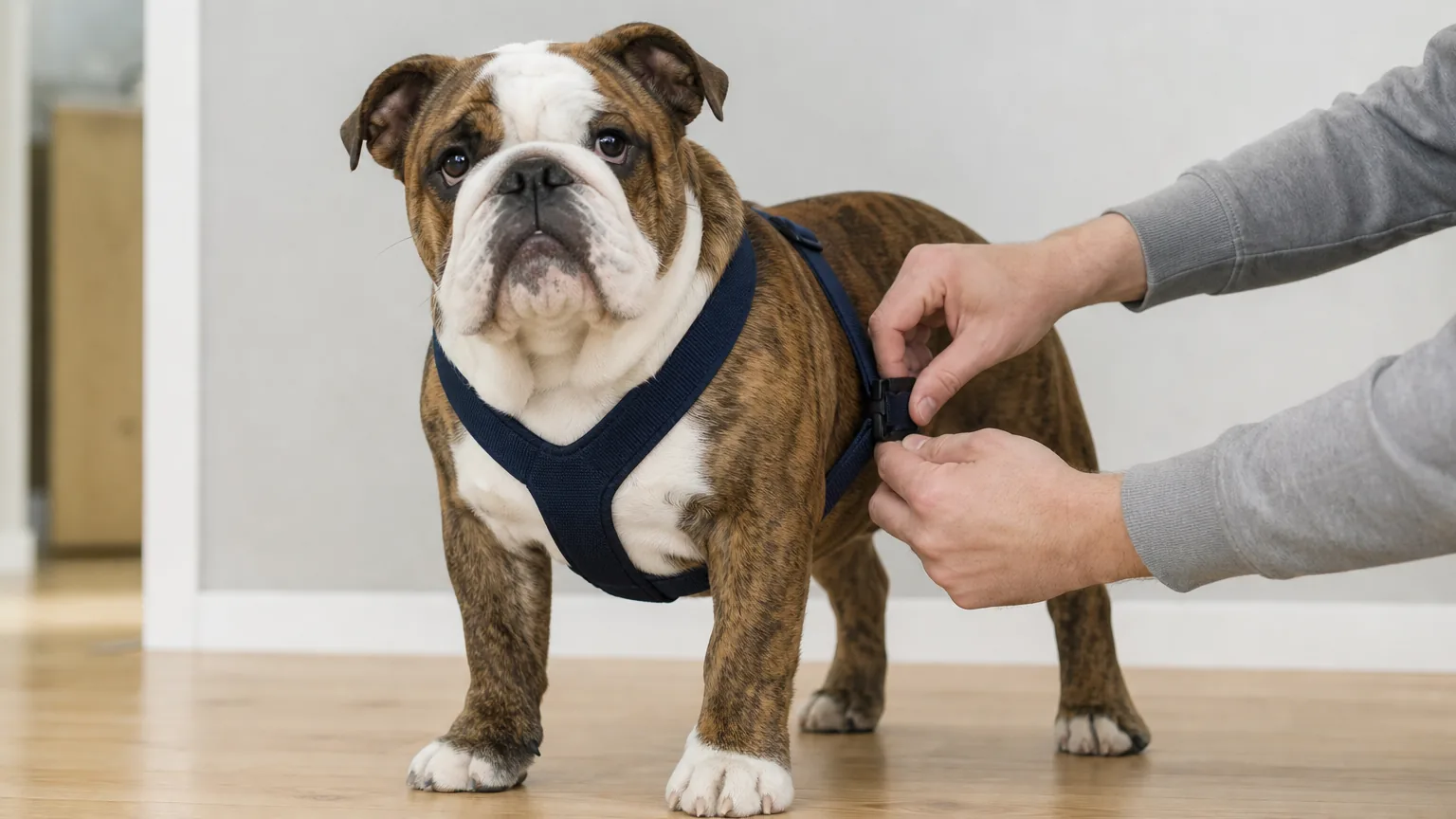
Recheck the fit every week or two. These puppies broaden fast, and a harness that fitted at ten weeks can pinch at fourteen. Then teach the puppy to like wearing it: the harness conditioning steps in our loose-leash walking guide take about three days.
A Realistic Training Timeline
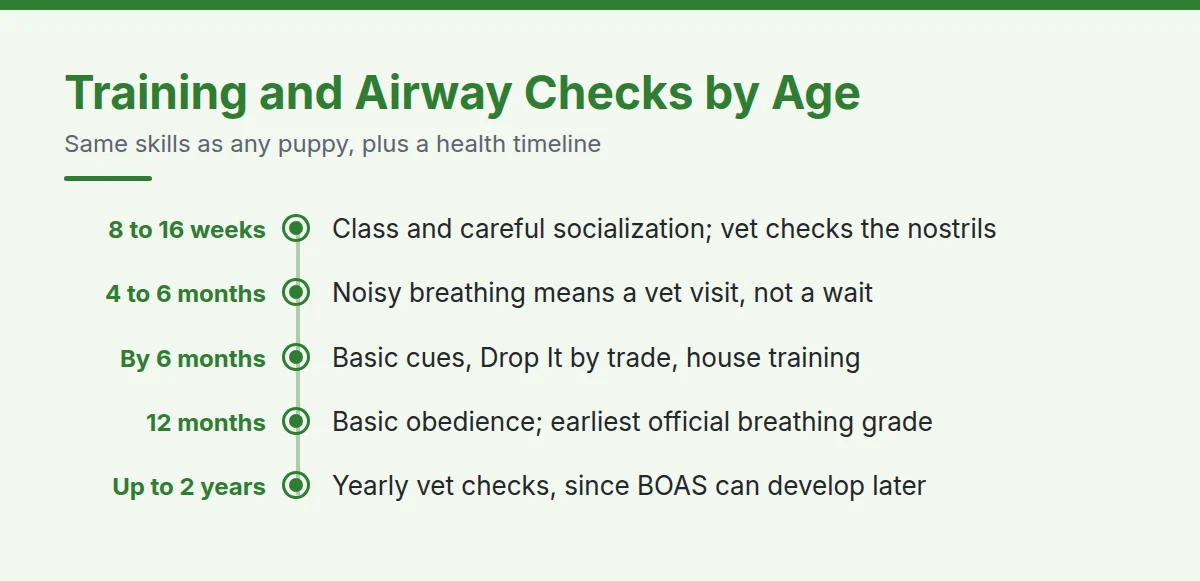
The good news is that the learning timeline is the same as any other puppy’s. The AKC’s Bulldog timeline sets out the usual milestones:
- 8 to 16 weeks: socialization, with the emphasis on quality. The trainer quoted puts it as curating your puppy’s friend list so it only meets dogs who will behave well toward it. Add gentle handling of the face and wrinkles, and show the puppy what it is allowed to chew.
- By 6 months: basic cues such as sit, stay and leave it, a solid trade for Drop It, and house training well underway.
- By 1 year: basic obedience and a settled daily routine, with activities like obedience, tracking and agility open to them “as long as the weather is temperate.”
What differs is the volume and the season. A flat-faced puppy learns the same skills in more, shorter sessions, and a puppy who comes home in July will do much of its early work indoors, with outdoor practice saved for the cool ends of the day. Progress per week can look slower than the Labrador’s next door. That is a scheduling difference, not a learning one.
Run a health timeline alongside the training one:
- First vet visits: ask your vet to look at the nostrils. Narrow nostrils are one of the clearest BOAS risk factors, and they are visible from the outside.
- Four to six months: do not wait for a puppy to grow out of noisy breathing. An Irish case series described seven brachycephalic puppies aged four and a half to six months who already had laryngeal collapse, a secondary change driven by the effort of breathing against an obstruction, and two of them died. The authors urged assessment as soon as any signs appear.
- 12 months: the minimum age for an official Respiratory Function Grading exam through OFA. Earlier exams count only as preliminary. The scheme began with Pugs, French Bulldogs and Bulldogs, and in April 2026 OFA added Boston Terriers, Cavaliers, Boxers and ten other breeds.
- Under 2 years: OFA recommends yearly vet checks for dogs graded before 24 months, because BOAS can develop later. If surgery is ever suggested, the Packer and Tivers review reports one series in which 91 percent of dogs that had soft palate surgery before age two improved, against 68 percent of older dogs.
When It Is a Vet Problem, Not a Training Problem
Some of what looks like a training problem in a flat-faced puppy is a breathing problem in disguise. Before you label a puppy stubborn, rule these out with your vet:
- Planting or lying down a few minutes into a walk, especially on warm days. Exercise intolerance is one of the core BOAS signs, not a motivation issue.
- Refusing to settle on a mat, or always sitting up or staying propped on the chest instead of lying flat. Dogs who are working to breathe tend to avoid lying down.
- Gagging, regurgitating or vomiting after eating, drinking or a session. OFA lists regurgitation and difficulty swallowing among the signs of BOAS.
- Breathing noise at rest, or noise you can hear across the room after a short, brisk walk.
- Loud snoring every night, or pauses in breathing during sleep. Snoring is on the list of BOAS signs, and sleep-disordered breathing, including episodes of apnea, has been recorded in Bulldogs.
- A blue, gray or purple tongue or gums, fainting or collapse. That is an emergency, not an appointment.
If your puppy overheats, move fast. The signs UK researchers used to identify heat-related illness include panting that carries on after the puppy is out of the heat or has stopped exercising, drooling, vomiting or diarrhea, stiffness or reluctance to move, wobbliness, collapse and seizures. The rule is cool first, transport second: veterinary emergency guidelines from 2016 name cold-water immersion, or soaking the coat while keeping air moving across it, as the best methods, ideally started before the drive. Then go, with the air conditioning on full, and phone ahead. In a VetCompass study of 623 cases, only about a fifth of the dogs whose records mentioned cooling had been cooled before the trip, and the most common method was wet towels, which the authors note works less well.
Choosing a Class for a Flat-Faced Puppy
Dog training is unregulated in most states, so credentials and practices matter more than the sign on the door. Start with a certified instructor (CCPDT, KPA or IAABC), then ask the questions that matter for this puppy:
- Is the room climate-controlled, and what happens to the schedule in a heat wave?
- Are breaks built into the curriculum, or do puppies work straight through?
- How is play grouped, and how long are the rounds?
- What does the instructor do if a puppy overheats?
- Is any equipment that tightens on the neck, such as slip leads, choke chains or prong collars, used or sold?
An instructor with a ready answer to the overheating question has done this before. Our guide to choosing the right puppy class covers the rest of the vetting.
The Short Version
Flat-faced puppies learn as fast as any other puppy, but they hit a breathing and heat ceiling long before they run out of enthusiasm. Train in short sets with built-in breaks, keep arousal low, train somewhere cool when it is warm, and put the leash on a well-fitted harness, never a collar. Treat breathing noise you can hear without a stethoscope as a question for your vet, not a breed quirk. And treat any blue tongue, collapse or panting that will not settle as an emergency: cool first, transport second.
Further reading (sources)
- American Kennel Club on a stage-by-stage training timeline for Bulldog puppies
- American Kennel Club for its latest breed popularity rankings
- Orthopedic Foundation for Animals with how the Respiratory Function Grading Scheme works in North America
- Whole Dog Journal on telling ordinary panting from labored breathing
- Packer, Hendricks and Burn about owners who saw airway signs as normal for the breed
- Packer and Tivers for managing and preventing airway disease in flat-faced dogs
- Liu and colleagues on nostril width, body condition and BOAS risk
- Pink and colleagues with laryngeal collapse in seven puppies under six months
- Hall, Carter and O’Neill on which breeds face the highest heatstroke risk
- Hall, Carter and O’Neill for why exercise, not hot cars, triggers most canine heatstroke
- Hall and colleagues with how overheated dogs were cooled, and which methods work best