The Complete Guide to Puppy Play: Styles, Consent Tests, and Building an Off Switch
Published on September 14, 2026
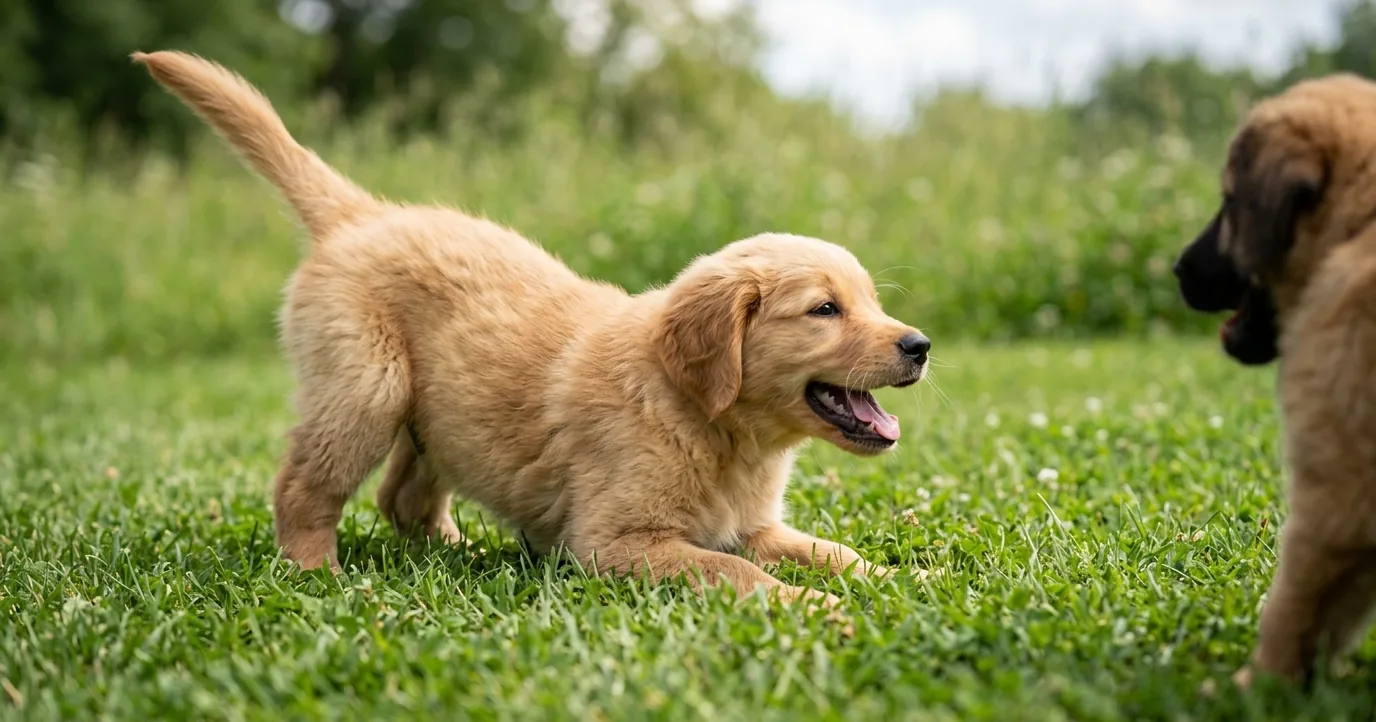
Two puppies are going at it on the grass in front of you. One is screaming. There is a lot of teeth. Somebody is pinned. The other owner says “oh, they’re fine, let them sort it out,” and you genuinely cannot tell whether that is true or whether you are watching the first thirty seconds of something you will be paying a vet to fix.
This is the single most common judgment call in puppy raising, and almost nobody is taught how to make it. The good news is that you do not need to become a behaviorist to referee a play session. You need a rough map of what the styles are, two physical tests you can run in about four seconds each, and a short list of the signs that mean stop. The rest of this guide is those three things, plus the part everyone skips: teaching a puppy to come out of play, which turns out to matter more than any of it.
Play Is Practice, Not Just Energy Burning
Owners tend to treat play as a fuel tank problem: the puppy has energy, play empties the tank, everyone sleeps. That is the least interesting thing play does.
Social play is where a puppy learns the grammar of being a dog. It is how bite pressure gets calibrated, how a stop signal gets learned and honored, how to read another animal’s intent in the first half second. Researchers who study why dogs keep playing into adulthood, unusually for a carnivore, make the point that the different kinds of play (with objects, with other dogs, with people) are structurally different behaviors that probably serve different purposes. Play with another dog is not simply a louder version of tug with you. Dogs compete over objects with each other and cooperate over them with humans, which is one reason a puppy who only ever plays with people arrives in a dog play group without the vocabulary.
Two features tell you that you are watching real play rather than a fight in slow motion. The first is self-handicapping: a bigger or more confident puppy voluntarily plays below its ability, rolling onto its back, mouthing softly, letting itself be caught. The second is role reversal: the chaser becomes the chased, the pinner becomes the pinned, and the swap happens over and over. Play that is genuinely mutual is full of both. Play that has stopped being play has neither.
The Five Play Styles, and Which Pairings Work
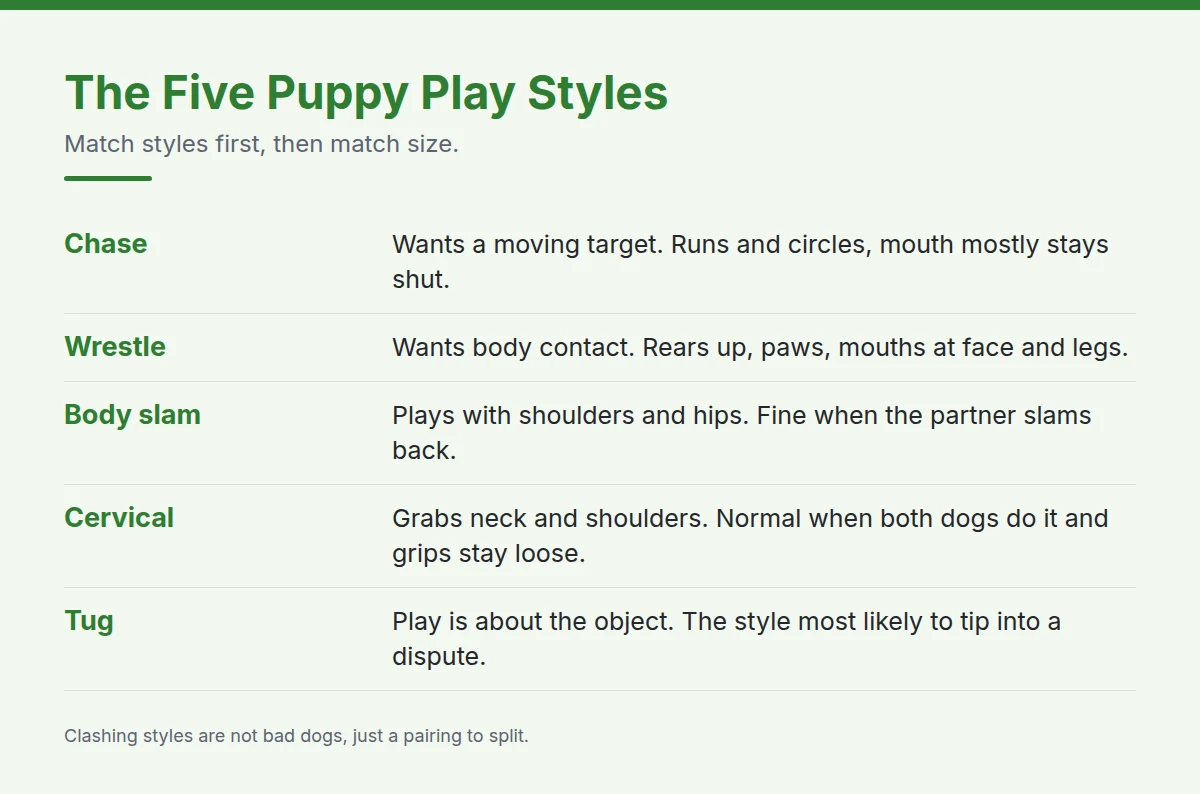
Trainers who run play groups for a living tend to sort dogs into a handful of recognizable styles. Knowing your puppy’s style is the difference between picking a good playmate and hoping.
Chasers want a moving target. They run, circle, herd, and mostly keep their mouths to themselves. Herding and sporting breeds are over-represented here.
Wrestlers want body contact. They rear up, paw, mouth at the face and legs, and do most of their playing in a small patch of ground.
Body slammers play with their shoulders and hips, running past and into a partner. Bully breeds and big retrievers often slam. It looks alarming and frequently is not, as long as the partner slams back.
Cervical players grab and hold the other dog’s neck and shoulders. This is the style that terrifies owners most and is normal between two dogs who are both doing it, mouths loose and grips shifting.
Tuggers need an object. Their play is about possessing, carrying, and being chased for something, and they are the style most likely to tip into a conflict over a resource.
The pairing rule is simple: styles that match, play well; styles that clash, need managing. Two wrestlers are usually delighted with each other. Two chasers run happily for ten minutes. A wrestler paired with a chaser gets a puppy who keeps body-slamming a dog that only wants to run, and the chaser starts flinging out stop signals that the wrestler does not respect. Neither puppy is bad. They are speaking different dialects, and that is a pairing an instructor should split rather than let grind on.
Size is its own axis. The AKC’s guidance on mixed-size play is blunt that the larger the size gap, the greater the risk of accidental injury, even between two friendly dogs playing gently. Compatible temperament and style can carry a size difference; nothing carries a size difference when a Great Dane puppy lands wrong on a Yorkie. If you are running that pairing, read our piece on what the other dog’s body language is telling you alongside this one, because the small dog’s early warnings are the ones most often missed.
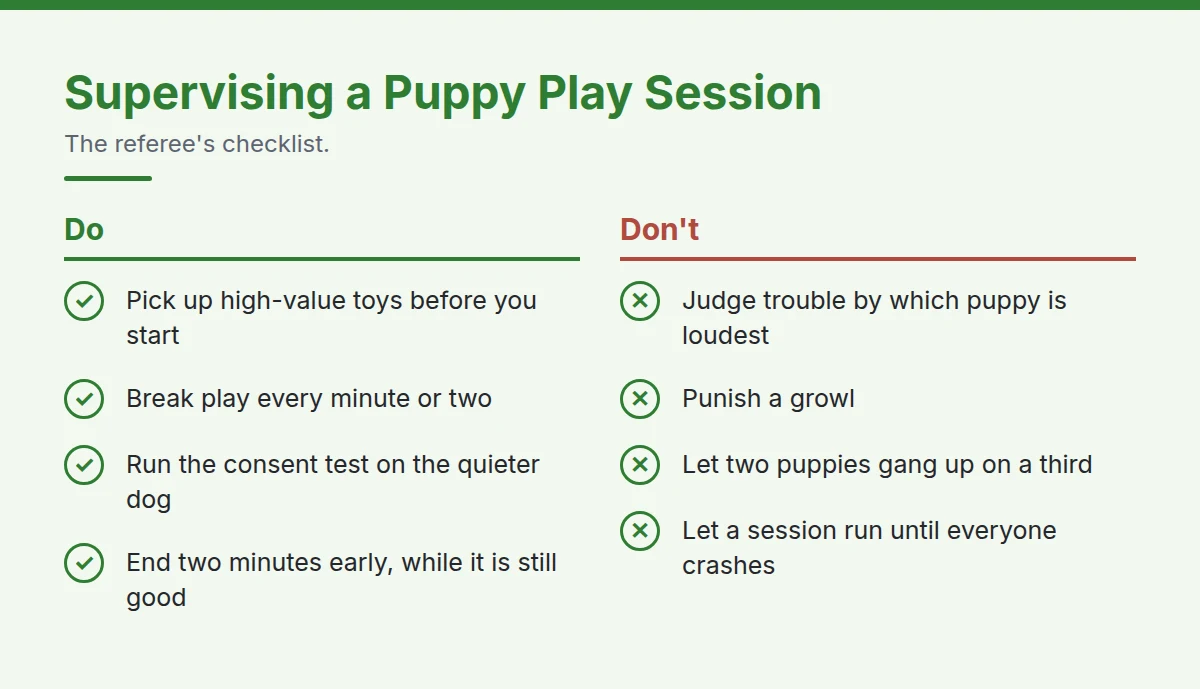
Also pick up the toys before you start. High-value objects are the fastest route from play to a genuine dispute, and if you are going to leave toys out, they need to be big enough that the largest dog present cannot choke on one. Our resource guarding prevention guide covers the underlying work, but the management version is one line: no favorite chews on the floor during a play session.
Two Tests That Answer “Is This Still Fun?”
You cannot read body language continuously for twenty minutes. What you can do is interrupt and let the dogs answer the question for you. There are two distinct tests, and most owners only know the first.
The consent test asks whether the quieter dog wants this. Briefly hold the more forward puppy, by the chest or a harness, for two or three seconds, then let go and watch the other one. A puppy who was enjoying itself bounces straight back in, play bows, or paws at the one you just held. A puppy who was coping rather than consenting will shake off, sniff the ground, walk away, or come stand behind your legs. That answer is not negotiable. If the other puppy does not come back, the session is over, no matter how much the boisterous one wants to continue.
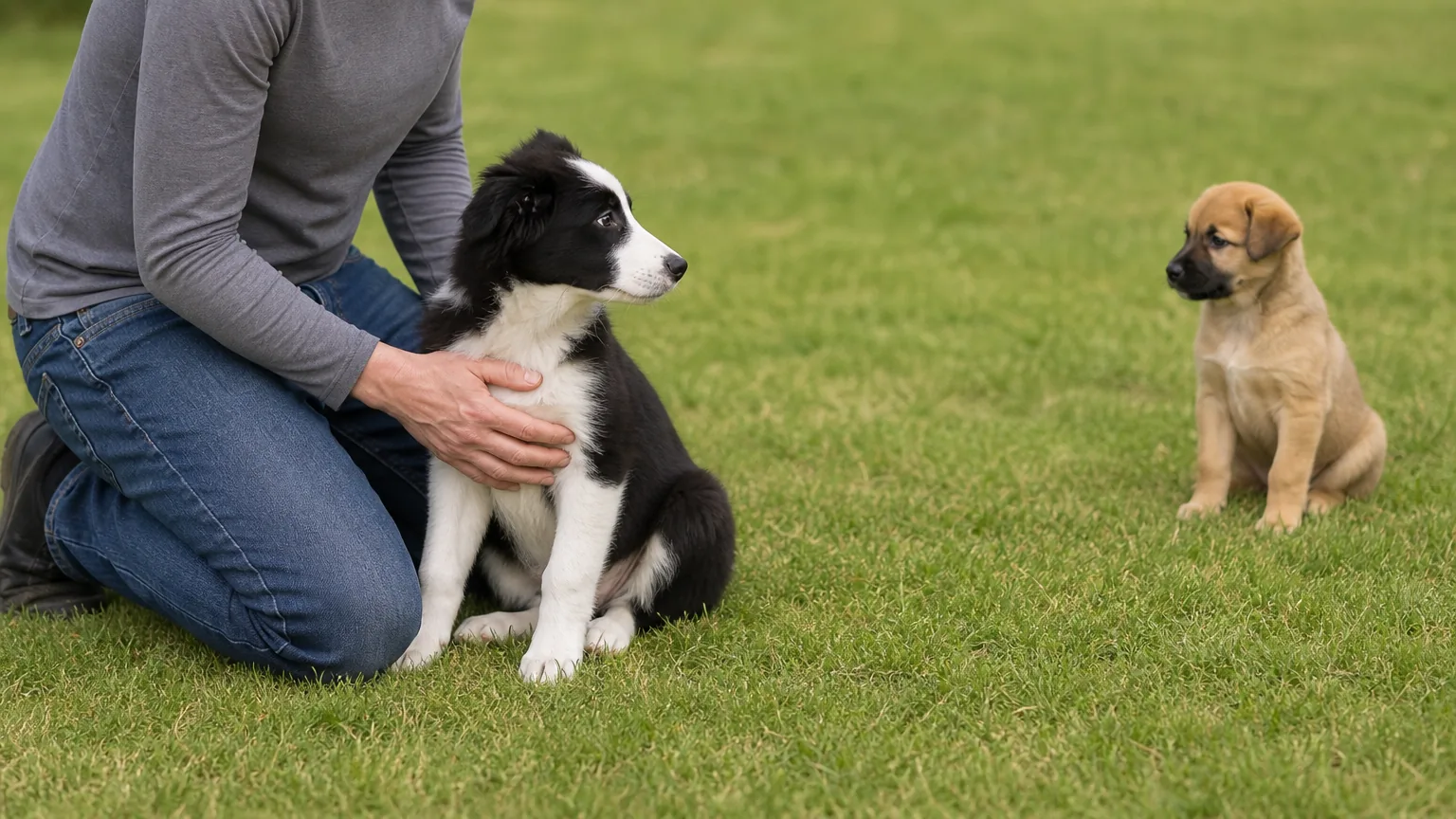
The pause test asks a different question: can both dogs still hear you? Call both puppies out of play, pay them well, and see how long it takes. A puppy who breaks off in a second or two and checks in is still thinking. A puppy who cannot disengage, who ignores a cue it knows perfectly well at home, who takes ten seconds and a body block to notice you exist, has gone past the point where its brain is available. That puppy is not being defiant. It is over threshold, and over-threshold dogs make bad decisions.
Run both, alternating, every minute or two. The AKC makes the same point in its size-mismatch guidance: interrupting play regularly to check that each dog can come back to you is what stops a session from getting out of control, and it gives you a moment to assess each puppy individually rather than watching the blur. Use food carefully in a group, though, and separate any puppy with a guarding history before treats appear.
Arousal Creep: The Signs a Session Should End
Play rarely goes bad suddenly. It creeps. The specific thing to watch for is the disappearance of pauses. Healthy play is punctuated: a few seconds of chaos, a break, a shake-off, a sniff, back in. As arousal climbs, the self-interruptions stop first, and then everything else accelerates.
The list worth memorizing:
- No more pauses. Continuous motion with nobody choosing to stop.
- Faster and louder, with less structure. The play bows and bouncy signals drop out; the running gets straight-line and frantic.
- The mouth stops being soft. Grabs that hold. Yelps that produce no apology and no break.
- Mounting, or a fixed hard stare. Both are arousal spilling over, not dominance.
- Ganging up. Two puppies orienting on a third is the point to end it immediately, whatever the third puppy is doing.
- Tense bodies, pinned ears, raised hackles, or a dog repeatedly trying to leave. These are the signals that come before growling and snapping, not after.
Arousal creep is also where fatigue does its damage. An overtired puppy gets worse, not calmer, and a session that runs until everyone collapses teaches the puppy that play ends in a crash. If your puppy reliably falls apart at the end, our guide to how much exercise a puppy actually needs explains why the tank model misleads people and what an honest activity budget looks like.
The fix is not to end play forever. It is to end this session two minutes before you think you need to, while both puppies are still doing it well.
The Loudest Puppy Is Usually Not the One in Trouble
Here is the thing that makes owners intervene in exactly the wrong place. Some puppies are simply vocal players. They scream, they growl theatrically, they sound like a crime is being committed, and their bodies are loose, bouncy, and repeatedly re-inviting the dog they are apparently being murdered by.
The puppy actually in trouble is usually silent. It has gone still. It is tucked under a chair, or pressed against a human leg, or standing frozen with a closed mouth and a hard little stare while another puppy works on it. Stillness in the middle of motion is the alarm. Noise is just noise until the body says otherwise.
So do not sort by volume. Sort by whether the quiet dog is choosing to be there, which is exactly what the consent test measures.
When Growling and Pinning Are Normal, and When They Are Not
Play growling is normal. It is typically lower, rolling, and comes packaged with a loose body, an open mouth, and play bows. A growl that arrives with a frozen body, a closed mouth, a hard stare, and weight shifted forward is a different message entirely.
Whichever kind you hear, do not punish it. A growl is information, the dog telling you it needs room, and a puppy punished for growling often learns to skip the warning next time and go straight to the snap. Interrupt the situation, not the sound.
Pinning follows the same logic. A puppy briefly pinning another, then getting pinned in turn thirty seconds later, is role reversal and it is fine. Sustained pinning where the bottom dog is struggling to get up, or standing over with a stiff body and no swap coming, is not play anymore. End it before either puppy learns something you will spend months undoing.
The line to escalate is behavior that does not fit this picture at all: a puppy who freezes and then lunges without warning, who cannot recover after a break, who targets a specific dog repeatedly, or who shows real fear rather than over-excitement. That is a conversation with a veterinary behaviorist or a credentialed behavior consultant, not a management problem for the grass at the park.
Building an Off Switch
An off switch is a trained skill, not a temperament a puppy either has or lacks. It is also the part of play management with the best return, because a puppy who can stop is a puppy you can safely let start.
Play in short rounds on purpose. Thirty to sixty seconds of play, then a break. Keep doing it even when nothing is going wrong. The goal is for stopping to be a normal, unremarkable part of the game rather than a punishment that only ever happens when the fun is at its peak.
Recall out of play, then release back into it. This is the single most valuable rep you can bank. Call the puppy, pay it, breathe, then say “go play” and send it back. If coming when called reliably predicts the end of everything good, your recall will rot by adolescence. If it predicts a snack and permission to return, you have made the recall itself rewarding. That only works if your payment genuinely beats the other puppy, which is why it is worth knowing what your puppy actually values before you test it against a playmate.
Have a settle spot. A mat or a bed where the puppy has been taught, in quiet conditions, to lie down and do nothing. Practicing it at home is what makes it available in a noisy room later.
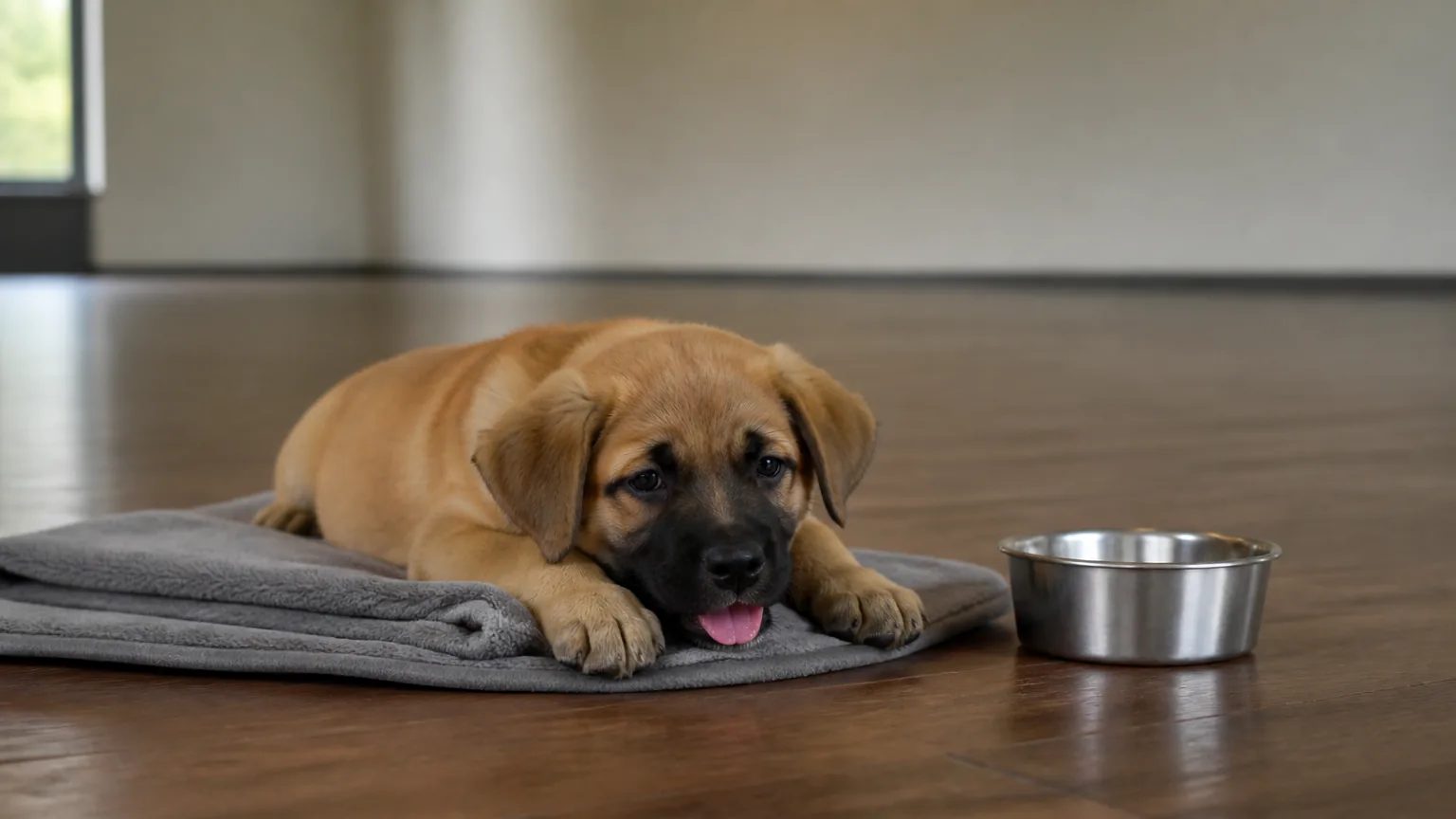
Enforce the nap. Play is expensive. After a good session, a crate or a pen with a chew is not a punishment, it is the part where the learning consolidates, and skipping it is how a decent play session turns into an hour of ankle biting.
Why a Puppy Social Beats the Dog Park at This Age
Both involve off-leash dogs, and that is where the similarity ends. A well-run puppy social, the kind a good class includes, is a curated environment: puppies of similar age and roughly matched size and style, small numbers, vaccination requirements checked at the door, an instructor who splits pairings that are not working and calls breaks before anyone needs them, and a low-stakes exit if your puppy would rather sit this one out.
A dog park is none of that. It is unknown adult dogs of unknown history, no size matching, no referee, no screening, and a single bad thirty seconds during the socialization window can leave a puppy wary of other dogs for years. The risk asymmetry at eight to sixteen weeks is not close. A handful of good, short, well-matched interactions builds more social confidence than an hour of chaos.
When you are choosing between programs, ask specifically how playtime is run: how many puppies, how they are grouped, who is watching, how often they break, and what happens to the puppy who does not want to join. Our guide to picking the right puppy class covers the rest of the vetting, but the play answer is a fast tell. Good instructors referee. The ones who let six puppies loose and chat by the door do not.
If your puppy hides, freezes, or wants out of the room entirely, that is not a puppy who needs more exposure at higher volume. Work at a distance first, on the graded plan in our protocol for the fearful puppy.
Your Adult Dog Is Not the Puppy’s Play Outlet
The most tempting shortcut in the house is the resident adult dog. It is right there, it is free, and for the first week it may even seem to work.
It is a bad plan for three reasons. The adult did not volunteer, and a tolerant dog absorbing a needle-toothed puppy for weeks is being worn down, not entertained. Tolerance is finite, and when it runs out the correction tends to be sudden and disproportionate to what the puppy did. And the puppy learns the wrong lesson either way: either that pestering works, or that other dogs are frightening.
Your adult dog gets to be a role model, an occasional short playmate, and a dog with a gate it can go behind. Same-age puppies and structured class play are where the play budget should be spent. Manage the pair actively, keep sessions brief, and give the older dog a place the puppy cannot follow.
The Short Version
Watch for pauses and role reversal. Match styles, then match size. Run the consent test on the quieter dog and the pause test on both. Sort by bodies, not volume. End it early, teach the recall out of play, and enforce the nap afterward. That is the whole job, and it is a learnable one.
Further reading (sources)
- American Kennel Club on what makes play between big and small dogs safe or risky
- American Kennel Club for its guidance on supervising puppy play sessions
- Behavioural Processes on why dogs keep playing into adulthood and how the types differ
- Animals for welfare-led thinking about how dogs are selected and grouped
- Peer-reviewed research with why play does not always signal a positive emotional state