The First Eight Weeks You Didn't See: How Early Life Decides How Puppy Class Goes
Published on September 8, 2026

Put two ten-week-old puppies in the same class on the same night and you will often watch two completely different animals. One trots in, sniffs the mats, takes food from a stranger in the first minute, and startles at the door buzzer for about a second before going back to work. The other flattens at the threshold, will not eat, and spends the hour behind its owner’s legs. Same age, same breed sometimes, same instructor, wildly different starting line. Owners tend to explain the gap with personality, and personality is real. But a large share of that difference was set before either puppy ever met them, in eight weeks nobody in the room witnessed.
Three Stages Before Pickup Day
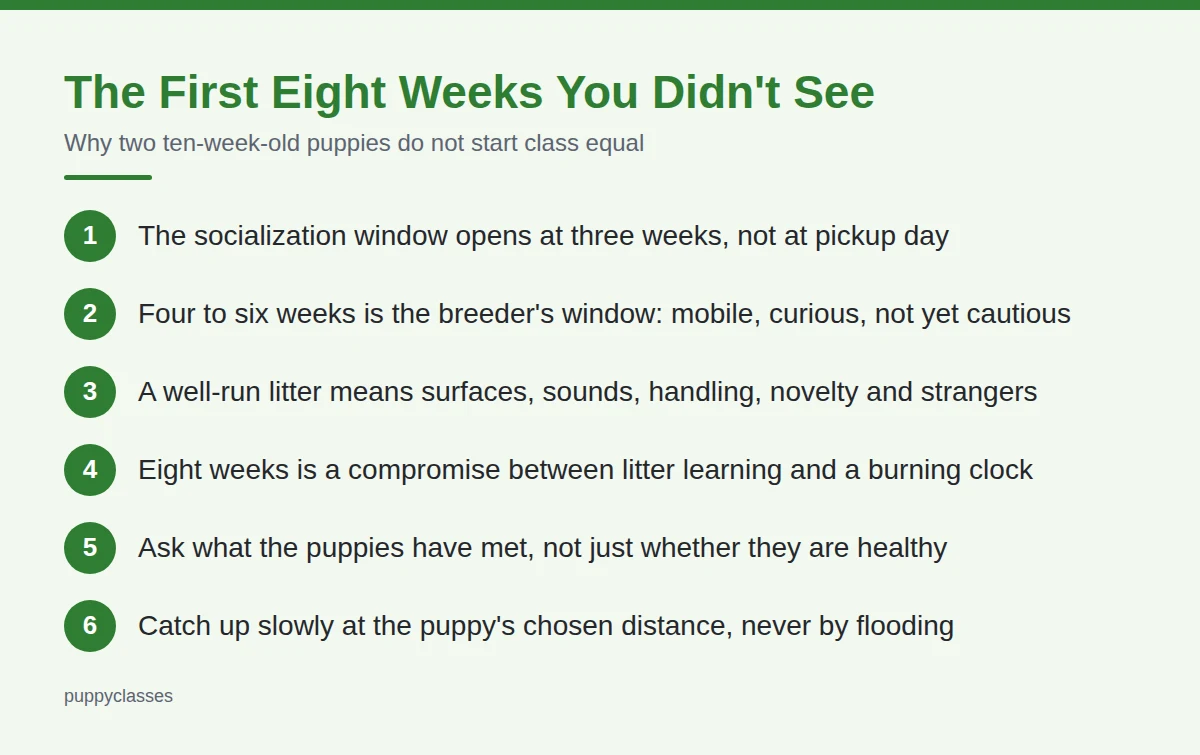
The classic developmental map, laid down by Scott and Fuller’s mid-century work at the Jackson Laboratory and still the backbone of how behavior professionals think about puppies, splits those weeks into stages that look nothing alike.
The neonatal period, roughly birth to two weeks, is a sealed box. Eyes and ear canals are closed, the puppy cannot regulate its own temperature, and its world is warmth, milk, and the smell of its mother. It is easy to assume nothing that matters can happen here. That is not quite right: gentle handling and mild stress during this stage appear to nudge stress-response systems in a useful direction, which is the reasoning behind the structured neonatal handling protocols many breeders run.
The transitional period, roughly two to three weeks, is a fortnight of switches flipping. Eyes open, ears open, the first wobbling steps happen, teeth appear, and the puppy starts to eliminate without the dam’s prompting. Sound and sight arrive as raw sensation.
Then, somewhere around three weeks, the socialization period opens, and it is the one that matters most for who your puppy becomes. From about three to roughly twelve to fourteen weeks, the brain is unusually ready to file new things as normal. What a puppy meets in this stretch, and how it feels while meeting it, becomes the baseline against which everything later is judged. Most of that window is not yours. Roughly the first five weeks of it belong to whoever is raising the litter.
The 4-to-6-Week Period Belongs to Someone Else
Ask a breeder-side trainer which two weeks they would protect above all others and many will say four to six. By four weeks a puppy can see, hear, walk, and investigate, and it is still young enough to be genuinely fearless. The mild caution that shows up later has not arrived yet. That combination, mobile plus unafraid, does not last long, and it is the cheapest window anyone will ever get for building an optimistic dog.
A litter given nothing during that fortnight is not neutral. Sensory input is what wires the developing brain, and a puppy raised in a plain pen with a single floor surface, one set of human hands, and no novelty is learning something too: that the world is a small, quiet, predictable place. Then it turns eight weeks old, gets into a car, and everything is new at once.
What a Well-Run Litter Actually Looks Like
The good news is that this work is unglamorous and cheap. A breeder or foster doing it well is not running a facility. They are being deliberate about ordinary things.
- Surfaces. Puppies walk on grass, gravel, tile, carpet, a wobbly board, a rubber mat, wet ground. Footing confidence built here shows up years later on vet tables and metal stairs.
- Sounds. Vacuum, hairdryer, doorbell, thunder recordings played low, kitchen clatter, a television. Volume kept low enough that puppies keep playing.
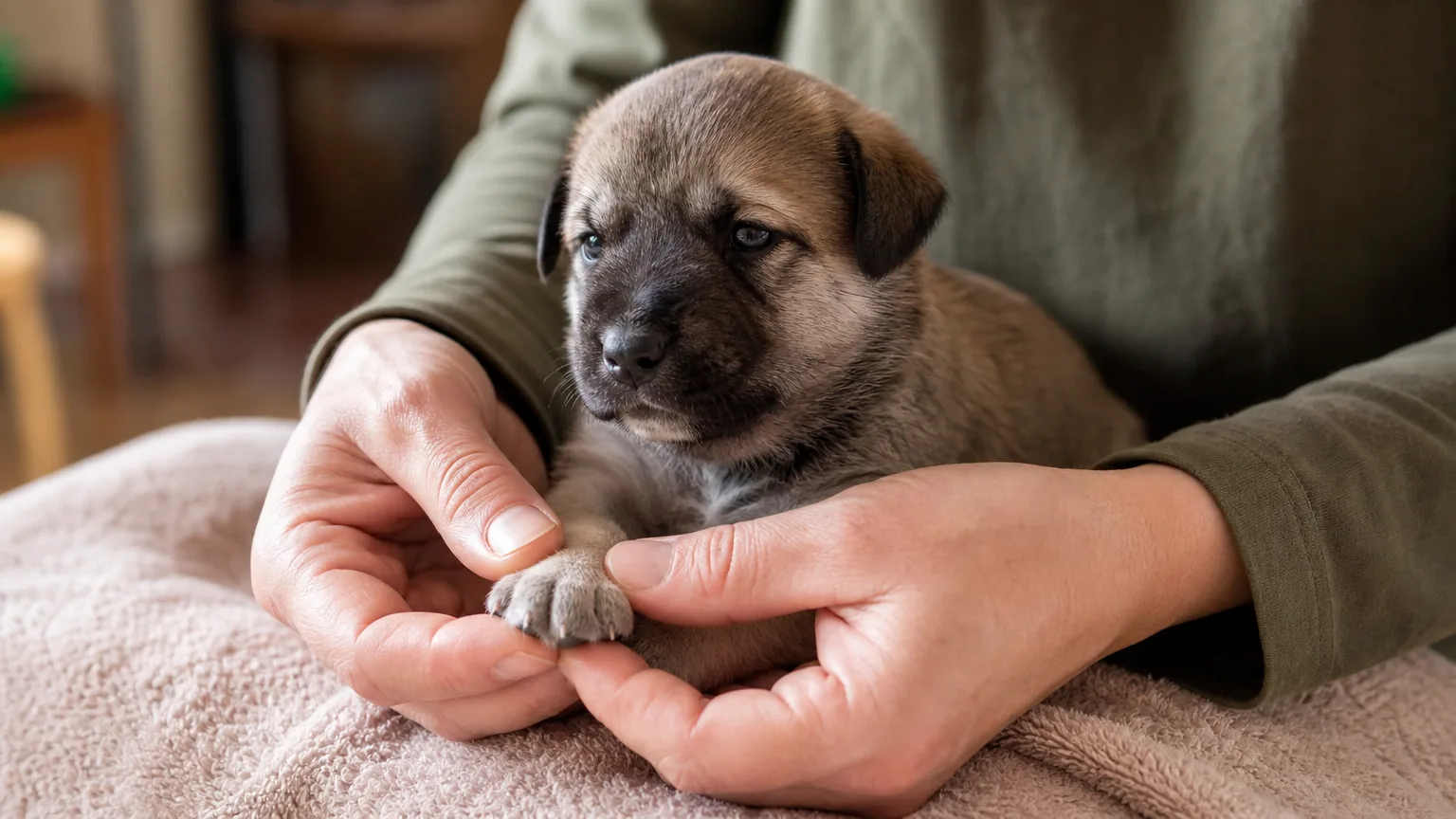
- Handling. Daily, by more than one person. Ears, paws, mouth, belly, brief restraint, nail tips touched with clippers before any nail is cut.
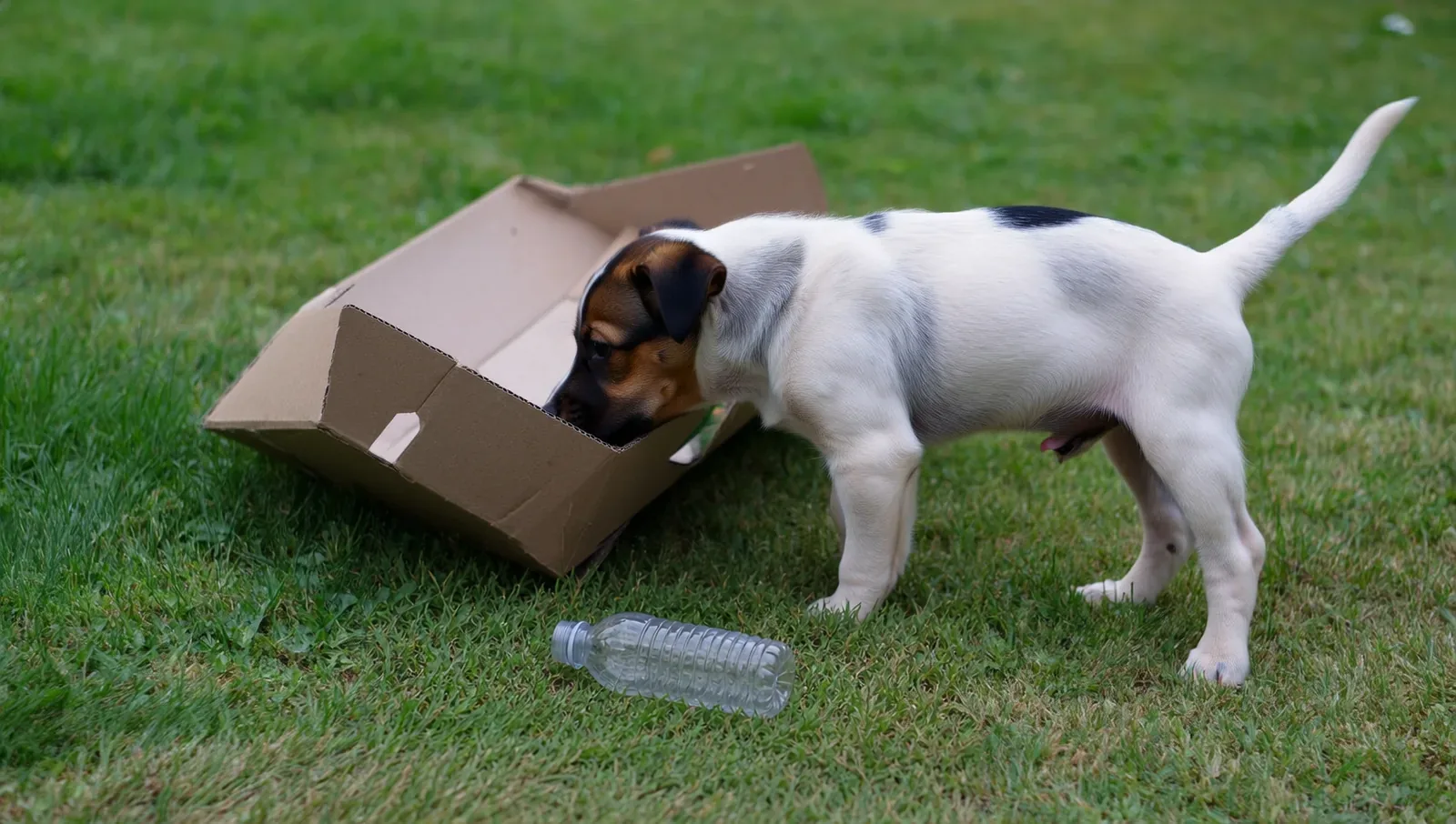
- Novel objects. Something new in the pen most days. A cardboard box, an upturned laundry basket, a crinkly bag, a plastic bottle, an exercise step to climb.
- Strangers. People who are not the breeder: different heights, voices, hats, beards, walking aids, and ideally a calm child.
- Separation. Short solo stints away from littermates, minutes at a time, so that being alone is not first experienced on night one in your kitchen.
- Crate and potty. A crate propped open in the pen as furniture rather than a punishment box, and a litter area separated from the sleeping area so puppies build a substrate preference before they arrive.
That last one is the sleeper. A litter raised with a dedicated potty surface arrives already inclined to leave the nest to eliminate, which is most of what housetraining is. It also means the puppy has met a crate before the crate is also a new house and a missing family. If that has not happened, a step-by-step home crate routine does the job from scratch, it just takes longer.
Why Eight Weeks Is a Compromise, Not a Rule
Owners often treat eight weeks as a biological fact. It is closer to a negotiated settlement between two needs pulling in opposite directions.
Staying with the litter longer is how a puppy learns dog. Bite inhibition comes from littermates yelping and quitting the game, and the dam teaching a puppy to accept being told no is a social skill no human can deliver as well. Leaving too early, at five or six weeks, correlates with more problems later, and many jurisdictions set a legal floor at eight weeks for exactly that reason.

Pulling against that: the socialization window is burning. Every week a puppy stays is a week of first meetings not happening in the home it will actually live in. Eight weeks lands where it does because it is late enough for reasonable litter learning and early enough to leave you a real slice of the window. Some breeders of very sensitive or slow-maturing breeds hold to ten or twelve weeks, and that can be the right call, but only if they are doing genuine outings and stranger work in the extra time. A puppy that stays until twelve weeks in an unchanged back room has spent the best of its window on nothing.
Questions Worth Asking Before You Commit
You are not auditing anyone. You are asking a few specific questions whose answers a good breeder or foster gives without hesitation, because they are proud of them.
- Where do the puppies spend their day, and can I see it?
- What sounds and surfaces have they met? What was new in the pen this week?
- How many different people have handled them, and have any been children?
- Has anyone been separated from the litter yet, even for a few minutes?
- Have they seen a crate? Where do they go to the toilet?
- Have they ridden in a car or been outside the property?
- Are the parents on site, and can I meet the dam?
- What have you noticed about this particular puppy compared to its siblings?
The last one matters more than people expect. Somebody who has watched a litter for eight weeks knows which puppy recovers fast from a surprise and which one broods, and that is worth more than any temperament test conducted in ten minutes by a stranger. Answers that are vague, defensive, or that route you to a parking lot handoff are information too.
Shelter and Foster Puppies Are a Different Problem
None of this is a case for buying rather than adopting. Plenty of shelter puppies land in class ahead of pedigreed ones, and a good foster home routinely out-socializes a mediocre breeder. What changes with a rescue puppy is what you can know. History is often partial or absent, the first weeks may have been spent somewhere with no novelty at all, and transport, kenneling, and illness can each eat into the window.
Ask the foster the same questions, since the person who had the puppy on their sofa usually has real answers. Then assume less and observe more. A puppy coming out of a shelter environment also needs a decompression stretch before you start filling the calendar, which is its own piece of work.
How a Thin Start Shows Up in Class
It rarely looks like fear in the obvious sense. More often it looks like:
- Refusing food. The single most reliable tell. A puppy that will not eat chicken in the room is over threshold, not stubborn.
- Startling at ordinary noise and taking a long time to come back, rather than the one-second flinch and recovery.
- Floor refusal. Sticking to one surface, balking at the rubber mat or the shiny entry.
- Not knowing how to play. Either bulldozing other puppies with no read on their signals, or freezing when approached, both consistent with limited littermate time.
- Tension around food and chews. A litter that competed hard over one shared bowl can produce a puppy quicker to stiffen over a chew, which is worth heading off early rather than waiting.
- Panic at handling. Paws and ears in particular, if nobody ever touched them.
- Nothing at all for three weeks, then everything at once, as the puppy finally relaxes enough to show you what it thinks.
None of these mean the puppy is broken. They mean the puppy is starting further back on a specific axis, and that axis is what you work on. Learning to read the stress signals in real time is what tells you which one you are looking at.
Catching Up Without Flooding
The instinct when you realize your puppy missed things is to make up the deficit fast. That instinct is wrong and it is the most common way an owner turns a slow start into a lasting fear. Flooding, holding a puppy in the presence of something frightening until it stops reacting, does not produce a confident dog. It produces one that has learned struggling does not work.
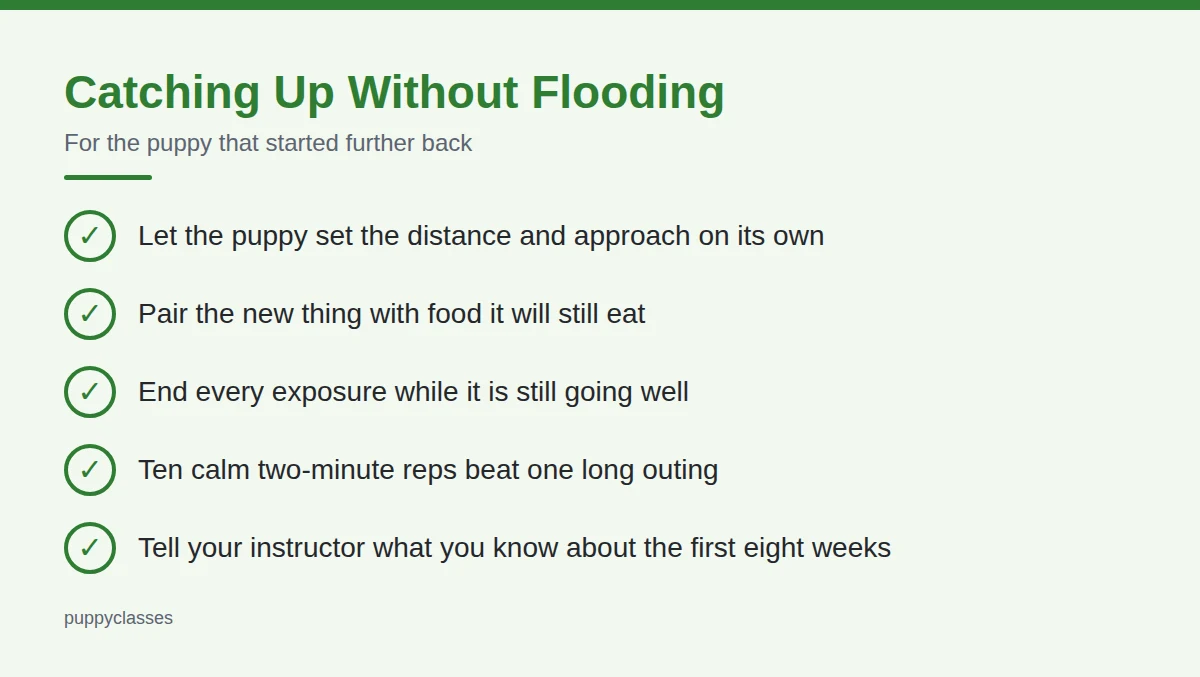
The version that works is slower and duller. Let the puppy choose the distance and let it approach on its own; every exposure ends while it is still going well. Pair the new thing with food at a distance where food still gets eaten, which is the whole of desensitization and counterconditioning in one sentence. Trade breadth for depth: ten calm two-minute exposures beat one thirty-minute outing. Find out what your puppy will actually work for first, since kibble is not going to cut it in a hard room. And tell your instructor what you know about the first eight weeks, because a good one will change where you park your mat and how much space they give you.
Progress is uneven. A puppy that spent five weeks in a bare pen may need a month to reach where a well-raised littermate started, and that is a normal cost of the gap, not evidence you are doing it wrong. A well-chosen class is still the highest-value thing on the calendar, which is why how you pick that class matters more for this puppy than for the confident one.
When It Is More Than a Slow Start
Some of what gets blamed on a poor first eight weeks is not catching up. Fear that generalizes faster than you can counter it, fear directed at the family rather than outside triggers, growling or snapping when handled, or a puppy that cannot recover in a quiet room all warrant a board-certified veterinary behaviorist rather than another six weeks of patience. Early deprivation is a genuine risk factor for anxiety disorders, and the same window that makes a young puppy so easy to help also means intervention pays off most now.
For everything short of that, the honest summary is this: you inherited a starting position you did not choose and cannot change. What you can change is the next eight weeks, and those turn out to count for a great deal.
Further reading (sources)
- American Kennel Club on why the four-to-six-week stretch is the breeder’s job
- American Kennel Club for early development exercises to run with a litter
- American Veterinary Society of Animal Behavior with the case for socializing before the vaccine series ends
- American Veterinary Medical Association on the literature review behind puppy socialization practice
- American Veterinary Medical Association for the sensitive period and when exposure should begin