Why Your Puppy Sits in the Kitchen But Not the Park: Generalizing Cues Beyond the Classroom
Published on September 2, 2026
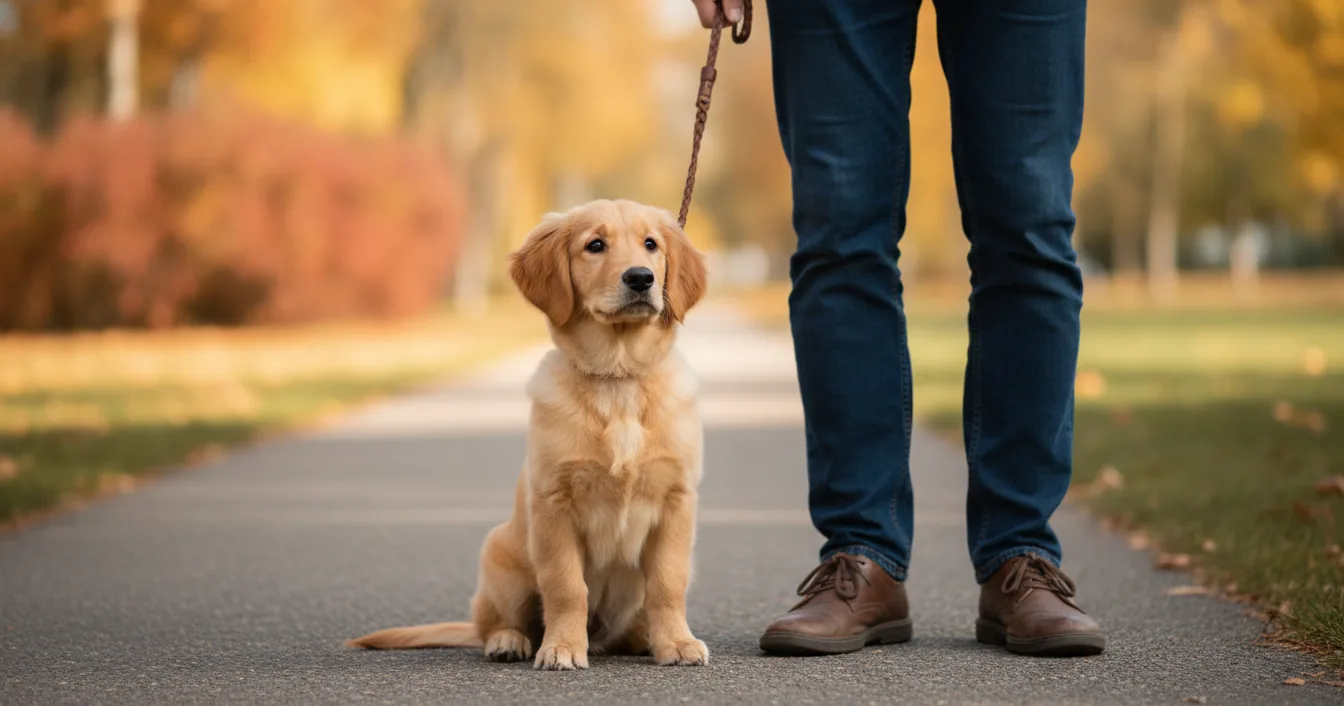
Graduation night at puppy class comes with a small ceremony and a large misunderstanding. Your puppy sits on the first ask, lies down on a hand signal, holds a stay while you count to ten. Four days later you are standing on a pavement outside the corner shop saying “sit” to a puppy who is looking at a pigeon like the two of you have never met.
The conclusion almost every owner reaches at that moment is that the puppy knows the cue and has decided not to bother. It is the single most common complaint trainers hear from graduates of their own classes, and it is almost never true. What you are watching is not defiance. It is a training design problem, and it has a fix that fits inside a week.
Dogs Learn Specifically, Not Abstractly
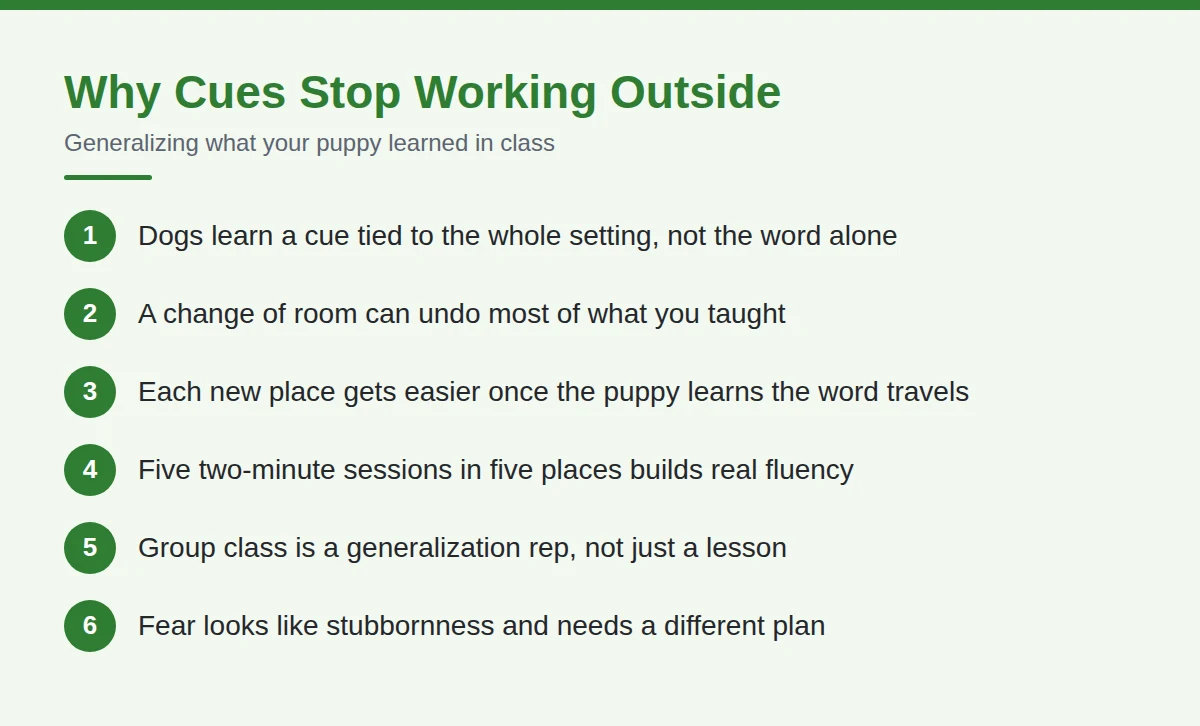
The American Kennel Club put the point plainly in a piece this August: dogs are very specific when learning. Teach a dog to roll over in the living room and they conclude that “roll over” means do that thing, in here, on this carpet. It is not that the concept failed to stick. It is that the concept your puppy formed was never the abstract one you had in mind.
Humans generalize almost involuntarily. We learn “chair” once and recognize a beanbag, a stool and a park bench as members of the club. Dogs do not extend categories that freely, and a young puppy least of all. When you cue a sit in your kitchen, your puppy files the whole picture: the word, your posture, the fridge hum, the grippy floor under their back feet, the fact that you are standing at a particular angle in a room with no other dogs in it. All of that is part of what they learned, because nobody told them which parts were the important bits.
Change the room and you have changed a great deal of the cue. The word survived. Almost nothing else did.
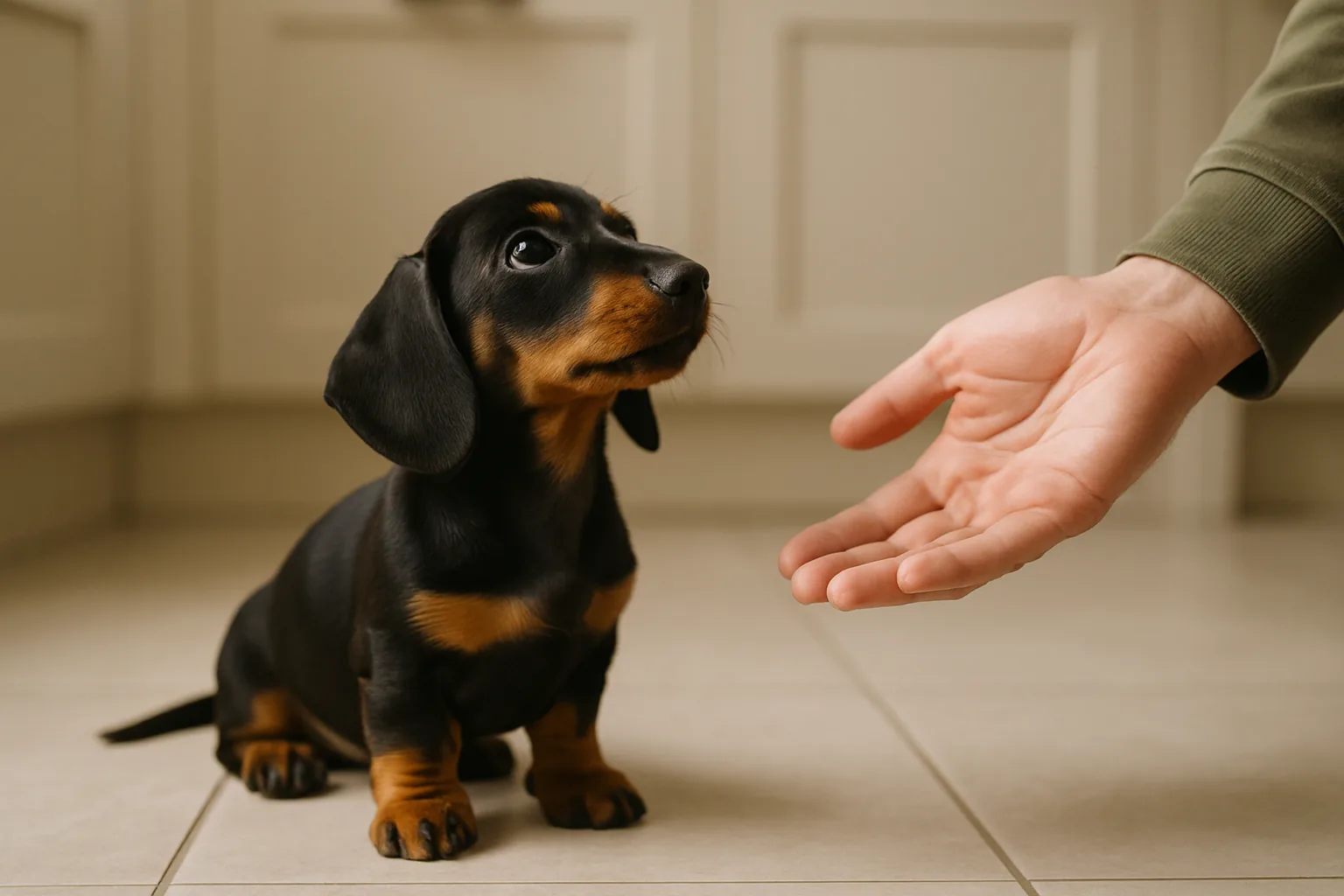
This is the same mechanism behind a visible treat becoming part of the instruction, which is the other half of the same AKC article and a problem I have written about separately in the difference between a bribe and a reward. A compound cue is a compound cue whether the extra ingredient is a sausage in your fingers or a kitchen wall behind your shoulder. Take away any load-bearing piece and the behavior wobbles.
Each New Place Is Closer to Starting Over Than You Expect
Here is the part that owners find genuinely disheartening for about three days: in a brand new environment, you are not at ninety percent of where you were. You are closer to the beginning than that. Expect the first sit in a new place to need the food back in play, a bigger hand signal, and a good deal more patience than the version you were proud of at home.
The encouraging half is that the deficit shrinks fast. The first new location is hard. The second is a bit easier. By the fourth or fifth, most puppies have worked out something more useful than any individual sit: they have learned that the word means the same thing regardless of the scenery. Trainers sometimes call this learning to generalize, and it is a skill in itself. Once a puppy has it, new places stop resetting the behavior and start being merely distracting, which is a much smaller problem.
So the goal of the week ahead is not to teach sit five more times. It is to teach your puppy that where they are is not part of the instruction.
A Five-Location Week
Run this with one cue at a time. Sit is the usual candidate because it is the most fluent. Five to eight reps per location, two minutes at most, and stop while it is still going well.
Day one, a different room. Not the kitchen. The hallway, the bedroom, upstairs. This sounds insultingly easy and it is deliberately so. You want the first rep of the experiment to succeed.
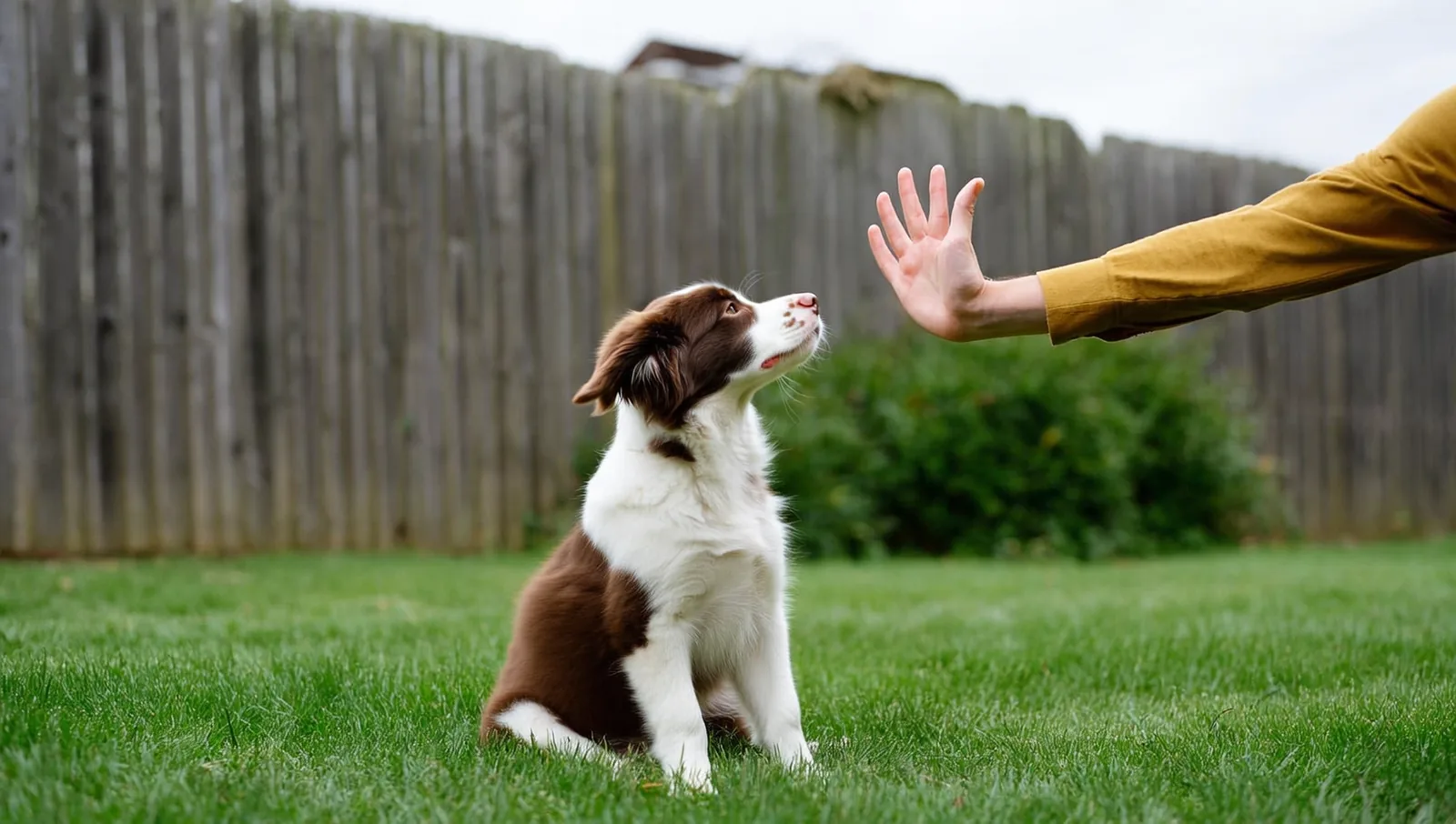
Day two, the garden or the hall outside your door. Outdoor smells, outdoor light, wind. Same cue, food back in the picture, generous pay.
Day three, the front step or driveway. Now there is traffic noise and passing strangers, and the puppy can see the street. This is where most owners get their first honest failure, and it is the most useful one of the week.
Day four, a quiet stretch of path. A park at an empty hour, a residential street with no shops. Do the reps mid-walk rather than making a production of it.
Day five, somewhere genuinely busy. Outside a cafe, near a school at pickup, a car park. Cut your expectations in half before you arrive.
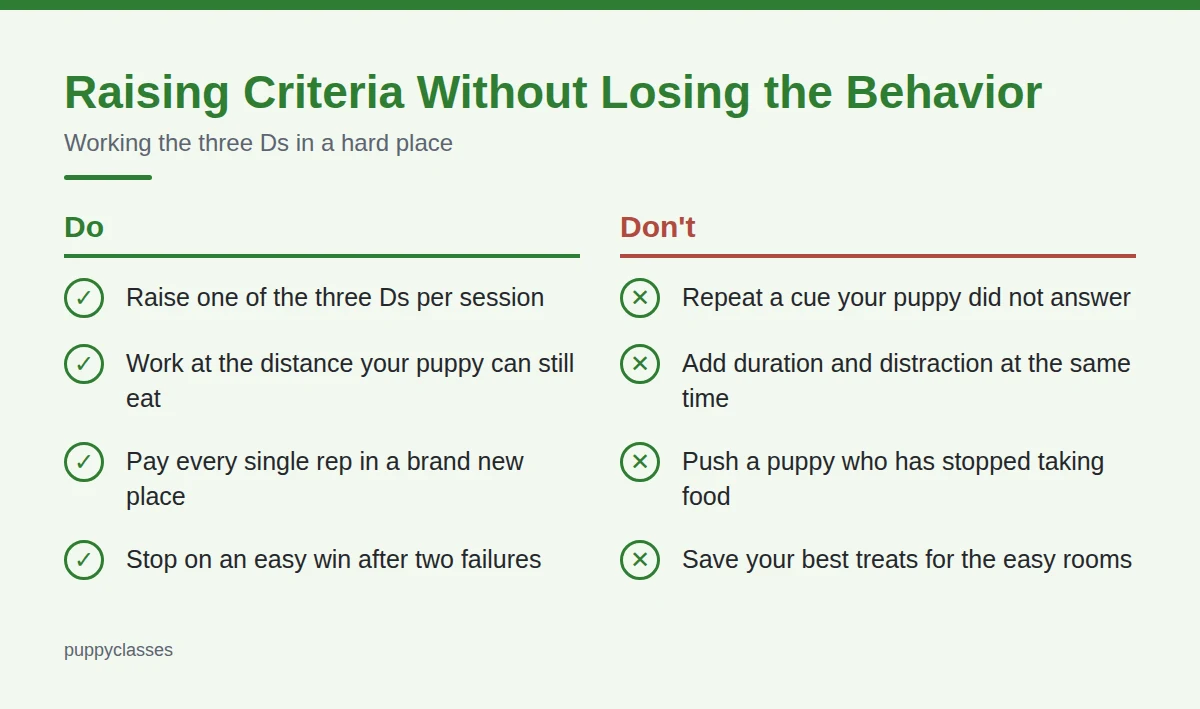
Two rules make the difference between this working and this being five days of frustration. Change one thing at a time, so a new location means an easy version of the behavior rather than a new location and a longer duration and a further distance all at once. And go back to paying every single rep in every new place, generously, with the good food rather than the kibble. New environment, new learning, full paycheck. If you are not sure what counts as good food for your particular puppy, a ten-minute preference test at the kitchen table will rank it for you and is worth more than another week of guessing.
The Three Ds, and Why You Only Move One
Trainers describe difficulty along three axes, and having names for them is what turns “it went badly” into a plan.
Distance is how far you are from the puppy when you cue, and separately, how close the distraction is. A sit at arm’s length is a different behavior from a sit with six feet of leash between you.
Duration is how long the puppy has to hold it. Three seconds of stay is not eighty percent of five seconds. It is its own skill.
Distraction is everything else in the environment competing for attention: another dog, a jogger, food on the ground, a child on a scooter, the smell of somebody’s barbecue two gardens over.
The rule is that you raise one and drop the others. If you are adding distraction by working outside the pet shop, then you stand right next to your puppy and ask for a one-second sit. If you want to build duration to fifteen seconds, do it in your living room with nothing happening. The classic owner mistake at graduation is to keep all three at their classroom values, take them to the park, and read the resulting collapse as attitude.
Distraction has a second dial worth knowing: intensity, which usually just means distance. A dog two hundred feet away across a field is a different animal from the same dog at ten feet. You do not have to choose between practicing near the distraction and not practicing at all. You choose the distance at which your puppy can still take food and still hear you, and you work there.
Drop Criteria Early, and Without Apology
When it falls apart, the useful reflex is to make the task easier rather than to repeat the failed version louder. Say the cue once. If nothing happens within a couple of seconds, do not say it again, because a repeated cue teaches the puppy that the first one is optional. Instead, help. Bring back a bigger hand signal, take two steps further from the distraction, shorten the duration to nothing, put the food back where the puppy can smell it.
This feels like backsliding and it is not. A puppy who succeeds three times in an easier version of a new place has learned that the word works here. A puppy who fails six times in the hard version has learned something too, and it is not what you wanted.
The three-strikes habit is a good one: if you get two failures in a row, the environment has beaten your criteria, and the third rep should be an easy one you are confident of, followed by leaving on a win. There is no prize for grinding.
Watch the puppy rather than the clock while you do it. A puppy who is distracted is busy, offering behaviors, glancing between you and the interesting thing. A puppy who has shut down is a different picture: sniffing the ground fixedly, turning away, refusing food they would take at home. Refusing food outdoors is a signal, not stubbornness, and the stress signals worth learning to read will tell you which one you are looking at. Distraction means make it easier. Shutting down means leave.
Group Class Is Itself a Generalization Exercise
This reframes what a good puppy class is actually for. Owners often assume the value is in learning sit, and then feel short-changed when the instructor spends week four on the same three cues from week two.
The point is that a training hall is a hard room. Six other puppies, a slippery floor, unfamiliar smells, a stranger at the front talking. Performing a known behavior in that environment is a generalization rep, and it is the part you cannot easily replicate at home. Your puppy is not there to learn sit. They are there to learn sit here, which is a different and more valuable lesson.
It also explains a persistent disappointment with training that happens somewhere else entirely. A puppy who spends three weeks at a board-and-train facility generalizes beautifully to that facility, with that handler, on that surface. What comes home is a dog who has learned a great deal in a context you do not live in, which is one of several reasons to ask hard questions before handing your puppy over to anyone who takes custody of them. Generalization is not a thing that can be done for you. It is done in the places you go.
When It Is Not a Generalization Problem
Two exceptions matter, because the plan above is the wrong medicine for both.
The first is adolescence. Somewhere between five and twelve months, well-generalized behaviors get patchy again, recall gets creative, and the puppy who was solid in November looks untrained in March. That is developmental rather than a hole in your training. Go back to easy versions, pay well, keep the leash on in unfenced places, and wait it out.
The second is fear. A puppy who will not sit on the high street because they are frightened of the high street does not need proofing reps. Pushing a worried puppy through a distraction ladder makes the fear worse and the behavior no better. Freezing, tucked tail, refusing high-value food, trying to leave: that is a puppy over threshold, and the work is graded exposure paired with food rather than obedience practice. If the fear is intense, generalizing across contexts, or tipping into growling and snapping, that is the point to involve a veterinary behaviorist rather than another class.
The Honest Timeline
Full generalization of a single cue takes most puppies somewhere between five and a dozen locations, and the cues you care about most, recall above all, need the most. That is a few weeks of two-minute sessions folded into walks you were taking anyway, not a project.
What you get at the end is worth being precise about. Not a dog who performs perfectly everywhere, because that dog does not exist in a world containing squirrels. A dog for whom the word carries the same meaning in the kitchen, on the pavement, at the vet and in the middle of a field. That reliability is built by deliberately practicing in the places where it currently fails, one variable at a time, with the food back in your hand and no hard feelings about it.
Further reading (sources)
- American Kennel Club on why a dog who only listens with treats also only listens at home
- American Kennel Club for what consistency across handlers and settings really requires
- Peer-reviewed research on the efficacy and efficiency of reward versus mixed methods
- AAHA for reading a dog that has tipped over threshold