Big Puppy, Little Puppy: Making Size-Mismatched Play Safe in Class and at the Park
Published on October 3, 2026
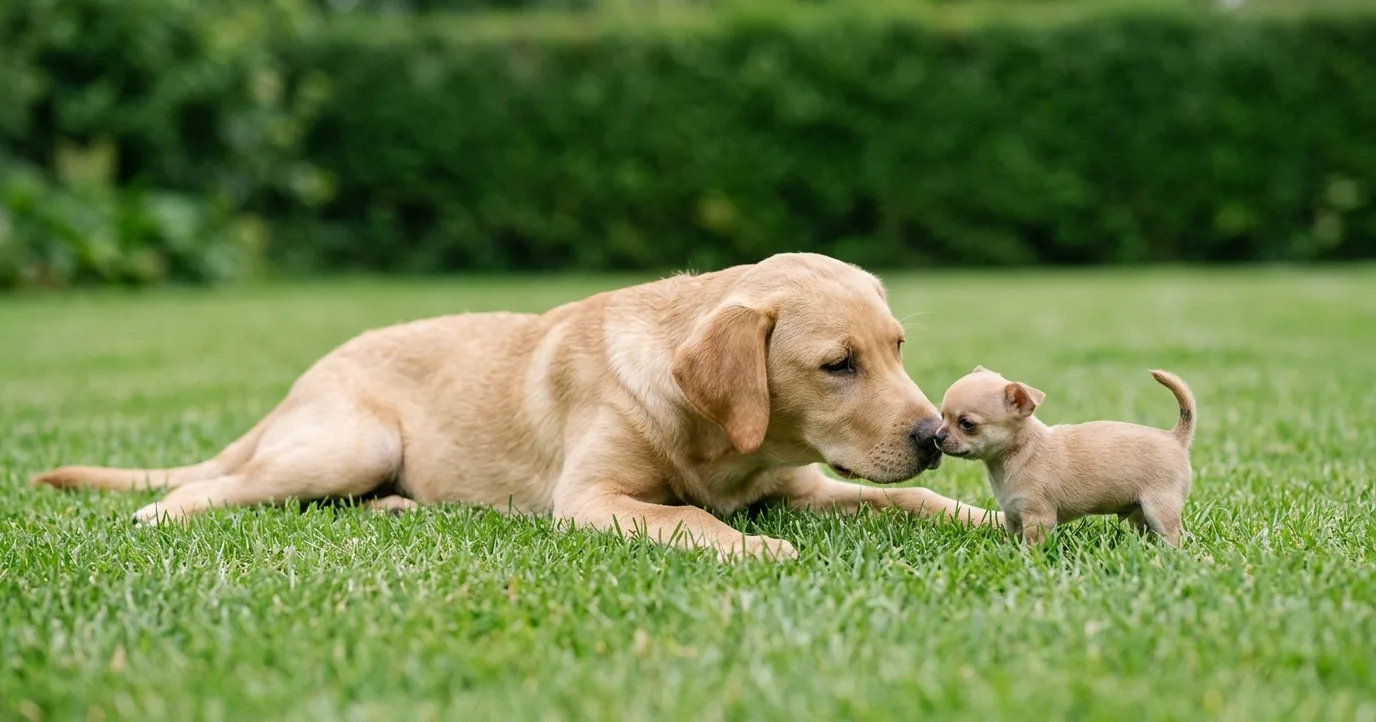
Look into the play pen at a typical puppy class and you will find every size the breed books have to offer. A four-pound Chihuahua cross who would fit in a coat pocket. A forty-pound Lab mix at five months, all legs and good intentions. Both are friendly, both were born the same spring, and on most enrollment forms that is where the matching stops.
Nobody in that pen means any harm, and that is exactly the trap. When mismatched play goes wrong it is rarely aggression. It is physics, a body ten times heavier landing in the wrong place, and, far less often but far worse, predatory drift: the moment a squeal or a frantic sprint flips a friendly big puppy from playing at chasing to actually chasing. The AKC’s guidance on mixed-size play, updated by a certified trainer in August 2026, is plain about the first part. The bigger the size gap, the greater the risk of injury, even when the two dogs get along and play gently.
The usual puppy-class reassurance is that baby teeth cannot do serious damage, and for bites that is mostly true, at least while everyone in the room still has them. Size is not a teeth problem. This guide covers what changes when the puppies are mismatched: how good instructors group them, how to tell a small puppy who is enjoying the game from one who is enduring it, and what each owner should be doing before anything goes wrong.
Why Size Is Its Own Safety Variable
Start with the arithmetic. A forty-pound puppy has ten times the mass of a four-pound one, so at the same speed it carries ten times the energy into whatever it runs into. Between matched partners, a body slam is a move in the game. Between partners ten times apart, it is a collision. Big adolescents make this worse, because they are growing faster than their coordination and have not yet worked out where their own feet are.
The small puppy’s skeleton is the other half of the equation. Forearm fractures are a recognized toy-breed injury. A German study that scanned 70 forearms found that toy breeds have thinner, less dense bone in the radius and ulna than other small dogs, with Chihuahuas at the fragile end, which the authors suggest helps explain why these breeds break their forelegs more often. A Japanese engineering model built from CT scans simulated a jump down from 40 centimeters, about coffee-table height, and found much higher peak stress in a toy poodle’s forearm than in a dachshund’s. One awkward landing, or one big paw arriving at the wrong moment, can be enough.
And when play does tip over into a real scuffle, size decides how bad it gets. Veterinary trauma literature has a label for these cases, “big dog, little dog” injuries; one JAVMA study compared 160 small dogs hurt in fights with larger dogs against dogs injured in other kinds of fights. In a registry of more than 12,000 dogs treated for bite wounds at veterinary trauma centers, published in 2026, the large majority survived, about 95 percent. But the dogs that did not survive averaged about 19 pounds, against roughly 39 for those that did, and the authors offer the plain explanation: a heavier dog is harder to overpower and harder to get a grip on.
None of this means a big puppy and a small one can never play. It means the margin for error is thinner, so the structure around their play has to be tighter.
Predatory Drift: When the Chase Stops Being a Game
Dog play is built from borrowed parts. Researchers at the University of Bristol who study why adult dogs keep playing note that in carnivores, play is assembled mostly from the movements of hunting, fighting and courtship: the stalk, the chase, the pounce, the grab and the shake. In play, each one is performed loosely, broken up with pauses and role swaps and signals that say none of this is serious.
Predatory drift is the trainers’ term for when those borrowed parts stop being borrowed. Writing for Vetstreet, trainer Mikkel Becker lays out the usual triggers. The smaller dog starts acting like prey, by yelping, struggling or running away, and the larger dog’s play slides into the real sequence. The yelp can come from something as ordinary as being stepped on. A chase that began as a game turns faster and more serious and can end in a take-down. And the grab-and-shake that every owner has seen a dog perform on a plush toy is, as she puts it, capable of breaking a small dog’s neck.
Three features make drift dangerous out of all proportion to how often it happens:
- It can surface in dogs who have never shown it. Becker is clear that the vast majority of dogs never act predatory toward other dogs, but the right circumstances can spark it in a dog with a spotless record. “They have played together for weeks” is not a safety plan.
- Groups multiply it. Several dogs chasing one is the classic setup. Two big puppies converging on one small puppy is a configuration to break up on sight, whatever the small one seems to think of it.
- It gives little warning. Predatory behavior often arrives with very few warning signs, which is why prevention matters more than trying to read it live.
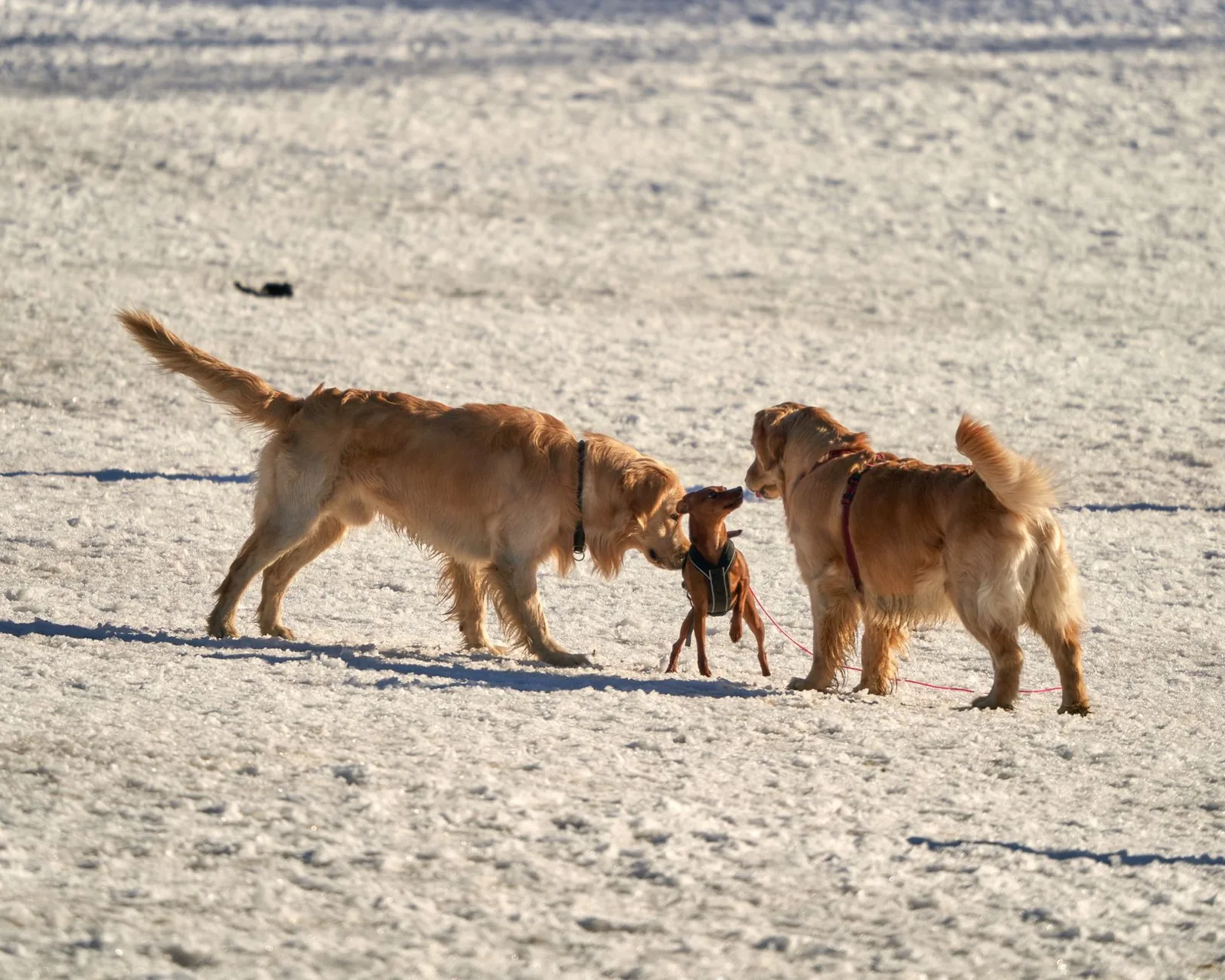
What warning there is looks like play draining out of the play. The bounce and the loopy, inefficient movement disappear. The big puppy goes quiet, its body gets low and its running gets straight and economical, its attention narrows onto the small puppy, and it stops hearing its name. The small puppy, meanwhile, is fleeing for real, often screaming. A frightened squeal plus a straight-line chase is the moment to step in, not the moment to see how it plays out.
How Good Instructors Split Play
Many classes match puppies by age and leave it there. In a 2025 study from the UK’s Generation Pup project, nearly 1,500 owners described the classes their young puppies attended. Almost two-thirds reported a mix of sizes in the room, and in over half of classes the puppies were the same age but different sizes. A third of classes let every puppy play together, about a quarter picked particular pairs, and the rest had no puppy play at all.
Age-matching is a sensible first filter, since a ten-week-old and a six-month-old play at very different intensities. But two puppies born the same week can be ten times apart in weight. Good instructors treat size and play style as filters of their own, and you can see it in how the room runs:
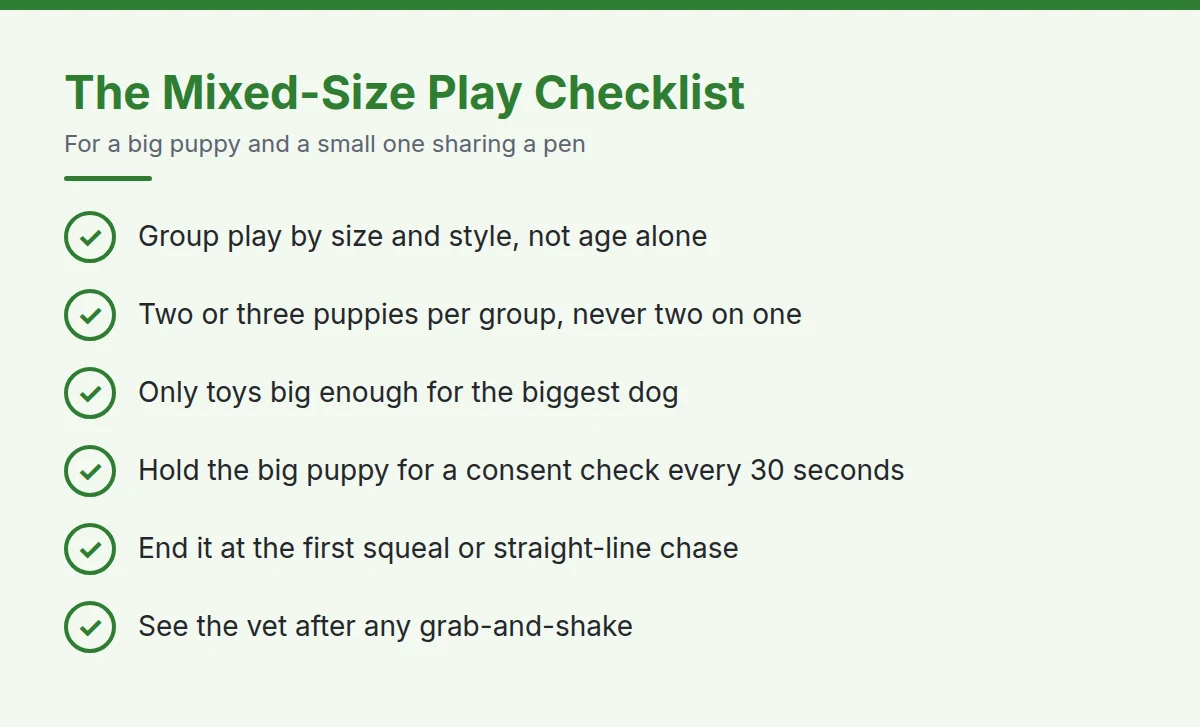
- Small groups, split by size and style. Two or three puppies per play group, not the whole class at once. A gentle big puppy and a confident small one can sometimes share a session. A body slammer and a toy breed should not.
- A separate pen or a rotation. A gated corner where the smallest or shyest puppies play with each other, or take turns, rather than being dropped into the middle.
- Short rounds with built-in pauses. Half a minute to a minute of play, then a break before anyone needs one.
- Never two on one. Any pair that converges on a third puppy gets split up immediately.
- Only big toys on the floor. The AKC adds a size-specific point most people miss: a toy that suits the small dog can be a choking hazard for the big one, so anything left out in a mixed session should be large enough for the biggest dog present.
- An opt-out that does not count as failure. A small puppy who would rather watch from a lap for the first week is still learning.
When you are comparing classes, ask how play groups are formed (by age only, or by size and style too), how many puppies play at once, and what happens to the puppy who does not want to join. Dog training is unregulated in most states, so ask about credentials while you are at it; our guide to choosing the right puppy class covers the rest of the vetting. A well-run class will also check vaccination records at the door, and our breakdown of which shots puppy class actually requires tells you what to bring.
Enjoying or Enduring? Reading the Small Puppy
The most useful skill in a mixed-size pair is telling a small puppy who is playing from one who is putting up with it. Small dogs get misread here constantly, because their stop signals are small and quick and easy to dismiss as attitude.
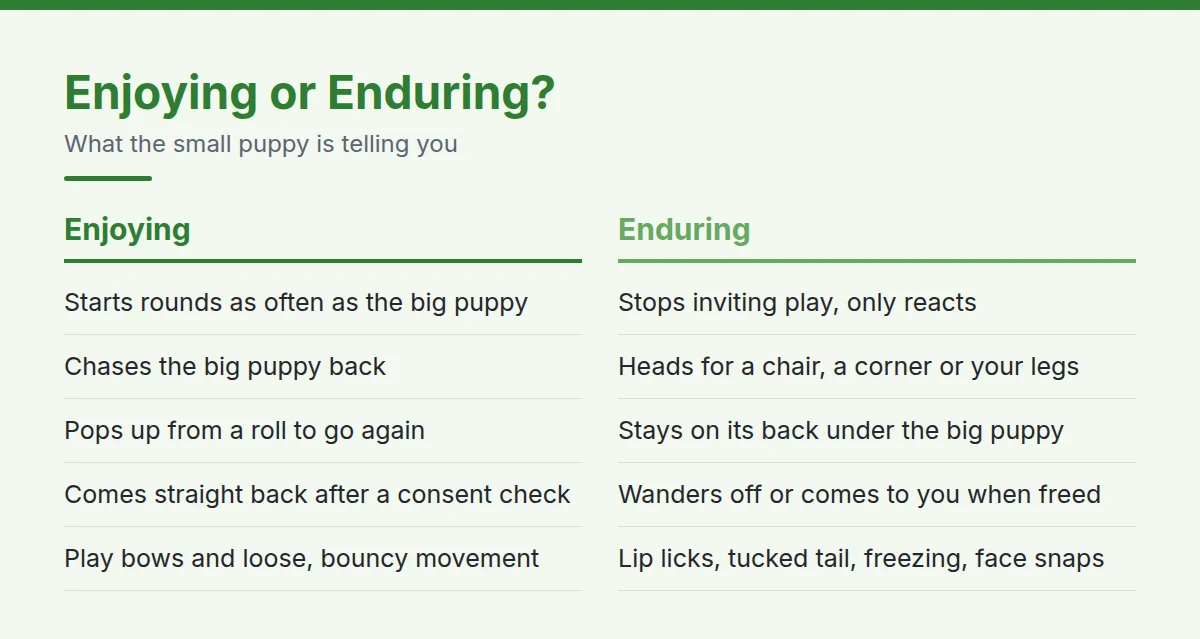
A small puppy who is enjoying itself starts rounds as often as the big puppy does. It chases the big one back, play bows, and pops up from a roll to go again. The big puppy, for its part, is visibly handicapping itself: lying down, mouthing softly, letting the small one win.
A small puppy who is enduring it stops inviting play and only reacts. It keeps steering for a chair, a corner, your legs or your lap. It goes onto its back and stays there while the big puppy stands over it. It licks its lips, turns its head away, tucks its tail, or freezes. Or it snaps at the big puppy’s face again and again while the game carries on. That last one gets laughed off as a little dog with big opinions. It is a stop signal that nobody is honoring.
The consent test settles the question, and with mismatched puppies two rules change. Always restrain the big puppy, never the small one: hold it gently for two or three seconds, let go, and watch what the small puppy chooses. If it comes straight back, carry on. If it wanders off, shakes off or heads for you, that round is over. And check more often, about every thirty seconds instead of every minute or two, because the distance between fine and hurt is shorter. The full test, plus the signs a session is creeping out of control, are in our complete guide to puppy play, and the body-language field guide covers the calming signals small dogs tend to use first.
If You Own the Big Puppy
You are responsible for the bigger body, and that means your job starts before anything looks wrong.
- Watch your own puppy, not your phone or the other owners. Mixed-size accidents happen inside a few seconds of inattention.
- Call your puppy out of play constantly, and pay well. Every thirty seconds or so, recall, reward, and send it back in. A big puppy who can leave a game is a big puppy you can safely let play.
- Give yourself a handle. A well-fitted harness, plus a light drag line where the instructor allows one, lets you stop your puppy without lunging for a collar mid-chase.
- End it at the first slam, the first squeal or the first straight-line chase. Do not wait for the small puppy’s owner to ask. By the time they ask, the moment has usually passed.
- Pay for the gentle version. When your puppy lies down, plays low and lets the small one win, that is the behavior to reward.
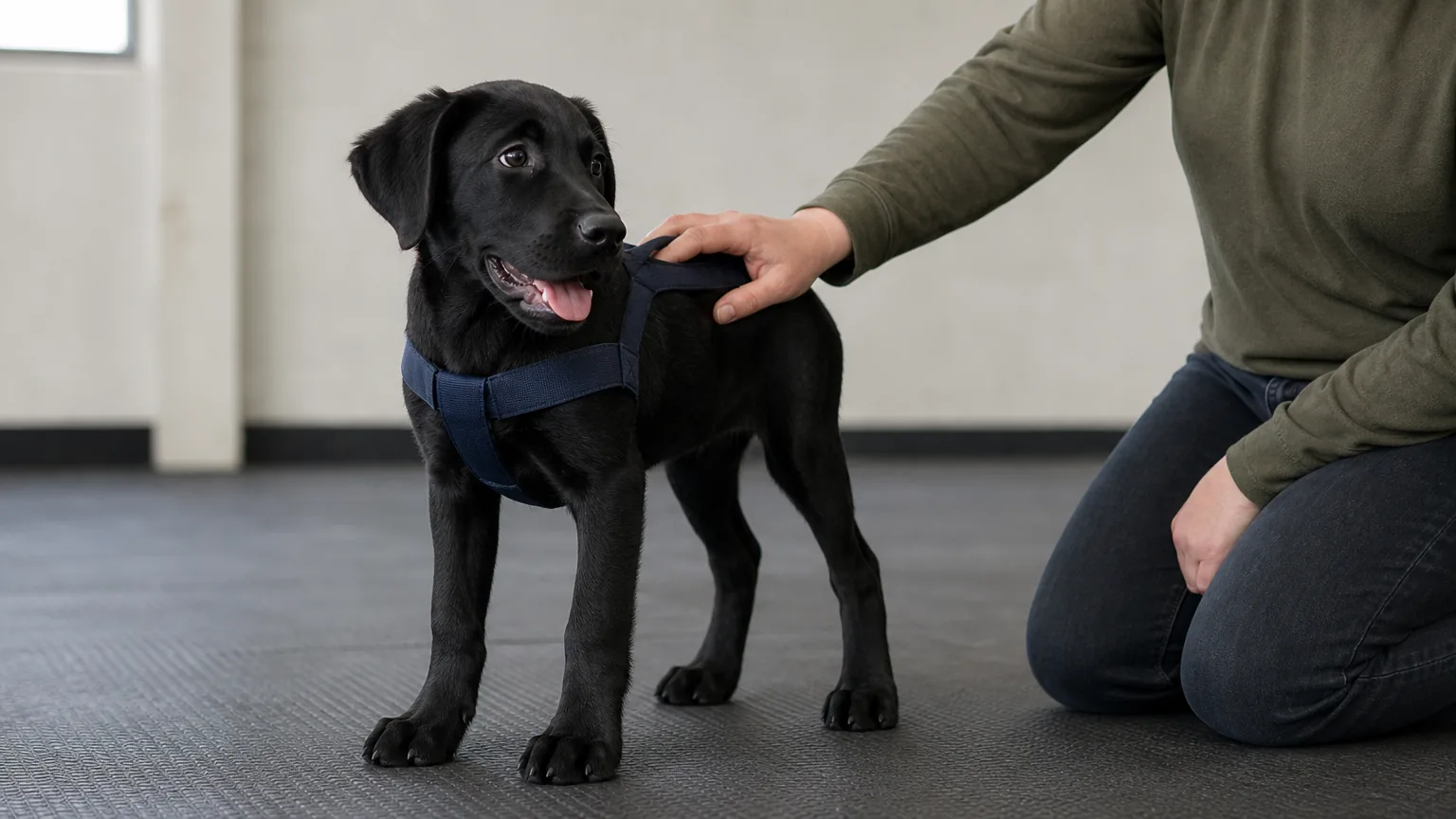
If your puppy fixates on small dogs, by staring, stalking, going silent, or getting more intense rather than less when another dog squeals, stop mixed-size play entirely and talk to a credentialed behavior consultant or a veterinary behaviorist. That is behavior modification territory, not a puppy-class problem. It is not a puppy to punish. It is a puppy to manage carefully while you get expert eyes on it.
If You Own the Small Puppy
You are allowed to say no. A good instructor will not blink at “can she play with the smaller group?”, and an instructor who bristles at the question has told you something useful.
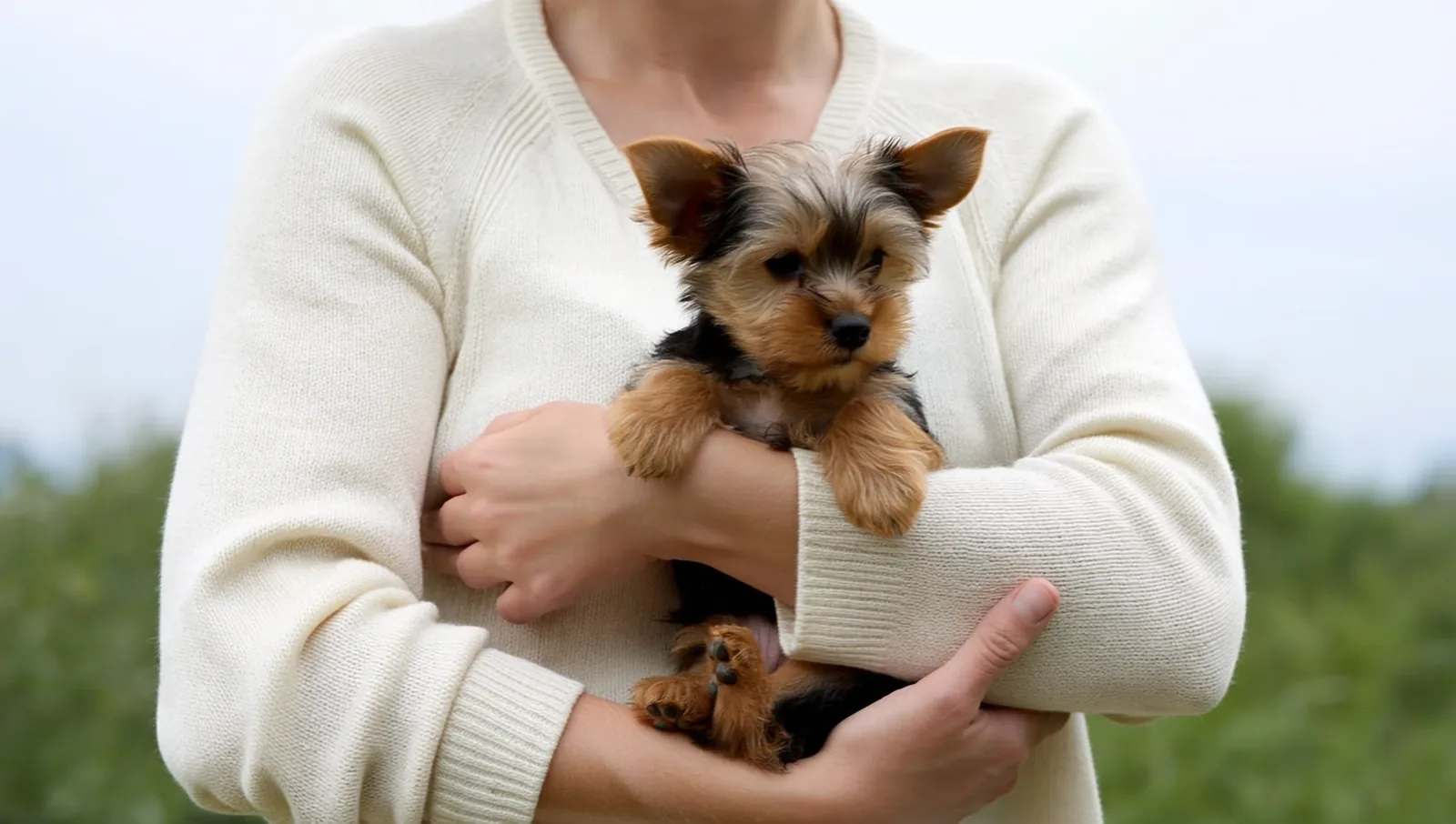
- Ask for a size split, or sit the session out. One good, matched session is worth more than three chaotic ones.
- Lift early, not late. Scooping your puppy up before a big dog gets going is often the simplest protection there is. But once a large dog is close and locked on, the lift itself can pour fuel on it. Michelle Stern, a certified trainer and behavior consultant quoted in the AKC’s guide to picking up small dogs, warns that the motion “can add to the arousal of the other dog,” and an aroused dog may bite you on the way. If the big dog is already close and fixated, step in front instead, turn side-on, and call for its owner.
- Make being lifted predictable. Stern suggests giving a verbal cue before you pick your dog up, so a lift is a known event and not a surprise grab. Practice it at home when nothing is happening.
- See the vet after any grab-and-shake, even with no blood. A Dutch study of 45 dogs with chest bite wounds, most of them small breeds, found that what a wound looked like from the outside, and even on X-ray, did not reliably predict the damage surgeons found inside.
- Watch for fallout. A small puppy who has been flattened or run down can come away wary of every large dog. If yours starts freezing or barking at big dogs afterward, rebuild at a distance with our protocol for the fearful puppy instead of putting it back in the deep end.
The Dog Park Is the Same Problem Without a Referee
Everything above assumes someone is running the room. At a dog park, nobody is. The dogs are unfamiliar adults with unknown histories, there is no size grouping unless the park builds one in, and nobody calls a break.
That is why the better parks have separate areas for big and small dogs, and Becker’s advice is simply to use them. Staying in the size-appropriate area is one of the easiest protections against drift, even though plenty of small dogs romp in the big-dog section without incident. Treat the small-dog side as your puppy’s default, not a demotion. And whichever side you are on, leave when two or more dogs start orienting on yours.
For a young puppy, the park can wait. The vaccine series needs to be finished first, and one bad half minute with a group of adult dogs can cost weeks of good class work. While the socialization window is open, matched play dates with a dog you know are a far better use of it.
The Short Version
Size is its own risk, separate from temperament. Group play by size and style, not age alone. Keep groups small, rounds short and toys big, and never let two puppies chase one. Hold the big puppy for consent checks, and do it often. Read the small puppy for enduring, not just for obvious fear. Big-puppy owners interrupt first; small-puppy owners lift early or block. And treat any grab-and-shake as a reason to see the vet.
Further reading (sources)
- American Kennel Club on whether small and large dogs can safely play together
- American Kennel Club for when picking up a small dog helps and when it backfires
- Vetstreet with Mikkel Becker on predatory drift at the dog park
- Bradshaw, Pullen and Rooney on why adult dogs play and where its movements come from
- Buckland and colleagues for how UK puppy classes mix ages, sizes and play
- Planner and colleagues on forearm bone structure in toy breeds
- Anggoro and colleagues with a model of toy poodle forearm stress on landing
- Intarapanich and colleagues about injuries from big dog, little dog fights
- Cook and colleagues for body weight and survival in 12,412 dogs with bite wounds
- Scheepens and colleagues on hidden damage beneath thoracic bite wounds