When a Trainer Has Your Puppy: Safety Vetting in an Unregulated Industry
Published on September 1, 2026

A family in Southwest Ranches, Florida did what a lot of owners do around the eight-month mark. Their shepherd mix, Buddy, had gotten big, strong, and hard to walk, so they went looking for professional help. On a recommendation they found a local groomer who offered a five-week in-home training program for $3,500. A wellness check said Buddy was in perfect health at roughly seventy pounds. They dropped him off on the 28th of May.
Communication got spotty almost immediately. Less than three weeks later, Buddy was dead. He had lost twenty pounds. Broward Animal Care investigators issued an animal cruelty civil citation, which the trainer’s household elected not to contest, and concluded that whatever the cause of death, the weight loss alone amounted to deprivation of necessary care. The Willners have since started a petition drive to require certification for pet trainers in Florida.
Nobody Was Going to Check Her Paperwork
Here is the part most owners find genuinely surprising: nothing in that arrangement was illegal on its face. No US state licenses dog trainers the way it licenses electricians, cosmetologists, or massage therapists. There is no board to file a complaint with, no license to suspend, no mandatory education, no required insurance, and no inspection of the place where your dog will sleep. Anyone can print business cards tomorrow and take custody of your puppy for a month.
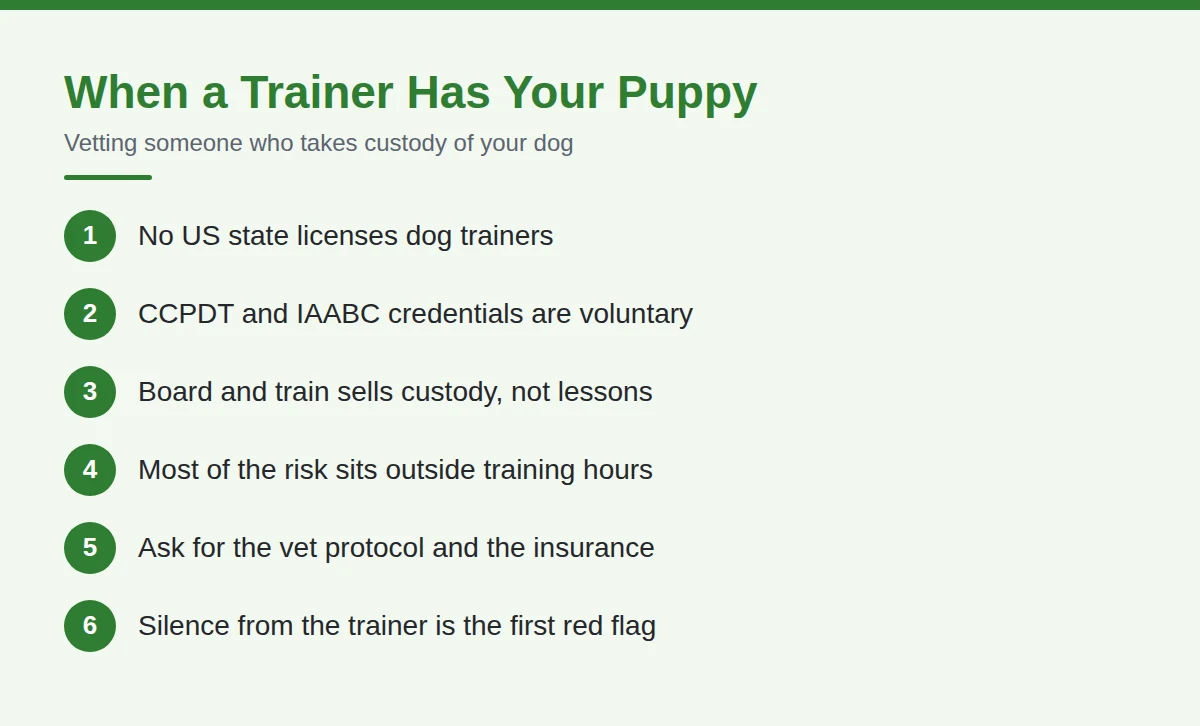
The credentials that exist are all voluntary. CCPDT, the Karen Pryor Academy, and the IAABC require documented coursework, assessed skills, continuing education, and adherence to a code of conduct, and the first and third of those will accept and investigate a complaint against a certificant. That is real accountability, but it is accountability the trainer opted into. It vanishes the moment you hire someone who never bothered.
This is not a fringe concern raised by outsiders. When researchers surveyed working trainers about ethics for a 2026 Frontiers study on training methods, practitioners on both sides of the force-free divide independently named the absence of regulation as a problem for the field. The people inside the industry know.
Boarding adds a second gap. Many counties license commercial kennels and inspect them, but a trainer keeping four dogs in a private house often falls outside that definition entirely, or simply operates without anyone noticing. The facility standards you might assume apply usually do not.
Custody Is a Different Question From Curriculum
Most advice about hiring a trainer, including our own guide to choosing a puppy class, is about method and teaching quality. Those checks assume you are in the room. In a group class you can watch every minute, and if something goes wrong you are three feet away.
Board-and-train and day-training break that assumption completely. You are no longer buying six hours of instruction. You are buying custody: sleep, meals, water, temperature, exercise, bathroom breaks, and medical judgment, for weeks, out of your sight. The training happens in maybe an hour a day. The other twenty-three hours are boarding, and boarding is where dogs actually get hurt.

Buddy did not die during a training session. He died in a crate in a house where, by the trainer’s own account to investigators, the air conditioning had failed while the household was out for seven hours. That is a husbandry failure, not a training one, and no amount of asking about clicker mechanics would have surfaced it.
The Questions to Ask Before You Hand the Leash Over
Ask these on the phone, then ask to see the answers in person. A good trainer will have thought about all of them already.
Where exactly does my dog sleep, and can I see it? Not a photo on a website. The actual room, the actual crate or run. Look at size, ventilation, flooring, and whether dogs can see each other constantly (a stressor, not a feature). If you would not leave your puppy there overnight yourself, do not pay someone to.
How many hours a day is the house empty? This is the question almost nobody asks and the one that mattered most in Buddy’s case. Ask for a number. Ask what the longest stretch is. Ask who covers weekends.
What happens if the power or the AC fails? A serious operation has an answer: a temperature alarm, a generator, a neighbor with a key, a written policy about moving dogs. “That has never happened” is not an answer.
What is the crate, and how long is he in it? Solid-sided metal boxes marketed for anxious or escape-prone dogs restrict airflow badly in a hot room. Ask for total daily crate hours, including overnight. Anything over the fourteen to sixteen hours a young dog spends resting anyway means the dog is being warehoused between sessions. Our crate training routine covers what a healthy crate schedule actually looks like.
Who feeds him, what, and how much? Get it in writing, matched to what he eats at home. Ask them to weigh your dog on arrival and at pickup and to tell you the numbers. Twenty pounds does not disappear overnight; it disappears over weeks while nobody is looking.
What is your veterinary emergency protocol? Name the clinic. Name the after-hours clinic. Who transports, who authorizes treatment, what is the spending ceiling, and how fast do I get called? A signed vet release form should be part of the paperwork, not an improvisation at 11pm.
Are you insured, and for what? General liability usually excludes injury to animals in your care. The coverage that matters is a care, custody, and control endorsement. Ask for the certificate of insurance, not a yes.
How and how often will I hear from you? Set a specific cadence: a daily video, a weekly call, whatever. Then treat any silence as a red flag rather than a scheduling hiccup. Spotty communication was the first sign in Broward and it is almost always the first sign.
Can I visit unannounced? The answer should be a qualified yes: a window, a time of day, some structure. A flat no is disqualifying.
What is the training plan, in specifics? Ask what the marker is, when they pay, what they do when the dog gets it wrong. A trainer who can walk you through when the marker gets paid and when it does not has a real method. A trainer who talks about respect, dominance, and being the pack leader is describing a philosophy, and usually a set of tools you will not like.
The Force-Free Program Is Also the Safer One
These two things look like separate concerns and they are not.
Aversive board-and-train exists partly because you cannot see it. A program built on prong collars, e-collars, and corrections produces fast-looking obedience that is difficult to demonstrate in front of the owner without the owner flinching. Opacity is load-bearing for those businesses, which is exactly why “we do not allow visits, it disrupts the dogs” is such a common line.

A reward-based program has the opposite incentive. There is nothing to hide in a session that consists of food, praise, and short reps, so those trainers tend to send video willingly, run open facilities, and invite you to the handover sessions. The methodological question and the transparency question have the same answer, which makes your job simpler.
Force-free work is also gentler on the dog’s stress load in an environment that is already stressful. A puppy in a strange house, away from his people, sleeping badly, is not a candidate for anything that adds pressure.
Red Flags That Should End the Conversation
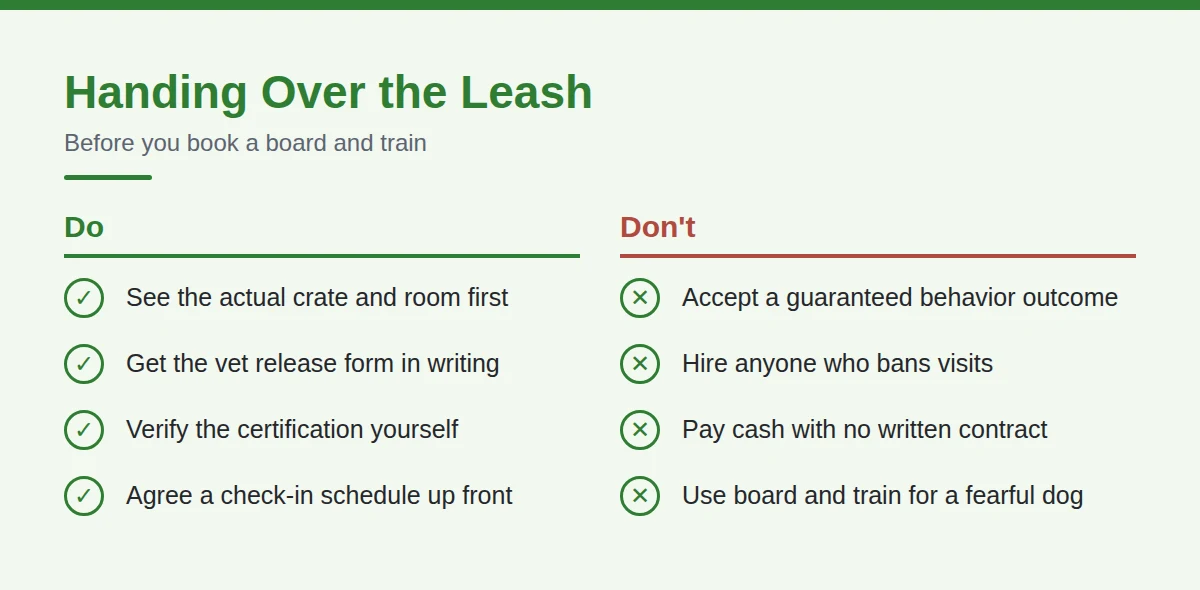
- A guaranteed outcome. Behavior is not warrantable and honest trainers say so.
- No visits, no cameras, no video, and a reason why.
- Credentials that will not verify. CCPDT and IAABC both publish searchable directories. Check the name yourself.
- No written contract, or cash only.
- Refusal to name the veterinary clinic they use.
- Vague answers about staffing and overnight coverage.
- The dog comes home shut down, flat, or flinchy and you are told he is just tired.
- Any suggestion that a five-week program will resolve fear or aggression.
That last one deserves emphasis. Board-and-train cannot fix a fearful dog, because fear responds to graded exposure at a threshold the dog can handle, delivered over months, mostly by the people the dog lives with. Our desensitization and counterconditioning protocol is the shape of that work. A puppy showing real fear or aggression needs a board-certified veterinary behaviorist, who can rule out pain and build a plan, not a boarding program.
The Boring Option Is Usually the Right One
For a puppy under six months, the safest format is also the cheapest and the most effective: a small group class where you stay in the room, plus private sessions at home if you need more. You see everything, you learn the mechanics yourself, and nobody takes custody of your dog.
If you do use board-and-train, treat it like leaving a child with a sitter you found online. Visit first, get everything in writing, verify the insurance, name the vet, agree the check-in schedule, and go pick your dog up the moment the answers stop coming. The industry will not do this vetting for you. In every state in the country, that job is yours.
Further reading (sources)
- CBS News Miami on the Broward family whose puppy died in a trainer’s care
- CCPDT with the ethics and conduct standards a certified trainer signs up to
- CCPDT for the public directory where you can verify a trainer’s certification
- IAABC on the standards of practice behind its LIMA commitment
- AVSAB for why reward-based methods are the professional standard
- Whole Dog Journal with what to look for in a boarding and training facility