How Much Exercise Does a Puppy Actually Need? The Five-Minute Rule, Zoomies, and the Overtired Biter
Published on September 13, 2026
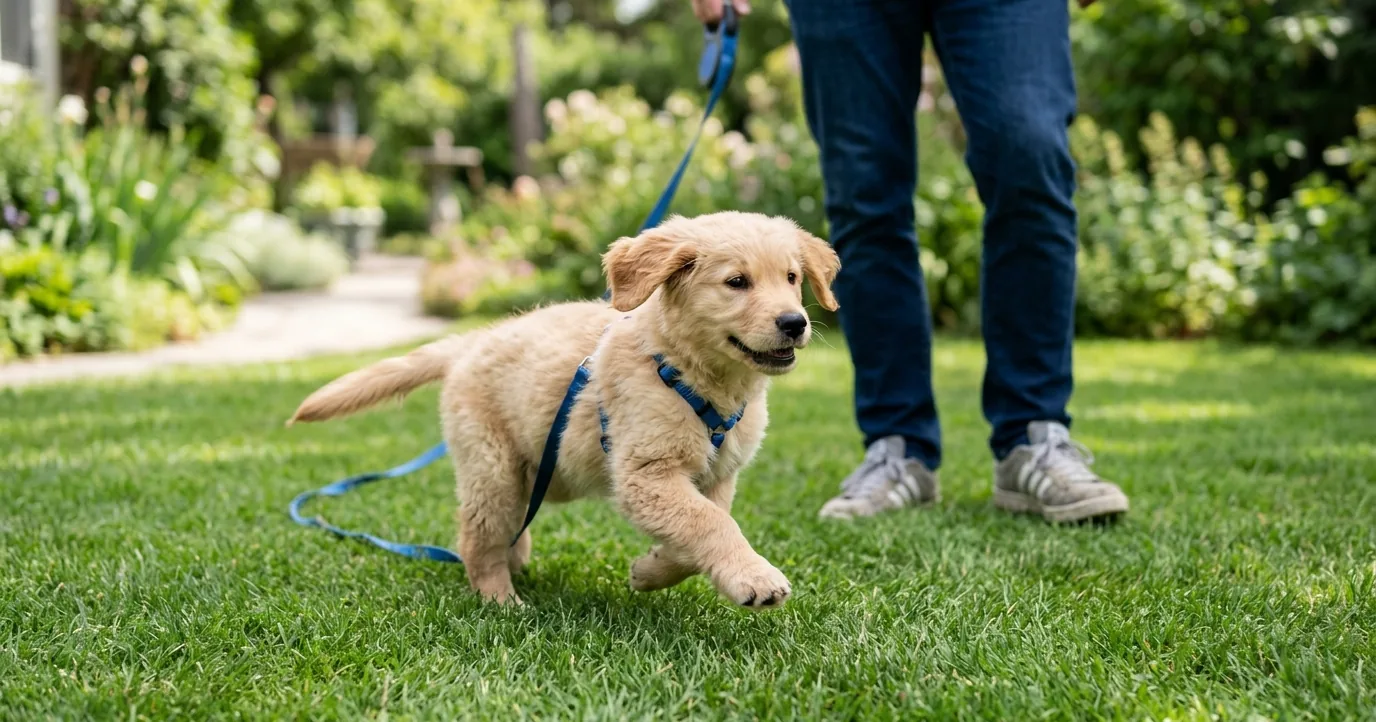
You have been told two things, by two people you trust, in the same week. The trainer says a tired puppy is a good puppy, so wear it out. The breeder and the vet say do not over-exercise a growing dog, you will wreck its joints. Meanwhile your puppy has spent forty minutes racing around the yard, come inside, and immediately started biting your ankles like it has had six espressos. Nobody’s advice appears to be working, and you cannot tell whether you are doing too much or too little.
Here is the thing that resolves the contradiction: those two pieces of advice are about different kinds of activity. Not all exercise loads a puppy the same way, and the type that is safest for a growing skeleton also happens to be the type that actually settles a puppy down. Once you stop counting minutes and start counting kinds, most of the confusion clears.
Where the Five-Minute Rule Actually Came From
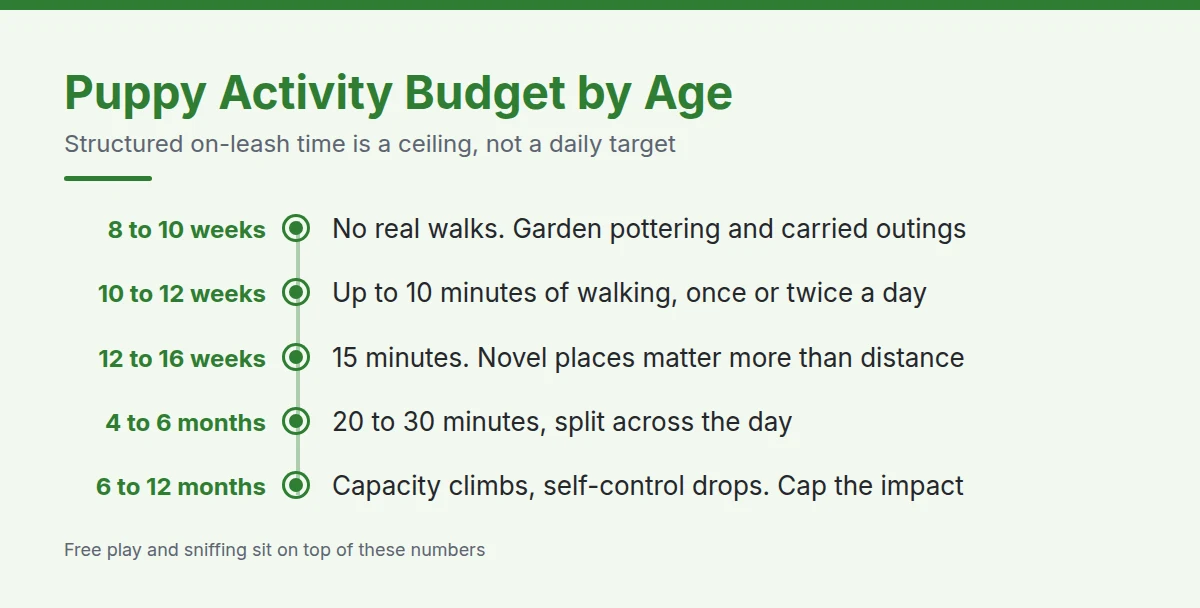
Almost every owner meets the same formula: five minutes of exercise per month of age, once or twice a day. So a three-month-old gets fifteen minutes, a five-month-old gets twenty-five.
It is a reasonable rule of thumb. It is not a research finding. No study ever established five minutes per month as a safe threshold, and you will not find a paper behind it. It seems to have circulated through UK breeder and kennel-club advice for decades, and it stuck because it is easy to remember and because it errs on the cautious side. Treating it as a scientific dosage is the mistake.
What research does exist is more interesting and points in a slightly different direction. A Norwegian prospective cohort study that followed four large breeds from puppyhood found that puppies allowed daily off-lead exercise in parks and on soft, varied ground had a lower risk of developing hip dysplasia, while regular use of stairs in the first three months was associated with a higher risk. Read those two findings together and the message is not “less movement.” It is that free, self-paced movement on forgiving surfaces looks protective, and repetitive, owner-imposed impact does not.
So keep the five-minute rule, but use it for the right thing. It is a sensible ceiling on structured, forced, repetitive activity: the on-leash road walk where the puppy has to keep your pace, the jog, the sixty-throw fetch session. It was never meant as a cap on how long a puppy is allowed to potter about the garden sniffing things and lying down when it feels like it.
Four Kinds of Tired
Owners tend to treat “exercise” as a single currency. It is at least four, and they are not worth the same.
Structured walking. On leash, at your pace, in a straight line. This is the category the five-minute rule governs, because the puppy cannot self-regulate: it goes as far as you go. It is also, minute for minute, one of the least tiring things you can do with a puppy’s brain. Useful for training and exposure, weak as a settler.
Free play. Off-leash pottering, chasing, wrestling with a suitable playmate, self-selected sprints and rests. Puppies stop when they need to, which is the whole point. On grass, this is the healthiest physical exercise a young dog gets. The caveat is that puppies playing with other puppies will sometimes override their own off-switch, so you supervise and you enforce breaks.
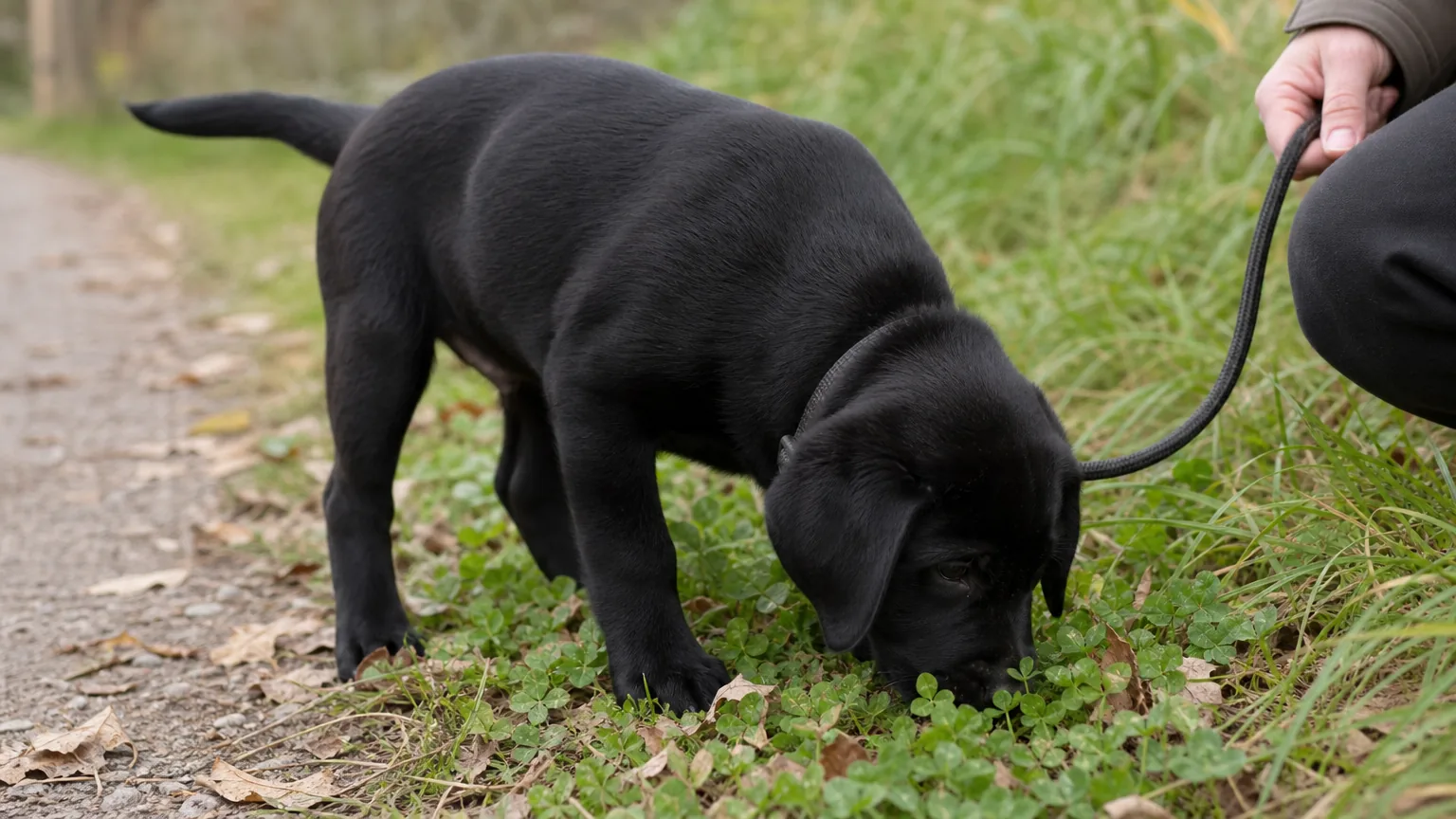
Sniffing. A puppy given twenty minutes to work a hedgerow with its nose comes home visibly more settled than one marched briskly for the same twenty minutes. Scent work is genuinely demanding: olfaction takes a large share of a dog’s processing, and the physical pace is a crawl. This is the single most under-used tool most owners have. A “sniffari” (a walk where the puppy chooses the route and the pace and you follow) costs your joints nothing and drains theirs not at all.
Mental work. Shaping a new behavior, a food puzzle, a scatter-feed in the lawn, learning to target your hand. Five focused minutes of this will do more to produce a sleepy puppy than fifteen minutes of the block. It also has zero impact cost, which makes it the obvious lever when the weather is bad, the vaccinations are incomplete, or the puppy is on restricted rest.
The practical version: if your puppy is bouncing off the walls, your first instinct should not be a longer walk. It should be a sniffier one, or a five-minute training game.
The Overtired Puppy Reads as a Hyper Puppy
This is where the “tire them out” advice does real damage, because it creates a loop that gets worse the harder you work.
A puppy that is past its awake window does not slow down. It speeds up. It gets frantic, mouthy, and much harder to interrupt, and it bites with less control than it had an hour earlier. To an exhausted owner that looks exactly like a puppy with energy to burn, so the owner does the logical thing and takes it out again. The extra activity pushes the puppy further past the point of no return, the behavior gets worse, and everyone concludes the puppy needs even more exercise.
Puppies in the socialization window sleep something like eighteen to twenty hours out of twenty-four, and can typically only manage an hour or two awake before they need to go down again. If your puppy is wild, the arithmetic is worth doing before the leash comes out: how long has it actually been up? The sleep physiology behind this is worth understanding properly, because it reframes the frantic hour as a symptom rather than a fuel gauge.
The tell is what happens next. An under-exercised puppy that gets an appropriate outlet settles afterward. An overtired puppy that gets more exercise gets worse. Run the experiment once with a nap instead of a walk and you will usually have your answer inside twenty minutes.
If you are currently three weeks in, sleep-deprived, and convinced that the frantic puppy is proof you are failing, that feeling is extremely common and has its own well-documented shape. Chasing exhaustion with more activity is one of the fastest routes into it.
Decoding the 8pm Zoomies
At some point most evenings, a lot of puppies detonate. Ears flat, rear tucked, a hard lap of the sofa, a skid on the kitchen floor, then another lap. Trainers call these FRAPs, or frenetic random activity periods. They are normal, they are not a behavior problem, and dogs of every age do them.
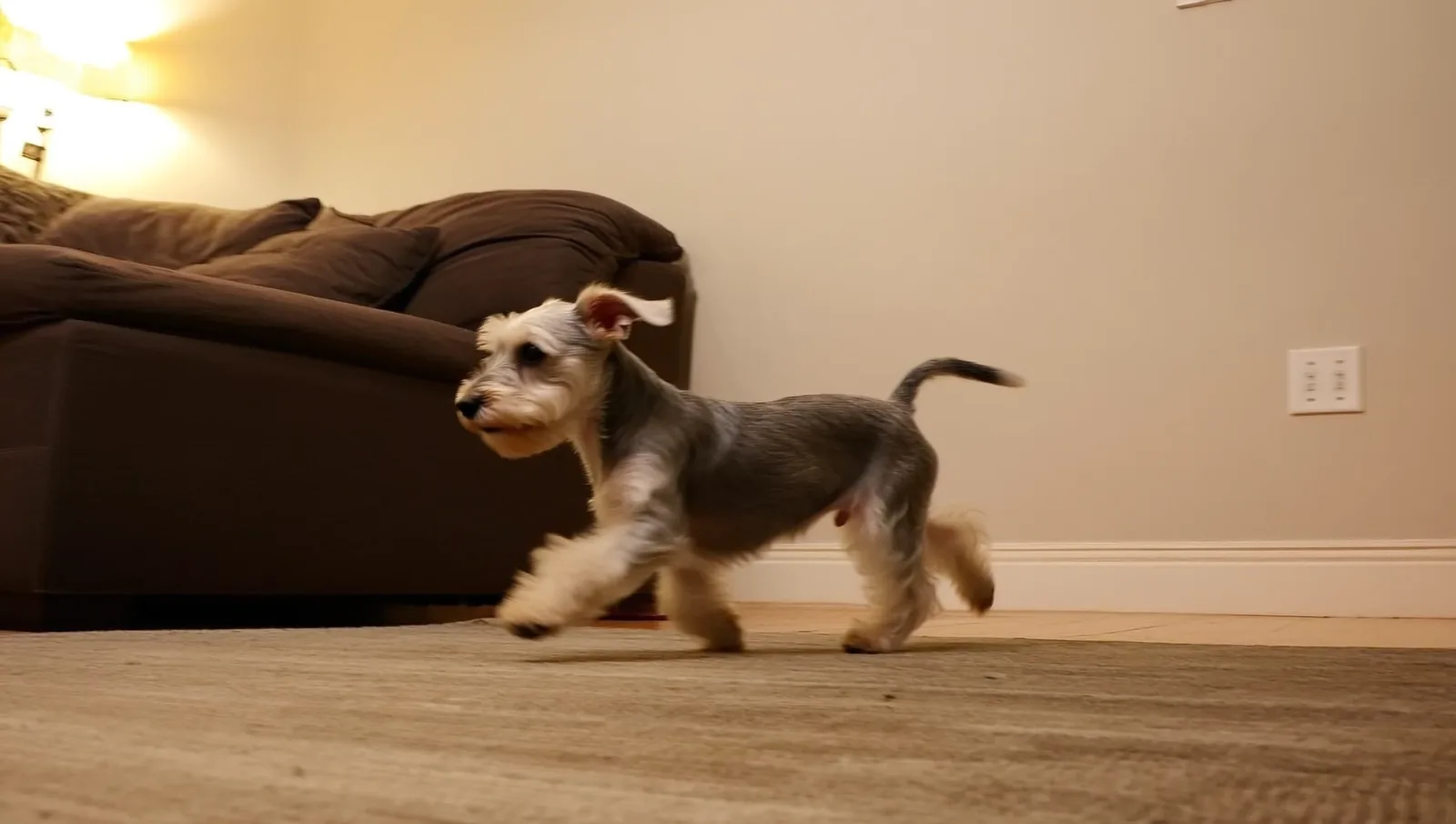
What sets off the evening version is usually one of three things. A day’s worth of accumulated arousal with no release valve. Overtiredness, arriving on schedule at the same hour a toddler falls apart. Or simple relief, the pressure dropping the moment the household finally sits down.
What to do about them is mostly nothing. Do not chase the puppy, which turns a thirty-second burst into a game worth repeating. Do not scold, which teaches nothing except that you are unpredictable when it is excited. Clear the runway instead: get the coffee table corner out of the way, and get the puppy off slick laminate and onto rug or grass, since flooring with no grip is where zoomies turn into a soft-tissue injury.
Then look at the clock and the day behind it. Zoomies at the same time nightly, ending in hard biting and an inability to settle, are overtiredness and want an earlier, enforced nap. Zoomies in a puppy that has been crated most of the day are a genuine outlet shortage and want a sniffing walk and a food puzzle in the late afternoon, before the explosion, not after it.
Safe Impact and Unsafe Impact
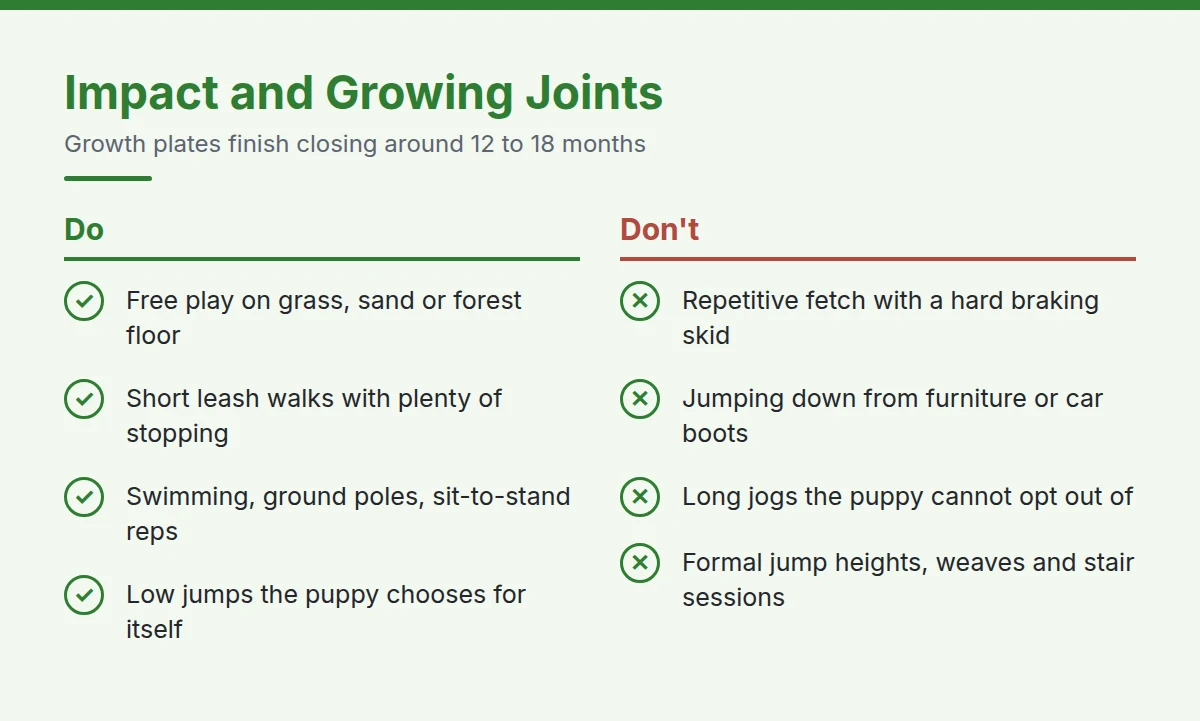
Growth plates are the soft cartilage zones near the ends of a young dog’s long bones where new length is added. They are structurally weaker than mature bone, and in most dogs they do not finish closing until somewhere between about twelve and eighteen months, later in the giant breeds. Until they do, repetitive concussion and hard rotational force are the things worth managing. This is a matter of loading and repetition, not of keeping a puppy still.
Reasonable to allow, most days:
- Free play on grass, sand, or forest floor, where the puppy chooses the pace and takes its own breaks
- Short on-leash walks for exposure and training, with plenty of stopping
- Swimming, where there is no impact at all
- Sit-to-stand and down-to-stand reps, hand targeting, slow walking over poles laid flat on the ground
- Jumping that the puppy chooses for itself at low height on soft ground
Worth restricting until the skeleton has matured:
- Repetitive high-value fetch, especially the hard braking skid at the end of every throw
- Jumping down from furniture, car boots, or the deck (lift the puppy down instead)
- Long jogs, bike runs, or any distance the puppy cannot opt out of
- Formal jump heights, weave poles, and contact equipment in agility, and repeated stair sessions
- Rough play with a much larger, heavier dog
The distinction that does most of the work here is self-selected versus imposed. A puppy that hurls itself off a bank in the middle of free play is doing one unplanned thing at its own choosing. A puppy doing forty identical fetch stops on hard ground is doing the same load forty times, and it is the repetition that accumulates.
Foundation Games That Build a Body Without the Pounding
If you want a puppy that is physically prepared for sport later, or just a well-coordinated adult dog, the productive work at this age is body awareness rather than mileage. Sport-foundation games for puppies are deliberately low-impact, and they double as excellent settlers.
- Poles on the ground. Four broom handles flat on the grass, spaced roughly the puppy’s body length apart. Walk it through slowly on leash. This builds rear-end awareness, which is the thing most adult dogs are worst at.
- Front-foot pivots. Front paws on a low, stable, non-slip platform, and the puppy shuffles its back feet around in a circle following a lure. Astonishingly tiring for something that covers no ground.
- Hand targeting and recall games. Two people, a hallway, and a puppy trotting between them for food. Short distances, no hard turns.
- Tug with rules. Keep the toy low and horizontal so the puppy is not hanging or twisting off its back legs, and build a trade cue into it.
- Scatter-feeding and find-it. Toss a handful of kibble into the lawn and let the puppy hunt. It is sniffing, foraging, and food all at once, and it is the most reliable calm-down tool in the box.
Most of these also cover the coordination and confidence groundwork that later shows up in the S.T.A.R. Puppy and Canine Good Citizen track, and the leash mechanics you build during slow, sniffy walks feed directly into proper loose-leash work.
An Honest Activity Budget, 8 Weeks to Adolescence
Treat the walk figures as a ceiling on structured on-leash time, not a target to hit. Free play and sniffing sit on top and are governed by the puppy’s own off-switch.
8 to 10 weeks. Structured walking: essentially none, beyond carrying the puppy out to see the world. Two or three short garden pottering sessions, two five-minute training games, and roughly 18 to 20 hours of sleep. Socialization outings are the real work at this age, and they count as exertion even when the puppy never touches the ground.
10 to 12 weeks. Up to about ten minutes of structured walking once or twice a day, once vaccinations allow. Add a daily sniffing session and a food puzzle. Awake blocks still capped at about an hour.
12 to 16 weeks. Fifteen minutes of structured walking, once or twice daily. This is peak socialization, so prioritise novel places over distance. Introduce the ground poles and pivot work. Expect the evening zoomies to be at their most spectacular in this window. The week-by-week milestone map is the better guide to what should be happening now than any mileage number.
4 to 6 months. Twenty to thirty minutes of structured walking, still split across the day. Free play with well-matched dogs. Teething is in full swing, so chewing outlets matter as much as movement.
6 to 12 months, adolescence. Physical capacity climbs fast and self-control collapses, which is a dangerous combination for joints, because the dog will now happily run itself into injury. Hold the line on repetitive impact and formal jump heights until your vet confirms skeletal maturity. Increase sniffing, scent games, and training instead. Most adolescent “energy” problems are boredom and hormones rather than an exercise deficit.
When It Is Not an Exercise Question
Book a vet appointment rather than adjusting the schedule if you see limping or stiffness that lasts more than a day, a bunny-hopping gait with both back legs moving together, reluctance to use a leg after play, sudden refusal to go up stairs or jump into the car, or a puppy that yelps on being picked up. Growth-plate injuries in young dogs are easy to miss and matter a great deal when caught early.
And if the frantic behavior does not respond to any of this, if it comes with real fearfulness, or if the biting is genuinely damaging rather than puppy-sharp, that is a conversation for a veterinary behaviorist rather than a longer walk.
The short version: stop asking how many minutes and start asking what kind. Cap the repetitive stuff, let the free stuff be free, spend more of your budget on the nose and the brain than on the legs, and count naps as part of the plan rather than the absence of one.
Further reading (sources)
- American Kennel Club on whether it is safe for a growing puppy to jump
- American Kennel Club for keeping a puppy active with stimulation as well as exercise
- Preventive Veterinary Medicine with the Norwegian cohort data on exercise, stairs and hip dysplasia
- VCA Animal Hospitals for how exercise can damage growth plates in a puppy
- Peer-reviewed research with a framework for managing joint disease in growing dogs