Puppy Fear Periods: The Weeks When Your Confident Puppy Suddenly Isn't
Published on September 16, 2026
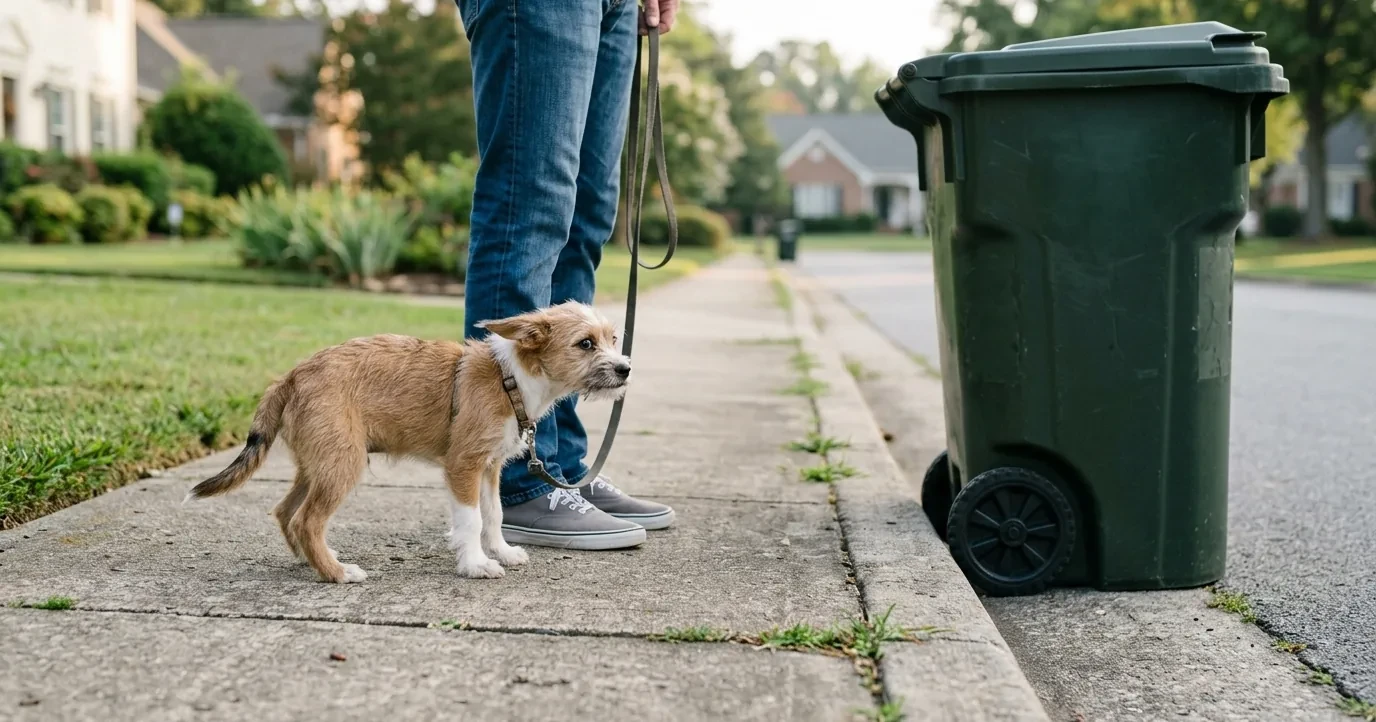
Last weekend your puppy greeted every guest at a family barbecue like a long-lost friend. This morning the same puppy stopped dead at the end of the driveway and barked, hackles up, at the neighbor’s trash can. That can has stood there every day of the puppy’s life.
Owners in this spot nearly always assume they broke something: a loud truck, a rough moment at class, a visitor who loomed. Sometimes that is true. More often the puppy has walked into a fear period, a short and developmentally normal stretch when caution runs hot and yesterday’s furniture becomes today’s threat. What you do in those days matters, and the two most common instincts, pushing through it or hiding the puppy at home until it passes, both cost you something.
Two Windows, and Both Arrive at a Bad Time
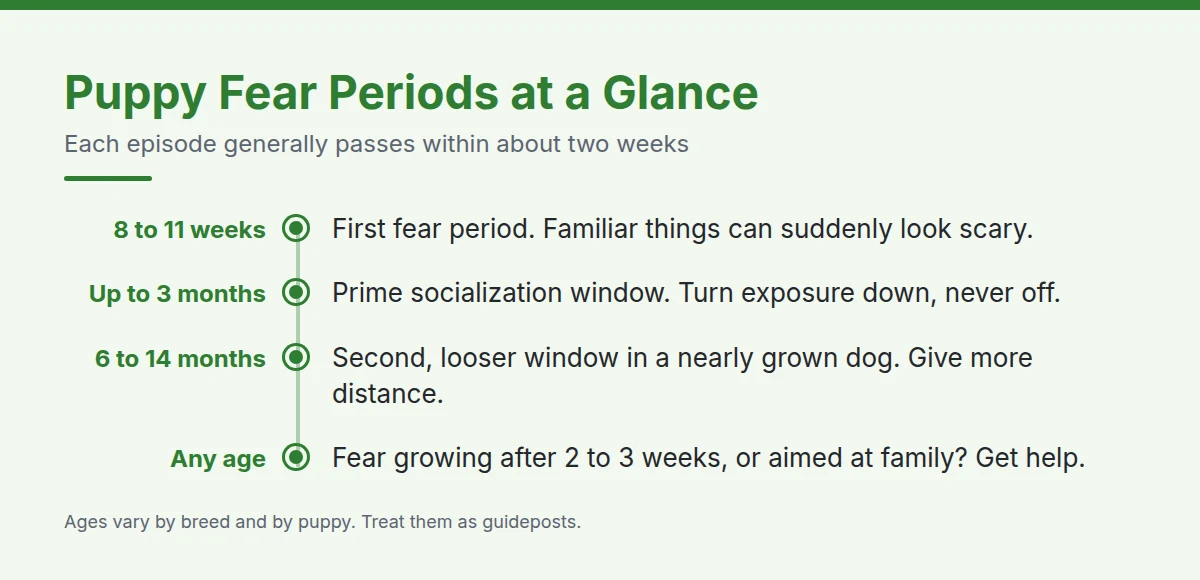
Trainers describe two fear periods. According to the American Kennel Club’s guidance on training through them, the first falls between 8 and 11 weeks and the second generally somewhere between 6 and 14 months. The change tends to appear suddenly and generally lasts no more than two weeks.
The first one lands at the worst possible moment. Eight weeks is when most puppies come home, and the weeks right after are when many start class, which is why the week-by-week milestone plan treats them as the case for gentle exposure rather than bold.
The second window is looser and easier to miss. Your dog is near adult size and in the middle of adolescence, and a flash of fear from a 50-pound dog (barking, raised hackles, a lunge at a man in a hood) looks far more alarming than the same feeling in a puppy you can scoop up.
Treat the ages as averages, not appointments. When Morrow and colleagues tracked 98 puppies of three breeds between 4 and 10 weeks of age, fear-related avoidance showed up later in Cavalier King Charles spaniels than in German shepherds and Yorkshire terriers. The adolescent window also rests on thinner evidence. As recently as 2020, Asher and colleagues described their study as the first empirical evidence, to their knowledge, of an adolescent behavioral phase in dogs at all. Much of what is written about the second fear period comes from trainers and breeders who have watched a great many dogs grow up.
Why Yesterday’s Social Butterfly Startles at a Trash Can
Growing caution is part of normal development. Morrow’s team described the onset of fear-related avoidance as occurring during, and to some extent defining, the sensitive period, and the American Veterinary Society of Animal Behavior (AVSAB) calls the first three months the time when sociability outweighs fear. A fear period is a phase when the caution side of that balance runs hotter than usual.
What you see varies, but the usual versions are:
- Startling at something familiar and taking longer than usual to recover
- Stopping on a walk at a spot the puppy has passed a hundred times
- Barking, backing up, or raising hackles at a garden statue, a bin, or a parked stroller
- Hiding behind your legs at class, or turning down a treat it would normally grab
- Growling at a stranger, especially one who leans over, wears a hat, or approaches fast
Most of this is ordinary, but it deserves care, because a frightening experience in puppyhood can outlast puppyhood. In a study of 978 young guide dogs, Serpell and Duffy found that puppies whose raisers reported they had been frightened by a person scored significantly worse for fear of strangers at 12 months, and puppies threatened by an unfamiliar dog scored worse for fear of dogs. That is an association in one population, not proof that one scare ruins a puppy, but it is a good reason to slow down while a fear period runs its course.
Fear Period or Fear Problem?
You usually cannot tell on day one. Watch for a week and ask five questions.
- How did it start? A fear period tends to arrive suddenly in a puppy that was confident the week before. A fear problem has often been there since the puppy came home, or has built steadily.
- How fast does the puppy recover? A puppy in a fear period startles, backs off, and within a minute or so is sniffing or taking food again at a distance. A puppy that cannot settle even in a quiet room, or will not eat anywhere near the trigger, needs more than patience.
- Is it spreading? A handful of new worries is typical. New triggers every few days is not.
- How long has it lasted? Fear that is still growing after two or three weeks deserves a professional’s eyes.
- Who is it aimed at? Worry about bins, traffic, and strangers fits a fear period. Fear of family members, or growling and snapping when handled, does not, at any age.
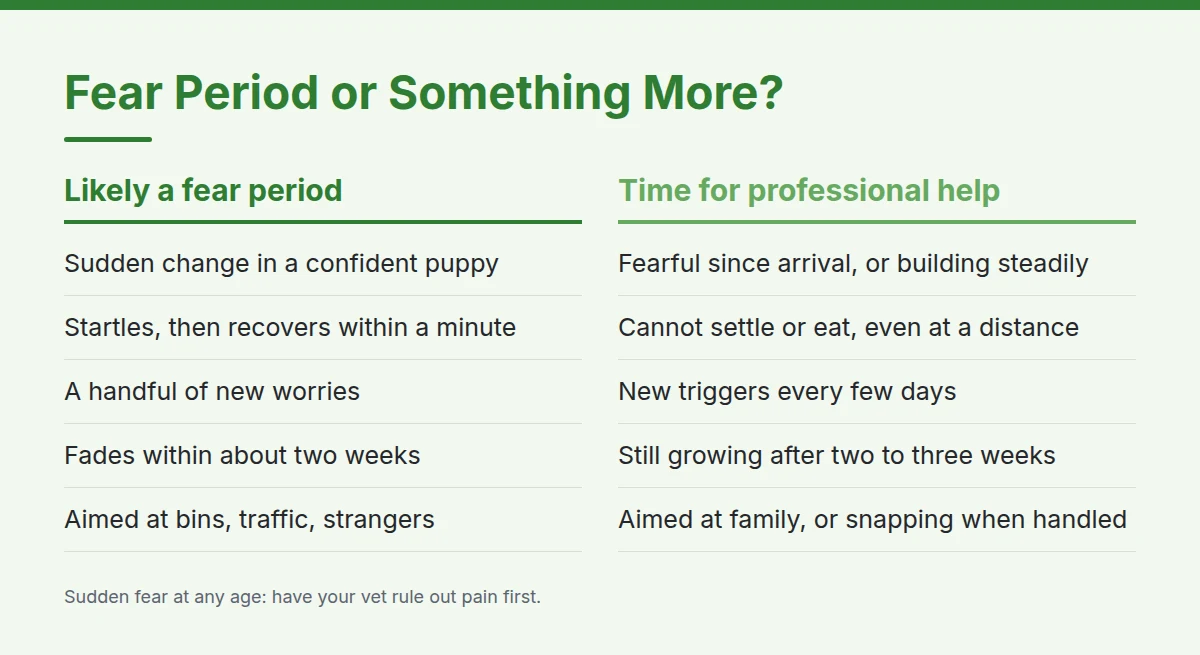
Rule out pain before you blame development. A puppy that suddenly refuses walks, yelps when picked up, or snaps when touched in one spot needs a vet first, and AVSAB’s position statement advises owners of fearful puppies to seek veterinary guidance. If the answers point to a genuine fear problem, the right tool is a structured desensitization and counterconditioning plan, ideally with a qualified professional guiding it.
The Central Rule: Do Not Force, Do Not Flood
Nearly everything about getting through a fear period follows from one principle: the puppy decides how close it gets to the scary thing.
So do not drag the puppy up to the trash can to prove nothing happens, and do not hold it next to the thing it fears. Above all, do not flood, which means keeping a puppy in the presence of something frightening until it stops reacting. A flooded puppy that goes quiet has not learned the thing is safe. It has learned that struggling does not work.
The principle also rules out a mistake that feels kind: luring a worried puppy closer with treats, which AKC guidance warns can leave a puppy overwhelmed. The food draws it nearer than it is ready to be, and once the treat is gone it is standing next to the thing that worried it.
What works instead:
- Let the puppy back away. Retreat is information, not failure.
- Feed at a distance. Find the spot where the puppy can look at the trigger and still eat, and deliver treats there while it looks.
- Lower the bar. The AKC’s example is rewarding a puppy for approaching a wobble board rather than asking it to step on.
- Quit while it is going well. End on an easy success and come back another day.
And yes, you can comfort your puppy. Fear is an emotion, not a trick you can accidentally train, and a calm hand will not make a worried puppy more afraid.
Turn the Dial Down, Do Not Switch It Off
The instinct is to stop socializing until the fear period passes. For the first window that is an expensive choice. AVSAB calls the first three months the primary and most important time for socialization, and two weeks at home at nine weeks old spends a real share of it. The same statement says exposure should avoid the over-stimulation that shows up as excessive fear, withdrawal, or avoidance. The way to honor both is to keep going at a lower intensity:
- The pet store becomes its parking lot. AKC guidance singles out a crowded pet supply store as potentially too much for a puppy in a fear period.
- Meeting strangers becomes watching strangers. Sit on a bench at the edge of a park and let people pass at a distance while your puppy eats.
- New places become familiar places with one new thing. Your own street with a delivery van parked on it is plenty.
- Twenty-minute outings become five-minute outings, done more often.
- Counting things met becomes counting calm looks. Success is a puppy that notices a skateboard, looks at it, and goes back to sniffing.
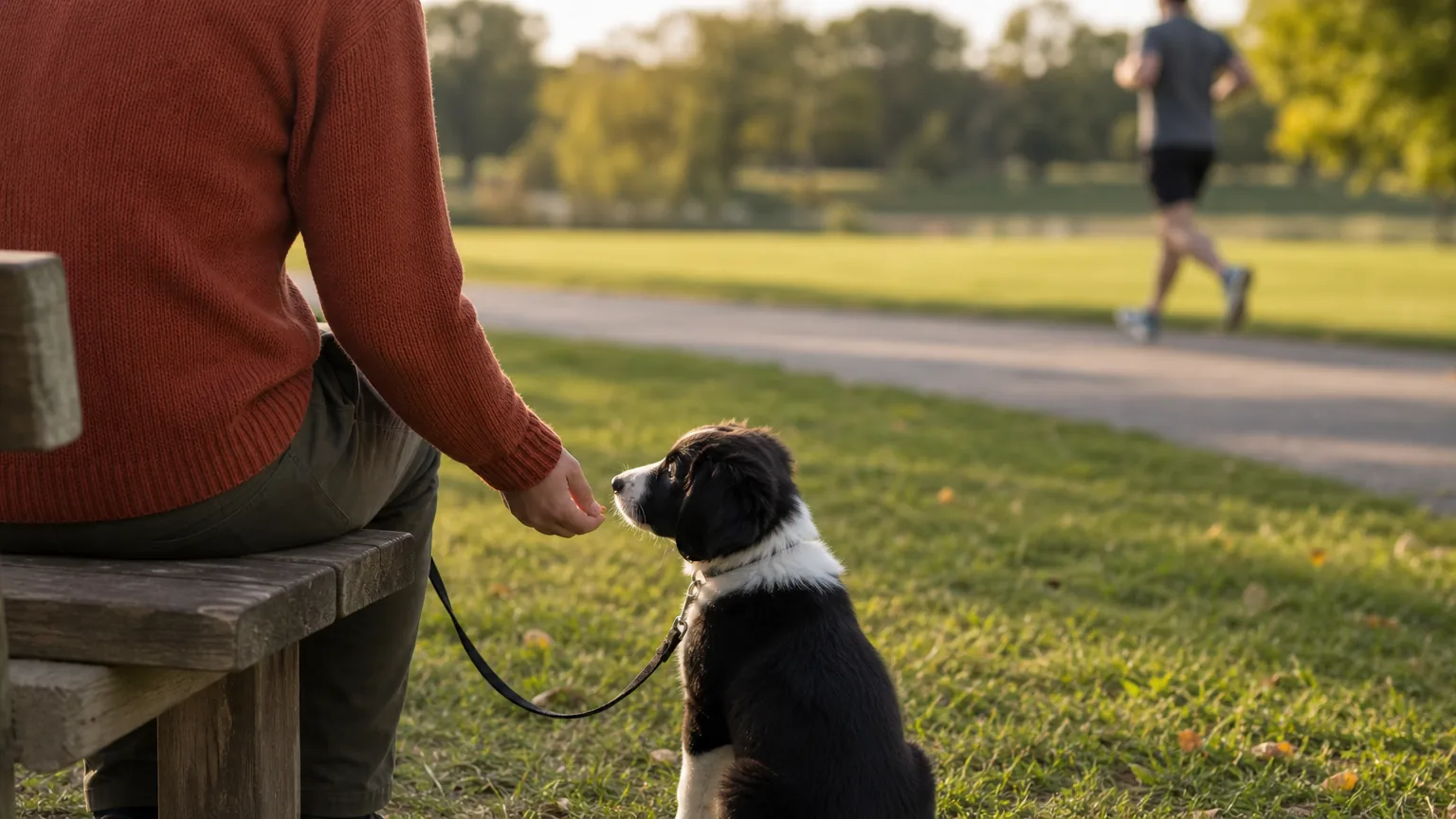
Training follows the same logic: short, easy sessions, lower criteria, and better food than you think you need.
The Puppy Who Plants Its Feet on Walks
A puppy that suddenly sits down at the end of the driveway, or stops at the same corner every day and turns for home, is one of the most common fear period stories. The mistake is to read it as stubbornness and pull. A leash takes away a frightened puppy’s best coping strategy, which is putting distance between itself and whatever worries it, so pulling teaches it that walks are the scary thing.
Instead, walk the other way, since nothing says the route has to pass that corner. Shorten the walk, or spend a few days in the backyard or on a quiet dead-end street. Carry a small puppy past a spot you truly cannot avoid, without stopping to show it the scary thing. And check the gear, because a harness that rubs can stop a puppy just as well as fear can.
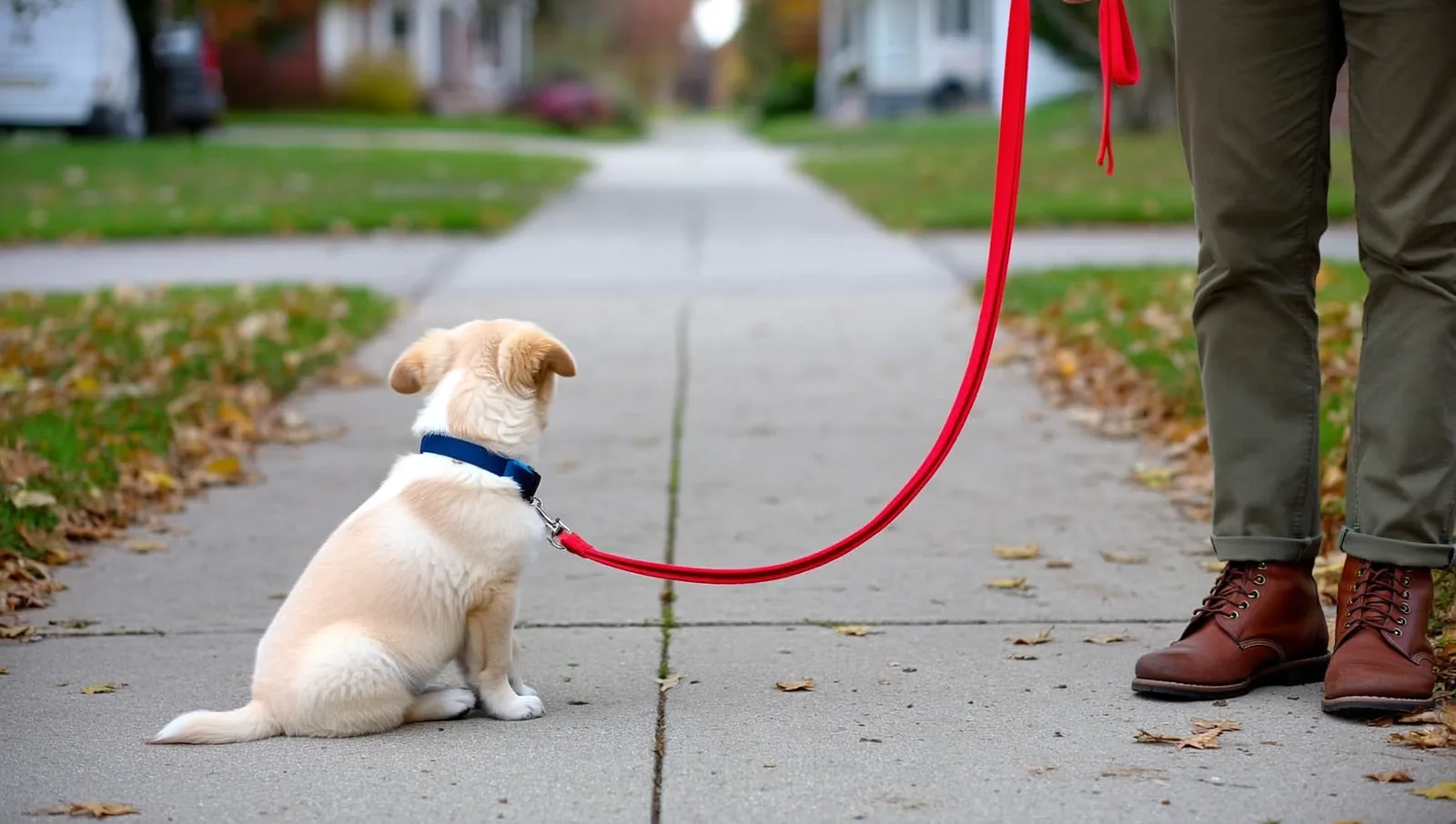
When the fear period passes, rebuild with the same patience you would use for loose-leash walking from scratch.
The Puppy Who Growls at Strangers
A growl from a puppy you thought loved everyone is upsetting, but it is communication. The AKC’s advice on puppies who growl at strangers makes the key point: punish the growl and you may stop the growling, but you have done nothing about the feeling behind it. You have also removed the warning.
So take the information and create distance. For now, ask strangers not to approach, lean over, or pet the puppy at all. Let the puppy do the approaching, at its own speed or not at all. Pair the sight of people with your best food at a distance where the puppy stays relaxed, which might be twenty feet for one puppy and two feet for another, and close the gap only as fast as the puppy stays comfortable.
This is the scenario the guide dog finding should make you careful about. If the growling is aimed at family members, shows up during handling, or comes with snapping, it is no longer a fear period question. Take it to your vet and a qualified behavior professional.
What to Tell Your Class Instructor
Class can be the best support a puppy in a fear period has, or the thing that sours. The AKC notes that puppy classes are great at this age if the trainers understand puppy development and how to support a puppy and owner through a fear period. Help yours by speaking up before class, not after a meltdown. Tell them:
- That your puppy has been spooky since a particular day, what it is worried about, and what it still loves
- That you would like a spot at the edge of the room, with a barrier or chair between you and the nearest dog
- That you may skip off-leash play, or join it with one gentle puppy only
- That you would rather skip pass-the-puppy handling and new equipment, or simply reward looking at it
- That you may step outside for breaks, arrive late, or leave early
A good instructor will make these changes without fuss. One who insists your puppy needs to push through it is telling you something about their methods. Learning to read the stress signals yourself means you can call a break before anyone else notices one is needed.
When It Comes Back at Eight Months
The second window catches owners who thought the hard part was over. Your adolescent dog has graduated from class and now barks at a garden gnome it has walked past all summer. Two things are often happening at once.
One is fear, and the rules are the same as at nine weeks: distance, choice, your best food, lower expectations, no punishment. The dog is bigger, so management matters more. Give more space on walks, pick quieter routes, and have fewer visitors for a while.
The other is adolescence itself. In the Asher study, potential guide dogs (golden and Labrador retrievers and their crosses) were tested at 5 and 8 months, and at 8 months they were less likely to respond to “sit” from their own carer, though not from a stranger. The authors call this a passing phase, but note that it coincides with the peak age at which dogs are relinquished to shelters. If cues that worked at five months have fallen apart, the cause is often mechanical, and the twelve mistakes that stall puppy training are worth auditing before you draw conclusions about your dog.
How Long Until Your Puppy Is Back?
For most puppies, days to a couple of weeks. Recovery rarely looks like a switch flipping. It looks like shorter startles, a puppy that eats in places it refused last week, and one morning, a puppy that walks up to the trash can and sniffs the wheel.
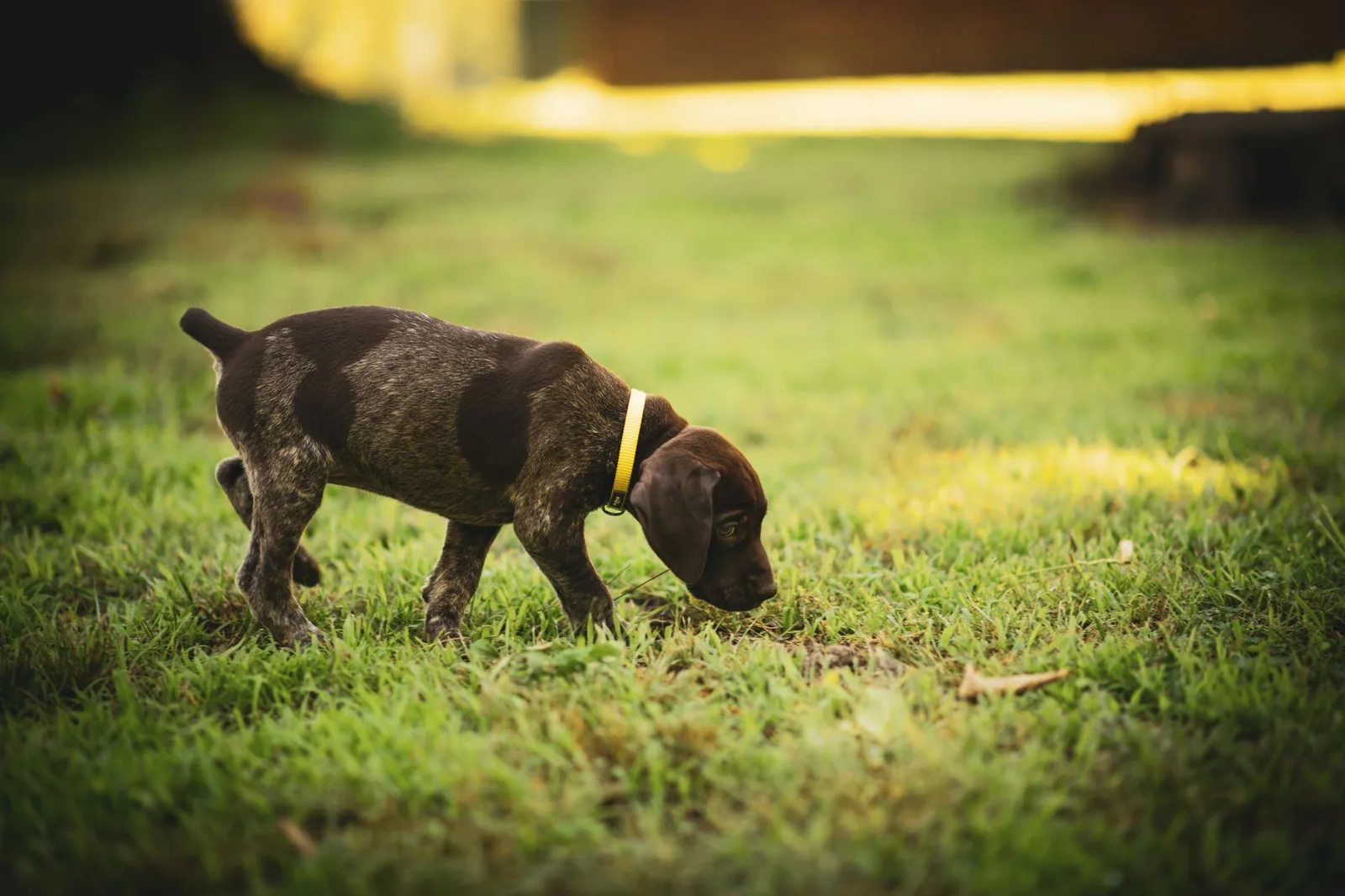
As it passes, bring normal outings back gradually, and revisit the things that scared your puppy in easy versions, at a distance, with good food. Then keep socializing. AVSAB strongly encourages owners to keep socializing puppies past three months, and says exposures should continue into adulthood.
Get help without waiting if fear is still growing after two or three weeks, if new triggers keep appearing, if the puppy cannot recover even somewhere quiet, or if there is any growling or snapping toward family or during handling. For fear that continues, AKC guidance is to involve your veterinarian and a professional trainer who specializes in fear, and a board-certified veterinary behaviorist is the right call for aggression or panic.
Most puppies come out of a fear period with nothing to show for it except an owner who reads them better. That is a good trade for two careful weeks.
Further reading (sources)
- American Kennel Club on keeping training short and easy through both fear periods
- American Kennel Club for why a puppy grumbles at unfamiliar people, and why not to punish it
- American Veterinary Society of Animal Behavior with its position on socializing puppies without overwhelming them
- Morrow and colleagues on breed differences in when fear-related avoidance begins
- Serpell and Duffy for what in the raising environment predicted fear in year-old guide dogs
- Asher and colleagues with evidence for a passing adolescent phase in dogs