Raising Two Puppies at Once: Littermate Syndrome, Solo Training, and Class Logistics
Published on September 29, 2026

The offer usually comes at pickup. The breeder has one left from the litter, or the shelter volunteer mentions that the brother is still in the back and the two have never been apart. The reasoning is hard to argue with: two puppies will keep each other company, wear each other out, and never be lonely while you are at work.
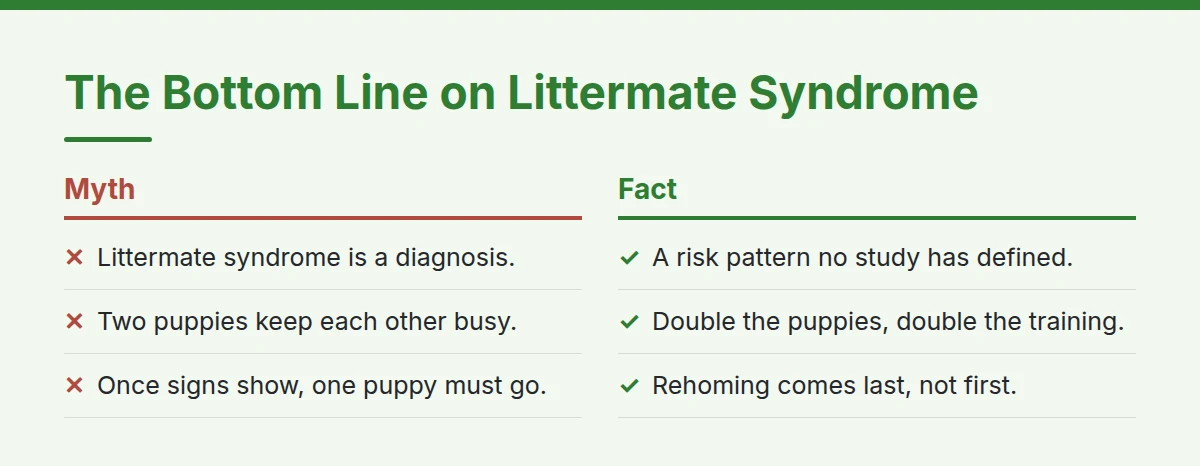
That reasoning is exactly the problem. Two puppies raised as a unit tend to become a unit, turning to each other for everything a puppy is supposed to learn to get from people and the wider world. Trainers call the result littermate syndrome. It is not a diagnosis, it is not inevitable, and it is not limited to littermates. It is the predictable outcome of one particular way of raising two puppies, which means a different way mostly prevents it.
This guide is for the household that already has two and for the one being offered a second: what the label means, the early signs, the daily schedule that prevents it, how to handle class, and the honest arithmetic before you say yes.
What Littermate Syndrome Is, and What It Is Not
The AKC’s trainers put the core worry in one line: littermates “tend to prefer each other’s company over that of any human,” and littermates raised together “sometimes have trouble developing social skills with other dogs or people.” Kayla Fratt, a certified dog behavior consultant writing for the IAABC Foundation Journal, notes that professionals using the term usually mean one of two patterns: a pair that panics when separated, often with a strong fear of anything new, or siblings who start fighting in earnest around social maturity. Some pairs show both, but they are different problems.
What the term lacks is research. When Fratt searched Google Scholar in 2019, she found nothing relevant, and a PubMed search in September 2026 is no better: the phrase does not appear in the title or abstract of a single dog study. Penn State Extension, in a page written by a former assistant clinical professor of canine behavioral welfare, holds both halves at once. “The scientific literature on littermate syndrome is nonexistent,” it says, yet the anecdotal evidence from veterinarians, shelters, and behavior specialists “is overwhelming.” It calls this a phenomenon rather than a true syndrome, one that can occur with any two puppies close in age, related or not.
Three more points keep the label in proportion:
- The sibling is not the cause. Whole Dog Journal notes that veterinary behaviorists do not treat it as a disorder, because the problems come from too little socialization and enrichment, and can show up in a puppy raised alone.
- It is not guaranteed. Harmony Diers, a veterinary technician at Texas A&M’s veterinary school, says the problems are neither a guaranteed outcome nor specific to any breed, though she describes them as more common than not. Fratt points out that many breeders keep sibling pairs without trouble.
- Another dog is not the risk factor. In a University of Helsinki survey of nearly 14,000 pet dogs, dogs with frequent non-social fears (noises, novel situations, surfaces) were more likely to live without another dog. The risk is a housemate who replaces the people and the wider world.
Fratt’s objection to the word “syndrome” is practical. It makes the outcome sound like fate, so owners conclude nothing could have been done, and online advice jumps straight to “rehome one of them.” Treat it instead as a risk pattern with known causes, most of which live in your daily routine.
The Bond You Are Actually Protecting
A 2021 Oregon State University study offers a picture of what normal looks like. Researchers ran adult dogs who shared a home through a secure base test, which looks at whether a companion’s presence lowers a dog’s stress and supports exploration. Most dogs showed that classic attachment toward their person. Most did not show it toward the dog they lived with; those bonds looked more like sibling attachment in people. Both relationships mattered, but they did different jobs.
That is the arrangement to grow: each puppy uses a person as its safe base and the other puppy as a sibling. The pattern to prevent is the swap. Diers describes closely bonded puppies as “in their own world,” looking to each other rather than their owner for how to react to something new, which lets them “feed off of one another’s fear and anxiety.” Her example is ordinary: one puppy discovers that shoes are chewable, the other agrees, and the habit is reinforced between them before you get a vote.
Early Signs Worth Tracking
Plenty of single puppies do each of these things, so no one item means much. What matters is a cluster that gets stronger week by week instead of fading.
- Panic, not protest, at separation. Screaming, scrabbling at the crate, or refusing food when the other puppy is carried out of sight for two minutes.
- Brave together, fragile apart. Confident as a pair, but frozen or fearful with new people, dogs, or objects alone.
- Checking the sibling instead of you. When something new appears, each looks to the other, and cues that work in the kitchen evaporate when the other puppy is in view.
- A bold one and a shadow. One puppy goes first into everything while the other hangs back. Diers lists this lopsided pairing, pushy on one side and timid or withdrawn on the other, among the common signs.
- No interest in other puppies. In class social time the pair seek each other out, or play clumsily and roughly with puppies they do not know.
- Scuffles with an edge. Play that tips into real fights more often, especially from around six months, the age Diers flags.
If you see the first three together, bring the separation work below forward, in small steps rather than all at once. Panic is not a learning state.
The Separation Schedule: Solo Naps, Walks, Meals and Reps
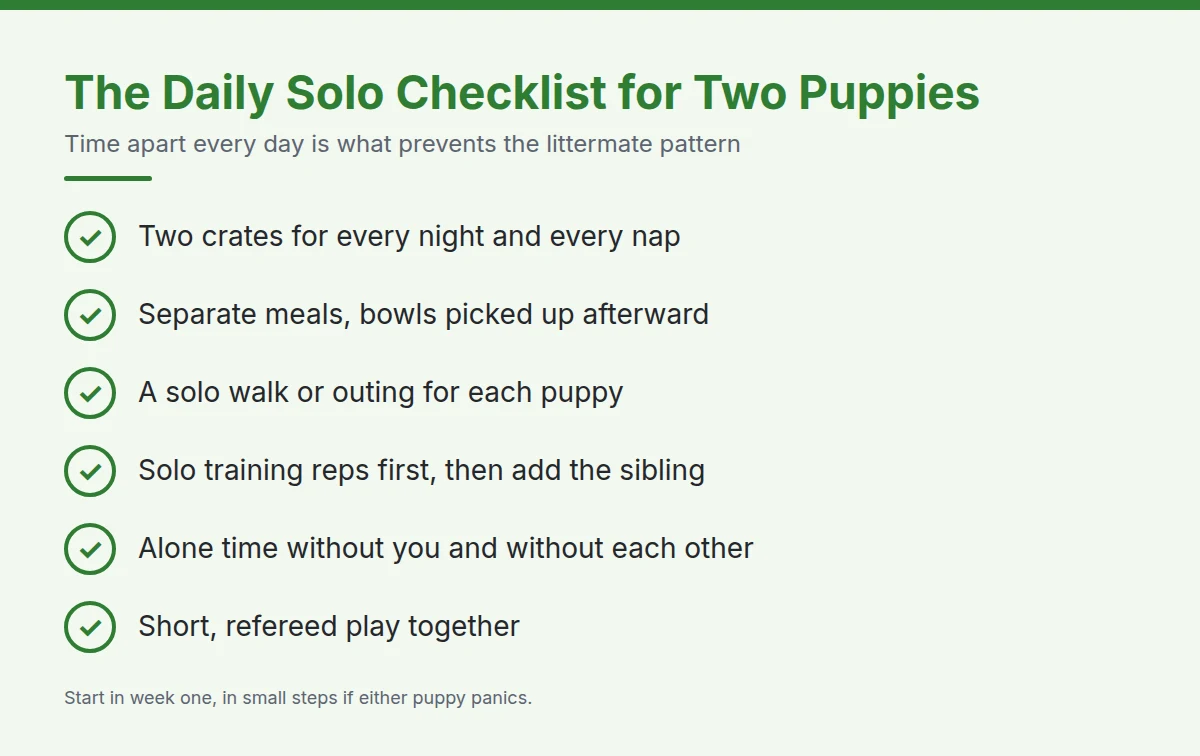
The AKC’s advice for littermates is concrete: plenty of time apart, only short periods of play together each day, and lots of one-on-one time with their people, spent playing and training. Fratt’s shelter experience shows the opposite. Many of the hyperbonded pairs she met had been “crated together, walked together, taken to the vet together,” and had never been apart. The goal of the schedule below is for time apart to be ordinary and a little boring, not an event.
Sleep. Two crates from the first night, in separate rooms or with real distance between them, as Diers suggests. Naps count too: after play, each puppy goes to its own crate or pen with a chew.
Meals. Separate crates or rooms, with bowls picked up afterward. Fratt names slack management of food and resting spots as one of the conditions that turns sibling pairs into problem pairs, and a shared pile of kibble is where guarding habits get practiced.
Potty trips. One at a time at first. Whole Dog Journal points out that littermates do not housetrain at the same rate, and you only learn each puppy’s signals by watching them individually. Pick up after every trip; two puppies fill a yard fast, and prompt cleanup is the first step in stopping a puppy from eating poop.
Outings. Each puppy gets its own socialization trips. Whole Dog Journal calls this critical, since the two may tolerate new places and things very differently. A trip that suits the bolder puppy can overwhelm the quieter one.
Walks. Diers’s progression runs from solo walks and outings in the first months, to both puppies out at once with a handler each, to walking them in opposite directions while you watch for distress. The test is whether each puppy cares more about its person than about where its sibling went.

Training reps. Separate, and starting now. The AKC’s answer to an owner of four-month-old littermates was that training “needs to be done separately with each puppy and can start ASAP.” Board-certified veterinary behaviorist Valli Parthasarathy, interviewed for the AKC about a new puppy and an older dog, describes the next step in terms that fit a pair: “It’s important for them to be separated from each other and be able to do things and do cues in each other’s presence and each other’s absence.” Train solo first, then with the other puppy crated in the room, then with it on a mat beside a second person, and only then both loose together.
Alone time. Each puppy needs practice being alone, without you and without its sibling. The alone-time ladder for young puppies works the same way for a pair, run one puppy at a time.
Class Logistics: One Puppy, One Spot, One Handler
Put two siblings in the same class and each spends the hour watching the other, the social segment turns into sibling play instead of meeting new puppies, and one handler’s attention splits in two. Fratt notes that owners who raise sibling pairs successfully go to class, shows and trials with one dog at a time, and Diers recommends separate classes outright.

Rank your options:
- Two classes, one handler each. Different nights, or back-to-back sessions. This is the setup that works as intended.
- One class, two handlers, if the instructor agrees. Opposite ends of the room, a visual barrier if there is one, and never partnered for play. If either puppy spends the session watching its sibling, split them.
- One adult, two puppies, one class. Don’t. Nobody can time reinforcement well for two learners at once.
Both puppies need to be in class inside the socialization window, which closes whether they are enrolled or not, so stagger them by night, not by session. Tell the instructor at registration that the puppies are littermates and ask how they handle pairs; a good one will have an answer. Then budget for two full enrollments. Our guide to what puppy classes cost gives the usual ranges, and the second puppy’s place is not the line to trim.
Splitting the Work: Two Adults or One
Two adults. Give each adult a class puppy so each puppy has a consistent handler in the room. At home, swap for training reps and walks so both puppies learn both people; a puppy bonded to only one person has traded one narrow attachment for another.
One adult. This is the hard version, and what makes it possible is crate-and-rotate, one of the management strategies Fratt recommends. One puppy settles in a crate or pen with a stuffed food toy while the other gets its walk, reps or outing, then they swap. Make the crate half of each block genuinely good, so the resting puppy is working on a chew rather than waiting to be let out. You will need two class nights or a friend to handle the second puppy, and some days one puppy will get the full program and the other a shorter one. Just make sure it is not the same puppy every day.
Penn State’s page has the line every one-adult household should read first: a second puppy should not be viewed as “helpful” or “easier,” because “puppies do not raise themselves.”
Play Between the Pair: Short, Refereed, and Not the Only Outlet
The AKC’s formula for littermates is short play sessions together each day, not play as the background noise of the house. Free play all day causes two problems. The first is that owners start counting it as dog socialization. Fratt calls this an especially easy trap with siblings: two same-age puppies playing together is no substitute for meeting other dogs, and the owners she knows who did well introduced their puppies to other dogs both together and separately.
The second is that nobody referees. Parthasarathy counts the idea that dogs can work out issues by themselves among the big myths, and siblings are no exception. Watch for the usual warning signs: one puppy always on top, the quieter one trying to leave, the pauses disappearing. The consent test and recall-out-of-play drill in our guide to puppy play work on siblings too, and the same guide explains why a resident adult dog should not become a puppy’s entertainment. The other puppy is not the babysitter either. Fratt and Diers both mention that an older, steady dog can help a pair, so if you have one, treat it as a role model with an exit, not a nanny.

Plan for adolescence now. Fratt’s review of the research on household aggression points to sex as one variable: same-sex pairs may be more prone to conflict, and fights between two females tend to be harder to resolve. If scuffles are getting sharper, keep toys and chews out of shared space, separate the puppies before arousal peaks, and get professional help early.
Before You Say Yes to the Second Puppy
The honest math is not “two puppies for a little more than the price of one.” Penn State sums up the training side: “Double the puppies, double the training.” Separate reps do not overlap, so the time does not either. If one puppy’s day holds three short training sessions, two walks and an outing, the pair’s day holds six sessions, four walks and two outings, plus the rotation time in between. Everything else doubles too: two vaccine series, two spay or neuter surgeries, two class enrollments, and later two adolescences arriving in the same month.
Both university sources land in the same place. Penn State says the best way to avoid littermate syndrome is to have one puppy at a time, and Texas A&M’s advice is to avoid raising two puppies at once. If you want two dogs, the easier route is one puppy now and a second once the first is through adolescence and reliably trained.
If you already have two, that is not a mistake to undo. Whole Dog Journal is clear that raising two same-age puppies well is possible if you treat each one as an individual. The schedule above is what that looks like on an ordinary Tuesday.
If the Pattern Is Already There
Separate in steps small enough that neither puppy panics: a baby gate with both in sight, then a few seconds out of sight with something good to eat, then longer. Do not jump straight to a week of separate rooms. For a pair that screams at any separation, freezes around new people or dogs, or fights with real intent, bring in an IAABC-credentialed behavior consultant, or a board-certified veterinary behaviorist whenever fear or aggression is involved. Dog training is unregulated in most states, so check credentials before you hire anyone.
Rehoming one puppy is sometimes the kindest outcome for a pair who cannot live together safely, but it should come after the management, training and professional help above, not as a reflex. As Diers notes, with so many dogs already in shelters, it is not always the best option.
The Bottom Line
Littermate syndrome is not a curse that comes with siblings. It is what tends to happen when two young puppies spend so much time together that each becomes the other’s whole world. Break that up on purpose, every day: separate crates, meals, walks, training and classes, plus short, refereed play together. Start in the first week, and you end up with two dogs who each look to you first and happen to like each other.
Further reading (sources)
- AKC GoodDog! Helpline trainers on training two littermate puppies separately
- American Kennel Club with a veterinary behaviorist on why dogs cannot sort out problems alone
- Kayla Fratt in the IAABC Foundation Journal for the case that no science backs the label
- Penn State Extension on littermate syndrome as a phenomenon rather than a diagnosis
- Texas A&M School of Veterinary Medicine for separate crates, walks and classes for puppy pairs
- Whole Dog Journal on raising two same-age puppies as individuals
- Sipple and colleagues with how adult dogs attach to their people versus the dogs they live with
- Hakanen and colleagues on living without another dog as a correlate of non-social fear