The Puppy Blues: Surviving Burnout, Regret, and the Weeks Before It Gets Better
Published on September 11, 2026
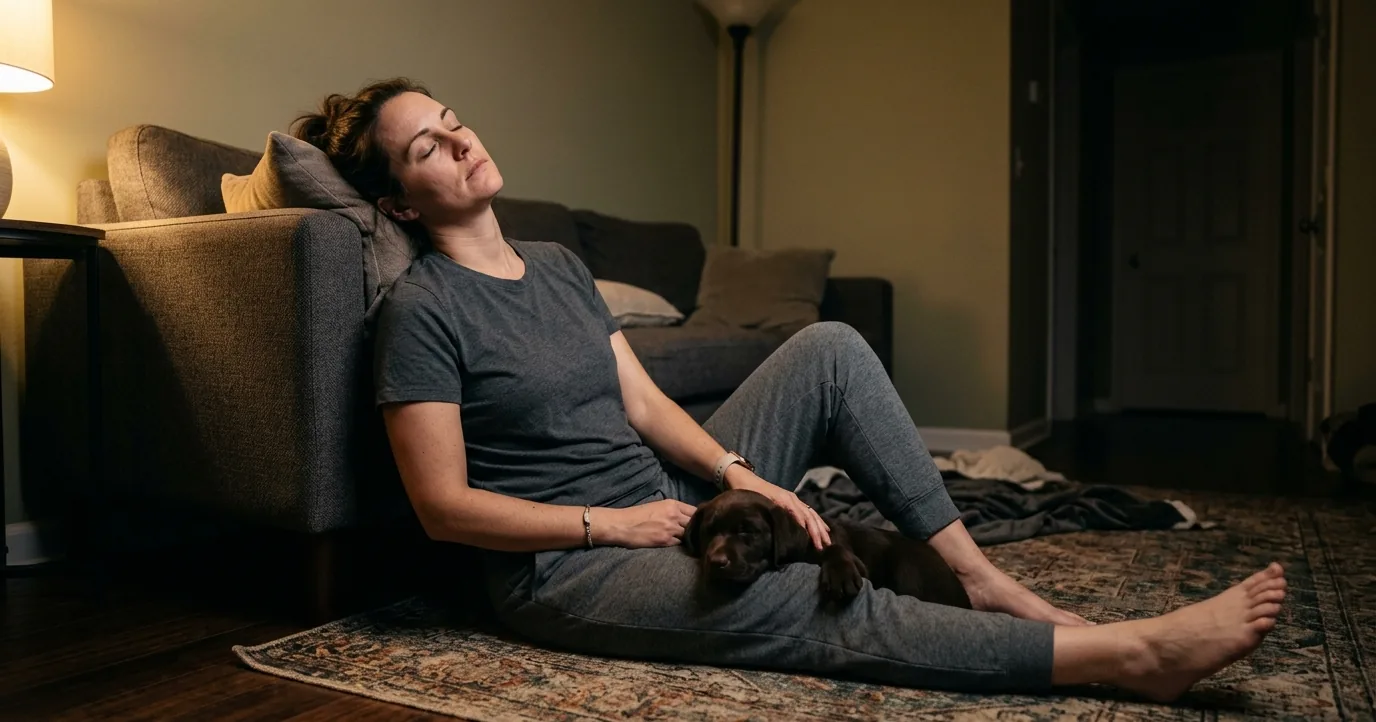
It is a Tuesday. You have had four broken hours of sleep for eleven nights running, there is a fresh puddle by the back door, and the puppy you waited six months for has just latched onto your wrist again. Somewhere underneath the exhaustion is the thought you have not said out loud to anyone, including the person who picked the puppy out with you: I think I have made a terrible mistake.
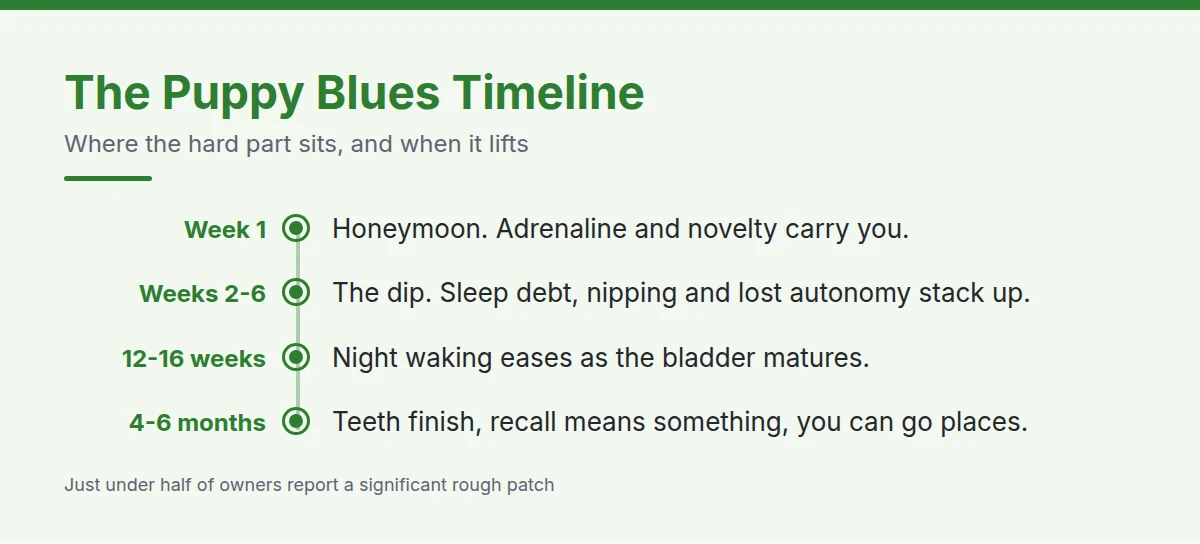
The Puppy Blues Are a Documented Thing, Not a Character Flaw
Researchers at the University of Helsinki surveyed more than 2,000 dog owners about the emotional experience of raising a puppy and built a measurement tool out of the answers, published in npj Mental Health Research in 2024. They called it the puppy blues scale, deliberately echoing the baby blues, and the results are worth knowing on a bad night.
The strain sorted itself into three distinct clusters. Anxiety, meaning heightened worry about the puppy and about your own adequacy as its owner. Frustration, which the researchers describe as irritation, feeling burdened, difficulty bonding, and regret. And weariness: plain exhaustion, disrupted sleep, and the sense of being permanently on call. The three usually arrive together, though plenty of owners get one much harder than the others.
Just under half of the owners surveyed reported significant negative experiences during their dog’s puppyhood. About a tenth reported the most severe levels of strain, which the researchers noted is broadly in line with the prevalence of postnatal depression in people. That is not a fringe experience. That is closer to a coin flip.
The study also explains why nobody warned you. The longer the time since puppyhood, the more positively owners remembered it. Every person at the park with a calm two-year-old dog has genuinely, neurologically forgotten the worst of this. They are not lying to you. Their memory has quietly sanded the edges off, which is how the brochure version of puppy raising survives contact with reality.
Why Weeks Two to Six Are the Worst of It
The dip has a fairly predictable shape, and it is not week one. Week one runs on adrenaline, novelty, and a stream of people wanting to see photos. The crash tends to land once the novelty burns off and the arithmetic sets in, roughly somewhere between the second and sixth week home.
Three loads stack on top of each other in that window.
Sleep debt is cumulative, not daily. One broken night is an inconvenience. Fourteen of them in a row degrades patience, emotional regulation, and your ability to see a situation clearly. Most of the despair owners report at this stage is, mechanically, a sleep problem wearing a costume.
Autonomy disappears all at once. You cannot leave the house for more than a couple of hours. You cannot finish a meal sitting down, take an unplanned evening out, or work an uninterrupted ninety minutes. For adults used to running their own schedule, that loss is genuinely destabilizing, and it is rarely what people expect to grieve.
There is an animal in your house that bites you. Mouthing is normal, developmentally necessary, and how a puppy learns bite inhibition. Knowing all of that does not change how it feels to be bitten forty times a day by something you are supposed to be bonding with. Teething peaks in the same window, which is exactly when your tolerance is lowest.
None of those three is a training failure. They are the predictable cost of a baby animal, front-loaded into about a month.
Regret Is Not Evidence You Got the Wrong Puppy
Here is the number that should settle this. When the AKC reported on a survey of people who became first-time dog owners during the pandemic, 73 percent said they had considered rehoming their dog. Seventy-three percent. The reasons owners gave were not that they had bad dogs. They were surprised by the time and the money involved, and they did not have good enough access to information about what they had taken on.
So regret, on its own, tells you almost nothing about whether this was the right puppy. It tells you about your load. The useful question is not “do I regret this?” at eleven o’clock at night, because the honest answer on no sleep is frequently yes. The useful question is whether the regret survives a full night’s sleep and two afternoons off duty. If it does, that is worth taking seriously, and there is a section on it further down. If it evaporates the moment you are rested, you did not have a dog problem. You had a sleep problem.
The Four Pressure Points, and What Actually Moves Them
Owners in the dip usually describe the same four things.
Night waking. An eight-week-old puppy has a bladder that physically cannot last eight hours. This is plumbing, not obedience, and no amount of training shortens it much. What helps: put the crate beside your bed so you are not walking the house at 3am, and set an alarm to take the puppy out before it wakes you. Being the one who chose to get up is far less corrosive than being dragged out of sleep by screaming. Keep the trip boring, with no play and almost no talking. Expect a real step change somewhere around twelve to sixteen weeks. The crate work is the piece that pays this back fastest, and it is worth running a proper step-by-step crate routine rather than improvising each night.
Nipping. The single most useful thing to know is that nipping spikes when a puppy is overtired, not when it is being naughty. If you redirect onto a legal chew and the puppy comes straight back at your hands twice in a row, you do not have a bite inhibition problem in that moment. You have an overdue nap. Puppies at this age sleep eighteen to twenty hours a day, and the frantic, biting version is what you get when the awake block ran long.
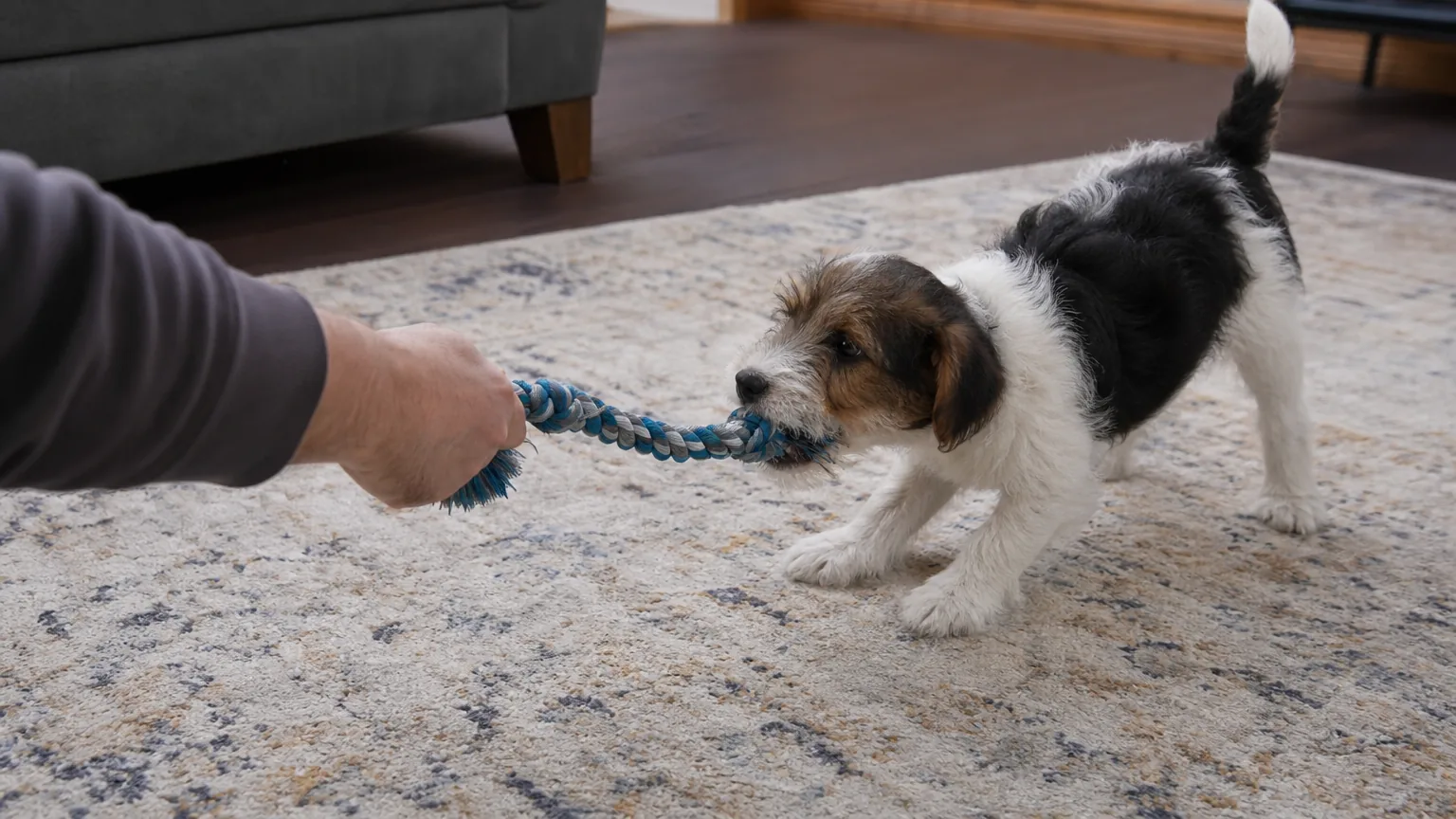
Potty setbacks. A puppy that was doing well at ten weeks and starts having accidents at fourteen has not forgotten. Usually your supervision has quietly relaxed as your confidence grew. Tighten the schedule back up for a week and it generally resolves. One exception worth taking seriously: if accidents come with frequent squatting, straining, obvious discomfort, or blood, that is a vet appointment before it is a training plan.
No free time at all. This one has no clever fix, because the honest answer is not a better routine. It is fewer hours on duty, which means asking for help.
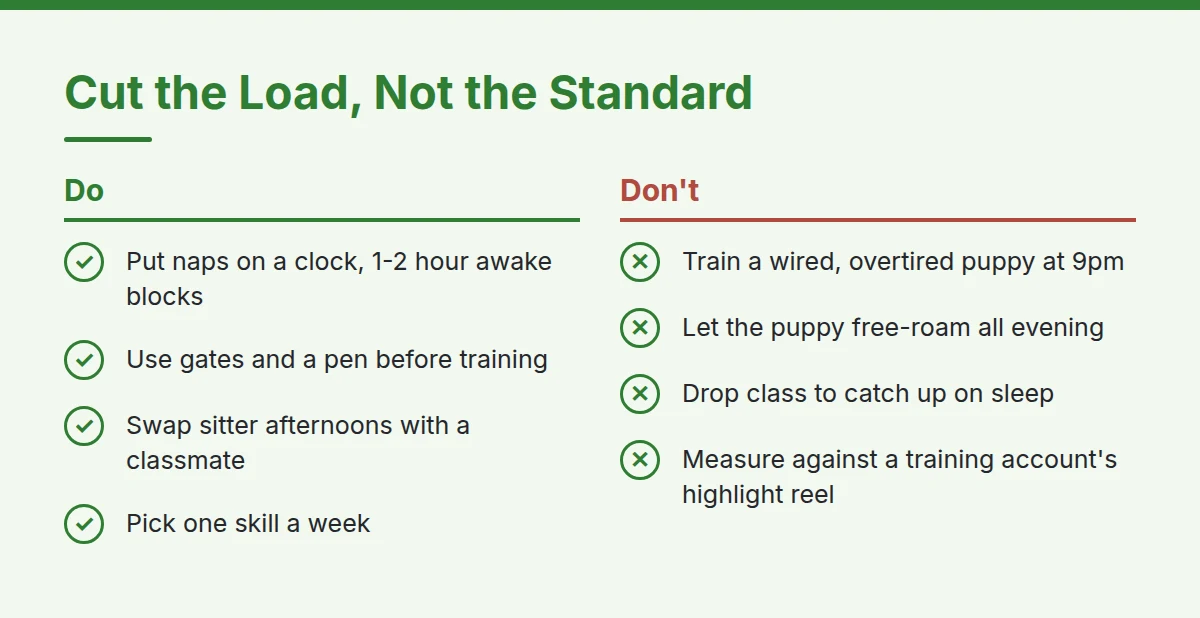
Cut the Load, Not the Standard
The instinct in the dip is to try harder. That is almost always the wrong lever. The right one is reducing how many hours a day you are actively responsible for a conscious puppy.
- Put naps on a clock. Cap awake blocks at roughly one to two hours for a young puppy, then crate or pen it whether it looks tired or not. Enforced naps do more for a household’s mood than any training drill, and they make the training that does happen stick.
- Manage before you train. Gates, a pen, a closed door, a house line you can step on. Every square metre of the house you close off is an hour of supervision you get back, and management costs you nothing emotionally.
- Set up a sitter swap. Trade afternoons with another owner from your class, or pay someone for two hours. Two hours where you are not listening for a puppy is worth more than four hours where you technically could be resting.
- Pick one skill a week. Not ten. A puppy that learns one thing properly per week is progressing at a completely normal rate.
- Lower the public bar. An eleven-week-old that pees outside most of the time, settles in a crate, and takes food from your hand is on track. That is the actual standard. Measuring yourself against a training account that posts a nine-week-old doing a two-minute stay is measuring yourself against somebody’s highlight reel and several hundred unposted takes.
What a Good Class Actually Does For You
Puppy class is sold as socialization for the puppy, and it is. But for an owner in the middle of the dip, its most valuable function is something the marketing never mentions: it is one hour a week in a room with six other people who also have not slept, where someone qualified tells you that what your puppy is doing is normal.
That normalization is not a soft benefit. The Helsinki researchers’ own recommendations, and the AKC’s coverage of the study, both land on the same practical advice: express what you are feeling rather than hiding it, reduce other stressors during puppyhood, and do not try to do this alone. A class is the cheapest, most structured version of “not alone” available to a new owner.
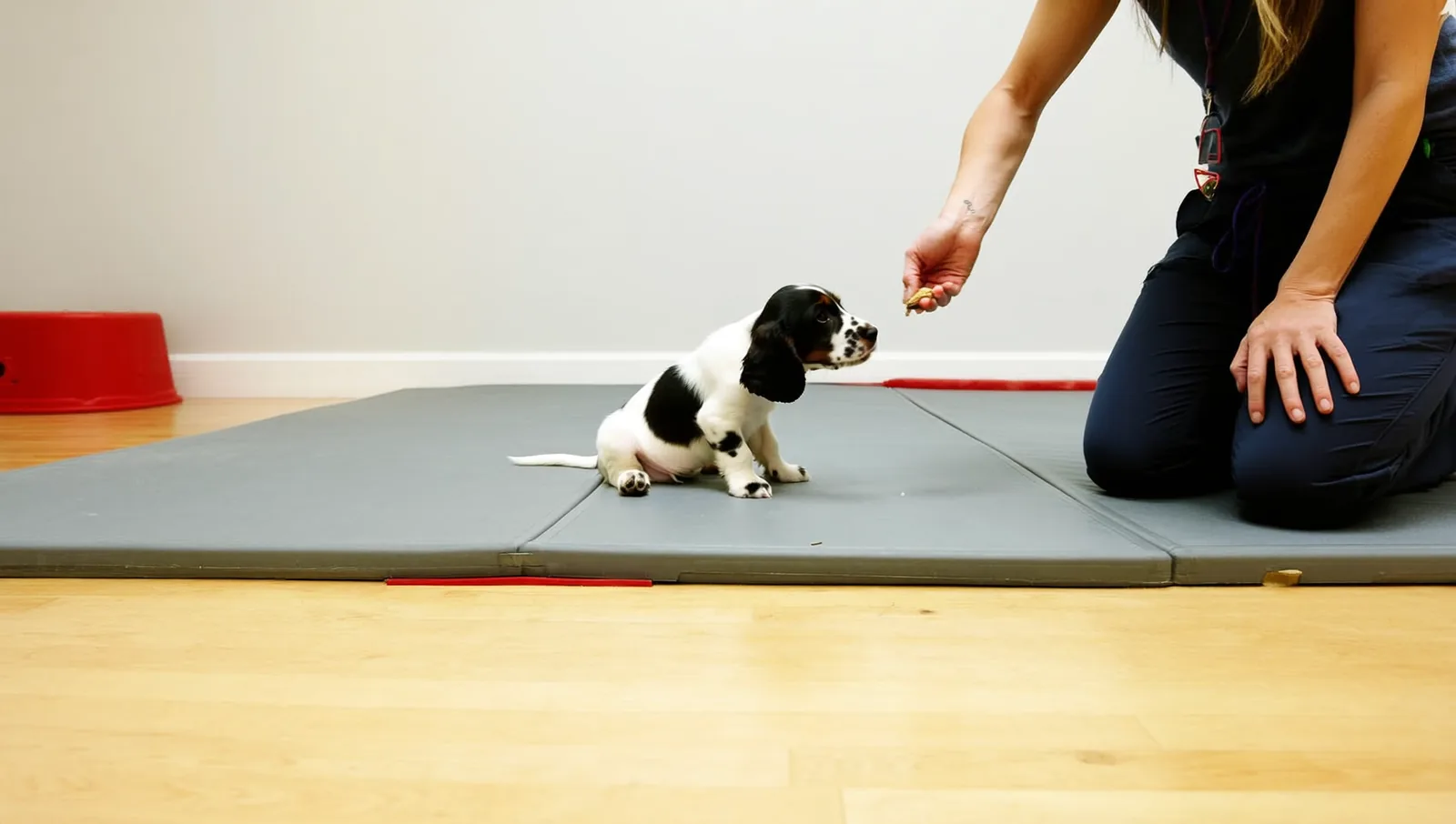
The second thing class gives you is one fixed hour of visible progress per week. When everything at home feels like regression, having one measurable thing that is better than it was seven days ago is disproportionately steadying. That, more than any individual cue, is the real argument for enrolling early and staying enrolled.
Tell Your Instructor You Are Struggling
Say it plainly, in those words, before or after class: we are not sleeping, and I am struggling. Instructors hear this constantly and a good one has levers.
They can cut your homework to one exercise. They can move you to a morning slot, which is a better hour for a baby dog anyway. They can pair you with a calmer puppy for partner work instead of the one that spends the hour screaming. They can give you a realistic two-week target instead of a curriculum. And they can tell you where your puppy actually sits relative to the others, which is usually far more reassuring than you expect.
Pay attention to the answer you get. An instructor who responds to “I am exhausted” by suggesting you need to be firmer, or by recommending a correction collar to shortcut the hard part, has told you something important about their methods. That is a reason to look harder at the class you picked, not a reason to push through.
When Rehoming Is the Right Call
It needs saying honestly, because the alternative is owners sitting in silent misery for years.
Most rehoming impulses in week three are made by a sleep-deprived brain and pass. But some are correct. A genuine mismatch between the dog’s needs and your life that no amount of management closes, a household member whose health or safety is actually at risk, a serious behavior problem that needs a veterinary behaviorist you cannot afford, or your own mental or physical health collapsing under it: those are real, and staying out of guilt serves nobody, least of all the dog.
If you are there, three things first. Get one genuinely full night of sleep, with someone else taking the puppy overnight. Get the puppy vet-checked, because pain and illness look a lot like an impossible temperament. And have one honest conversation with your instructor or vet about what you are dealing with. If the answer is still the same after those three, it is a real answer rather than an exhausted one.
Doing it early, openly, and well is not a failure. A reputable breeder will take a puppy back for life and should be your first call. Breed-specific rescues place dogs with full disclosure and good matching. A puppy rehomed at fourteen weeks to a household that suits it has a better life than one kept for a decade by someone who resents it. Separately, if your own symptoms are persisting rather than lifting, the advice from the researchers and the AKC alike is to speak to a doctor. Puppy blues that do not fade are worth a professional conversation, and so is any puppy showing real fear or aggression, which belongs with a board-certified veterinary behaviorist (a DACVB).
There Is a Horizon, and It Is Closer Than It Feels
Somewhere around four to six months, the nights consolidate, the teeth finish, the bladder catches up, and the recall starts to mean something. The puppy becomes a dog you can take places. Owners who were certain at week three that they had ruined their lives are, by month six, the ones at the park telling a stranger that puppies are hard but it passes quickly. Their memory will sand the edges off too.
If you need something to aim at while you wait, pick a concrete goal rather than a feeling. Working toward S.T.A.R. Puppy and then the Canine Good Citizen gives the next few months a shape, a syllabus, and a date on the calendar, which on a bad Tuesday is worth more than reassurance.
Further reading (sources)
- American Kennel Club on what the puppy blues study found and how to cope with it
- University of Helsinki for the survey that put numbers on new-owner strain
- npj Mental Health Research with the validation of the puppy blues scale itself
- Pets (MDPI) on caregiver guilt and burden among owners of dogs with behavior problems