What Your Family Can Catch at Puppy Class: Giardia, Ringworm, Roundworm, and Sensible Hygiene
Published on October 6, 2026

Picture week one. Eight puppies between 9 and 14 weeks old sit on their mats, every one of them partway through a deworming schedule that is not finished yet. Around them are their families, and in plenty of those families there is a four-year-old on the floor who wants to pet every puppy in reach and will have a hand in their mouth a minute later.
That pairing, puppies and small children, is exactly the one public health vets write guidance about. Puppies are the age group most likely to carry intestinal parasites, and young children are the age group most likely to swallow what a puppy sheds. The reassuring part is that the list of infections that genuinely move from puppy to person is short, the risk from a well-run class is low, and the habits that make it negligible are the same dull ones your pediatrician already recommends. Here is what can travel from the puppy side of the room to yours, how likely it is, and what a good facility and a sensible household do about it.
Why Puppies and Small Children Are the Pairing to Watch
Start with the puppy. The dog roundworm, Toxocara canis, passes from mother to puppies before birth: larvae that have lain dormant in her tissues wake up late in pregnancy and cross the placenta. The Companion Animal Parasite Council (CAPC), a veterinary body that publishes parasite control guidelines, says some studies have found virtually all puppies are born infected, and that US surveys show more than 30 percent of dogs under six months old shedding roundworm eggs. That is why the recommended deworming schedule starts at two weeks of age, before those worms are old enough to shed eggs.
Giardia, a single-celled gut parasite, is common in dogs too. CAPC notes that dogs from shelters, breeding facilities and kennels are more likely to carry it. The CDC says young animals such as puppies are more likely to get sick from it than adults, and that an animal’s poop can contain Giardia even when the animal looks healthy.
Now the child. The National Association of State Public Health Veterinarians (NASPHV), whose compendium sets the standard recommendations for places where the public has contact with animals, lists children under 5 as being at greater risk of picking up gut infections from animals because of how they behave around them: they get closer, and they touch their faces more than adults do. A review of pet-borne infections by veterinary public health researchers at Utrecht University adds that young children put their hands or other objects in their mouths every two to three minutes.
One more fact before the list: fecal germs do not stay in feces. NASPHV points out that animal fur, skin and saliva carry fecal organisms, so petting, holding, kissing and being licked all count as contact. That does not make puppies dirty. It means the moment that matters is the one between touching a puppy and touching a snack. (The handling and supervision side of kids and puppies has its own guide to bringing a puppy home to a family with kids.)
The Short List: What Actually Moves From Puppy to Person
Roundworm: Serious When It Happens, and Mostly a Yard Problem
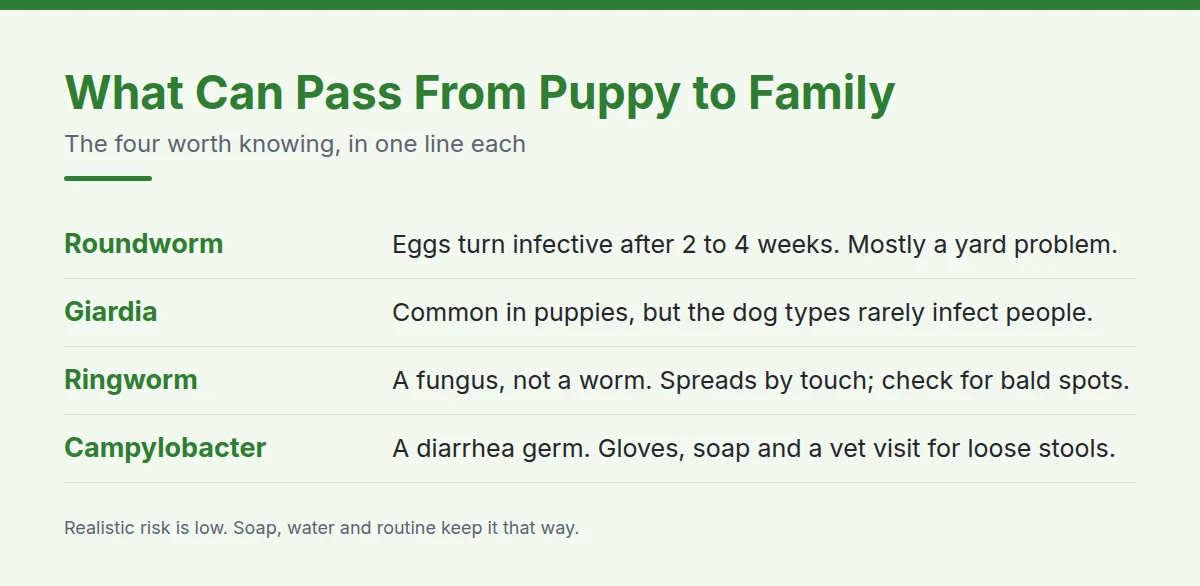
Roundworm has the worst reputation of the four, and the details are more reassuring than the reputation. Its eggs are not infectious when a puppy passes them. CAPC says most need two to four weeks in the environment before they can infect anyone, which means a fresh accident on a class floor, cleaned up promptly, is not a roundworm risk. The danger builds where droppings are left to break down unnoticed: yards, parks, flowerbeds and sandboxes. Once there, CAPC says, the eggs can stay infective for years, and common disinfectants do not kill them.
People get infected by swallowing those eggs, usually from soil on unwashed hands. Many never have symptoms. In others the larvae wander through the body, and the CDC describes two forms: one that moves into organs such as the liver, and one that reaches the eye, where it can inflame and damage the retina and cause vision loss, typically in one eye. CAPC says infection is most common in children, and the CDC says severe cases are more likely in young children who have been playing in or eating contaminated dirt. Most cases can be treated with medication.
How common is it? When CDC researchers tested blood from more than 13,500 Americans aged 6 and older in the 2011 to 2014 national health survey, about 5 percent had antibodies showing past exposure. That figure counts exposure, not illness, and it was lower than the estimate from the 1988 to 1994 survey.
Hookworm follows the same logic. Its larvae live in contaminated soil and infect people through bare skin that touches it, causing skin lesions. Like roundworm, it is a yard and sandbox problem rather than a classroom one, and the same routine of deworming and daily poop pickup is the defense.
Giardia: Common in Puppies, Rarely the Kind People Catch
Giardia is common: in one survey CAPC cites, it was the most common intestinal parasite found in dogs. It is also the one where a class floor accident does matter, because CAPC says Giardia cysts are immediately infective when passed. Most infected dogs show no signs. When they do, the usual sign is diarrhea, which may come and go.
What keeps the human risk low is that Giardia comes in types, and dogs mostly carry types adapted to dogs. “The type of Giardia that makes people sick is usually not the same type that makes dogs and cats sick,” the CDC says, and CAPC’s guidance is that transmission from dogs to humans appears to be rare. A Spanish public health team that tested 63 households found Giardia in 29 percent of the dogs but just 3.4 percent of the people, and not one household where a pet and its owner had it at the same time. The three dog samples the lab could genotype were all a dog-specific type. NASPHV’s conclusion is plain: domestic animals in public settings do not pose a significant risk of giardiasis to people.
Low is not zero. CAPC advises people whose health makes them more susceptible to limit contact with a Giardia-positive pet, and says anyone who develops stomach symptoms after exposure should see a doctor. If your puppy is diagnosed, your vet will treat it, and CAPC recommends a bath on the last day of treatment to wash cysts off the coat. The CDC asks owners to keep a pet that has diarrhea, or is on Giardia treatment, out of shared outdoor dog spaces such as dog parks, and the same logic applies to a class floor.
Ringworm: A Fungus That Travels on Fur
Ringworm has nothing to do with worms. It is a fungal skin infection, and the veterinary dermatologists who wrote the World Association for Veterinary Dermatology’s consensus guidelines describe it as contagious and transmissible to people. The Utrecht review calls it a common zoonotic skin infection, mainly in children, and notes that infected animals can carry the fungus without showing any signs. It spreads by contact, either directly from an animal’s skin and hair or indirectly from things the fungus has landed on, such as bedding, towels and grooming tools. In people it most often appears as a ring-shaped rash.
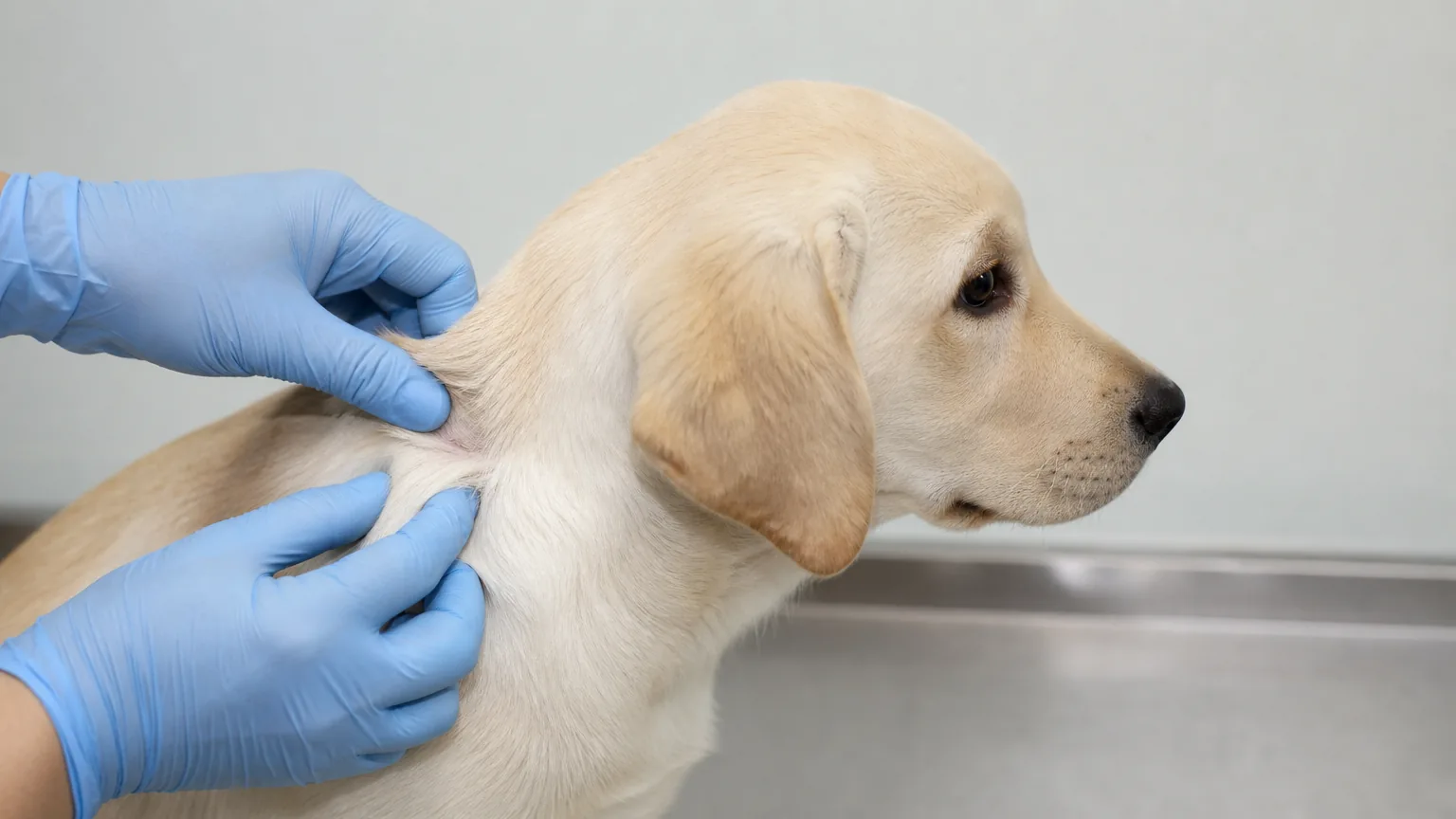
On a puppy, look for round patches of hair loss, often with scaly or crusty skin. A puppy with a patch like that should see the vet before the next class. According to the consensus guidelines, treating the dog takes oral antifungal medication together with a topical treatment for the coat, and for the house, physical cleaning is what matters most. The same guidelines note that serious complications from catching ringworm from an animal are exceedingly rare. For a child it is a nuisance that needs a visit to the doctor, not a crisis.
Campylobacter: The Diarrhea Germ With a Pet Store History
Campylobacter is a bacterium that causes diarrhea, and puppies earned it a place on this list in 2018, when CDC and state health investigators published an outbreak traced to them. Between January 2016 and February 2018, 118 people in 18 states fell ill, 29 of them pet store employees. Nearly all of the patients had touched a puppy from a pet store. Their ages ran from under 1 to 85, and about a quarter of those with known outcomes were hospitalized, though nobody died. The outbreak strain resisted every antibiotic commonly used to treat Campylobacter, and 95 percent of the puppies whose records investigators checked had been given antibiotics, most often as a preventive measure. Puppies from six pet store companies were involved, which suggested they picked up the infection before they reached the stores.
You do not need a pet store puppy for the lesson to apply. Any puppy with diarrhea is a reason for gloves at cleanup, careful handwashing, a fecal test at the vet, and a break from class until your vet clears it. If someone at home gets sick afterward, tell the doctor about the puppy. In this outbreak the CDC advised clinicians to culture the bacteria and test which antibiotics would work before choosing one.
What a Well-Run Class Does About Hygiene
Most of what makes a class safe for families is visible in the first five minutes. The standard for early puppy classes from the American Veterinary Society of Animal Behavior (AVSAB) asks for a first deworming as well as a first set of vaccines, says each puppy should be disease and parasite free before entering class, and prefers surfaces that are easy to clean and disinfect. Beyond that, here is what good practice looks like, drawn mostly from the NASPHV compendium:
- A sink, soap and paper towels. Sanitizer gel by the door is a useful extra, but NASPHV says washing with soap and water is still preferred, because sanitizers do not work equally well against every kind of germ and work poorly on hands that are heavily soiled. A good instructor tells families where the sink is.
- An accident routine, done properly. Pick up the mess, clean the spot to remove organic matter, then disinfect. NASPHV says products should be used as the label directs, and most need more than 10 minutes of contact time on the surface. CAPC adds that surfaces should dry thoroughly after cleaning. A quick spray and wipe while puppies walk through it does not do the job.
- A sick-puppy rule that is enforced. Diarrhea, vomiting, coughing or patchy hair loss means sitting out that week. NASPHV’s position is that direct public contact with ill animals is inappropriate for any audience.
- Paperwork that goes beyond vaccines. The shots a class can ask for cover viruses and say nothing about worms, so a class that also asks for a deworming record, or a recent fecal test, is taking the parasite side seriously.
- No human food on the training floor. During the puppy outbreak, the CDC’s prevention messages included keeping human eating areas separate from animal areas. Kids’ snacks happen after handwashing, away from the mats.
- Each family feeds its own puppy. Treats come from your own pouch, and nobody hands treats to someone else’s puppy without asking.
A class that gets these right is a low-risk room. One that shrugs at them is telling you something about how it is run, which is worth weighing alongside the other things to check when you choose a puppy class.
The Household Routine That Makes the Risk Negligible
Your puppy spends an hour a week in class and the rest of it at home, so most of the real exposure, and most of the protection, happens in your house and yard.
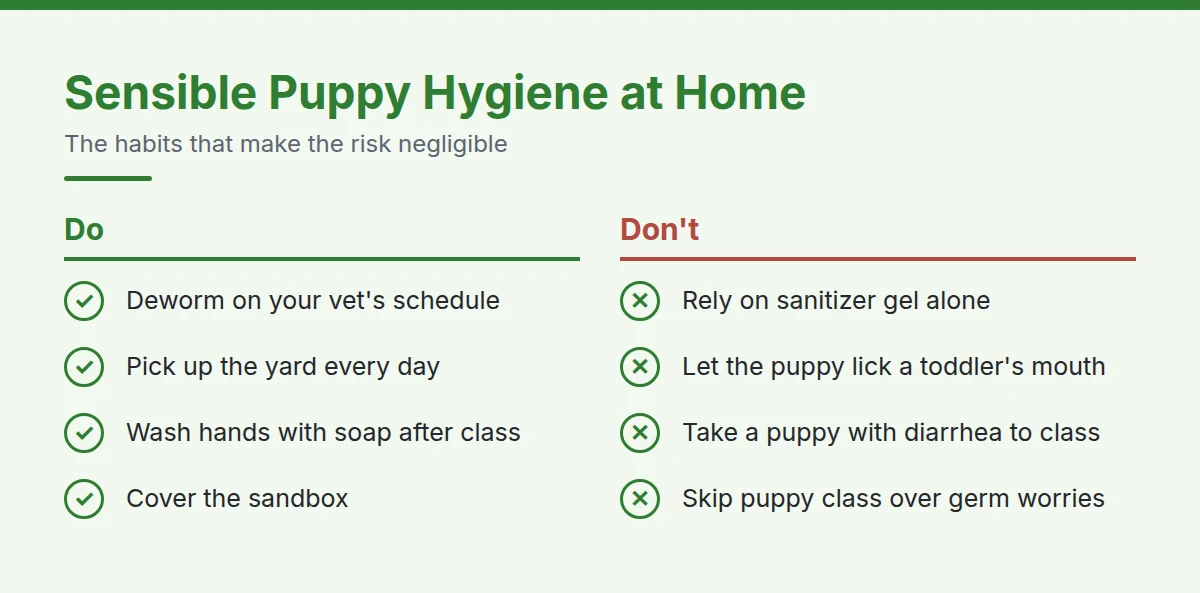
- Keep the deworming schedule. CAPC recommends a dewormer at 2, 4, 6 and 8 weeks of age, then a monthly preventive that covers roundworms. Ask the breeder or shelter for the dates and products already given, one of the questions worth asking about your puppy’s first eight weeks, and let your vet fill any gaps.
- Let the fecal tests happen. CAPC recommends testing for intestinal parasites at least four times in the first year. If your puppy eats poop, say so: a puppy who eats poop can pass eggs straight through from what it ate, which changes how a result is read.
- Pick up the yard every day. That is CAPC’s standard, and it always beats the two to four weeks roundworm eggs need to become infective.
- Cover the sandbox. CAPC wants sandboxes, gardens and playgrounds protected from dog feces, and the Utrecht review recommends sandboxes that can be covered.
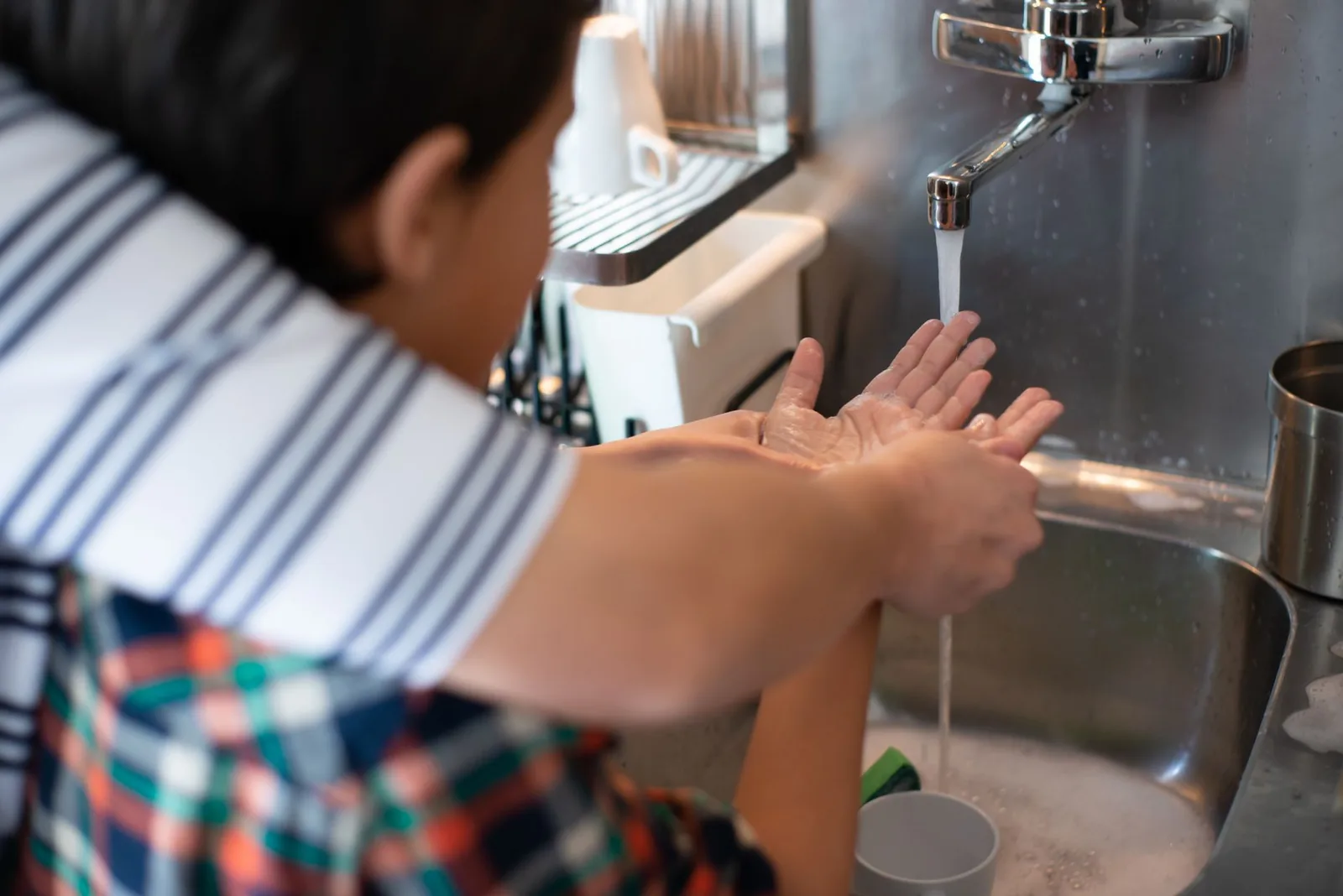
- Make handwashing automatic. The CDC’s toxocariasis advice is soap and water after playing with pets, after outdoor activities, after picking up poop, and before handling food or eating. Add “after class” to the list. Small children need an adult to wash with them, and the Utrecht review suggests keeping their nails short.
- Steer the licks. A puppy licking hands is fine if the hands get washed before snacks. The Utrecht review advises against letting pets lick faces or open wounds. For a toddler, that mostly means redirecting the puppy away from the mouth, not banning contact.
- Check the coat during cuddles. A round bald patch goes to the vet before it goes to class.
- Have a diarrhea plan. Gloves for cleanup, bedding and toys cleaned and disinfected, a fecal sample to the vet, and a week off class if your vet agrees.
When to Call the Vet, and When to Call the Doctor
Call the vet if your puppy has diarrhea that is not clearing up, blood in the stool, worms you can see, or a patch of hair loss. Each is also a reason to skip class until you have an answer.
Call the doctor if a child develops a ring-shaped rash, if anyone at home gets diarrhea after the puppy had it, or, rarely, if a child has eye trouble such as redness, seeing spots or flashes of light, or vision loss. Mention the puppy every time, because it changes which tests make sense.
Talk to your doctor early if someone in the household has a weakened immune system. NASPHV notes that people with weakened immunity, a group that includes young children and adults 65 and older, are more likely to become seriously ill when they are infected. That does not have to mean giving up the puppy. It may mean a stricter version of the routine above.
The Bottom Line
Puppy class is not a germ hazard you have to trade off against socialization. Only a handful of infections move from puppies to people, the realistic risk is low, and most of it lives in yards and sandboxes rather than on a class floor that is cleaned properly. Deworm on schedule, pick up daily, cover the sandbox, wash with soap and water after class and before snacks, and keep a sick puppy home. Then let your children enjoy the puppy, and let the puppy enjoy class while the socialization window is still open.
Further reading (sources)
- Companion Animal Parasite Council on roundworm in puppies, egg timing and deworming ages
- Companion Animal Parasite Council for Giardia types in dogs and the rare spread to people
- Centers for Disease Control and Prevention with why people are unlikely to catch Giardia from dogs
- Centers for Disease Control and Prevention on how toxocariasis spreads and how it can harm the eye
- National Association of State Public Health Veterinarians with its compendium on preventing disease from animal contact in public settings
- American Veterinary Society of Animal Behavior for the deworming and clean-surface standard for early puppy classes
- Overgaauw and colleagues about the infections pets can pass to people, from a One Health view
- Liu and colleagues on how many Americans carry antibodies to dog roundworm
- de Lucio and colleagues for testing pets and owners in 63 households for shared Giardia
- Montgomery and colleagues on the drug-resistant Campylobacter outbreak traced to pet store puppies
- Moriello and colleagues with consensus guidelines on ringworm in dogs and cats