From S.T.A.R. Puppy to Canine Good Citizen: The Complete Certification Roadmap
Published on September 9, 2026

Your puppy class ends on a Wednesday. There is a certificate with a paw print on it, somebody takes a group photo, and then you are standing in a parking lot with a four-month-old dog and nothing on the calendar. Most owners drift from that exact point. Class gave you a weekly deadline, and without one, training quietly becomes a thing you mean to get around to.
The American Kennel Club runs a ladder of credentials built for that gap, and hardly anyone uses it deliberately. It starts with S.T.A.R. Puppy, runs through the Canine Good Citizen, and continues into advanced and urban versions after that. None of it is a dog show. There is no ring, no gaiting, no judge scoring your handling. What gets tested is whether your dog is pleasant to be around in public, which is what you wanted out of class in the first place.
The Ladder Is Shorter Than It Looks
Four rungs, and the first two are both reachable inside a dog’s first year.
AKC S.T.A.R. Puppy is the entry point, for dogs under a year old, awarded at the end of a six-week class rather than at a one-off test. Canine Good Citizen is the main event: ten pass-or-fail items, open to any dog of any age, and since 2013 an official AKC title your dog carries after its registered name. CGC Advanced, also called Community Canine, repeats the idea in real-world settings instead of a training room. CGC Urban does it again on city streets, with traffic, elevators and pavement grates.
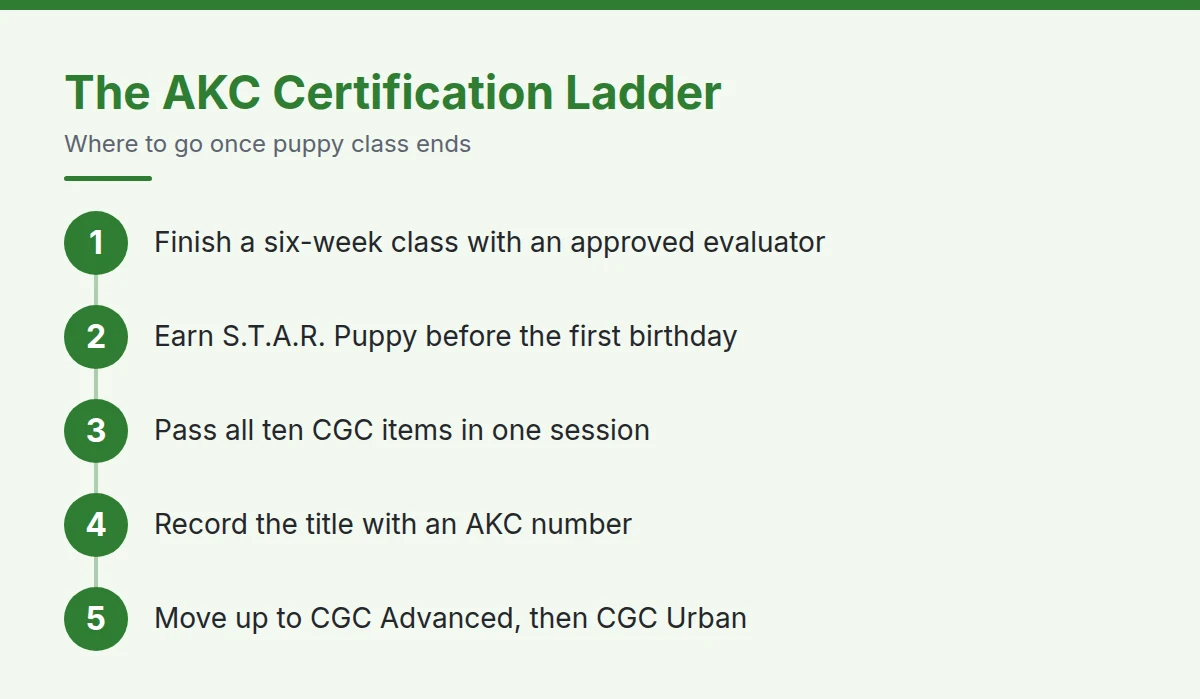
You do not have to climb all of it. Plenty of owners stop at CGC, which is the rung outside institutions actually recognize. But knowing the shape of the thing is useful the week your class ends, because “we are working toward the CGC in the spring” is a far better answer than “we finished class.”
What S.T.A.R. Puppy Is, and Where a Generic Class Differs
S.T.A.R. stands for Socialization, Training, Activity, and Responsibility, and the last one is the giveaway. Half of what gets evaluated is you.
The structural differences from a generic six-week puppy course are worth understanding, because they are the reason the program exists. A S.T.A.R. class runs a minimum of six weeks and has to be taught by an AKC Approved CGC Evaluator, which is a real credential in an industry that is otherwise licensed nowhere. The curriculum is fixed rather than improvised. You sign the Responsible Dog Owners Pledge before you start. And the assessment at the end covers twenty items split across owner behavior and puppy behavior: bringing the puppy to class every week, carrying clean-up bags, having a collar with ID on the dog, alongside the puppy accepting a stranger’s petting, tolerating the collar being held, allowing basic grooming, and showing no aggression toward the people or puppies in the room.
Vaccination requirements come from the individual class, not from the AKC, and most want the first round plus deworming before week one. That is deliberately early. The socialization window is closing while you wait for the full series, and a well-run indoor class on a sanitized floor is one of the lowest-risk places a young puppy can be. What your puppy brought with it to week one still matters more than most owners realize, and the first eight weeks you did not see explains why two twelve-week-olds in the same room are not starting from the same place.
One honest caveat. The evaluator credential certifies that someone can administer the test. It does not certify their training methods, and a person holding it can still reach for a prong collar on week three. Vet the instructor on method exactly as carefully as you would any other class, using the same questions in our guide to choosing a puppy class.
The Ten Things the CGC Test Actually Checks
The whole test is public manners. Read the list and you will notice that not one item requires precision.
- Accepting a friendly stranger. The evaluator walks up, greets you, ignores the dog. Your dog stays put without lunging or backing away.
- Sitting politely for petting. The stranger pets the dog’s head and body. No jumping, no shrinking away.
- Appearance and grooming. The evaluator brushes the dog and handles each ear and both front feet. You bring the brush.
- Out for a walk. Loose lead, a left turn, a right turn, an about turn and a stop. Heel position is not required and the dog can be on either side.
- Walking through a crowd. Past at least three moving people without straining toward them.
- Sit and down on cue, and staying in place. You pick sit or down for the stay, then walk twenty feet away on a long line and come back.
- Coming when called. Ten feet, with the evaluator mildly distracting the dog.
- Reaction to another dog. Two handlers approach, stop, shake hands, exchange a few words, and carry on. Casual interest is fine. A drag toward the other dog is not.
- Reaction to distraction. The evaluator produces two distractions, typically a dropped chair, a rolling crate dolly, a jogger, or a dropped cane. Startling is allowed. Panicking or barking at it is not.
- Supervised separation. You hand the leash to the evaluator, walk out of sight, and stay gone for three minutes.

The Items That Fail the Most Dogs
Item 10 fails more dogs than anything else, and it fails them for a reason that has nothing to do with obedience. Three minutes with a stranger while their person disappears is an emotional test, not a mechanical one. A dog that has never practiced being calmly alone will bark, pace or shut down. That work starts in the puppy’s first weeks, and our alone-time training ladder is the same protocol scaled down, built out of seconds before it is ever built out of minutes.
Items 8 and 9 are arousal problems dressed up as obedience problems. The dog that hits the end of the leash for the other dog is not disobedient, it is over threshold. Punishing that makes the underlying feeling worse while suppressing the visible part, which is precisely the trade force-free training refuses. The fix is distance and repetition: work at whatever range your dog can still eat at, pay for looking at the other dog and then back at you, and close the gap over weeks. Item 4 catches the puller, and the mechanics of that are in the loose-leash walking guide.
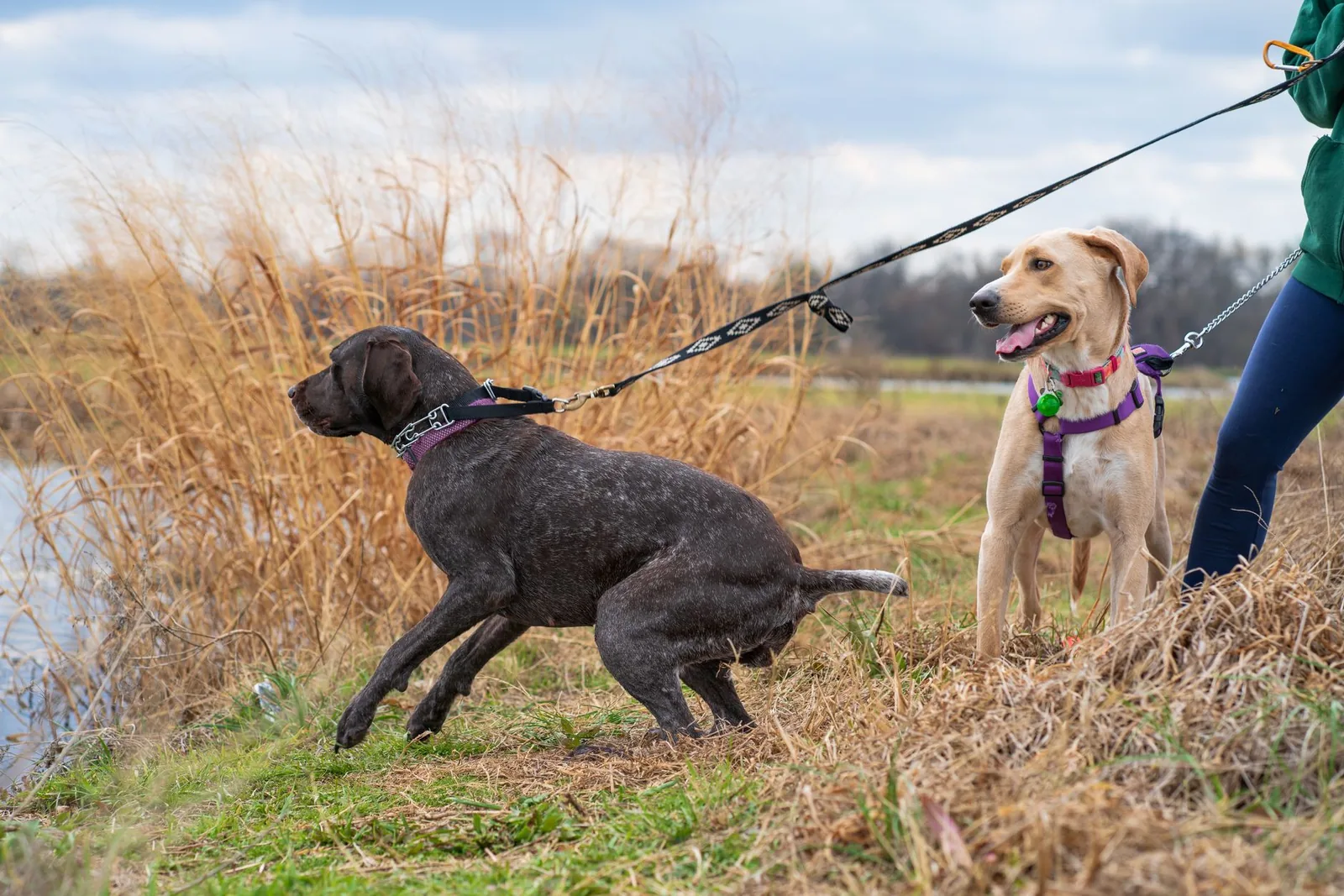
There is a quieter failure mode too. Dogs that pass beautifully at home fall apart in an unfamiliar room, because dogs learn far more specifically than owners expect. Train the test items in at least four or five different locations before you book, for the reasons laid out in why your puppy sits in the kitchen but not the park.
Test Day, and Why the Equipment Rules Are on Your Side
The rules of the test lean force-free, which surprises people who assume the AKC is a traditionalist institution.
As the standard currently reads, your dog wears a flat buckle collar, a slip collar, or an ordinary body harness. Prong collars, electronic collars and head halters are not permitted. Ask your evaluator for their copy of the current form if you want to check before you turn up.
The rule that catches most owners is the food ban. No treats, no toys, no clicker during the ten items. You can praise and you can pet, but if your puppy only performs while a treat is visible you will find out on the day. Fixing that is not a matter of willpower, it is mechanical, and it is the whole subject of fading the food lure. Get it sorted weeks ahead.
All ten items have to pass in the same session. Fail one and you retake the whole test, which is normal and costs nothing but another booking. Growling, snapping, biting or attempting to attack a person or dog ends the test immediately, and that is a signal to work with a certified veterinary behaviorist rather than to rebook.
Finding an Evaluator and What It Costs
The AKC keeps a searchable directory of approved CGC evaluators, and most decent training schools have at least one on staff. Local kennel and obedience clubs run test days, and some shelters host them as adoption follow-up.
Cost splits in two. The evaluator sets their own fee for administering the test, usually in the range of a single class session. The AKC charges a separate fee to record the title on the dog’s record. Both are small next to what you already spent on class, and both change from year to year, so get the current figures from the AKC site rather than from any blog, including this one.
Mixed Breeds Are Fully Eligible
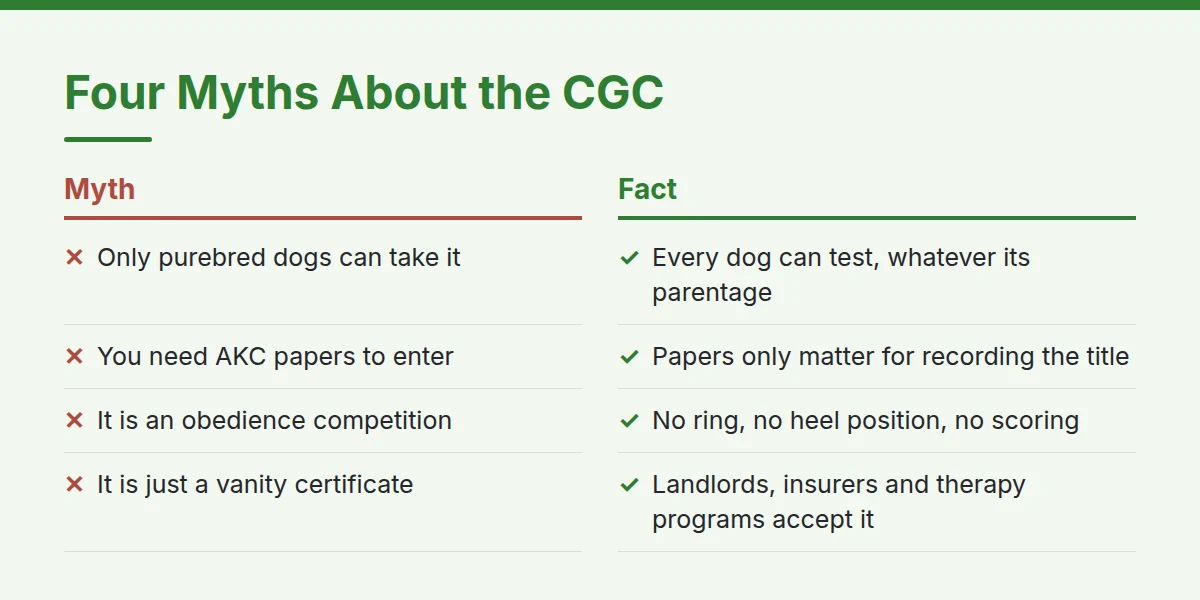
This is the most persistent myth in the whole subject, so let us be blunt about it. Two different things are going on, and only one of them involves registration at all.
Taking the CGC test is open to every dog alive. Purebred, mixed, rescue, unknown parentage, no paperwork of any kind. The evaluator does not care.
Recording the title on an official AKC record requires the dog to have an AKC number, and mixed-breed dogs get one through AKC Canine Partners, which exists specifically for them. Enrollment also opens the door to agility, obedience, rally, tracking and trick dog titles. Requirements for competing in companion events have their own details worth reading on the enrollment page, but eligibility for the CGC itself is not in question.
What Comes After
CGC Advanced moves the same skills into a real environment: a park, a show ground, a store that allows dogs. The dog walks past distraction dogs, holds a stay in a small group of other handlers, leaves food on the ground on cue, and waits at a doorway. CGC Urban adds traffic noise, crowded pavements, building entrances and transport.
The therapy dog route runs through here as well. AKC’s therapy dog titles are awarded on the strength of visits logged through a recognized therapy organization, and most of those organizations use the CGC or something close to it as their entry standard. There are also titles you can work on entirely from home, including trick dog levels and temperament testing, so a bad winter or a rural address is not a reason to stall.
A Practical Credential, Not a Rosette
The reason to care is that the CGC travels outside the dog world in a way almost no other dog title does.
Landlords and property managers accept it as evidence in a pet application. Some insurers will look at it. Therapy programs treat it as the baseline. Boarding facilities, daycares and vet clinics read it as a signal that the dog on the other end of the leash has been somewhere before. Some municipalities reference it in their ordinances. None of that is guaranteed in your particular county, but the certificate costs very little and occasionally settles an argument you would otherwise lose.
Be honest about its limits too. It is a snapshot of one dog on one afternoon, not a warranty. A dog that passes at fourteen months can still come apart at two years if nobody maintains the work. The value is not the paper. It is that a goal with a date attached is the single most reliable way to keep training happening after the class ends, and this one happens to hand you a certificate at the finish.
Further reading (sources)
- American Kennel Club on what the S.T.A.R. Puppy program covers and who can teach it
- American Kennel Club for the ten CGC test items in full
- Certification Council for Professional Dog Trainers for how to vet a trainer in an unregulated industry
- American Veterinary Society of Animal Behavior on the position statement on humane, reward-based dog training
- American Veterinary Society of Animal Behavior for what reward-based training methods actually are