Preventing Resource Guarding in Puppies: The Complete Prevention Guide
Published on September 6, 2026
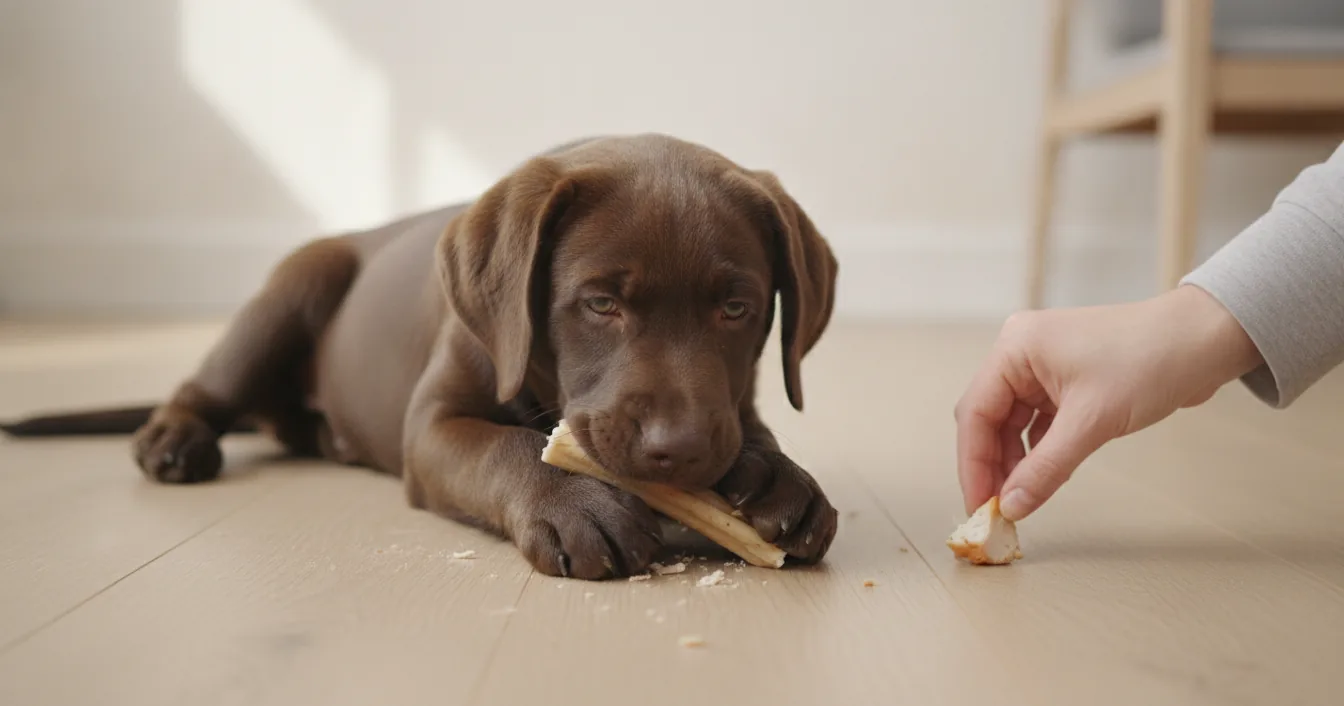
Your puppy is working on a chew in the middle of the living room floor. You walk past on your way to the kitchen and something changes. The chewing speeds up. The body drops a little lower and curls a little tighter over the chew. The eyes track you without the head moving. Then you leave the room and it all goes back to normal.
Nothing happened. There was no growl, no snap, nobody got hurt, and most owners never register the moment at all. But that quiet three seconds is the earliest, cheapest, most fixable version of the behavior that sends more adult dogs to behaviorists and shelters than almost anything else. Resource guarding is the one puppy problem where the standard advice, the stuff handed down through television and well-meaning relatives, reliably manufactures the thing it claims to prevent.
Guarding Is Normal, Not a Character Flaw
Start here, because the frame determines everything that follows.
Protecting food and possessions is ordinary canine behavior with a long evolutionary logic behind it. An animal that surrendered a carcass to every passing competitor did not do well. Whole Dog Journal notes that puppies as young as six to eight weeks guard from their own littermates, well before any human has trained anything into them. Your puppy did not learn this from a bad breeder or invent it out of spite.
It is also not dominance. The dog is not filing a claim on the household hierarchy. It is doing a much simpler piece of arithmetic: when that human comes over, does the good thing continue or does it end? A puppy who has learned that approaching hands take things away is behaving perfectly rationally when it tenses over a bully stick. Every prevention technique that actually works does one thing, which is change the answer to that question.
The American Veterinary Society of Animal Behavior has been explicit that aversive methods have no role in modifying aggressive behavior, with no exceptions, because they tend to escalate the underlying fear rather than resolve it. Guarding is a fear behavior wearing an aggressive costume. Treat it as fear and it responds. Treat it as insubordination and it gets worse.
The Advice That Builds a Guarder
Three pieces of folk wisdom cause most of the cases I see in class, and all three are still in circulation.
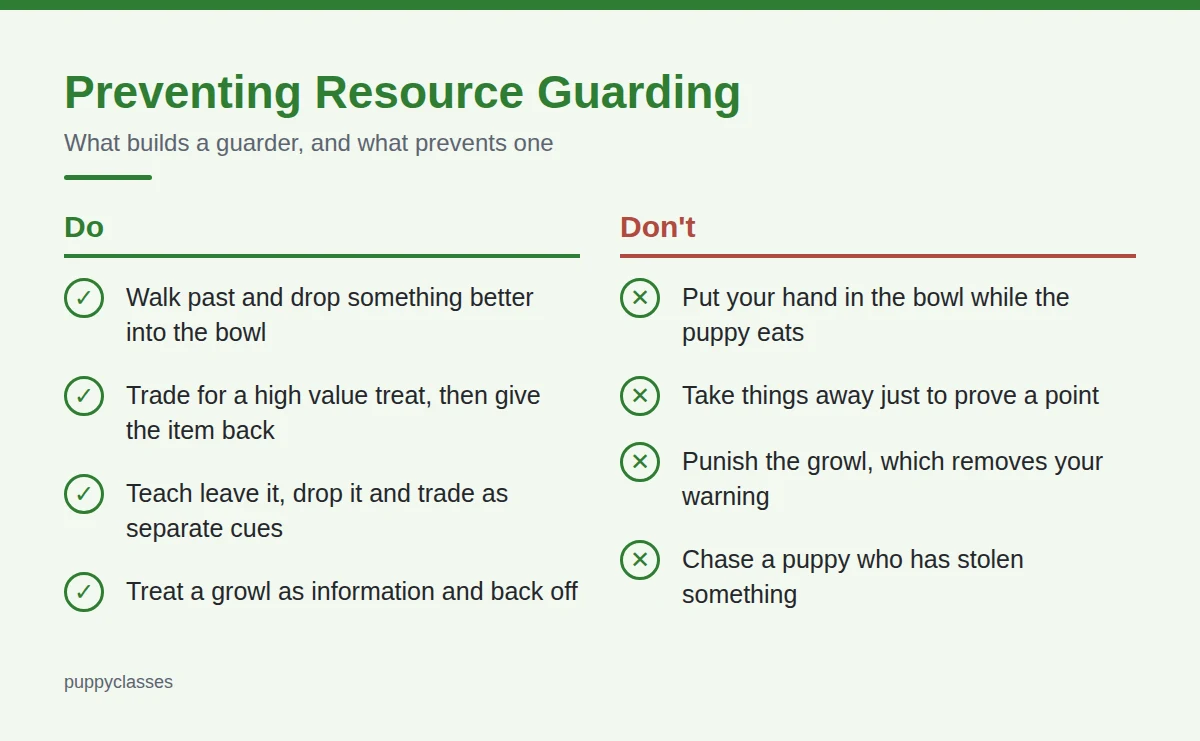
Putting your hand in the food bowl while the puppy eats. The theory is that the puppy learns to tolerate intrusion. What actually happens is that the puppy learns hands in the bowl mean the food gets worse or disappears for a moment. You have run a conditioning program, just backwards. A puppy who was neutral about people near the bowl in week nine can be genuinely worried about it by week twelve, purely from this.
Taking things away to prove a point. Removing a chew for no reason, then handing it back, is sold as a demonstration of who owns what. The puppy has no access to your theory of ownership. It observes only that valuable items vanish when you approach, and it starts holding on tighter, eating faster, and carrying prizes under the sofa.
Punishing the growl. This is the dangerous one. A growl is not the problem, it is the warning system, and the AKC is blunt about the consequence of correcting it: punish the growl often enough and you do not get a calmer dog, you get a dog who skips the growl. Silent guarders bite without a readable warning. When your puppy growls, you are receiving useful information at no cost to anyone. Back off, note what triggered it, and go build a plan.
The Ladder Starts Long Before the Growl
By the time there is noise, several rungs have already been climbed. Learn the quiet ones and you almost never meet the loud ones.
The rough progression: eating faster as you approach, then a freeze with the body still and the jaw locked, then curling the shoulders and head over the item, then whale eye (the whites showing as the eyes track you while the head stays down), then picking the item up and moving away with it, then a lip lift, then a growl, then an air snap, then a bite. Most puppies show the first three constantly and nobody notices.
Watch for these at feeding time, during chew sessions, and around anything the puppy has stolen. The same observation skills that make reading your puppy’s body language in class useful are exactly the ones that matter here, and freezing is the single signal worth learning first. A still puppy is not a relaxed puppy.
The Week Eight Protocol: Approach Equals Better
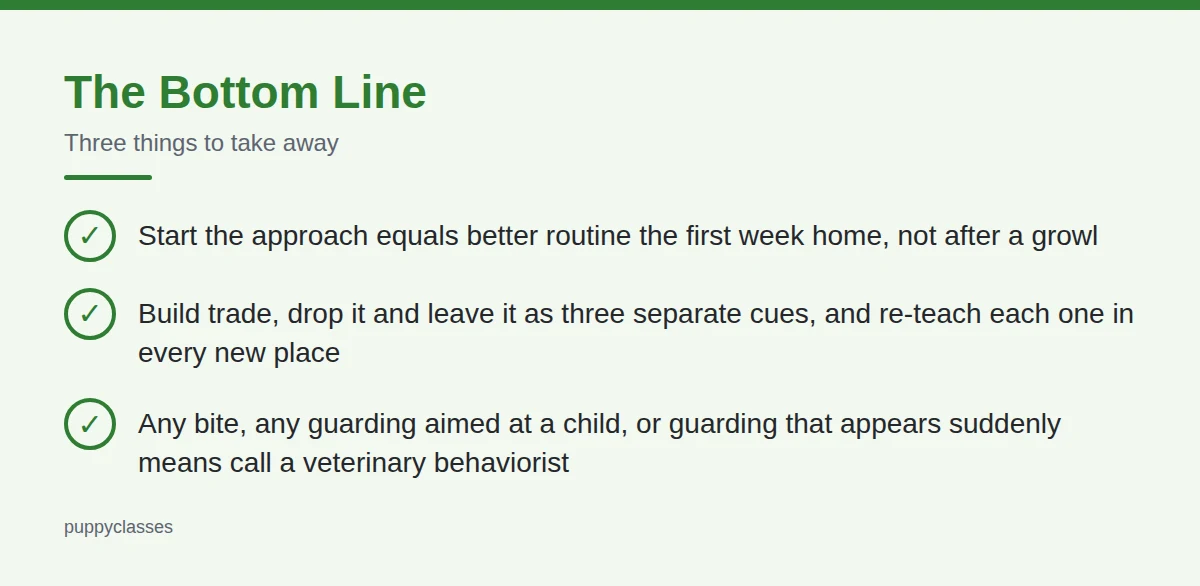
The whole prevention plan fits in one sentence. Every time you come near your puppy’s food or possessions, something better arrives.
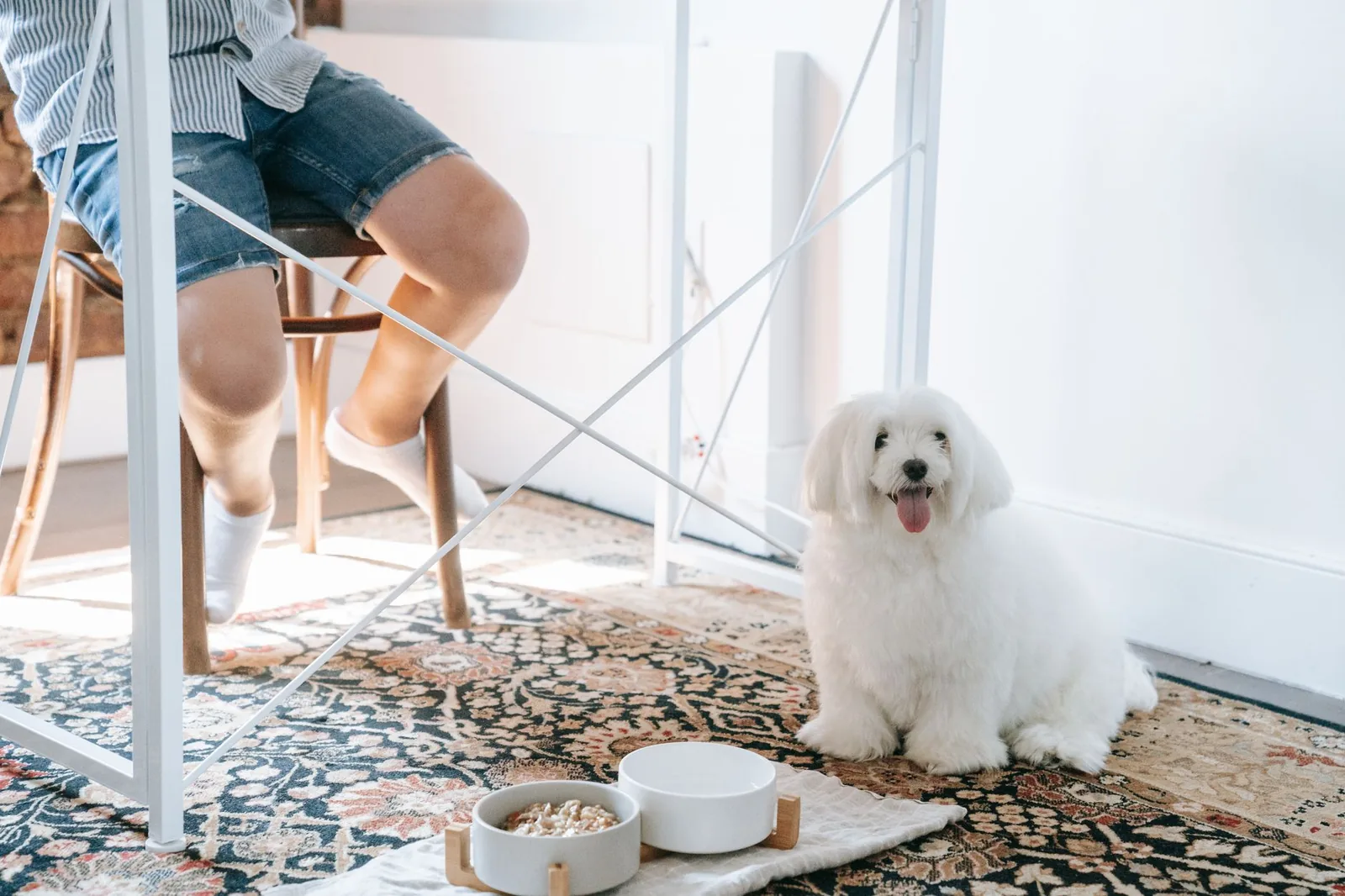
The bowl drive-by. While the puppy eats its normal meal, walk past at a comfortable distance, drop a small piece of chicken or cheese into the bowl without stopping, and keep going. Do not linger, do not reach in, do not make eye contact. Two or three passes per meal. Over a week or two, shrink the distance until you can walk right up. The puppy should end up lifting its head hopefully when you approach, which is the exact opposite of the response the hand-in-the-bowl method produces.
The chew walk-by. Same structure with a chew. Approach, toss something excellent to land near the puppy, walk away without touching the chew. The puppy learns that a human moving toward a valuable item predicts an upgrade rather than a loss.
Add rather than reach. If you want to interact with the bowl, put an empty bowl down, add a handful, let the puppy eat, add another handful. Your hands become the vending machine rather than the thief.
Hand feed some meals. Not all of them, but a portion of the daily ration delivered from your hand builds the same association without any technique at all.
Run this from the first week home. It costs about four minutes a day, and its emotional logic is straight desensitization and counterconditioning, just applied before there is a problem instead of after.
Trade, Drop It, and Leave It Are Three Different Cues
Owners tend to blur these together. Keep them separate, because they cover different emergencies.
Trade is an exchange. The puppy has something, you offer something better, the puppy releases and takes the swap. The AKC’s key mechanical detail is the order of operations: say the cue first, wait a beat, then produce the treat. Cue and then food teaches a cue. Food and then cue teaches your puppy to watch your hands. Build an object hierarchy, starting with a boring toy and working up through a stuffed chew toy to a genuinely high value item, and give the original object back after almost every rep. That return is what keeps the puppy willing to play.
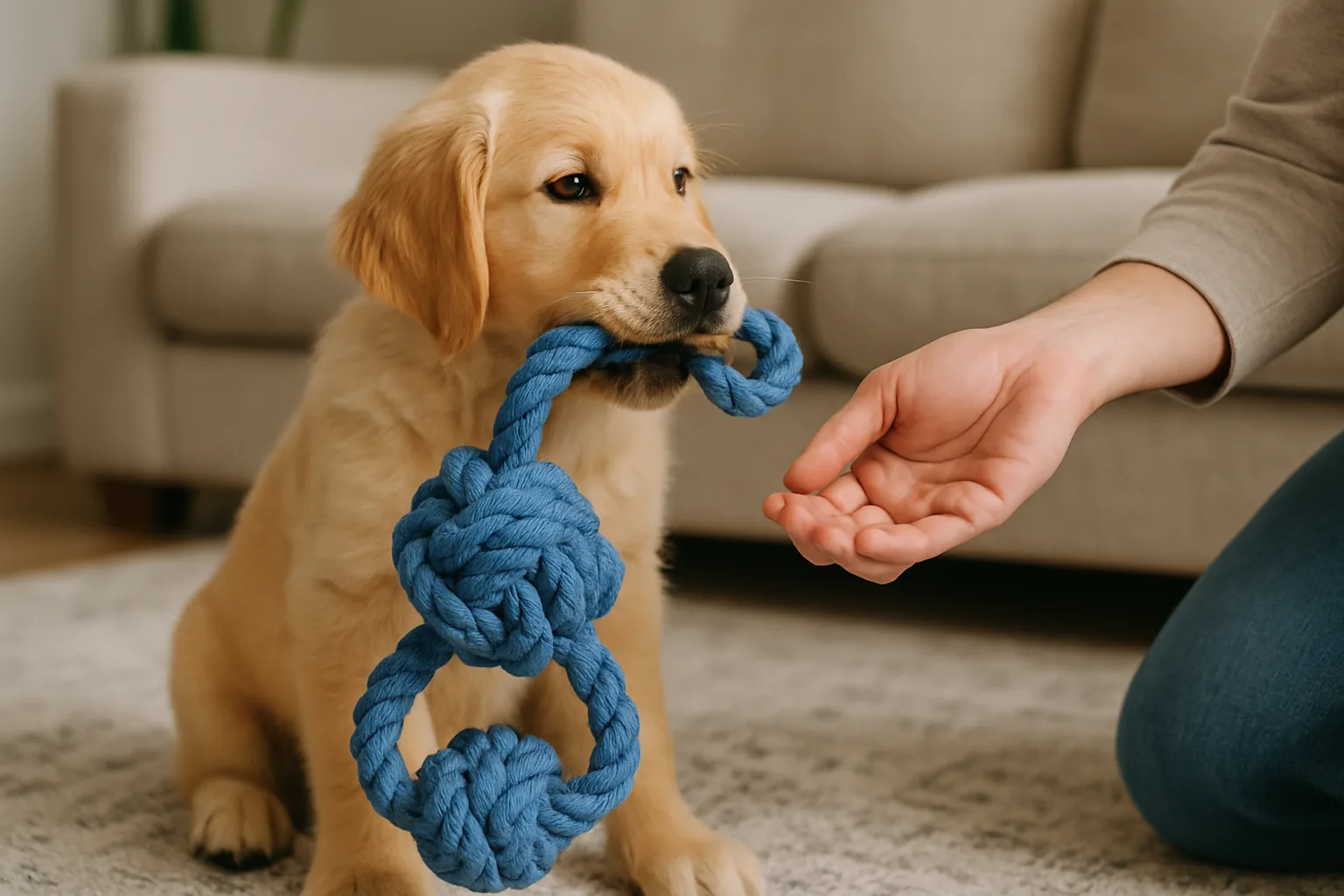
Drop it is the fast version with no negotiation, a trained release on a single word. It grows out of trade once the swap is fluent.
Leave it is the one that prevents the whole scenario, because it means do not pick that up at all. It is the only cue in the set that works at a distance, which is why it does the heavy lifting on walks. If you have already taught it for trail and wildlife safety, you are ahead.
Two practical notes. Pay properly: whatever you offer has to outrank what the puppy is holding, and a ten-minute preference test will tell you what that is faster than guessing. And expect these cues to fall apart the first time the context changes, because a trade taught on the living room rug with a rope toy is genuinely not the same behavior as a trade in the park with a chicken bone. That is normal, and generalizing a cue to new places is its own training project.
It Is Not Only About Food
Food bowls get the attention, but puppies guard whatever they value.
Chews and bones carry higher risk than kibble because they last longer and matter more. Feed high value chews behind a barrier or in a crate, in a spot where nobody has to walk past.
Stolen objects are their own category, covered below.
Beds, crates, and furniture produce the guarding most likely to reach a child, because a resting dog looks approachable. Never reach in to haul a puppy out of a crate or off a bed. Call the puppy to you and pay for arriving.
People get guarded too. A puppy who stiffens on your lap when the other dog approaches is guarding you. Same fix: the other dog’s approach makes good things rain on the lap puppy.
Doorways and sofas count as locations, and a puppy who freezes when someone steps over it is telling you something worth hearing.
The Puppy Who Swallows Rocks
Here is the sequence every owner of a determined scavenger knows. Puppy grabs something forbidden. Owner lunges. Puppy runs. Owner chases. Puppy swallows the item to keep it.
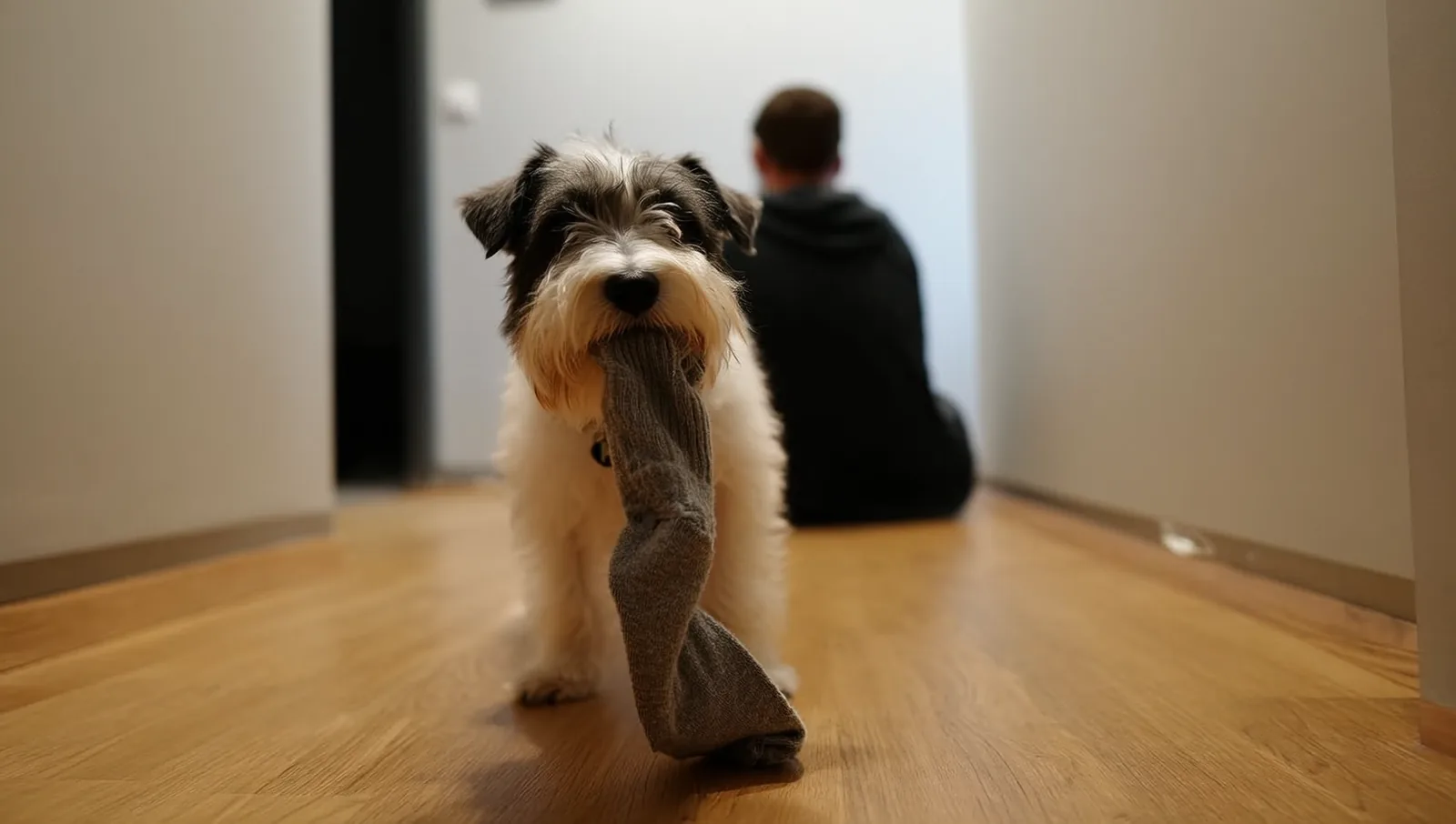
Every part of that is trainable in the wrong direction. Chasing teaches keep-away, which is a fabulous game, and it teaches that a human approach means the item is about to be lost, which is the exact belief that drives guarding. Puppies who swallow rocks and socks have usually been taught to, one chase at a time.
Break the pattern. Do not move toward the puppy. Go the other way, open the fridge, scatter a handful of food on the floor several feet away and say nothing about the item. Trade if the puppy comes to you, and manage the environment so the rocks are not available in the first place. Pick up, gate off, supervise.
The exception is medical. If your puppy has something genuinely dangerous, a cooked bone, a battery, a corn cob, stop training and go to the vet. Safety first, dignity later.
What a Good Instructor Does in Class
Chew time in a puppy class is where guarding surfaces publicly, usually over a dropped treat between two mats.
A good instructor adds space and barriers, moves the class rather than the puppy, and hands the owner a scatter of food to redirect with. They treat it as information about that puppy’s threshold and often turn it into a teaching moment for the whole room. They do not take the item away to make a point, they do not suggest pinning or scruffing, and they do not park the worried puppy in a corner where it feels trapped.
If an instructor’s answer to a guarding puppy involves showing it who is boss, leave. Dog training is unregulated in most US states, so credentials are the only filter you have. Look for CCPDT, KPA, or IAABC, and use the rest of the checklist for choosing a class before you enroll.
When to Stop Doing This Yourself
Prevention is an owner job. Established guarding, especially with any bite history, is not. Call a professional if you see:
- Any bite that makes contact, whether or not it breaks skin
- Growling that escalates over sessions rather than settling
- Guarding directed at children, at any intensity
- A puppy that goes stiff and silent with no warning signals
- Guarding that appears suddenly in a puppy who never did it, which warrants a vet visit first because pain and gastrointestinal discomfort both cause it
- Guarding that spreads to more and more categories of item
The referral you want is a board certified veterinary behaviorist (search the ACVB directory for a DACVB near you) or a credentialed behavior consultant working alongside your vet. Going early is not an admission of failure. Guarding responds well to good protocols and badly to time.
The three seconds of stillness over a chew is not a crisis. It is an invitation to start the easy version of this work now, while the puppy is eight weeks old and the worst outcome available is a slightly annoyed look.
Further reading (sources)
- American Kennel Club on stopping resource guarding before it starts in puppies
- American Kennel Club with the mechanics of teaching a dog to trade items
- Whole Dog Journal for why littermates guard from each other at six weeks
- AVSAB on why aversive methods have no place in treating aggression
- American College of Veterinary Behaviorists for finding a board certified behaviorist near you
- Peer-reviewed research on how well shelter evaluations predict resource guarding in the adoptive home