The Twelve Mistakes That Stall Puppy Training: What Instructors See Every Week
Published on September 15, 2026
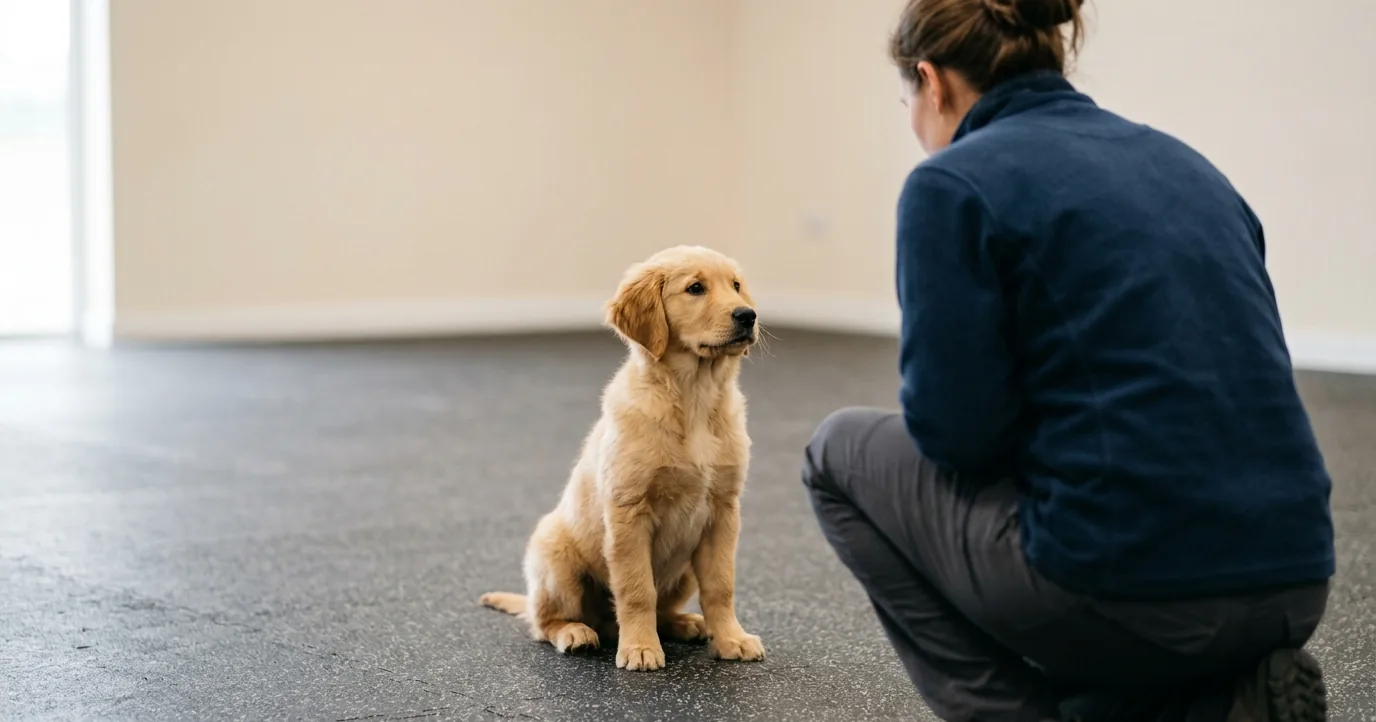
Week four of a puppy class has a particular atmosphere. The novelty has worn off, the puppies are bigger and busier, and somewhere in the room there is an owner who has quietly stopped believing this is working. Their puppy sat beautifully in week two. Now the same puppy stares at a wall while they say “sit” for the fourth time.
The thing almost nobody in that position can do is name what changed. Training feels like a single blurry activity that is either going well or not, so when it stops going well the explanations available are all about character: he is stubborn, she is distracted, this breed is hard. Instructors see something much more specific. Stalled training is nearly always one of a short list of mechanical errors, and the list is short enough to memorize.
Here are the twelve that come up most often, what each one looks like from the outside, what is actually happening, and how to undo it. None of them are about the puppy.
Mistakes in How You Ask
1. Repeating the cue
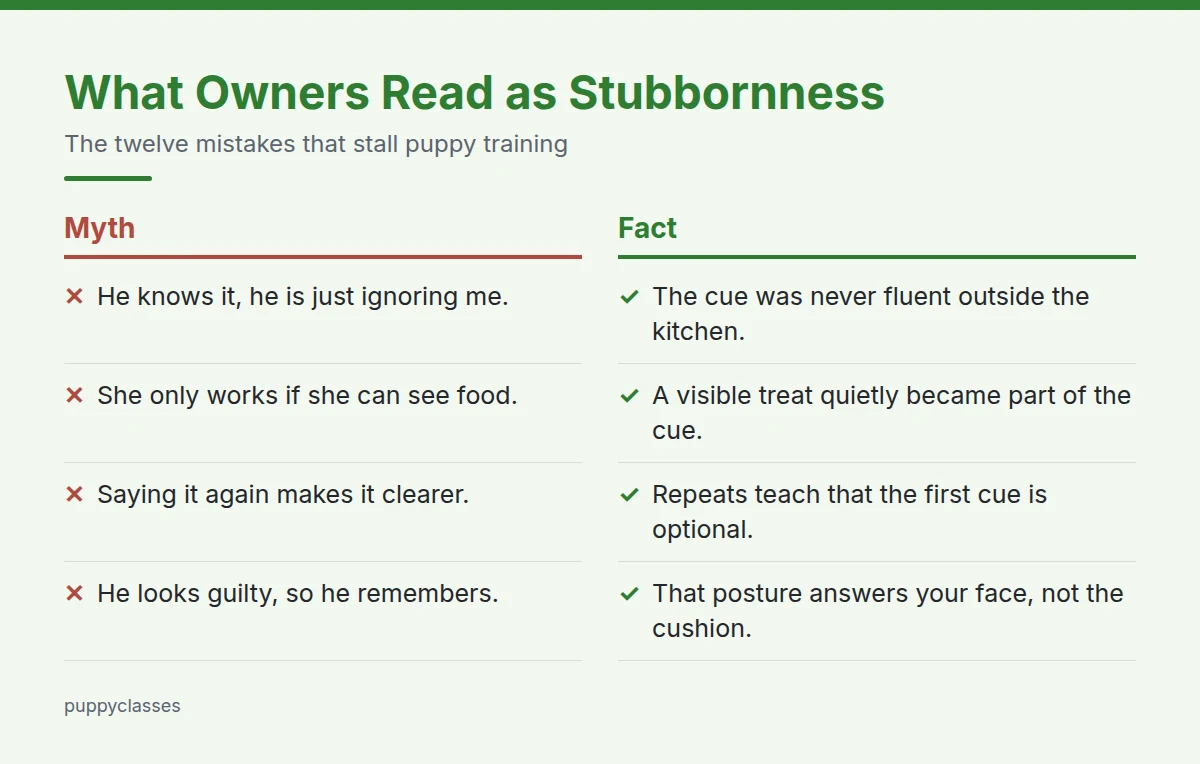
You say “sit,” nothing happens, so you say “sit, sit, siiiit.” Within a fortnight your puppy reliably sits on the third or fourth repetition and never on the first.
That is not a puppy tuning you out. It is a puppy who has learned the cue accurately. If the behavior only ever gets paid after four repetitions, then the real cue is four repetitions, and the first three are noise your puppy has correctly learned to ignore.
The fix: say it once. If nothing happens in about two seconds, do not say it again. Help instead, with a hand signal, a step closer, an easier version. Then make a note that this environment was too hard and lower the difficulty on the next rep.
2. Cueing before the behavior is fluent
You add the word too early, usually in the first session, because the word feels like the point of the exercise.
A cue attached to a shaky behavior becomes a cue for a shaky behavior. If your puppy only lands the down about half the time and you have been saying “down” through all of it, the word now means something like “possibly lie down, possibly stand there.” You cannot sharpen that later by saying it more firmly.
The fix: get the behavior happening smoothly eight or nine times out of ten with a lure or a hand signal, then start saying the word just before it happens. The word goes on last, not first.
3. Poisoning the cue with frustration
The word comes out flatter and harder each week. “Come” starts as a cheerful invitation in week one and by week five it is the sound you make through your teeth in a car park.
A cue is not just information, it is a prediction. When a word sometimes predicts chicken and sometimes predicts a tense voice and a grab at the collar, it stops being a clean signal and starts carrying a mixed forecast. Trainers call this a poisoned cue, and the visible result is hesitation: the puppy hears the word and slows down instead of speeding up. Three dog trainers making the case for tone of voice in the Guardian were describing exactly this mechanism. The broader research points the same way: work by Vieira de Castro and colleagues found that dogs trained with aversive methods showed poorer welfare indicators both during and outside training sessions.
The fix: retire the poisoned word and teach a fresh one. “Here” instead of “come” costs you a week and buys back a clean association. Then guard the new word, and never use it for anything the puppy will dislike.
4. Luring long past the point of fading
The food stays in your hand, visible, for weeks. Eventually you have a puppy who performs perfectly when a treat is in view and shrugs when it is not.
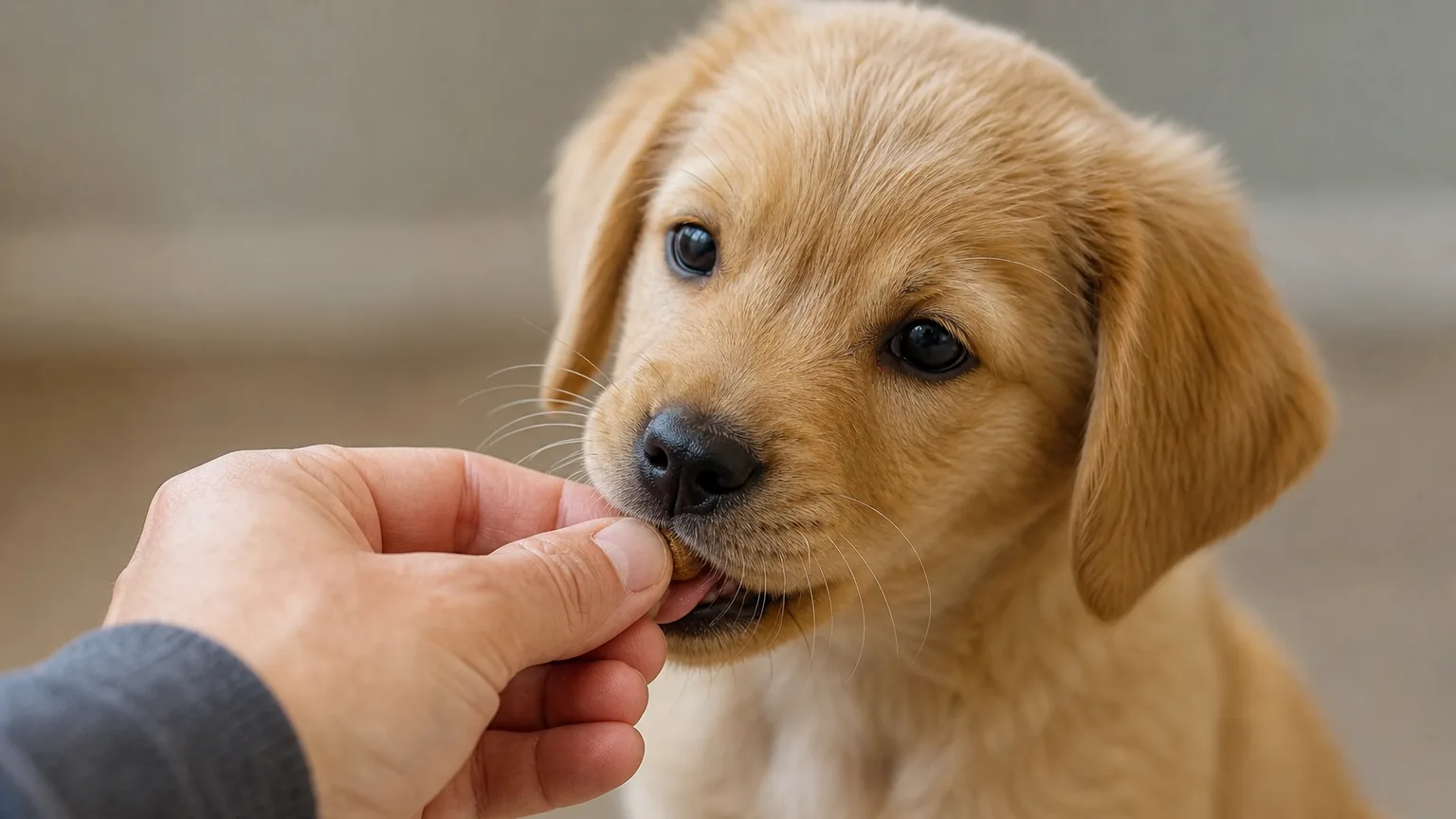
The American Kennel Club puts the distinction neatly: showing the food before you ask is a bribe, and delivering it afterwards is a reward. A visible treat quietly becomes part of the instruction, so an empty hand is not the same cue at all.
The fix: fade within a session or two. Lure with food, then lure with the same hand holding nothing, then pay from the other hand or a pouch behind your hip. I have written the full mechanical version of this in bribe or reward.
Mistakes in How You Pay
5. Reinforcing at the wrong moment
You mean to pay the sit. In practice the treat lands two seconds later, by which time your puppy has stood up, so what you actually paid was standing up.
Dogs connect reinforcement to whatever is happening in a narrow window around it. Late food is not weak feedback, it is accurate feedback about the wrong behavior. The classic symptom is a puppy who sits and pops straight back up, over and over, because that whole two-step sequence is what has been paid all week.
The fix: use a marker. A click or a crisp “yes” at the instant the behavior happens bridges the gap while you get the food out. And keep the marker honest. When Peiris and Rosales-Ruiz tested clicking without always following through with food, the behavior got worse rather than more durable: accuracy dropped and noncompliance rose. That study is worth a longer read in what the partial-reinforcement research means for class.
6. Rate of reinforcement too low
You are paying, but rarely. Three treats in a two-minute session, mostly at the end. Your puppy drifts off halfway through and goes to sniff the skirting board.
Rate of reinforcement is the single most underrated dial in a puppy session. A puppy learning something new needs paying at a pace that feels almost absurd to a human: ten to twenty reinforcers a minute in the early stages. Below that, staying with you simply is not the best available use of their time, and a puppy who disengages has usually done honest arithmetic.
The fix: count it. Run one two-minute session and tally the treats. If you are under fifteen, the problem is not motivation, it is payroll. Raising the value of the food helps too, and a ten-minute preference test will tell you what your particular puppy rates highest.
Mistakes in Where and With Whom You Practice
7. Training in one room only
Everything works in the kitchen. Nothing works on the pavement.
Dogs learn very specifically. The kitchen floor, your standing position and the absence of other dogs were all quietly recorded as part of the lesson, so the pavement version is closer to a fresh start than to a bad day. The AKC’s consistency piece names this as the wrong kind of consistency: train only in one place and you get a dog who behaves in that one place.
The fix: five locations in five days, one cue, easy criteria, food back in play everywhere. The full plan is in why your puppy sits in the kitchen but not the park.
8. Family members using different words
You say “off.” Your partner says “down.” Your son says “get down.” The puppy hears three unrelated noises and has no idea that they are meant to be one instruction.
Trainers interviewed by the AKC describe sitting families down and watching them discover, in real time, that everyone has been using different cues, different hand signals and different rules about the sofa. A word can only carry one meaning. If “down” means lie down for you and get off the furniture for someone else, it means neither.
The fix: ten minutes at the kitchen table. Write the list of cues, the exact hand signal for each, and the household rules, then stick it on the fridge. It is the cheapest single hour of training in this article.
Mistakes in Timing and Dose
9. Correcting after the fact
You come home to a chewed cushion, and the puppy’s flattened ears and averted eyes look so much like guilt that telling them off feels justified.
It is not guilt. As Whole Dog Journal lays out, that posture is a response to your body language in the present moment, not evidence of remembering an act from two hours ago. After-the-fact scolding teaches the puppy that your return is unpredictable and sometimes frightening, which is a cost with no learning attached.
The fix: manage the environment so the rehearsal cannot happen, and reinforce what you do want while it is happening. If you did not catch it within a second or two, it is gone.
10. Sessions too long for a puppy attention span
Ten solid minutes felt productive. The last six were a puppy trying every behavior they know at random, and now the clean sit has gone fuzzy.
A short session ending on a win is worth more than a long one ending in mush, because the final reps are what your puppy takes away. Fatigue, not defiance, produces the flailing. Learning to read the difference between a distracted puppy and a done puppy is the skill here, and the stress and disengagement signals worth knowing make it obvious once you can see them.
The fix: two minutes, three to five times a day. Stop while your puppy still wants more.
11. Practicing only when you need the behavior
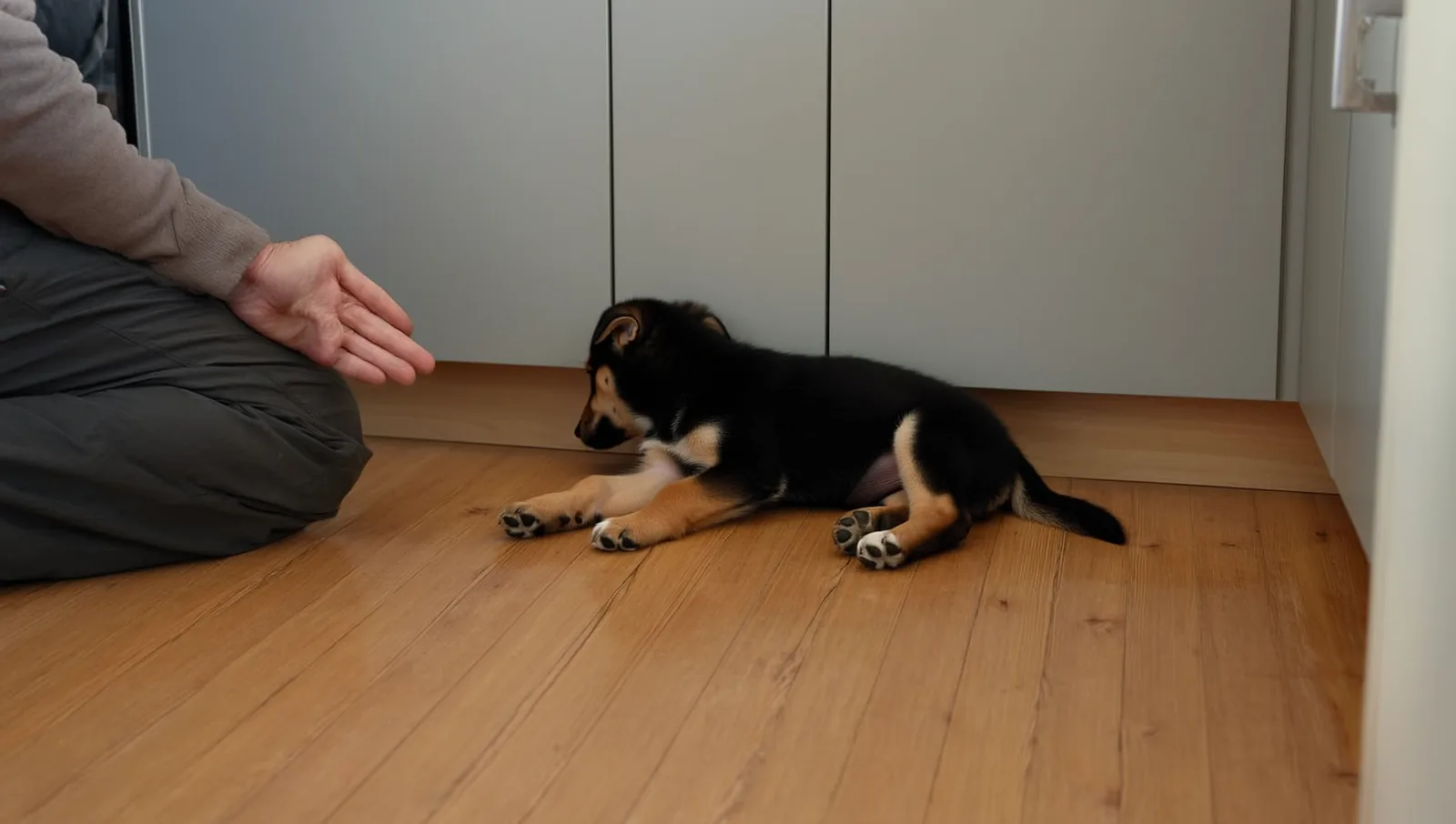
The only time your puppy hears “come” is when it is time to go home, and the only time they hear “leave it” is when they have something precious.
Under that pattern, every cue predicts something the puppy does not want, and a cue that reliably ends the fun becomes a cue to run the other way. The behavior also never gets practiced in a calm state, so it exists only at the hardest possible difficulty.
The fix: rehearse cues when you do not need them. Call your puppy out of mild play, pay well, release them back into it, which is also how a real off switch gets built. Recall should mean a party more often than it means the leash.
12. Skipping the homework between classes
The one hour a week in the hall is the whole training budget. Six days pass, nothing is practiced, and week five feels like a rerun of week four.
Survey work published in Animals found that most American owners do not formally train at all: about 70 percent train the dog themselves or do nothing structured, and only around 5 percent consult a trainer when a problem appears. Class attendance without between-class practice sits closer to that second group than most owners realize.
The fix: attach two minutes of training to something you already do daily. A sit before the food bowl goes down, a hand target at the back door. Habits stick to other habits far better than to good intentions.
Run the Audit on Your Own Week
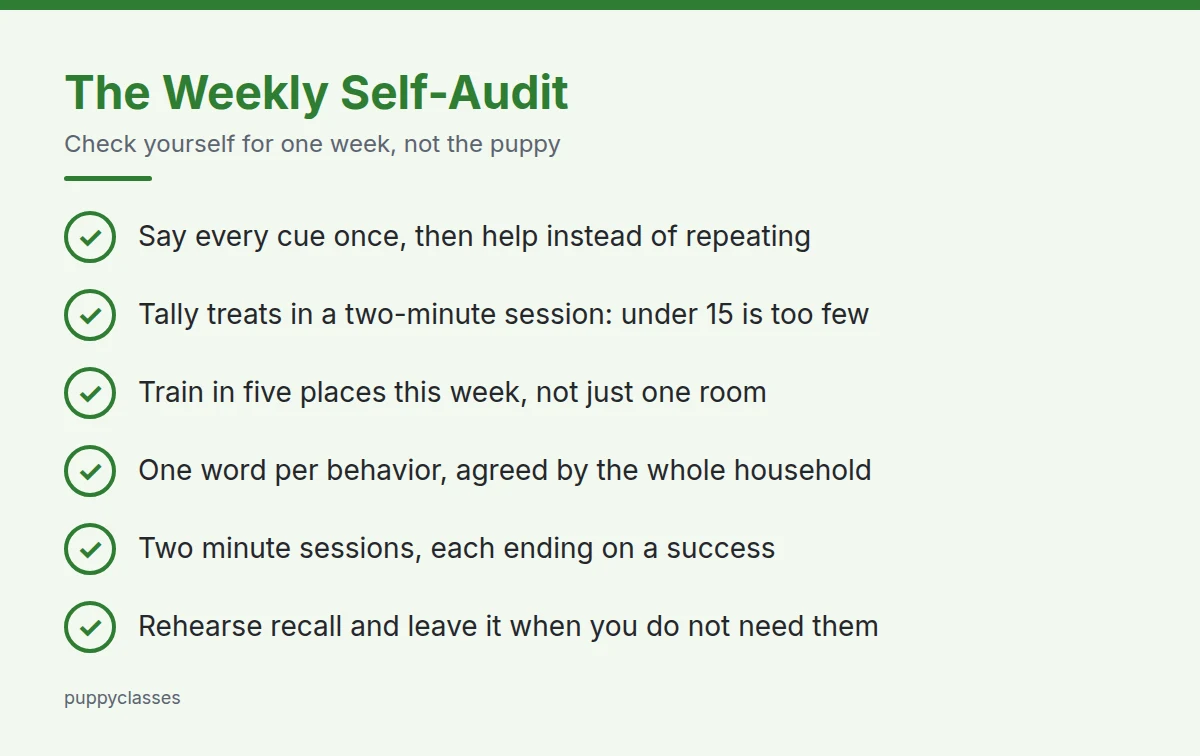
Pick one week and check yourself rather than the puppy. Record thirty seconds of a session on your phone if you can stand watching it back, because the gap between what you think you did and what you did is usually where the answer is. Then run through six questions:
- Did I say each cue once, or did I say it two and three times?
- How many treats did I actually deliver per minute?
- Where did I train this week, and was it all the same room?
- Does everyone in the house use identical words and hand signals?
- How long were my sessions, and did each one end on a success?
- Did I practice recall and leave it when I did not need them?
If more than two of those land, you have not found a stubborn puppy. You have found a to-do list, and it is a short one. Most stalled training moves again within a week of fixing the rate of reinforcement and the repeated cue alone.
When It Is Not a Mechanics Problem
Two things on this list look like handler error and are not. A puppy who cannot take food at all in class, freezes, or tries to leave the room is over threshold rather than under-motivated, and no amount of better timing fixes that. Neither does a puppy who growls, stiffens or snaps over food, toys or handling. Both warrant a conversation with your instructor and, if it persists, a referral to a veterinary behaviorist. Everything else on this page is mechanics, and mechanics are learnable.
Further reading (sources)
- American Kennel Club on what trainers wish owners knew about consistency
- American Kennel Club for the dog who only listens with a treat in your hand
- Whole Dog Journal with the case against the guilty look
- The Guardian on three trainers and why tone of voice carries so much
- Peiris and Rosales-Ruiz for what happens when a click stops reliably predicting food
- Vieira de Castro and colleagues on the welfare cost of aversive-based training methods
- Animals with survey data on how American owners actually train