Alone-Time Training From Day One: Preventing Separation Anxiety Before It Starts
Published on August 3, 2026
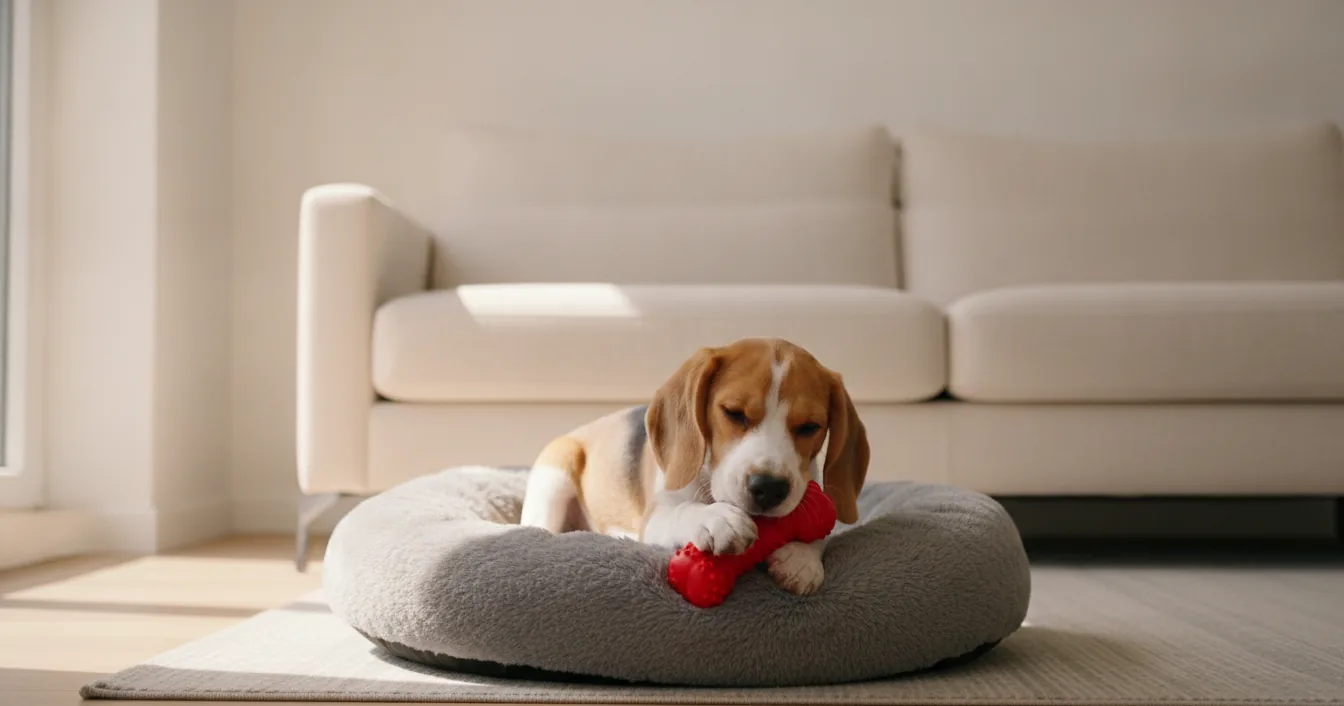
The American Kennel Club published a piece at the end of July listing the behaviors to teach a puppy in its first days home, and alone time sits right there in the top three alongside potty training and crate work. It is a genuinely good list. It is also the item almost nobody does, because the first fortnight with a puppy is a honeymoon: somebody booked time off, somebody else works from the kitchen table, and the puppy is never once by itself.
That is the trap. A puppy who has had three uninterrupted weeks of company has not learned that being alone is boring and survivable. It has learned the opposite, that a human is a permanent environmental feature like the floor. Then everyone goes back to the office, and the puppy meets absence for the first time at full intensity with no preparation at all.
Prevention Is a Different Job From Treatment
Separation-related behavior is one of the most commonly reported problems in pet dogs, and the prevalence figures you see quoted are almost certainly undercounts, because the whole thing happens when nobody is home to observe it. Owners find the evidence (a chewed door frame, a complaint from a neighbor, a puddle in a house-trained dog) rather than the behavior.
Here is the part worth internalizing. Preventing separation distress between eight and sixteen weeks costs about five minutes a day and some cheap chews. Treating established separation anxiety in an eight-month-old costs months of graded exposure, a strict rule that the dog is never left over threshold during the protocol (usually daycare, a sitter, or rearranged work), and often medication prescribed by a veterinarian. Same mechanism, wildly different price. It is one of the highest-return five minutes in the whole 8 to 16 week training window, and owners postpone it because the puppy seems fine.
The Departure Ladder: Seconds Before Minutes
The mechanics are simple enough to start today. What matters is the scale you start on, which is seconds, not minutes.
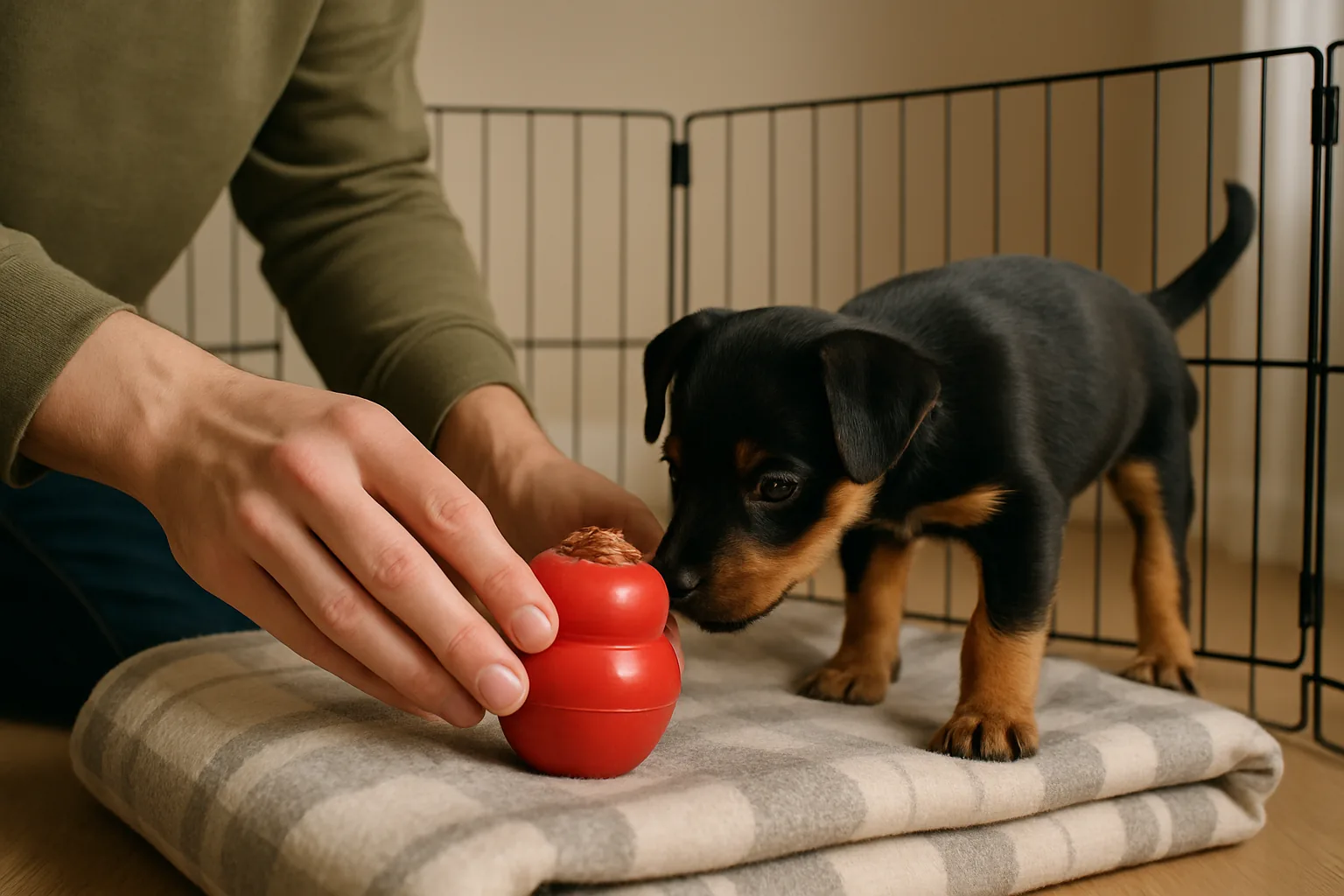
Set the scene. Puppy in its crate, pen, or a gated safe area with something excellent to work on: a food-stuffed rubber toy, a lick mat, a bully stick, whatever your puppy will genuinely commit to. If you are not sure what qualifies as excellent for your dog, a ten-minute preference test beats guessing.
Leave for three seconds. Walk out of sight, count, walk back. For the first several reps your puppy should not lift its head. If it notices you left, you left for too long.
Come back boring. No greeting ceremony, no “did you miss me,” no reunion. Walk in, potter about, then release the puppy calmly. Big emotional returns teach a puppy that your reappearance is the best part of the day, which makes your absence the worst.
Vary, do not climb. This is where most home protocols fall over. Owners run three seconds, five, ten, twenty, forty, and treat it as a staircase. Instead run a session as ten seconds, three, twenty, five, thirty, eight. Unpredictable durations with a low average build a puppy that does not start worrying at the eleven-second mark, because eleven seconds has never meant anything in particular.
Ceiling for the week, not the session. A reasonable shape is seconds in week one, one to three minutes by the end of week two, ten to fifteen minutes by week four, and thirty-plus by six to eight weeks in. Slower is fine. Faster is usually a puppy who is tolerating rather than relaxing.
One hard limit sits over all of this: alone-time training is not the same as leaving a puppy for a workday. An eight-week-old cannot hold its bladder anywhere near that long, and the rough guide of one hour per month of age still applies regardless of how well the training is going.
Why the Stuffed Chew Does So Much Work
The chew is not a distraction and it is not a bribe. It changes what the absence means.
Licking and sustained chewing are self-soothing behaviors for dogs. A puppy working on a frozen stuffed toy is in a physiologically different state from a puppy sitting in an empty pen listening for footsteps. It is also a puppy doing something rather than waiting for something, and waiting is where distress incubates.
There is a sequencing benefit too. Early on, the chew should outlast the absence, so that if you are gone twenty seconds and the toy takes six minutes, your puppy never reaches the moment of noticing. Over the weeks that ratio flips, and by the time your absence outlasts the chew, most puppies have decided the correct response to finishing one is a nap.
Feed some of these in the crate, and let the full crate progression run in parallel. The two overlap but they are not the same skill: a puppy can be perfectly happy in a closed crate while you sit beside it and still come apart the moment you leave the room. Confinement and absence are separate variables, so train them one at a time.
Uncouple the Keys, the Shoes, and the Coat
Dogs are exceptional at spotting predictive sequences, and the pre-departure routine is the most reliable one in the house. Keys, shoes, coat, bag, and the anxiety starts before you have reached the door. By the time an owner notices a problem, the trigger has usually moved upstream to something like closing a laptop.
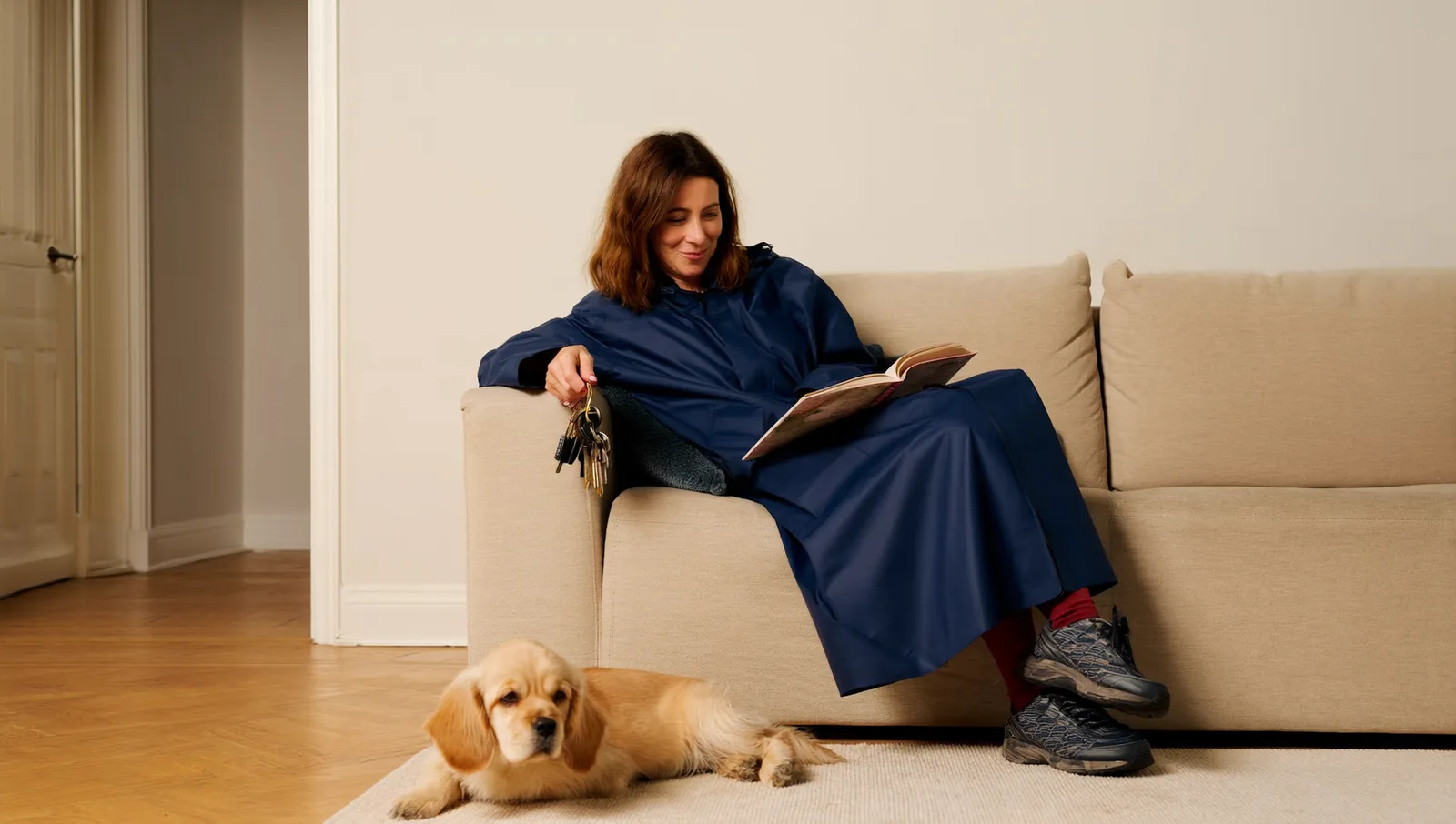
The fix is deliberately tedious. Pick up your keys and put them down again. Put your shoes on and watch television in them. Grab your coat, walk to the door, touch the handle, and go and make a cup of tea. Do this ten or twenty times a day, in no particular order, until the sequence has no predictive value left in it. You are not training the puppy to do anything. You are demolishing a correlation. Then, when you do leave, run the sequence exactly as normal, because “normal” no longer means anything alarming.
Reading the Puppy Cam: Settling Versus Panic
Set up any cheap camera and actually watch a few departures back, because guessing at this is how mild problems go unnoticed for months.
Normal settling looks like a short burst of protest (whining, a bit of scratching, maybe a bark or two) that decays within thirty seconds to three minutes, followed by chewing, sniffing, circling, and sleep. Position changes are relaxed, the puppy takes food if it is there, and any continued vocalization is intermittent and low effort.
Genuine distress does not decay. It escalates or holds steady. Look for rhythmic barking and howling that never tapers, pacing along a fixed route, scrabbling focused specifically at the exit point rather than randomly, heavy panting in a comfortable room, drooling that leaves a wet patch, refusal of food the same puppy would mug you for, trembling, and toileting in a puppy that is otherwise reliable. The whole-body picture matters more than any single item, and the same stress signals you learn to read in class apply on camera, just without the ability to intervene.
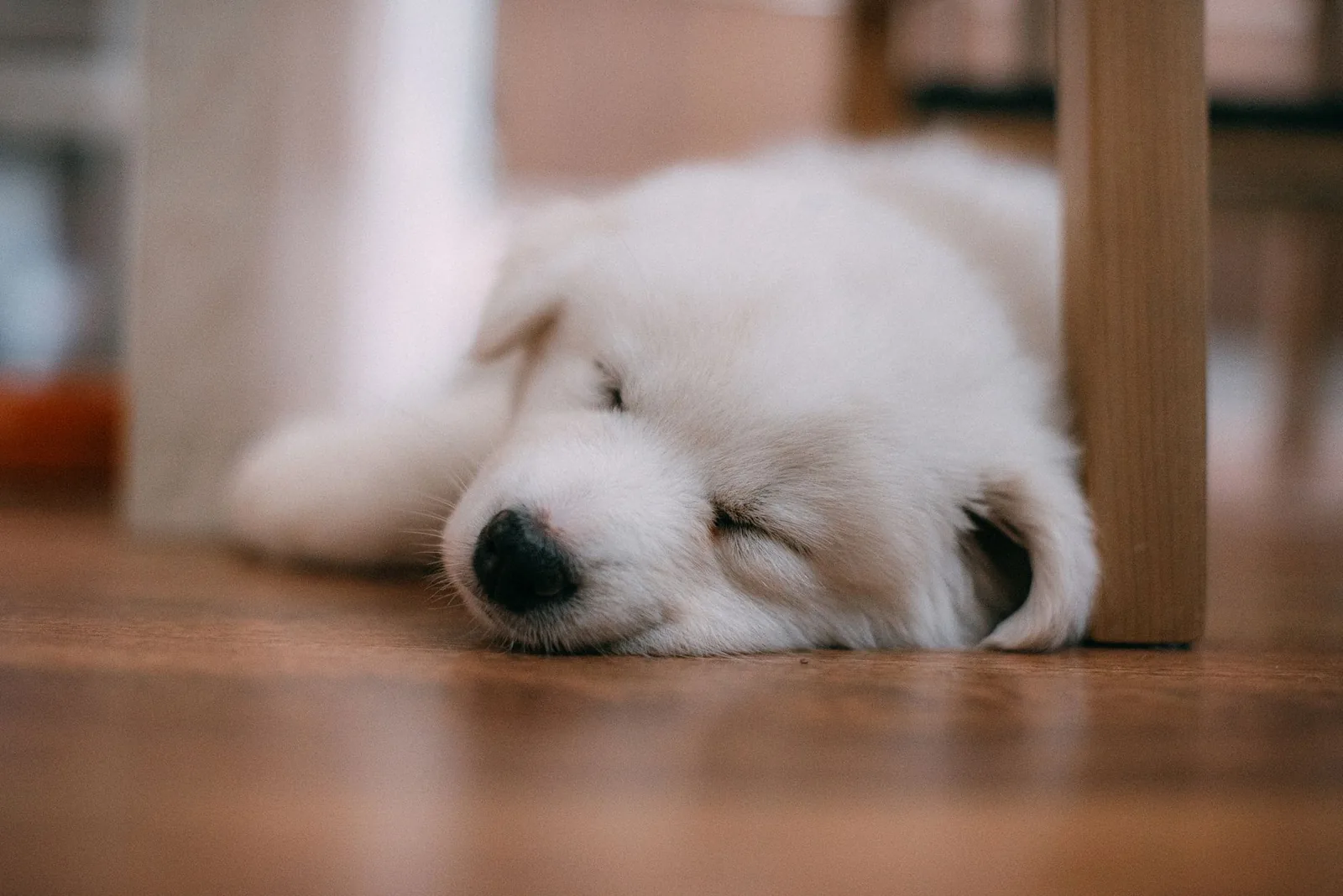
A puppy who settles at three minutes but starts up again at eighteen is telling you your ceiling is somewhere around fifteen. That is useful information, not a failure. Drop back and rebuild.
Class Day Is Its Own Mini-Exposure
A group puppy class quietly contains several separation reps, and it is worth using them on purpose rather than letting them happen to you.
The crate or carrier in the car is one. The handling exercise where the instructor takes your puppy a few feet away to check its ears and paws is another, often the first time a puppy has been held by someone else while its person stands still and does nothing. Many curricula also include a “puppy pass” where dogs rotate between owners, or an exercise where owners walk to the far wall and back while puppies stay on their mats. Each is a controlled, supervised, sub-minute absence in a novel environment, which is a harder and more useful rep than anything you can stage at home. Tell your instructor you are working on alone time and ask them to watch the handover.
The mat settle that class teaches is also the direct ancestor of settling alone. If your puppy can switch off on a towel while six others wrestle nearby, an empty room is a downgrade in difficulty. And do not underestimate sleep pressure: an overtired puppy cannot settle for anyone, and timing alone-time reps around the nap schedule makes a bigger difference than most owners expect.
For the Remote Worker Whose Puppy Has Never Been Alone
This is the highest-risk group, and “leave the house” is not the daily reality, so build absence into the working day instead. Gate the puppy out of your office for a stretch each morning with a chew. Take real lunch breaks somewhere the puppy is not. Do the bins, the post, the shop, and leave the puppy behind for each one rather than taking it along because that is easier.
The failure mode is a puppy that follows you room to room and is never more than six feet from a human. That puppy is not calm, it is untested, and the test comes eventually: a weekend away, a hospital appointment, a return-to-office announcement. Manufacture the small versions now, on your terms.
When to Stop Training and Refer
Some puppies show more than a training gap. Get a veterinary assessment, and ideally a referral to a board-certified veterinary behaviorist (a DACVB), if you see any of the following:
- Panting, drooling, or trembling during short absences in a comfortable room.
- Escape attempts focused on doors, windows, or crate seams, especially with damage to the surrounding area.
- Any self-injury: bloodied paws or gums, broken nails, worn teeth.
- Distress that starts before you leave, during the pre-departure routine.
- Toileting during absences in a puppy that is otherwise house-trained.
- No decay at all in vocalization across a whole absence.
- Distress that reliably gets worse over two or three weeks of careful, correctly paced work.
Do not push through these, and do not let anyone tell you to let the puppy cry it out. Every repetition of full-blown panic strengthens the association you are trying to prevent, which is why the graded exposure protocols used for fearful puppies insist on staying under threshold at every step. Absence work follows the same rule. A behaviorist can also rule out medical contributors (pain and gastrointestinal discomfort both present as apparent anxiety) and decide whether medication belongs in the plan.
For most puppies, though, none of that is needed. Five minutes a day, a stuffed chew, a pile of meaningless key-jangling, and a camera to check your work. Start it in week one, while the honeymoon is still on and there is nothing to fix.
Further reading (sources)
- American Kennel Club on the behaviors worth teaching in a puppy’s first days home
- ASPCA for distinguishing separation anxiety from ordinary boredom behaviors
- Dogs Trust with a graded plan for teaching a dog to be left at home
- American College of Veterinary Behaviorists for locating a board-certified behaviorist when distress is severe
- Peer-reviewed research on how separation-related distress is assessed and treated
- Peer-reviewed research for using the owner’s return as the reinforcer in graded departures