Why Puppies Eat Poop: Coprophagia Decoded and a Force-Free Plan to Stop It
Published on September 25, 2026
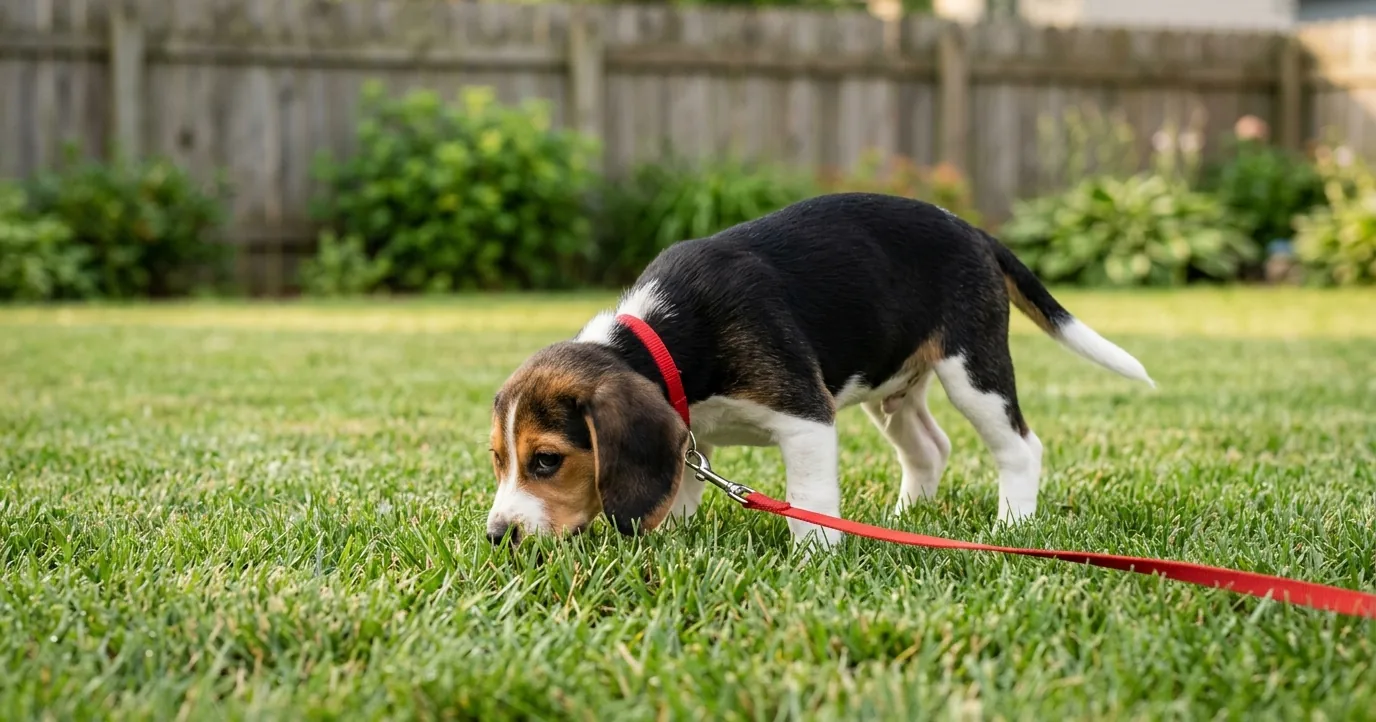
It usually happens in week two. The puppy has settled in, house training is going better than you dared hope, and then you watch through the kitchen window as your nine-week-old finishes a poop on the lawn, turns around, sniffs it, and eats it. You stand there with your coffee going cold and wonder what you have brought home.
You have brought home a dog. Coprophagia, the scientific name for eating feces, is one of the most revolting habits in the canine repertoire and one of the most ordinary. The American Kennel Club updated its guide to the behavior in July, and the headline has not changed: it is common, it is usually not a sign that anything is wrong, and the fix does not come in a tub. The research adds a sobering footnote about how badly the popular remedies perform, which is exactly why a management-first, force-free plan is the one worth your effort.
How Common Is Poop Eating in Dogs?
More common than any owner wants to hear. In 2018, a UC Davis veterinary team led by Benjamin Hart published two large online surveys: one comparing stool eaters with dogs that never did it (1,552 responses), and one recruiting owners of dedicated stool eaters (1,475 usable responses). In the general survey, about 23 percent of dogs had been seen eating dog stools at least once, and 16 percent, roughly one in six, at least six times. In a year-long Dutch study, close to half of the owners who answered its questionnaire (261 of 564) recognized the habit in their own dogs.
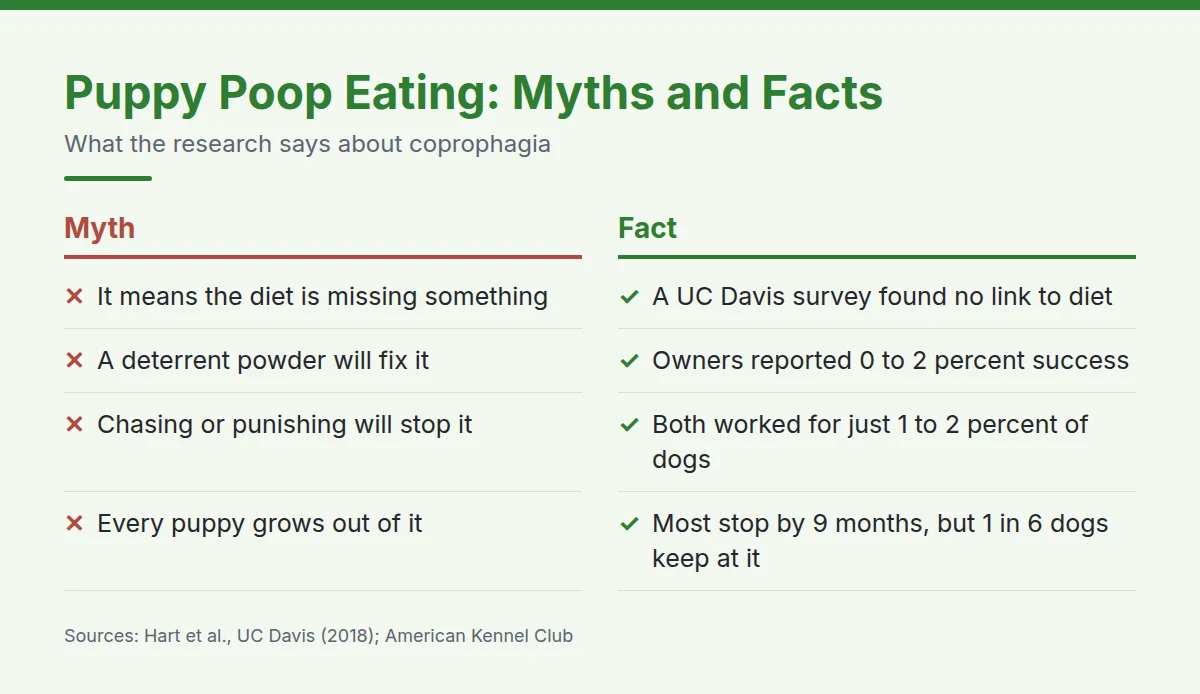
Puppies are their own category. For about the first three weeks, the AKC explains, mother dogs lick their newborns to make them eliminate and clean up by eating the results, and puppies go on to sample their own stools, other dogs’ stools, and cat and wildlife droppings as they explore the world mouth first. In most puppies, the AKC says, the habit fades before about nine months of age.
“Most” is doing real work there. Hart’s team found no link between stool eating and age, and concluded it did not look like juvenile behavior: three quarters of the frequent stool eaters in their general survey were over four years old. Nobody can tell you at ten weeks which kind of puppy you have, so the plan below starts now.
Why Puppies Eat Poop
There is no single cause, and anyone selling one usually has a product to go with it. These explanations have the most behind them.
Exploration. Puppies investigate with their mouths. Most settle for a thorough sniff; some put everything in. The AKC treats puppy stool eating as a normal part of discovering the world.
An ancient cleanup job. Hart’s team noticed that dedicated stool eaters overwhelmingly target fresh stools: 85 percent in the second survey ate stools no more than two days old. Their hypothesis is a den-cleaning instinct inherited from wolves. The eggs of the most common intestinal worms need at least two days in a stool (roundworms need weeks) before they become infective, so eating a sick packmate’s fresh stool near the den would remove them in time. The authors call the idea tentative, since nobody has documented it in wild wolves, but it fits their data better than the notion that stool eaters are broken: they were as easy to house train as other dogs.
Appetite. The strongest predictor in Hart’s data was eating style: just over half the frequent stool eaters were described as greedy eaters, against 28 percent of the dogs that never ate stools. The habit was also more common in homes with two or more dogs, in dogs that ate dirt or cat stools too, and in terriers and hounds.
The mother’s influence. Animal behaviorist Steven Lindsay, quoted by the AKC, suggests some puppies get the idea from the smell of feces on their mother’s breath, a plausible story with little testing behind it. Leaving the litter early is not the explanation either: Hart’s stool eaters were at least as likely as other dogs to have stayed with their mother for seven weeks or more.
Diet and enzymes. A long-standing theory, and the one behind the supplements sold for the problem, is that stool eaters are missing something: B vitamins, digestive enzymes, calories. Hart’s team found no evidence linking stool eating to diet; kibble was the main food for about four in five dogs whether they ate stools or not. A ravenous appetite deserves a vet visit (see below), but for a healthy puppy on a complete puppy food, the evidence does not point to a missing nutrient.
The attention loop. This one is on us. A puppy who picks up a stool and gets a shrieking human chasing it across the yard has discovered the best game in the house, which is why the AKC lists attention seeking among the triggers and warns against overreacting. Chasing also teaches a puppy to swallow fast before the prize is taken, the same keep-away pattern that feeds resource guarding.
Stress, isolation and confinement. The AKC notes that dogs kept alone in kennels or basements, dogs confined too long in small spaces, and dogs punished harshly during house training are all more likely to eat stools. The last is a vicious spiral: a puppy punished for accidents may learn that a stool on the floor means trouble, remove the evidence the only way it can, and get punished again.
The Cat Litter Box Problem
If you share your home with a cat, you may already know that many puppies rank cat stools above almost anything. Hart’s survey found that eating cat stools went hand in hand with eating dog stools, and the AKC recommends keeping the litter box clean or out of the dog’s reach.
The catch is that the obvious dog-proofing can wreck the cat’s habits. Cornell’s Feline Health Center warns that a cat harassed in the box, or ambushed as it leaves, may become afraid to use it. Most cats want a quiet, private spot they can reach at any hour, Cornell says, and a box with a 360-degree view and more than one way out helps them feel safe. A covered box wedged into a corner is close to the opposite.
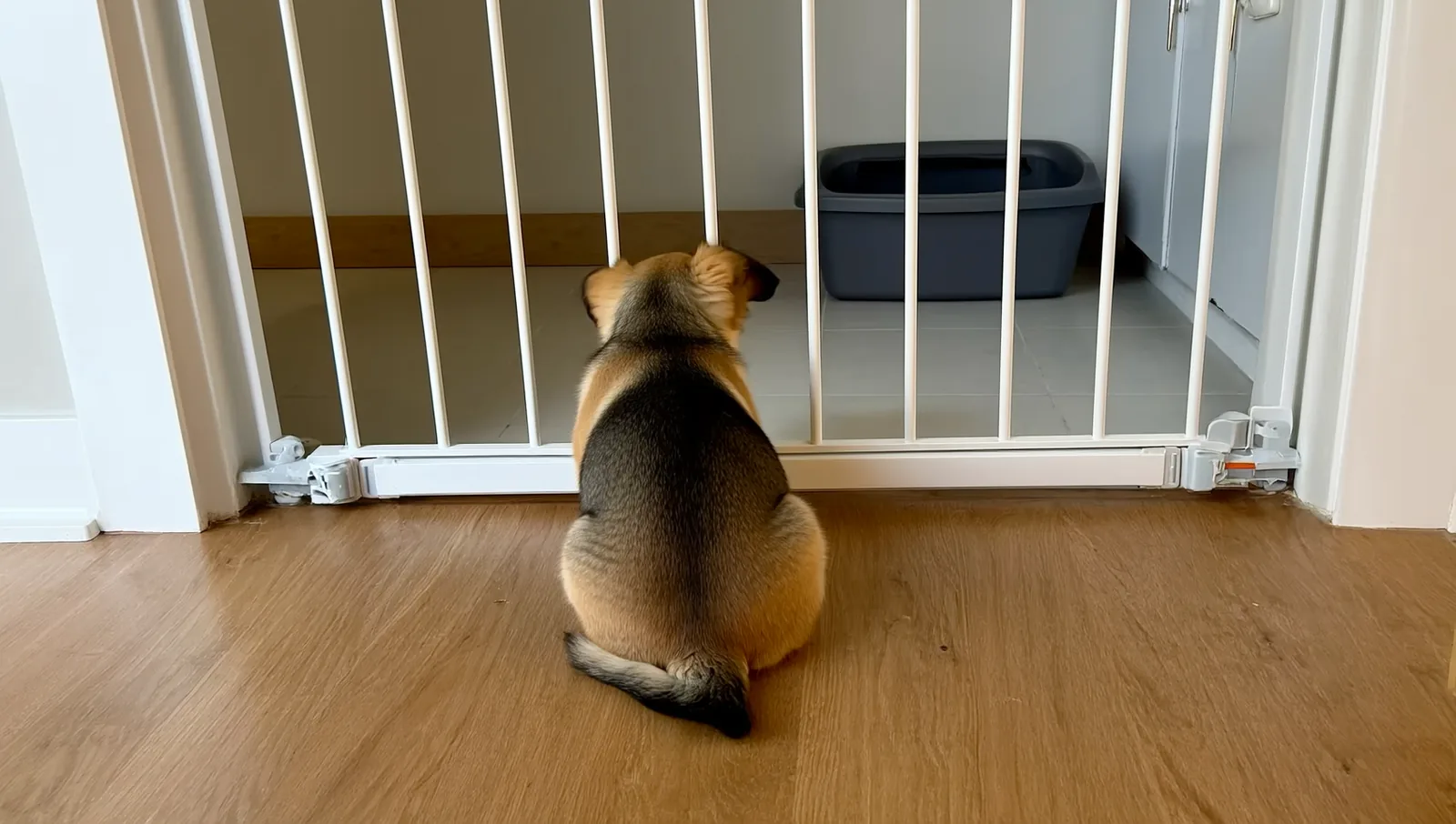
So gate the room, not the box. A baby gate with a small pet door the cat can use and the puppy cannot (recheck the fit as the puppy grows), or a gate your cat can hop over, keeps the box open on the cat’s side. Scoop at least once a day, which Cornell recommends for clumping litter anyway. And do not let the puppy lurk at the gate while the cat is using the box; that is exactly the ambush Cornell describes.
When Poop Eating Is a Medical Sign
Most puppy stool eating is behavioral, but not all of it. The AKC’s list of medical causes includes parasites, steroid medications, malabsorption syndromes, diabetes, Cushing’s disease, thyroid disease and other conditions that drive up appetite, along with diets short on nutrients or calories. In a puppy, ask first about parasites and problems absorbing food. Call your vet if the stool eating comes with any of these:
- A ravenous appetite, or a puppy who acts starving after full meals
- Weight loss, or a puppy who is not gaining as expected
- Loose, bulky, pale or greasy stools
- Diarrhea, vomiting, or unusual tiredness
- Stool eating that starts suddenly in an older puppy or adult that never did it
Exocrine pancreatic insufficiency is the textbook example: the pancreas stops making enough digestive enzymes, so food passes through poorly digested. The Merck Veterinary Manual lists weight loss, loose stools and excessive hunger as the most common signs, with pale, loose, voluminous feces, and says the condition is most frequent in young adult German Shepherd Dogs. A blood test confirms it, and most affected dogs can be managed successfully with enzyme replacement. That is the grain of truth in the enzyme theory: a dog that cannot digest its food may well eat stools (the AKC counts malabsorption among the medical causes), but it needs a diagnosis, not a guess from the supplement aisle.
Parasites come with a twist. Researchers at Utrecht University tested pet dogs’ stools monthly for a year, and when a sample showed roundworm eggs, the owner kept the dog away from feces for three days and sent another. Almost half of those retests (120 of 246) came back negative: the eggs had passed straight through from stools the dog had eaten. So tell your vet your puppy eats poop, because it changes how a fecal result is read and your vet may want a repeat sample after a few days of strict cleanup.
Other dogs’ stools carry their own risk. The American Veterinary Medical Association notes that parvovirus spreads through contact with infected dogs and their feces, and lists puppies between 6 and 20 weeks old among the dogs at greater risk. A puppy who hoovers up stools at a rest stop or the edge of a dog park is using exactly that route, one more reason to keep the leash on there and to keep the puppy vaccine series on schedule. It is not a reason to skip puppy class during the socialization window; a well-run class keeps its floor clean.
Why Powders, Pepper and Punishment Disappoint
Hart’s second survey asked owners of dogs with an established habit (seen eating stools more than ten times, and regularly) what they had tried. Eleven food additives and tablets marketed to stop stool eating, each tried by between 6 and 352 owners, had reported success rates of 0 to 2 percent. Behavior and management approaches barely did better. Chasing the dog away from stools (by far the most common response, tried by more than a thousand owners), lacing stools with pepper, and electronic or noise-making collars each worked for 1 to 2 percent of dogs. Rewarding a “leave it” cue did best, at a modest 4 percent.
Two caveats keep this fair. These were owner reports, not controlled trials, and nobody could tell whether owners followed the product directions. And for the products, owners were asked whether the habit was resolved, a far higher bar than whether a cue worked on the day. Still, the pattern is hard to argue with: nothing in a bag and no amount of punishment reliably talks a committed stool eater out of it. The AKC adds a snag for taste-aversion additives: every dog and cat in the house has to eat the product for their stools to taste worse.
Punishment also carries costs of its own. The American Veterinary Society of Animal Behavior lists increased anxiety, fear-related aggression and avoidance among the documented fallout of aversive methods, and notes that house training can be handled by arranging the environment and rewarding what you want. A puppy scolded around stools tends to learn to eat faster, eat out of sight, or stop pooping where you can see, which sabotages house training and makes prompt cleanup, your best tool, far harder.
So the goal changes. You are not curing a craving. You are making sure the puppy rarely gets the chance, giving it something better to do in the moment, and letting maturity finish the job in the many puppies that outgrow it.
The Force-Free Plan
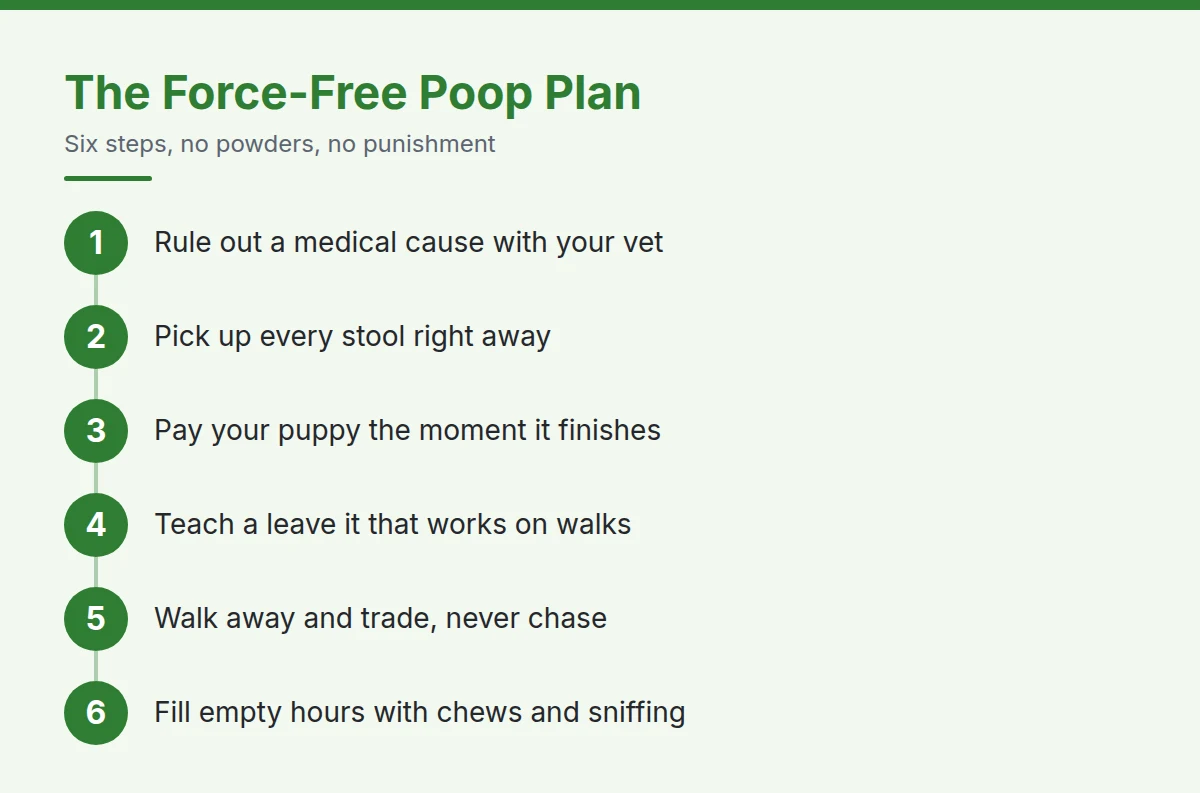
1. Rule out a medical cause. Especially if any of the red flags above apply. Take a fresh stool sample to the next vet visit and mention the habit.
2. Pick up every stool right away. In the early weeks this is most of the battle. Take your puppy out on leash to its toilet spot and clean up before it turns around. Walk the yard before any off-leash play, and feed well away from the toilet area, as the AKC recommends, so the smells of meals and stools do not blur together. If stools vanish from the crate or pen, the puppy is probably confined longer than its body can manage, so shorten the stretches and revisit the crate routine.
3. Poop, then pay. The AKC suggests teaching your dog to come to you for a treat as soon as it has pooped. Mark the moment your puppy finishes with a “yes!”, deliver something excellent at your feet a few steps from the pile, and clean up while it eats. With consistent repetition, many puppies start finishing and swinging straight round to you, a habit worth having for life that doubles as house training reinforcement. The treat has to beat the competition, so use the top of the list from a preference test, not a piece of kibble.
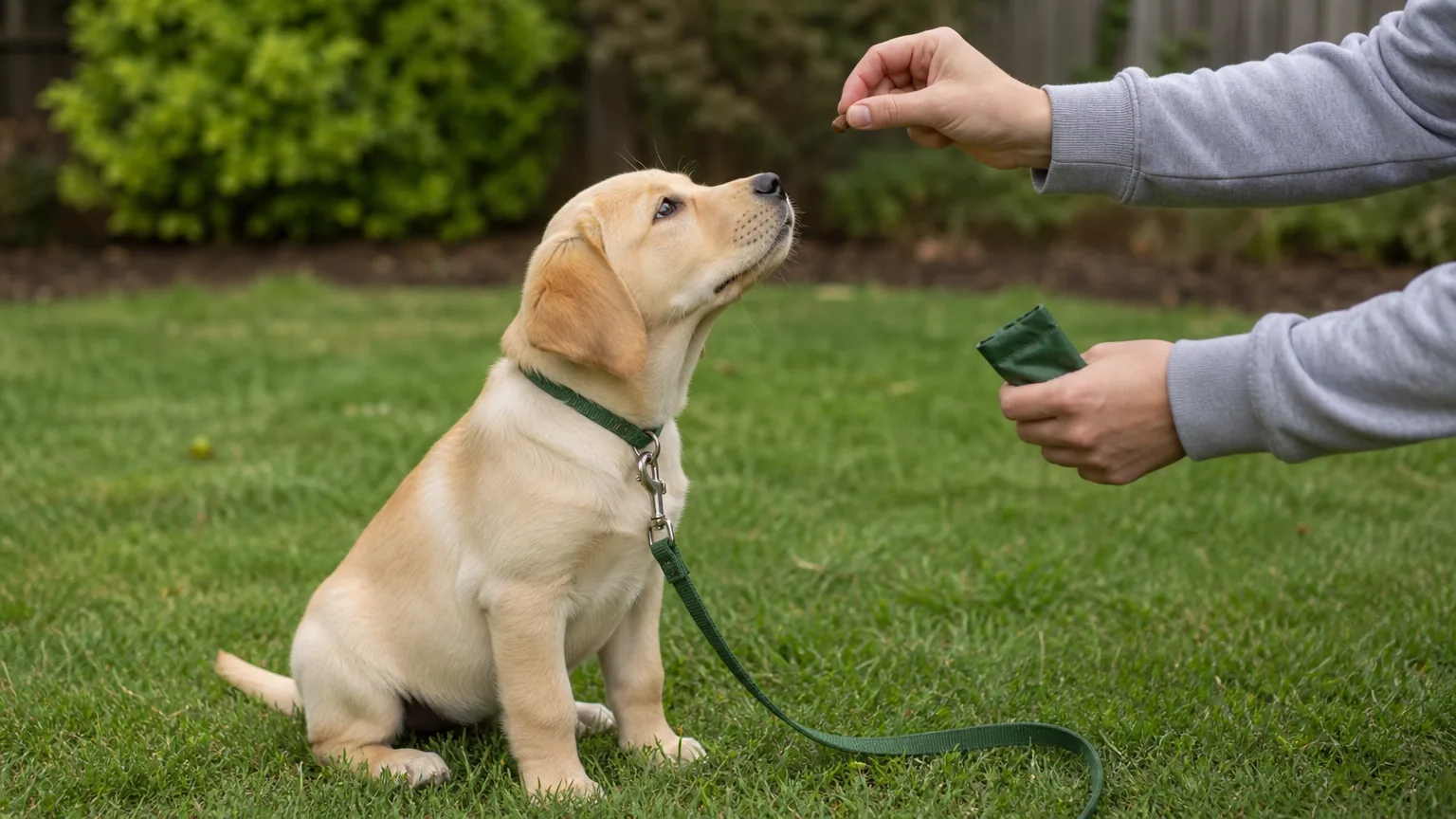
4. Teach a leave it that works on walks. Start with a treat in a closed fist and pay from the other hand when the puppy backs off. Progress to a treat on the floor under your hand, then to walking past food on the ground on leash, paying from your pocket every time and never with the item itself. Only then take it outside. Leave it will not remove the urge (remember that 4 percent), but a fluent one lets you interrupt on a walk. If you have already built one for trail safety, put it to work here.
5. Walk away and trade, never chase. When your puppy locks onto a stool, do not lunge. Say something cheerful, jog the other way, and drop a few treats behind you so that following you is the better game. If something is already in its mouth, offer a trade rather than prying the jaws open, the same approach that heads off resource guarding.
6. Fill the empty hours. Boredom and isolation feed the habit, so give your puppy real jobs for its nose and mouth: food puzzles, scatter feeding, suitable chews and short sniff walks. Go into the yard with your puppy rather than turning it out alone. Leash up where other dogs toilet or geese leave droppings, and patrol winter yards with care; the AKC notes that dogs are drawn mainly to firm stools and that frozen ones hold special appeal.
What a Good Puppy Class Does
Any experienced instructor has heard this question many times, so ask it. A typical stool-eating puppy needs class skills, not behavior modification: leave it, a recall, and a class rule that every accident is cleaned up at once. A trainer who suggests a shock or spray collar, hot sauce on stools, or rubbing a puppy’s nose in anything is using methods the evidence does not support. Dog training is unregulated in most US states, so look for CCPDT, KPA or IAABC credentials before you enroll.
When to Call a Professional
For most puppies, this is a management and training project. Get more help if:
- The stool eating continues well past nine months despite consistent management
- It shows up alongside anxiety, for instance only when your puppy is left alone or after it has been scolded
- It looks frantic or fixated, and your puppy is hard to interrupt
- Your vet has ruled out medical causes and the habit is straining how you feel about your dog
The referral you want is a board certified veterinary behaviorist, or a certified behavior consultant working alongside your vet. Do not wait until you are at the end of your rope: the AKC notes that finding out a dog eats poop is often cited as a reason people try to rehome one.
The puppy on your lawn is not broken, and by its own standards it is not being disgusting. Pick up fast, pay generously, gate the cat box, and let your vet rule out the medical causes. For most puppies that routine carries them through to the age when the habit fades. For the one in six who keep at it, the same routine is what keeps it manageable.
Further reading (sources)
- American Kennel Club on why dogs eat poop and the management that helps
- Hart and colleagues for two UC Davis surveys of stool-eating dogs and what their owners tried
- Nijsse and colleagues on how stool eating skews fecal parasite tests
- Merck Veterinary Manual with the signs and treatment of exocrine pancreatic insufficiency
- Cornell Feline Health Center for why a cat bothered at the litter box may stop using it
- American Veterinary Medical Association about how parvovirus spreads and which puppies it hits hardest
- American Veterinary Society of Animal Behavior with its case for humane, reward-based training