Which Shots Does Puppy Class Actually Require? Core Vaccines, Bordetella, Canine Flu, and Proof That Counts
Published on September 30, 2026

DHPP. Bordetella. CIV. Lepto. “Rabies, if over 16 weeks.” Sometimes a last line in bold: all vaccines must be given by a licensed veterinarian. The health section of a puppy class sign-up sheet is a column of abbreviations with a date box beside each one, and it lands in front of people whose puppy is nine weeks old, has had exactly one shot (possibly from the breeder), and will not finish the series for almost two months.
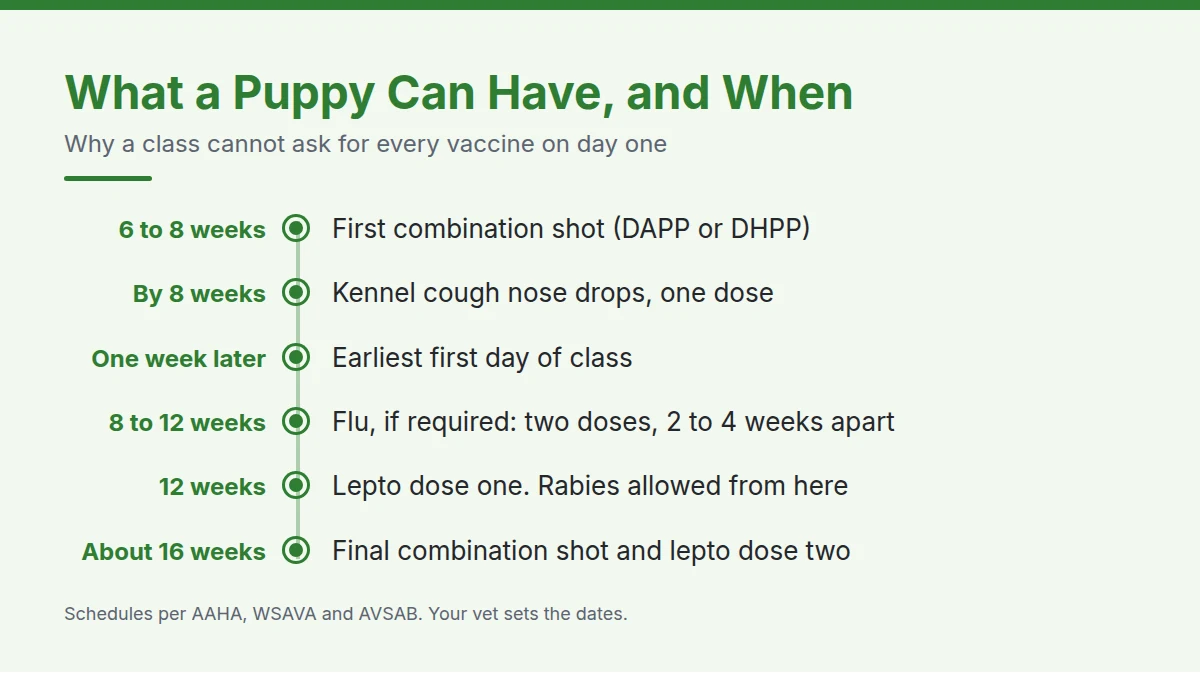
Here is the short version. No class that takes young puppies can ask for a finished series, because no puppy has one before 16 weeks. What a class can ask for is whatever a puppy that age is able to have on board, plus proof it can trust. Dog training is unregulated, so every class writes its own list. The lists all draw on the same few vaccines, though, and once you know when each one can be given, the form mostly explains itself.
“Core” and “Required” Are Two Different Lists
“Core” is a medical category. The American Animal Hospital Association (AAHA) uses it for vaccines recommended for every dog whatever its lifestyle, unless there is a medical reason not to vaccinate: distemper, adenovirus and parvovirus (usually with parainfluenza in the same syringe), leptospirosis, and rabies. Everything else is noncore, often called lifestyle. Bordetella, canine influenza, Lyme disease and rattlesnake toxoid are recommended for some dogs, depending on where they live and what they do.
“Required” is a door policy: what has to be in your puppy, and on paper, the day you walk in. The benchmark most often cited comes from the American Veterinary Society of Animal Behavior (AVSAB). It asks for at least one set of vaccines no less than seven days before the first class, a first deworming, and vaccines kept up to date for as long as the course runs.
The two lists do not match, and most of the confusion lives in the gap. Under the guidelines, two core vaccines do not start until 12 weeks, so no class can ask an eight-week-old for them. And one lifestyle vaccine, Bordetella, is the extra you are most likely to see, because a puppy in a group class has exactly the lifestyle it was made for. Noncore does not mean optional. The American Veterinary Medical Association (AVMA) recommends Bordetella and canine influenza vaccines for dogs that visit places where other dogs gather, training facilities included.
The Line Every Form Has: The Combination Shot
DHPP, DAPP, DA2PP and “5-in-1” all describe one injection covering distemper, adenovirus (the H stands for hepatitis, the disease it causes), parvovirus and, usually, parainfluenza. It is on every form, and it is the shot AVSAB’s seven-day rule is about.
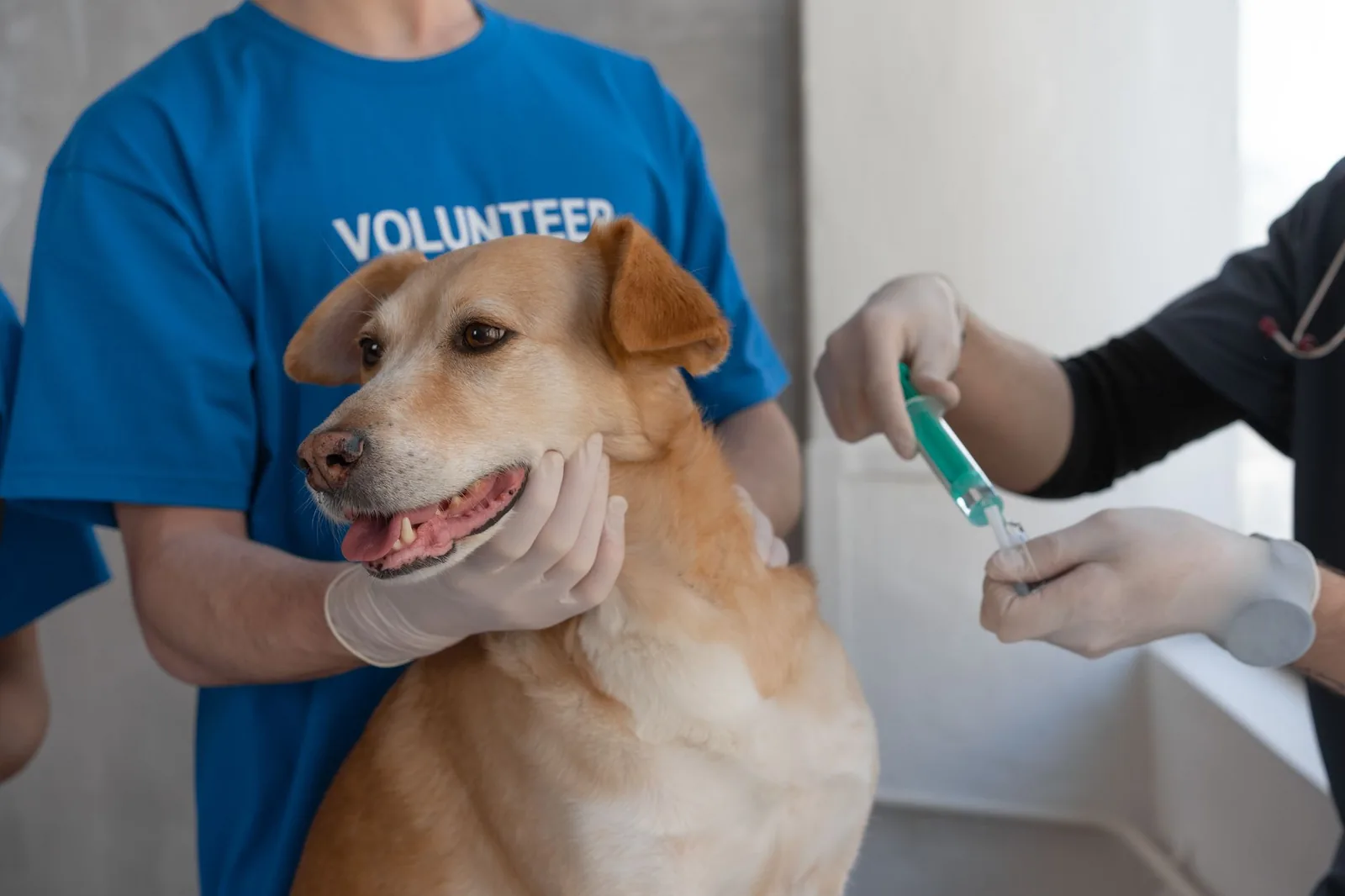
What varies is how much of the series a class wants to see. AAHA’s schedule is at least three doses between 6 and 16 weeks of age, two to four weeks apart. A class that follows AVSAB wants one dose, given at least a week before the first session. Some ask for ten days or two weeks, and some for two doses. A class that wants the whole series is telling you to wait until your puppy is past 16 weeks, after the socialization window has closed. That is a reason to find a different class, not a reason to wait. Why the series is spaced the way it is belongs to a separate piece on what delaying puppy shots actually costs.
Two practical notes. “Kept up to date” gets enforced, so expect to send in the new record after each booster. And the second P is parainfluenza, one of the kennel cough viruses. It is not canine influenza, which is a separate vaccine with its own line on the form.
Bordetella: The Extra You Are Most Likely to See
Kennel cough is not one disease. The AKC’s guide to the vaccine counts at least 12 respiratory organisms that can produce the same honking cough. Bordetella bronchiseptica, a bacterium, is among the most common and most contagious of them, and it is what the “kennel cough vaccine” targets.
That limits what the line on the form can promise. The World Small Animal Veterinary Association (WSAVA) says vaccines against respiratory pathogens cannot prevent infection, though they may make the disease less severe. A room of Bordetella-vaccinated puppies can still pass a cough around. The vaccine is there to make it milder and shorter.
It comes three ways, and for a puppy on a class deadline the route matters.
- Nose drops (intranasal). One dose. Some products can be given from 3 weeks of age, others from 7 or 8 weeks. Combination versions also cover parainfluenza, and AAHA’s schedule lists a single intranasal dose for dogs at risk of exposure.
- By mouth. One dose, squirted into the cheek pouch.
- By injection. Two doses, two to four weeks apart, so it cannot be finished in the week before class.
The AKC’s guide says the nasal and oral forms typically start protecting within three to five days.
Can a Puppy Go to Class Right After the Nose Drops?
Forms that require Bordetella often add their own lead time, usually a week or more. One reason is that the vaccine needs a few days to start working. The other is that the vaccine itself can make a puppy sneeze. The AVMA notes that vaccines given in the nose may cause sneezing, mild coughing or other respiratory signs two to five days afterward.
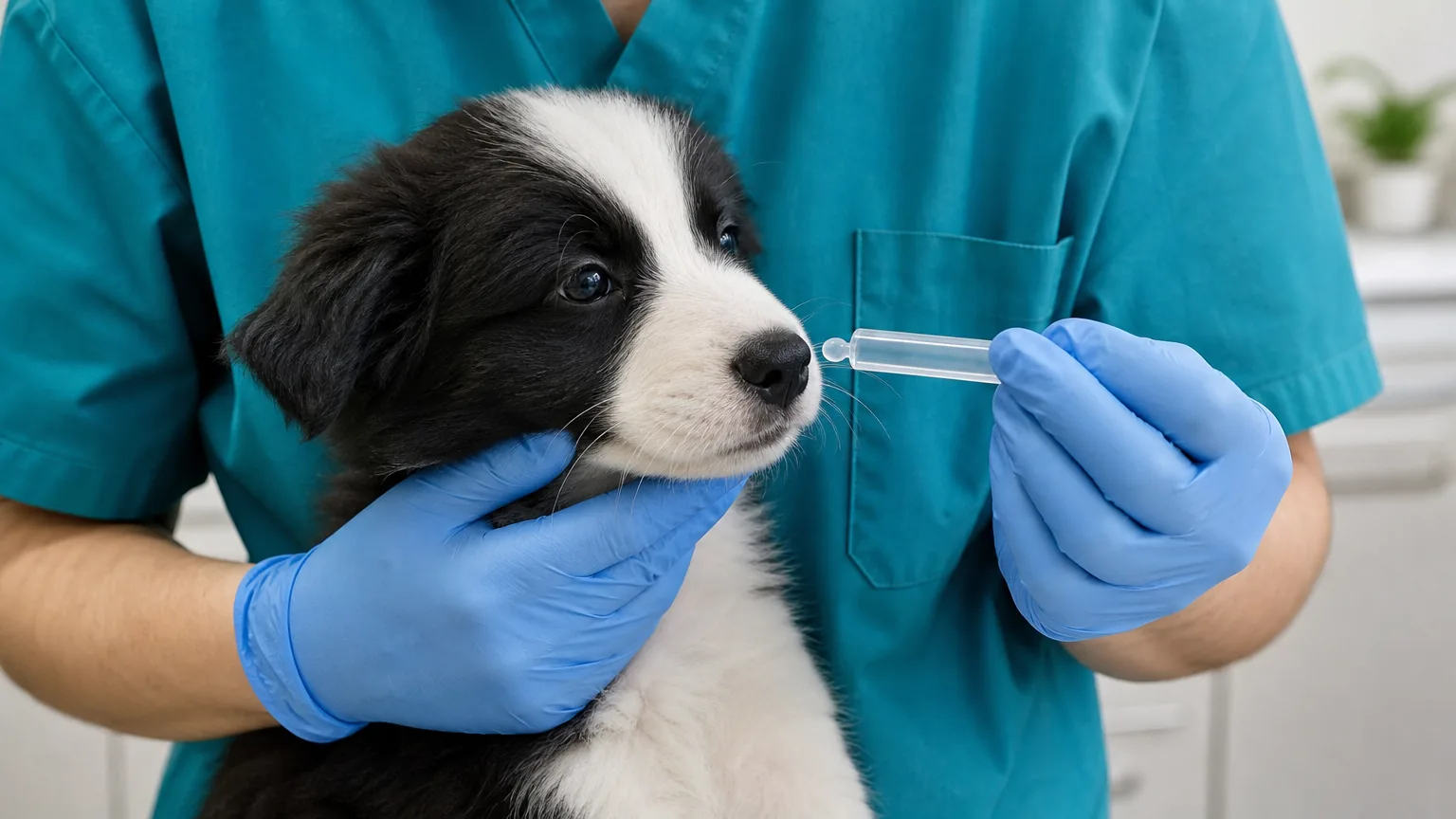
A small Colorado State University study shows why that matters in a group. Eight puppies were given an intranasal vaccine, and the three organisms in it kept turning up on their nose and throat swabs for as long as 28 days, most often between days 3 and 10. What the swabs found was the weakened vaccine itself, not an infection. But nobody in a classroom can tell a vaccine sneeze from the real thing, and a class with a sensible sick policy sends a coughing puppy home either way.
The fix is scheduling. Ask your vet whether the kennel cough vaccine can go in at the same visit as the first combination shot. Both clocks then run together, and any sneezing should be over before the first class. If it is not, call your vet and skip that week.
Canine Flu: Check the Local Picture Before the Form
Canine influenza (CIV on the form, strains H3N8 and H3N2) is a line you are more likely to meet at daycare or boarding than at puppy class. The AVMA’s description is blunt. Almost every dog exposed to the virus becomes infected. Most have a mild illness and recover in two to three weeks, and about 1 to 5 percent of infected dogs die. A dog can spread the virus for up to four weeks, even if it never looks ill.
Even so, the flu vaccine is not recommended for every dog. AAHA classes it as noncore, and the AVMA says vaccination is generally recommended only in certain circumstances. WSAVA describes the outbreaks as sporadic, clustered where dogs are housed or mixed together, and adds that the vaccine does not prevent infection but may make the illness shorter and milder.
For a young puppy there is a calendar problem too. The vaccine takes two doses, two to four weeks apart, starting from 6 weeks of age. A puppy who gets dose one at an 8-week vet visit cannot finish before 10 to 12 weeks. So when flu appears on a puppy form, ask two things. Will the class accept the first dose with the second one booked? And is flu circulating locally right now, which your vet will know? Whatever the answers, the AVMA suggests asking any facility whether it isolates dogs that develop respiratory signs and whether it tells owners after an exposure.
Lepto Is Core Now. It Is Still Not a Day-One Requirement
This is the line that changed. In 2024 AAHA updated its canine vaccination guidelines to move the leptospirosis vaccine from noncore to core. The change followed a 2023 consensus statement from the American College of Veterinary Internal Medicine (ACVIM), which says the vaccine should be given annually to all dogs from 12 weeks of age, regardless of breed. WSAVA’s 2024 guidelines call it core wherever the disease is endemic and a suitable vaccine is available.
The old picture of lepto, a disease of big hunting dogs in wet country, no longer fits. “Any dog that goes outdoors, whether in an urban or a rural setting, can be exposed to leptospirosis,” AAHA’s director of guidelines said. A Purdue epidemiologist on the task force added that small-breed dogs are now overrepresented among cases, because they have been the least likely to get the vaccine. The ACVIM panel reports cases in puppies as young as 11 weeks, and the infection can pass to people. As for the vaccine’s old reputation for reactions, task force members say current lepto vaccines do not appear to carry a higher risk than other vaccines.
Core still does not mean a 9-week-old needs it to enroll. AAHA’s schedule is two doses, two to four weeks apart, starting at 12 weeks. In practice they ride along with the last two puppy visits, usually while your course is already under way.
Where it matters is the next form you fill in. The ACVIM statement says boarding and daycare facilities should require the lepto vaccine, because outbreaks have been linked to them. AAHA observes that, while lepto was noncore, those facilities typically did not ask for it. Expect that to change. If daycare is in your puppy’s future, finish both doses on schedule.
Rabies: The Law Sets the Date
Rabies is core, and state or local law usually requires it, but not at eight weeks. The CDC says most dogs should not be vaccinated before 12 weeks, and that a dog counts as immunized 28 days after its first rabies vaccine. AAHA’s entry for it is four words long: “As required by law.” That is why class forms say something like “rabies, if over 16 weeks.” If your puppy reaches that age during the course, the certificate joins the file.
Rabies is also the one vaccine where who gave it is a legal matter. The CDC’s guidance is that animal rabies vaccines should be administered only by a veterinarian or under veterinary supervision, in line with local law.
Why Feed-Store Shots May Not Count
Combination puppy vaccines are sold over the counter, at feed stores and online, and plenty of breeders give the first dose themselves. It can be done properly. Purdue University’s canine welfare science group publishes a handout for breeders who vaccinate their own dogs.
The same handout shows why a class cannot take such a shot on trust. Most vaccines have to be kept between 35 and 45°F. A vial that has frozen has to be thrown away. Once mixed, a vaccine should be used within the hour. “Failure to store or handle vaccines properly can lead to vaccine failure,” it warns. As a veterinarian writing for PetMD points out, a clinic stores vaccines correctly and monitors the temperature, and nobody can promise the same for a vial bought over the counter and carried home.
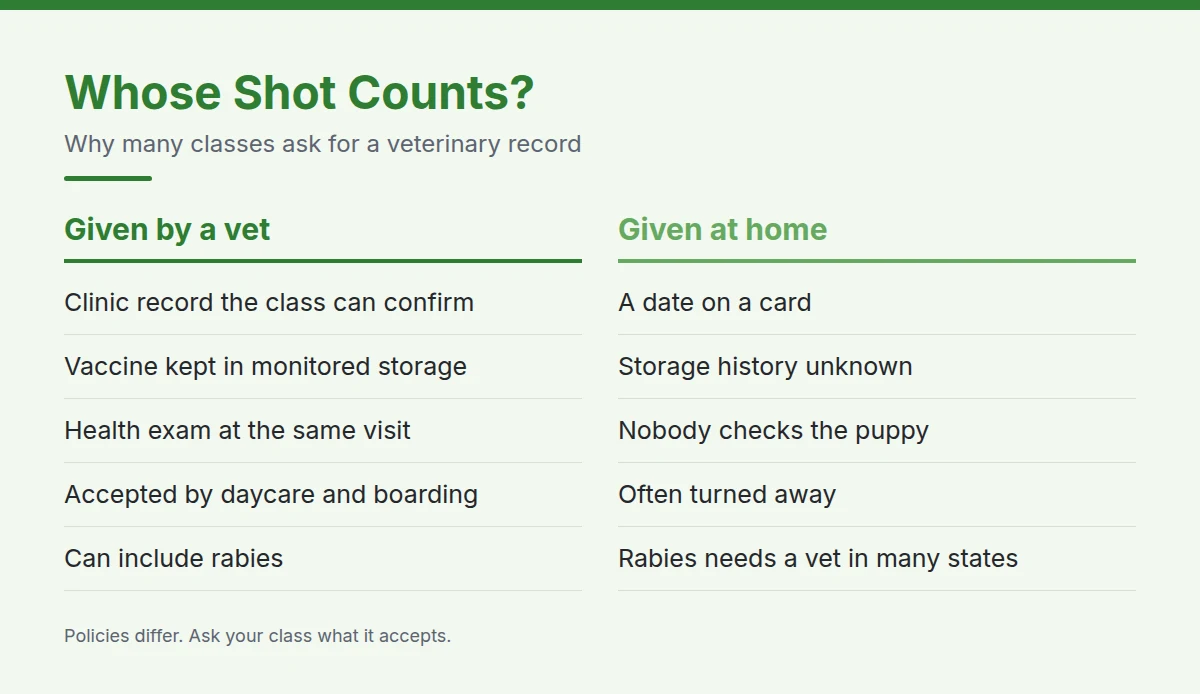
So many classes draw the line at who gave the shot, and storage is only one reason.
- A clinic record can be checked. It names the product, the date and the clinic, and the class can phone to confirm it.
- The evidence for early class is about puppies vaccinated by a vet. The main study behind the safety of early socialization classes followed 279 puppies and found no parvovirus among them. It enrolled puppies that had been vaccinated by a veterinarian at least once.
- The visit includes an exam. AVSAB’s standard is that each puppy should be “disease and parasite free” before entering class. A shot given at home comes with nobody checking.
- Other facilities will ask too. The PetMD piece notes that many boarding, grooming and daycare businesses do not accept at-home vaccines.
None of this means a breeder’s shot was wasted. It means the class may start its seven-day clock from the first dose your vet gives. Since the series repeats every two to four weeks anyway, the cost is usually one appointment your puppy needed regardless.
If the breeder vaccinated, ask for a record showing the date, plus the vaccine type, manufacturer, lot number and expiration date, the details Purdue tells breeders to keep. Take it to your first vet visit, along with the other questions worth asking about your puppy’s first eight weeks, and let your vet decide how to count it. Some classes accept a breeder’s or a rescue’s record as it stands and others accept only a veterinary one, so ask before you assume either way. And if you brought home two puppies, each needs its own record and its own place in class, one of several things that double when you are raising two puppies at once.
One Vet Visit, Then Class
- Get the list first. Ask the class for its health requirements before your puppy’s first appointment, and take them with you.
- Book the vet for the first few days home. Bring every record the breeder, shelter or rescue gave you.
- Ask for everything on the list your puppy is old enough for. Usually that is a combination shot, a deworming, and the kennel cough vaccine if the class wants it.
- If your puppy is tiny, ask about spacing. In a study of more than 4.6 million dogs, reactions were recorded after about 19 of every 10,000 vaccine visits. They became more likely as more vaccines were given at one visit, and were most common in dogs of 5 kilograms (11 pounds) or less. AAHA’s task force members caution that splitting shots across visits is usually unnecessary and risks a missed appointment, so treat it as a question for your vet, and raise it early.
- Count seven days, then start. Send the updated record after every booster. Lepto joins at 12 weeks, and rabies when your vet and local law say so.
- Push back on a form no puppy can meet. A finished series, rabies at ten weeks and a completed flu course are adult-dog rules. Ask whether the puppy class has its own. If it does not, look for one that follows AVSAB’s standard.
How a class handles its health rules is one of the better clues to how it is run, alongside the other things to check when you choose a puppy class. It also helps to know how chain-store, independent and online programs compare before you commit to one.
The Bottom Line
Read the form as a timetable, not a test. At 8 to 10 weeks a puppy can have one combination shot and a kennel cough vaccine, and that is what a well-run class asks for, along with a record it can verify. Flu depends on where you live. Lepto and rabies are core, and they come later because the vaccines do. Get the list before the first vet visit, bring every record you were given, and your puppy can be in class a week after that appointment, well inside the window the class exists for.
Further reading (sources)
- American Animal Hospital Association with its table of core and noncore vaccines and dosing schedules
- American Animal Hospital Association on why the leptospirosis vaccine was moved to core
- Sykes and colleagues (ACVIM) for the consensus statement recommending lepto vaccine for all dogs
- World Small Animal Veterinary Association with its global vaccination guidelines, including kennel cough and flu vaccines
- American Veterinary Society of Animal Behavior for the rule of one set of vaccines a week before class
- American Veterinary Medical Association on lifestyle vaccines and what to expect after a nasal vaccine
- American Veterinary Medical Association with how canine influenza spreads and what to ask a facility
- American Kennel Club on the three forms of Bordetella vaccine and how fast they work
- Ruch-Gallie, Moroff and Lappin for vaccine organisms on puppies’ swabs after an intranasal dose
- Centers for Disease Control and Prevention on rabies vaccine timing and who may give it
- Purdue University Canine Welfare Science with storage and record-keeping rules for breeders who vaccinate
- PetMD on why facilities often reject at-home vaccines
- Stepita, Bain and Kass for the parvovirus record of puppies vaccinated by a vet before class
- Moore and colleagues with how dog size and shots per visit change reaction rates