How Much Socialization Does a Puppy Need? What the Guelph Survey Found About Exposure, Classes, and Punishment
Published on October 31, 2026

Ask a new owner how socialization is going and you will often hear about the daily walk. Same loop, same time, the same two neighbors waving from their driveways. To the owner it feels like the wide world. To a 10-week-old puppy it may be one street, met over and over again.
How much is enough is one of the few socialization questions anyone has tried to count. Beginning in 2014, researchers at the University of Guelph in Ontario asked owners how many people and dogs their puppy had been exposed to, two weeks at a time, from before 8 weeks of age to 20 weeks. The results from 296 owners, published in the Journal of the American Veterinary Medical Association in 2017, describe a line that almost a third of the puppies never got above. Here is what the survey found, why a one-hour weekly class showed up in everything else the owners did, and a tally you can keep to check your own puppy.
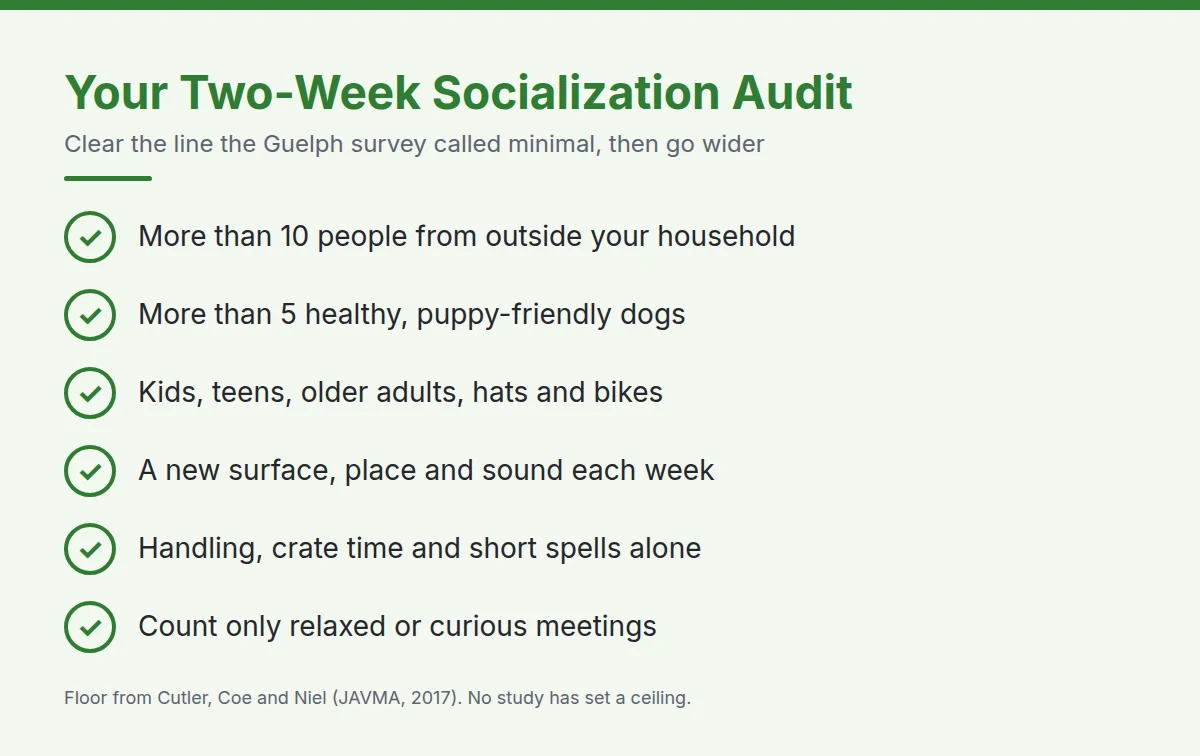
What the Guelph Team Counted
Janet Cutler, Jason Coe and Lee Niel recruited owners through dog associations, online forums, humane societies, retailers and a Canadian classified-ad site. Any adult with a puppy under 20 weeks could take part. Most of the recruiting ran through Canadian channels, with some in the United States, and each owner answered twice: once on signing up and again when the puppy turned 20 weeks.
The second survey did the counting. For the weeks before 8 weeks of age, and then for each two-week block from 8 to 20 weeks, owners picked a range for how many dogs, and how many people other than themselves, the puppy had been exposed to: none, 1 to 5, 6 to 10, 11 to 20, 21 to 30, or more than 30. They also recorded how the puppy reacted (scared, indifferent or excited), what they did when it was frightened, and which of 16 discipline methods they had used, from rewarding good behavior to hitting.
Two caveats travel with every number below. The counts are owners’ estimates, made at 20 weeks about weeks that were sometimes three months gone. And the owners found the study online, which the authors note may have drawn people more interested in puppy behavior than the average owner. If anything, that suggests the wider picture is worse, not better.
Almost a Third Barely Met Anyone
Most puppies were reported to meet plenty of people and dogs, and exposure climbed as they grew. But almost one third got what the authors called minimal exposure outside the home: 10 or fewer people and 5 or fewer dogs in a two-week block. (The university’s press release paraphrased this as fewer than five dogs and fewer than 10 people. The paper’s own cut-off is the one above.)
In everyday terms, 10 people in 14 days is less than one person a day, and five dogs is one every few days. A household routine plus the same short walk can produce exactly that.
The timing is what makes it worrying. The Guelph authors put the generally accepted socialization period at about 3 to 12 or 16 weeks of age, and AVSAB describes the first three months as the time when “sociability outweighs fear.” Two quiet weeks at 10 weeks old are not the same as two quiet weeks at 10 months.
The pattern is not a quirk of one Canadian sample. When a Royal Veterinary College team compared UK puppies bought during the 2020 lockdowns with puppies bought in 2019, the pandemic puppies were far less likely to have attended a puppy class before 16 weeks (28.9 percent against 67.9 percent) and less likely to have had visitors at home (81.8 percent against 94.5 percent). When a household’s world shrinks, the puppy’s shrinks with it.
Nobody Has Proven the Right Number
Here is the honest part. Ten people and five dogs is a line the Guelph team drew to describe their data, not a proven threshold. The authors say so plainly: no data exist on the specific numbers of people, locations and dogs a puppy needs for healthy social development, and they call for research to find the minimum. Five years later, a systematic review of 29 socialization studies by McEvoy and colleagues at Queen’s University Belfast reached the same place. The minimum and maximum levels of socialization needed to produce emotionally robust adult dogs, they wrote, “are currently unknown.”
What does exist is a working rule. The American Veterinary Society of Animal Behavior’s position statement asks owners to expose puppies to “as many new people, animals, stimuli and environments as can be achieved safely and without causing over-stimulation manifested as excessive fear, withdrawal or avoidance behavior.” That sentence sets the limit by the puppy, not by a number. So treat the Guelph line as a floor to clear every two weeks, and let your puppy’s reactions decide how far above it to go.
Why a Daily Walk Is Not the Same Thing
The survey also shows where the busier puppies got their extra experience. Owners who went to class reported more frequent exposure to every situation on the survey’s list except two: walking off leash and going to the dog park. Those were the only items on which the groups did not differ. The noises and novel situations on the rest of the list are where the class owners pulled ahead.
A walk counts, but it counts once. The same loop at the same hour meets the same people, and a dog seen across the road is a sighting, not a meeting. The dog park is a poor stand-in, too: AVSAB’s statement says puppies should stay away from dog parks and other areas heavily used by dogs whose vaccination and disease status is unknown.
Some of the exposures that matter most never leave the house. In the survey, the fear owners reported most often was being left alone, and the noise that most often scared a puppy was the vacuum cleaner, which the authors suggest is simply because it is a noise puppies hear a lot. Both belong on your list as much as a busy sidewalk does.

Why One Hour of Class Shows Up in the Other 167
About half the owners (145 of 296) took their puppy to a structured class before 20 weeks. The gap opened as the weeks went on: class puppies were exposed to more people from 10 weeks of age and to more dogs from 14 weeks, and class owners were less likely to report a puppy scared of thunder, the vacuum or crate training.
A class is one hour a week. Three things help explain why it shows up in the other 167.
- The room itself. The most common course in the survey ran six sessions, and the most common class size was four to six puppies. One evening puts three to five other puppies, their owners and an instructor in front of your puppy, which on its own comes close to the study’s two-week dog line.
- What the owner takes home. “This speaks to how puppy classes aren’t just about obedience,” Coe said in the university’s release. “They are about exposing your pet to other people and animals as well as educating pet owners.” A good class sends you home with ideas for the week: new surfaces, new sounds, new people, and a sense of what normal puppy worry looks like.
- Who signs up. Owners in the top income band (over $90,000 a year) had 2.9 to 3.7 times the odds of attending compared with owners in the two lowest bands. Owners who researched puppy care before bringing one home had 2.6 times the odds, owners without children almost twice the odds, and suburban owners about 2.5 times the odds of rural ones. The authors are candid that their survey cannot separate what the class taught from the kind of person who enrolls, a problem our look at what the follow-up research on puppy classes can and cannot prove covers in detail.
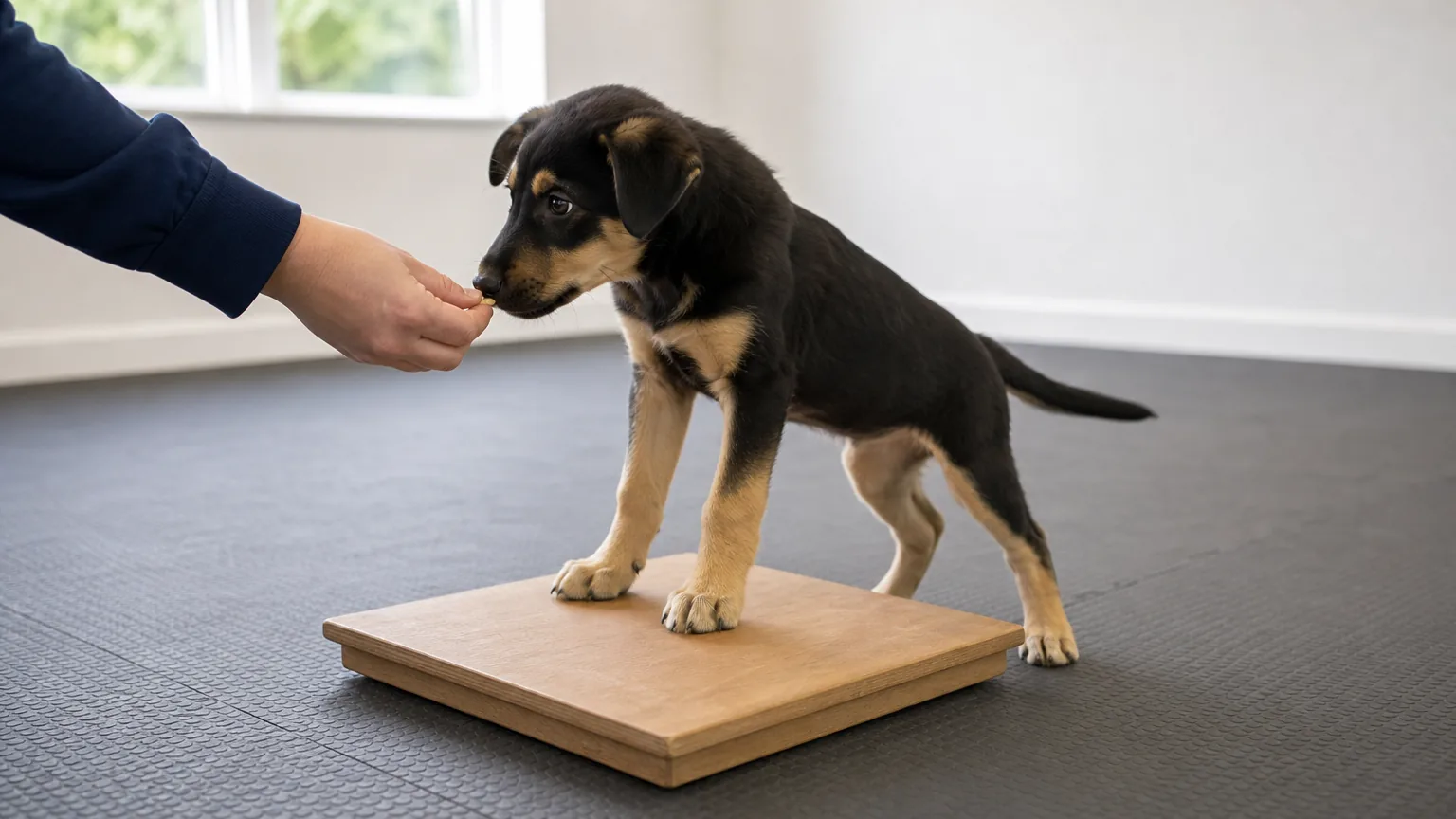
Classes also varied more than the word suggests. Sit, down, recall, loose-leash walking and attention exercises were taught in at least 80 percent of the classes attended. Fewer than half covered noise exposure, trading up (swapping an item for a treat, which helps head off guarding) or going to a mat, and just under 70 percent set aside time for the puppies to play. So ask what a class actually does before you enroll, and check the instructor’s credentials while you are at it, because dog training is unregulated in most states. Our guide to choosing the right puppy class lists the questions. You do not have to wait for the full vaccine series, either: AVSAB says puppies can start class as early as 7 to 8 weeks, with a first set of vaccines at least 7 days before the first session and a first deworming.
The Punishment Gap Was Mostly One Habit
The survey’s other headline was discipline. Fewer class owners reported using positive punishment, meaning something unpleasant added to stop a behavior. The detail is more useful than the headline, though, because most of that gap came from one technique.
- Holding the puppy on its back: 21 percent of class owners, against 76 percent of owners who skipped class.
- Verbal corrections: 82 percent against 96 percent, so common in both groups.
- Redirecting the puppy: 95 percent against 83 percent.
- Ignoring unwanted behavior: 37 percent against 20 percent.
- Rewarding the right behavior: 93 percent against 86 percent.
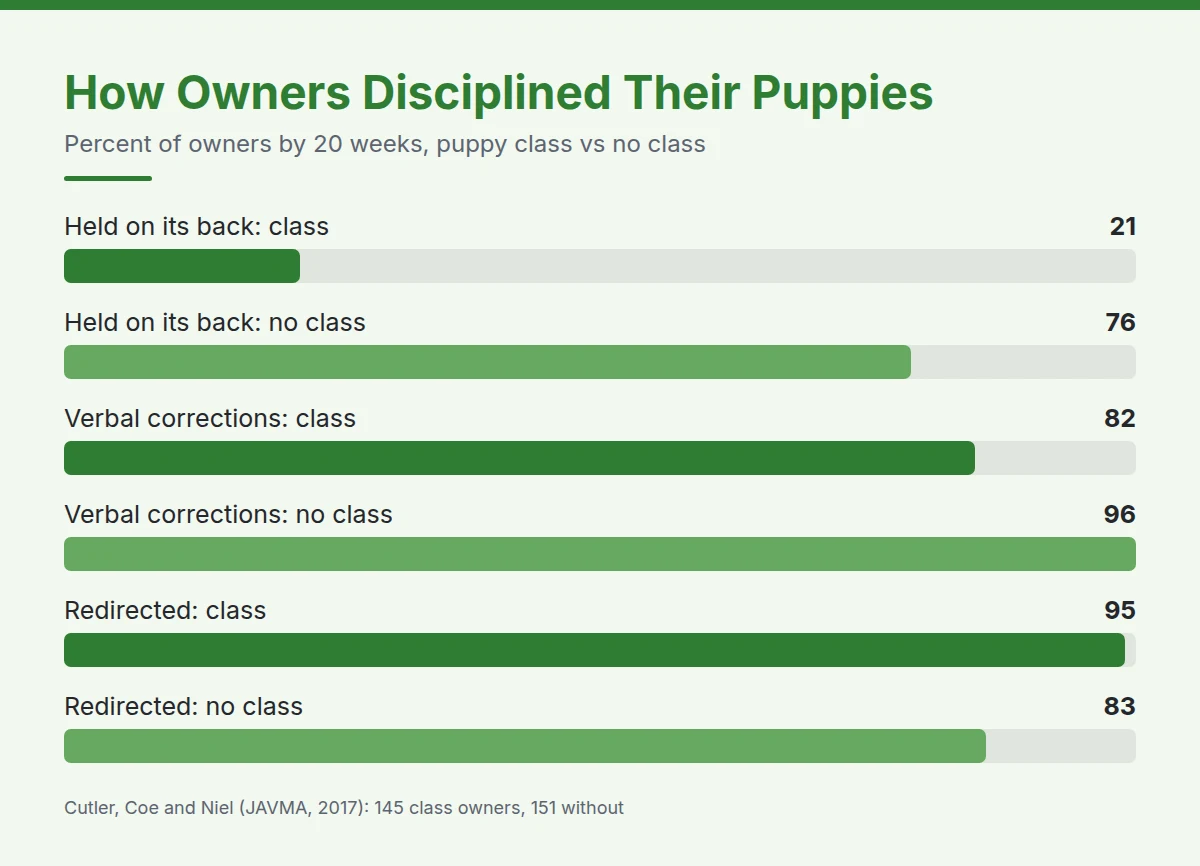
Not everything moved. Scruffing, grabbing the muzzle and spraying water were reported slightly more often by class owners, though none of those differences was statistically significant, and a few owners in both groups admitted hitting or kicking. These are also raw comparisons that do not adjust for income or anything else. Class owners were not punishment-free. Mostly, they had dropped the hold-down.
That one matters. Pinning a dog on its back is the move popularized as the “alpha roll,” and in a survey of 140 owners by Herron, Shofer and Reisner it drew an aggressive response from 31 percent of the dogs it was tried on. In the Guelph data, owners who used punishment were also more likely to report a puppy frightened by noise. That is an association, not proof that one caused the other, but it points the same way as the wider research. If you have been using corrections and want to stop, our guide for the crossover owner lays out the switch step by step.
A Two-Week Tally You Can Actually Keep
You do not need a spreadsheet. You need the survey’s own method, turned around: count in two-week blocks, and score each meeting the way the Guelph owners did.
- Mark the blocks. Start a page or a phone note with two-week blocks from the day your puppy came home to 20 weeks. A puppy who came home at 12 weeks, as many toy breeds do, has only two blocks left before 16 weeks, so each one carries more weight.
- Count people and dogs. Tally people from outside your household and dogs your puppy actually met, not just saw. The floor in every block is more than 10 people and more than 5 dogs, which keeps you above the line where almost a third of the Guelph puppies sat. Pick dogs you know are healthy, vaccinated and gentle with puppies; classmates count.
- Spread the people. Ten adults who look alike are not ten different experiences. Over each block, aim for children, teenagers and older adults; hats, beards, sunglasses and hoods; and people who move differently, on bikes, behind strollers or with a cane.
- Add one new thing a week in three columns. Surfaces and places (gravel, a metal grate, stairs, a friend’s kitchen, a car ride), sounds (the vacuum, the doorbell, a thunder recording played quietly at dinner) and handling and home routines (paws, ears, mouth, the crate, a few minutes alone). That is our working rule, not a research number. The point is breadth.
- Score every meeting. Use the survey’s three words: scared, indifferent or excited. Only relaxed or happily curious meetings go into the count. A scared mark means backing off to a distance or volume your puppy can handle, which is the heart of desensitization and counterconditioning.
- Review every second Sunday. An empty column is next week’s priority. A growing column of scared marks is a reason to slow down, and fear that is intense, lasting or spreading to new things is a reason to ask your vet about a referral to a board-certified veterinary behaviorist now, while the window is still open.

Sixteen weeks is not a finish line. AVSAB’s statement says these exposures should continue into adulthood to keep a dog outgoing, and the Guelph owners’ counts kept rising as their puppies grew. Keep the tally through the next couple of blocks, then switch to a monthly check through adolescence.
The Bottom Line
No one has proven how many people and dogs a puppy needs. What the Guelph survey shows is how easily a puppy ends up with very few: almost a third got 10 or fewer people and 5 or fewer dogs per two-week block. Class owners did better on exposure and mostly dropped the harshest correction, though some of that credit belongs to the kind of owner who enrolls. Clear the floor every two weeks, spread the experiences wide, count only the meetings your puppy enjoyed, and let a scared reaction slow you down rather than push you on.
Further reading (sources)
- Cutler, Coe and Niel on the 296-puppy survey of exposure counts, classes and discipline
- University of Guelph News with the researchers on why puppy classes are not just obedience
- McEvoy and colleagues for a systematic review of 29 canine socialization studies
- American Veterinary Society of Animal Behavior on how much exposure a puppy should get and when class can start
- Brand and colleagues about classes and home visitors among the UK’s pandemic puppies
- Herron, Shofer and Reisner with aggressive responses to confrontational training methods