Toy Breed vs Large Breed Puppy: How the First-Year Training Timeline Differs
Published on October 29, 2026
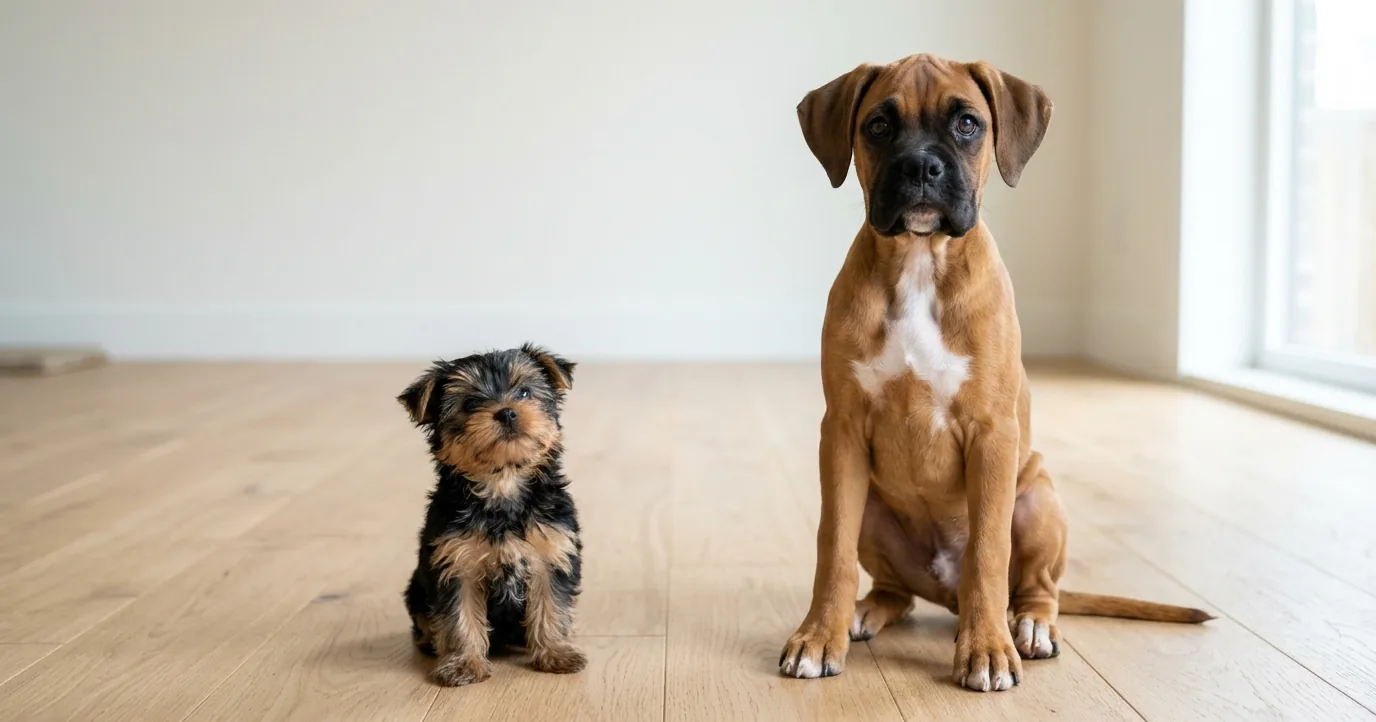
Put a Yorkshire Terrier and a Boxer on neighboring mats at puppy class, both 12 weeks old, and on paper they are classmates in every sense. Same age, same round of shots, same wobbly sit for a piece of chicken. One will weigh a few pounds as an adult. The other will weigh sixty or so.
For the next year they will not be on the same page. The Yorkie may be finished growing before the Boxer is halfway there. Their hormones will arrive in different months. One will spend its first few months leaving puddles too small to notice, and the other will be leaning serious body weight into the leash long before its self-control has caught up.
The skills do not change with size, and neither does the method: reward-based training works the same way on a four-pound dog as on a sixty-pound one. What changes is the calendar. Below, the two clocks are laid side by side, toy breeds at one end, large breeds at the other and mid-size dogs like the Beagle somewhere in between, along with what each one means for your goals in class.
The One Clock Every Puppy Shares
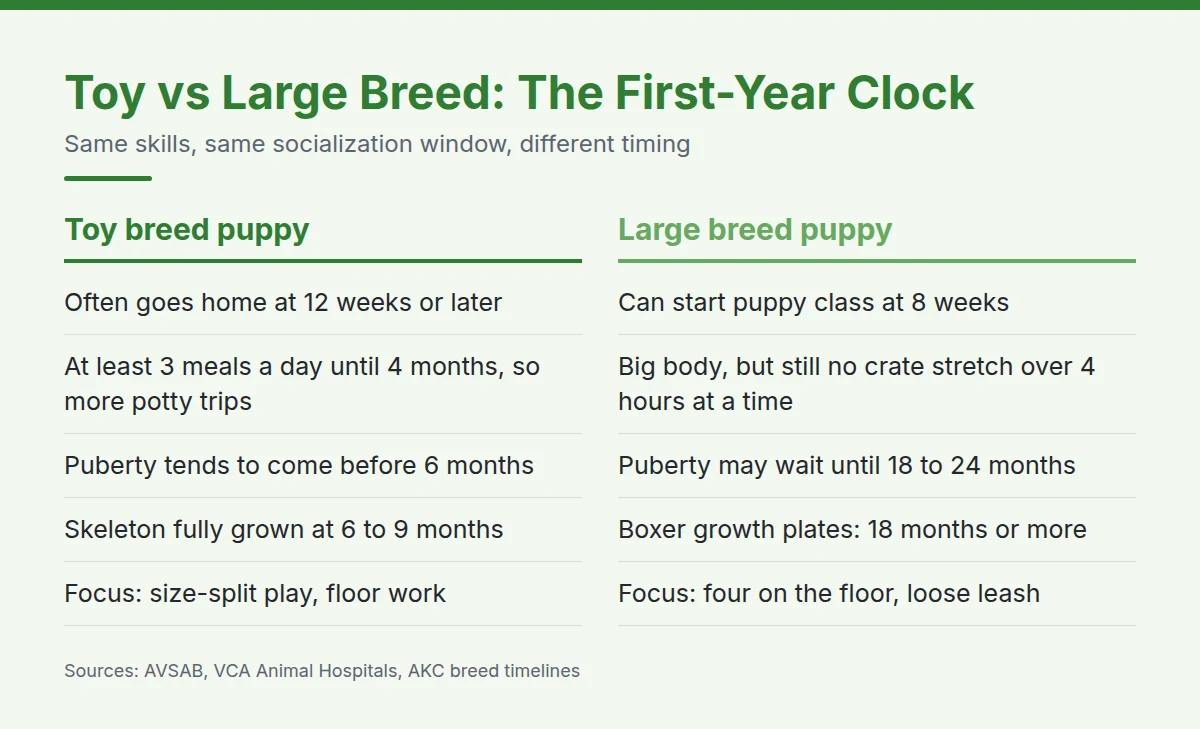
Start with what size does not change. The American Veterinary Society of Animal Behavior (AVSAB) states that the primary and most important time for puppy socialization is the first three months of life, and its position statement makes no adjustment for breed or size. A toy puppy does not get a longer window for being small, and a large-breed puppy does not get a shorter one for growing fast. The practical advice is shared too: puppies can start socialization classes as early as 7 to 8 weeks, once they have had at least one set of vaccines a week or more before the first class, plus a first deworming.
Everything wrapped around that window is where size starts to matter: when the puppy actually reaches you, how often it needs to go out, when its hormones arrive, and how long its body takes to finish growing. Our week-by-week milestones from 8 to 16 weeks cover the early stretch every puppy shares. This guide follows the two sizes across the rest of the first year.
Toy Puppies Often Come Home Later
Plenty of toy breeders keep puppies well past the eight weeks most owners expect. Judy Marksbury, a board member of the Yorkshire Terrier Club of America who has bred Yorkies for more than 30 years, says in the AKC’s Yorkie timeline that the earliest a puppy should go home is 12 weeks, and that many stay with their litter, mother and breeder until 16 weeks or longer. She links leaving too early with anxiety and eating problems.
Set that beside AVSAB’s three-month window and the arithmetic is uncomfortable. A Yorkie collected at 12 weeks has spent nearly all of the prime socialization period at the breeder’s, and one collected at 16 weeks has spent all of it there. A Boxer puppy, meanwhile, can already be in class at 8 weeks: Debra Henkle, a trainer quoted in the AKC’s Boxer timeline, says most training clubs accept puppies that young with proof of first shots.
So the toy owner has two jobs the large-breed owner mostly escapes:
- Find out what already happened. For a late-arriving puppy, the breeder’s home was most of the socialization period. Ask exactly what the puppy has met: visitors of different ages, household noise, car rides, handling, other dogs. Our guide to the first eight weeks you didn’t see lists the questions and how to fill the gaps.
- Don’t let a quiet start become a quiet month. Marksbury advises against taking a new Yorkie everywhere in its first week (“Go slow. Don’t overwhelm them.”), and a calm few days suits any puppy. But with the window already closing, book class for the second week home, not the second month.
Housetraining: The Small-Puddle Problem
Housetraining works the same way at every size. Take the puppy out on a schedule, reward at the spot, and prevent accidents rather than punish them. What differs is how many trips the schedule needs and how visible the mistakes are.
The triggers are universal. Henkle’s rule of thumb for Boxers holds for any puppy: expect a need to go within 5 to 15 minutes of eating, drinking, sleeping or playing. What changes is how often those triggers come around. VCA Animal Hospitals advises at least three small meals a day for toy and small puppies under four months, because their stomachs are small, and the Merck Veterinary Manual notes that low blood sugar is a risk for toy breeds in the first six months, usually managed with frequent meals. More meals mean more trips outside, and they are also why skipping a meal before class is a bad idea for a toy puppy.
Then there is visibility. When a large-breed puppy has an accident, the whole household knows. When a two-pound puppy squats behind the sofa, the evidence is a damp patch you might find hours later, or never. You cannot interrupt and redirect a mistake you did not see, so the puppy gets to practice going indoors, and practice is how habits form.
Whatever the mechanism, the pattern is visible in adult dogs. Using owner reports on 8,301 dogs from 49 breeds, McGreevy and colleagues found that the shorter the breed, the more often owners reported urination when left alone, defecation when left alone and urine marking. The authors are careful about why. Their candidate explanations include people being more tolerant of unwanted behavior in small dogs (and so breeding against it less), small dogs being kept differently (“over-indulged or over-protected,” in their words), and a genetic link between small size and reactivity, and they caution that owner reports carry bias. None of their explanations is that small dogs cannot be housetrained.
For a toy puppy, that points to a tighter version of the standard plan:
- Shrink the territory. Free run of the house means a dozen hidden corners. A pen or one puppy-proofed room, widened as the clean days add up, keeps every mistake where you can see it.
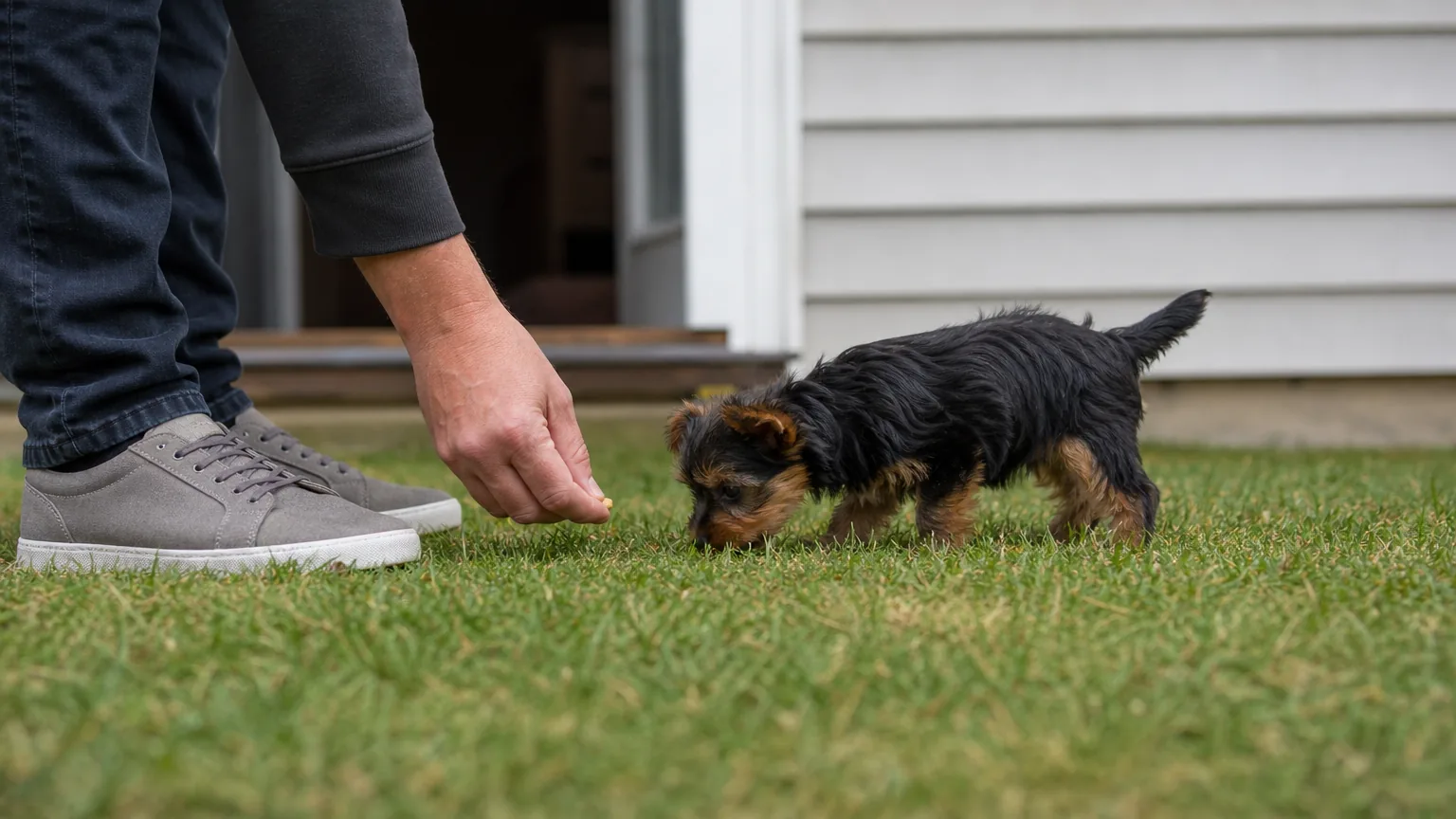
- Go out more often than seems necessary, after every meal, nap and play session, and carry the puppy straight to its spot instead of letting it wander and choose a corner on the way.
- Pick one system early. Pads indoors or grass outdoors can both work, but switching back and forth muddies the lesson.
- Stay outside with the puppy. Marksbury warns never to leave a tiny Yorkie alone in a yard, because small dogs are more vulnerable to predators such as hawks and coyotes, and more sensitive to both heat and cold. Being there also means you can reward the instant the puppy finishes.
For the large-breed puppy, the risk runs the other way: a quick early start tempts owners into giving freedom too soon. Henkle’s crate limit for Boxer puppies, no more than four hours at a stretch, is a reminder that a big body does not yet come with an adult bladder. The AKC’s Boxer timeline lists “completely potty trained” as a goal for the first birthday, not for four months.
Self-Control: Same Need, Different Stakes
A toy puppy who jumps at a visitor’s knees gets laughed at. A Boxer who does it at 50 pounds can knock a child flat. Neither has better manners in that moment. One just has more mass behind the same behavior, and that changes what people put up with.
There is some evidence of a breed-level difference in self-control itself. Horschler and colleagues analyzed citizen-science data on more than 7,000 purebred dogs from 74 breeds and found that breeds with heavier estimated brains, which in absolute terms largely means bigger breeds, did better on measures of short-term memory and self-control, while the link with other kinds of thinking varied widely. It is a finding about breed averages, not a forecast for the puppy in front of you.
How small dogs are raised seems to matter at least as much. In a survey of 1,276 dog owners, Arhant and colleagues confirmed the familiar reputation: dogs under 20 kilograms (about 44 pounds) were rated less obedient, more aggressive and excitable, and more anxious and fearful than bigger dogs. But their owners also reported being less consistent with them and doing less training and play, and among the smaller dogs, more consistency and more training and play went with better obedience. One result should give every small-dog owner pause. More frequent punishment was linked to more anxiety and fear in the smaller dogs, but not in the larger ones.
The practical reading for a toy puppy is straightforward. Hold it to the standard you would hold a Boxer to: sit to greet, wait at doors, settle on a mat. Train it on the floor at its own level rather than managing it from your arms, and keep corrections out of it entirely.
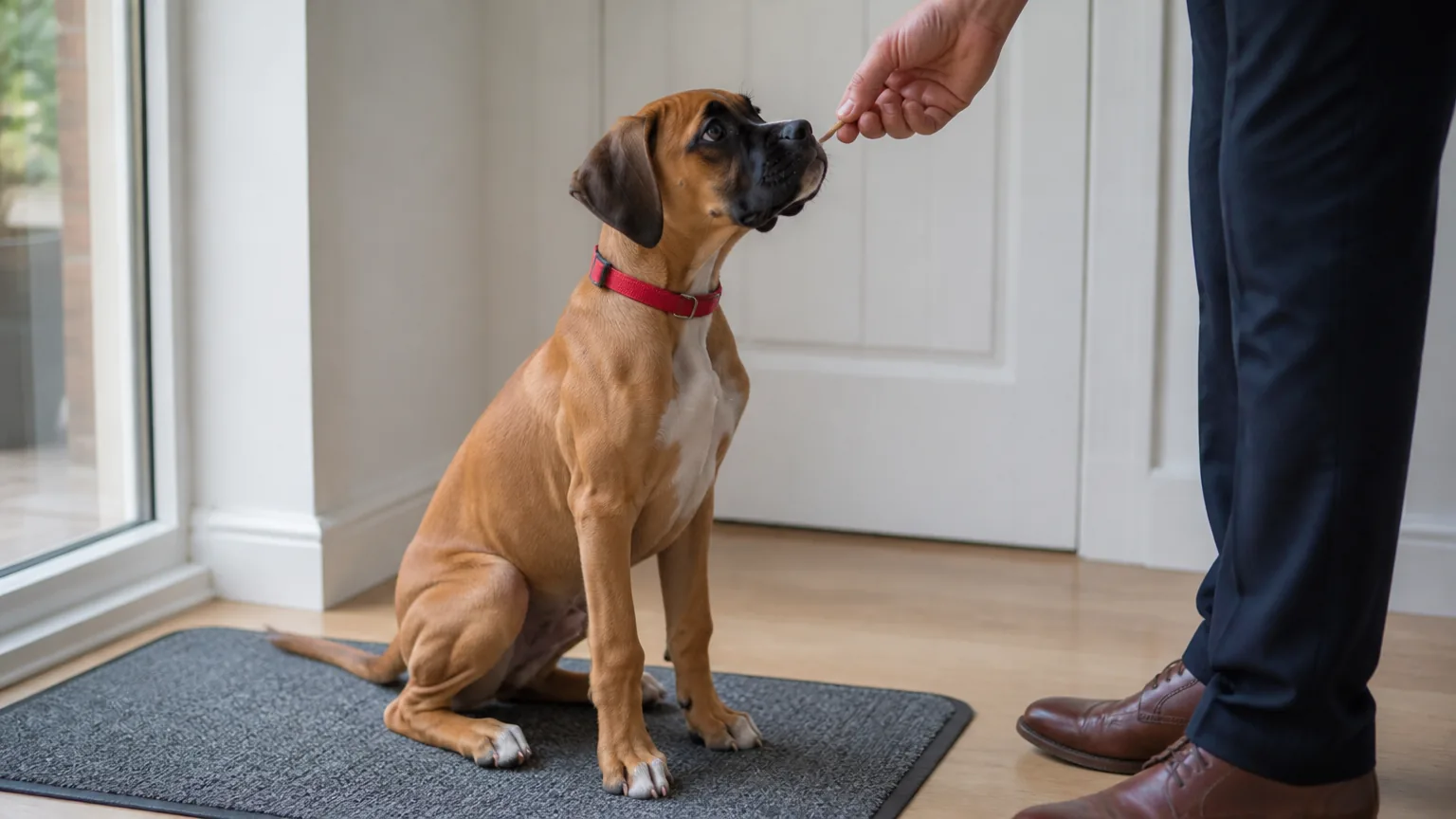
For the large-breed puppy, the pressure is time. Bray and colleagues tested 160 retriever puppies bred as assistance dogs at 8 to 10 weeks and again at about 21 months. Some of the biggest gains came in executive function, including a self-control task in which the dog has to detour around a clear cylinder to reach food it can see, instead of trying to go straight through. Self-control is still maturing well into the second year, but the body arrives much sooner. That makes the large-breed priorities the habits that are hardest to install later: four paws on the floor for greetings, loose-leash walking before the puppy is strong enough to win, and a reliable settle.
Adolescence Arrives on a Different Month
Puberty tracks size. VCA’s veterinarians put it at about six months on average, with smaller breeds tending to have their first heat earlier and large and giant breeds sometimes not cycling until 18 months to two years.
The best behavioral evidence for a canine teenage phase comes from big dogs. Asher and colleagues followed potential guide dogs, mostly Labrador and golden retrievers. At 8 months, the odds of a dog repeatedly failing to sit for its own carer were about twice what they had been at 5 months, yet the same dogs responded better to a stranger. Carers rated trainability lower at 8 months than at either 5 or 12 months.
Two lessons carry across sizes. The dip is aimed at the person the puppy lives with, so it is not proof the training failed. And it passed: by 12 months, the carers’ ratings had recovered.
What does not carry across is the month. No one has run the toy-breed version of that study, so there is no equivalent date to circle for a Yorkie. But with puberty coming earlier in small breeds, it is reasonable to expect the hormonal changes, and any wobble that comes with them, closer to six months than eight. The AKC’s Yorkie timeline flags six months as a good time to start more advanced training. For a large-breed puppy whose puberty arrives late, adolescence can run well past the first birthday.
In class terms, toy owners should book the next course (an adolescent or intermediate class) to start soon after puppy class ends, rather than taking a long break. Large-breed owners should expect the hardest stretch to land after graduation, and budget for training through the first year and into the second.
Growing Up: When Each Body Is Done
Physical maturity is where the gap is widest. VCA’s feeding guidance for toy and small dogs puts full skeletal growth at 6 to 9 months for toy breeds and 8 to 10 months for small breeds. Virginia Shames of the American Boxer Club calls the Boxer a late-maturing breed whose growth plates are not fully developed until at least 18 months, and advises limiting extreme performance activities until then. Salt and colleagues, who built growth charts from the records of more than 6 million young dogs, sum up the earlier research the same way: very small dogs reach maturity at 8 to 12 months, while larger breeds can need up to 24 months to reach adult body weight.
So exercise limits run on different clocks. The toy puppy may be done growing before the Boxer is halfway, and the joint-protecting limits on forced running, repetitive jumping and long jogs apply for much longer to the bigger dog. The activity budget by age is in our guide to how much exercise a puppy needs, so it isn’t repeated here. Read every “until skeletal maturity” in it with your own dog’s size in mind, and let your vet confirm the date.
Toy puppies carry their own physical risk: drops from arms and furniture, and rough play with much larger dogs. Our guide to size-mismatched play covers the toy-breed forearm research and how good classes split play groups by size.
How Class Goals Should Flex
The curriculum is the same. The weighting changes.
For the four-pound puppy:
- Size-split play. Ask how play groups are formed before you enroll. A class that turns every puppy loose together is the wrong class for a toy breed.
- Floor-level training. Kneel, sit on the floor or use a low platform, so the puppy learns on its own feet rather than from your arms.
- A harness for leash work. The AKC’s Yorkie timeline recommends one over a collar for a dog that size.
- Crumb-sized rewards. A toy puppy’s daily treat allowance is tiny, so cut rewards smaller than feels reasonable, and use part of a meal as class treats.
- The same greeting rules. Small is not a reason to let jumping slide. Sit to greet applies at every size.
- The next class booked early, so adolescence does not arrive in the gap.
For the sixty-pound puppy:
- Four on the floor, starting now. Every jump-up that earns attention at 15 pounds is rehearsal for 60.
- Loose leash before strength. Build the habit while you can still easily hold the puppy, so you never have to rely on muscle.
- Handling practice for a dog nobody will want to lift. Rehearse standing still for paws, ears, mouth and a stethoscope, and stepping onto a scale, since hoisting a 60-pound adolescent onto an exam table is nobody’s idea of a good vet visit.
- Impact limits for the long haul. No forced running, jumping down from heights or long jogs until your vet confirms the growth plates have closed.
- A plan for months 7 through 18. Expect the adolescent dip after puppy class rather than during it, and keep training through it.
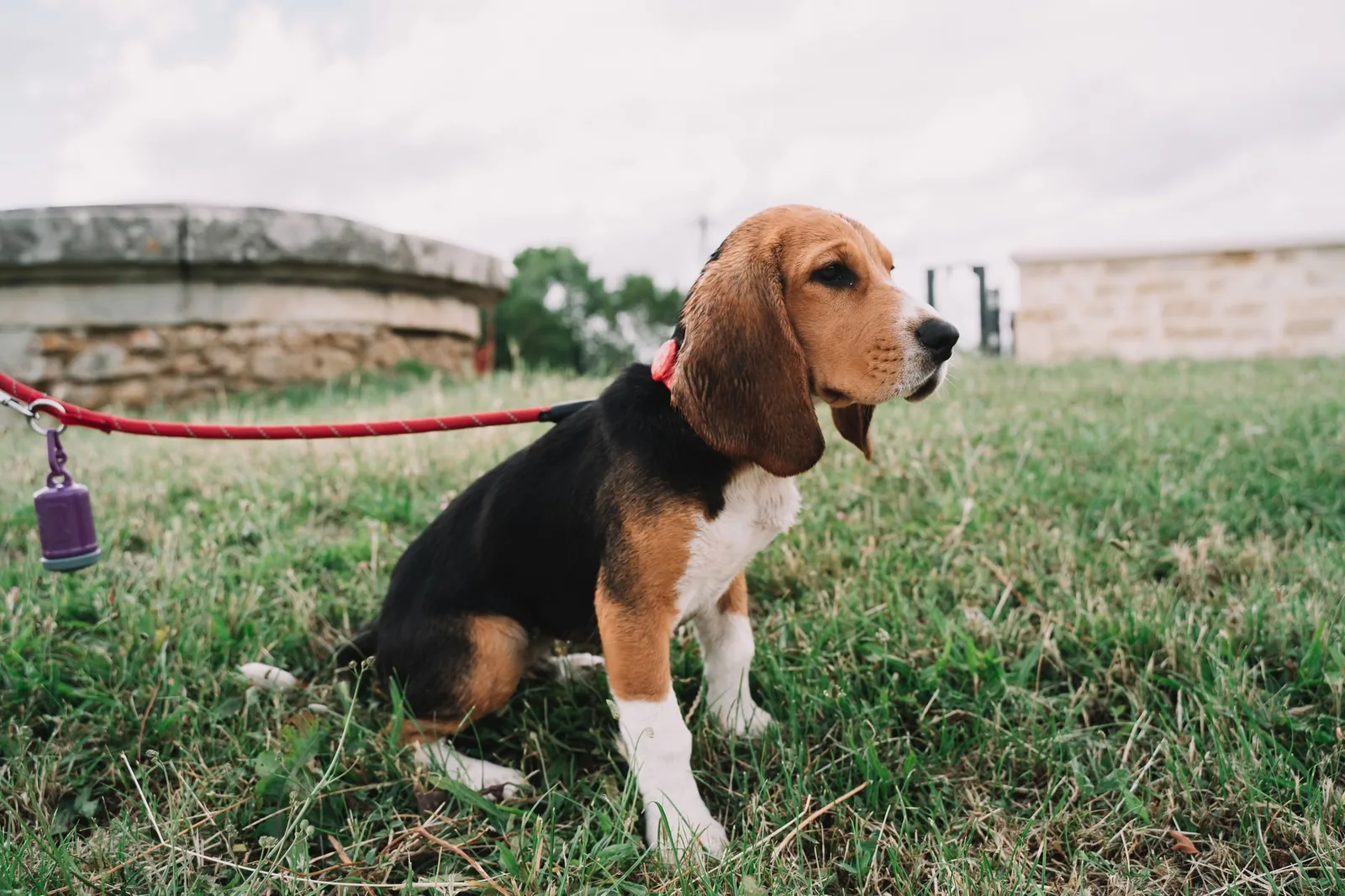
A mid-size puppy such as a Beagle lands between the two lists on most of these. Go by your puppy’s expected adult weight, not its weight today.
When the Calendar Isn’t the Problem
Some things are not about size. If a puppy who was clean starts having accidents again, or makes no progress despite a tight schedule, see your vet before you change the plan, since urinary infections and other medical problems can look like a training failure. And at any size, fear that is growing rather than fading, growling or snapping when handled or lifted, or adolescent mouthing that turns into real aggression is a job for a veterinary behaviorist or a credentialed behavior consultant. Dog training is unregulated in most states, so check credentials before you hire anyone.
The Short Version
Every puppy gets the same socialization window, and every puppy learns best with rewards. Size moves almost everything else. Toy puppies often arrive later, so start class fast and find out what the breeder did. They need more potty trips and closer supervision, because their mistakes are easy to miss, and their hormones and skeletons usually arrive earlier, so book the adolescent class early. Large puppies get the window at home, but their self-control lags their size for well over a year, so install greetings, leash manners and a settle while they are still small, and protect their joints until the growth plates close, which for a Boxer means 18 months or more. Whichever end of the scale you are on, plan for a whole year of training, not a six-week course.
Further reading (sources)
- American Kennel Club with the Yorkshire Terrier Club’s first-year timeline for Yorkie puppies
- American Kennel Club on Boxer experts’ puppy timeline, from potty training to growth plates
- American Veterinary Society of Animal Behavior for its position statement on socializing puppies before full vaccination
- VCA Animal Hospitals about meal frequency and skeletal growth in toy and small dogs
- VCA Animal Hospitals on when female dogs reach puberty, by breed size
- Merck Veterinary Manual for low blood sugar in toy-breed puppies
- McGreevy and colleagues on how behavior varies with height and bodyweight across 49 breeds
- Arhant and colleagues with owner consistency, punishment and behavior in smaller versus larger dogs
- Horschler and colleagues for brain size and breed differences in self-control
- Bray and colleagues about how thinking skills change from early puppyhood to 21 months
- Asher and colleagues on evidence for a teenage phase in guide dog puppies
- Salt and colleagues with growth standard charts for dogs of different sizes