The Crossover Owner: How to Switch to Reward-Based Training After Using Corrections
Published on October 20, 2026
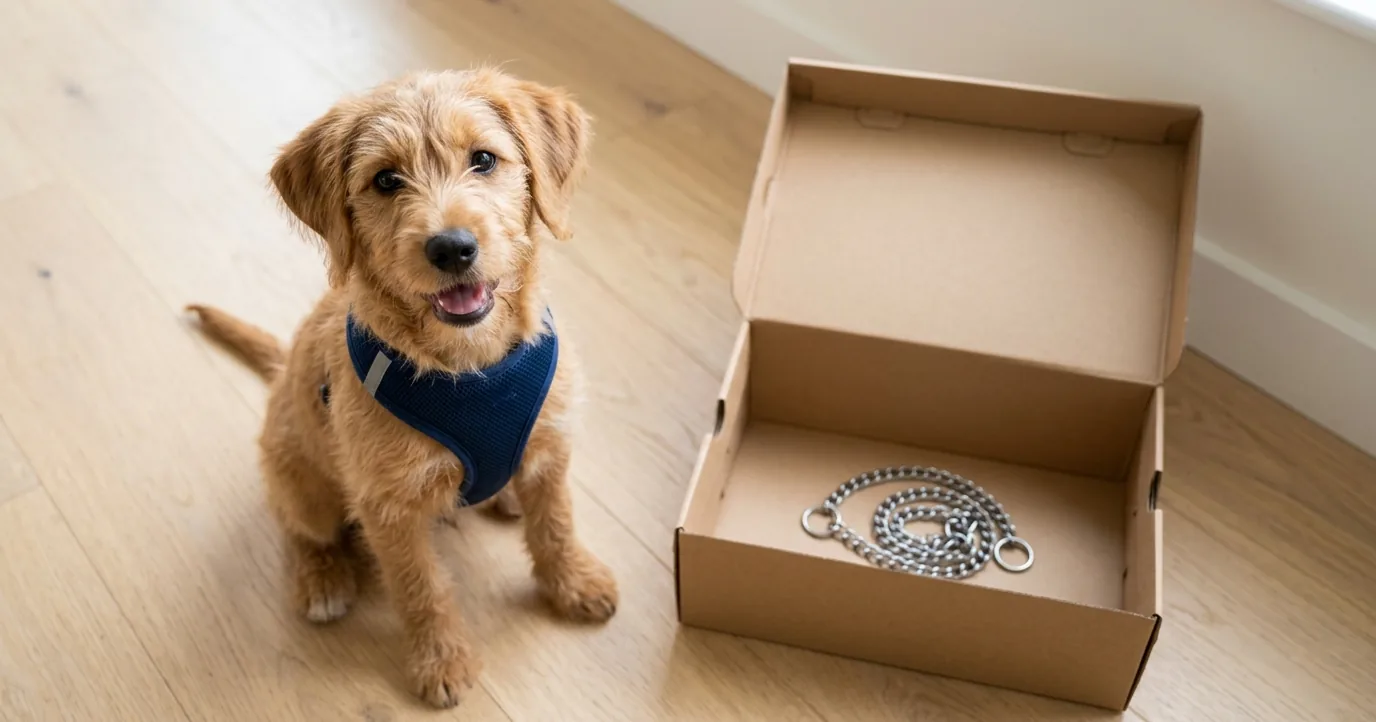
Most owners who end up reading about reward-based training did not start there. A neighbor showed you how to pop the leash. The breeder sent the puppy home with a spray bottle. The first trainer you paid fitted a prong collar at lesson one and told you it does not hurt. You did what the people with experience told you to do, and now you are watching your puppy and wondering two things: whether there is a better way, and whether you have already done damage.
There is a better way, and you would be in good company taking it. When DeLeeuw and Williams interviewed 35 American trainers listed in three professional directories, for a study published in Frontiers in Veterinary Science this year, 14 of the 17 who now train only with rewards had used aversive methods earlier in their careers. Trainers call people like them crossovers. About two-thirds of those who switched said that watching dogs in distress, fear or reactivity made them rethink, and many described the turning point as simply seeing it done another way, by a reward-based colleague or at a workshop. “I honestly didn’t know that that was possible,” one told the researchers.
This guide is for owners making the same move. Whether to switch is a question the evidence has already answered, and what the research shows about mixing rewards with corrections covers it in full. This is about what to do on Monday morning, without the guilt.
Why It Is Worth Switching Even If Your Puppy Seems Fine
Plenty of puppies on a correction-based program look fine. They walk, they sit, and they come when called most of the time. The reasons to switch anyway turn up in places owners do not usually look.
Casey and colleagues matched 50 dogs whose owners used two or more aversive methods with 50 reward-trained dogs of the same breed type, age, sex and neuter status. The list of methods that counted is worth reading, because most of it is ordinary: a choke chain, a water pistol, a rattle can, smacking or shaking, a citronella or electronic collar. Each dog learned that a bowl in one spot held food and a bowl in another spot did not, and was then timed going to bowls placed in between. The dogs from the aversive group were slower to all of the in-between positions (significantly so for two of the three), which the researchers read as a more pessimistic mood. The dogs were six months to twelve years old rather than young puppies.
Three details in that paper matter if you are switching. Both groups used rewards, so the comparison was rewards alone against rewards plus corrections, which is exactly the household you are leaving, and the authors raise the possibility that the inconsistency itself is part of the cost. The researchers did not record how recently the aversive methods had last been used, so the study cannot tell you how fast mood recovers after a switch. And the arrow may point both ways, since an anxious dog can push an owner toward corrections in the first place. It is a reason to stop, not a verdict on your puppy.
The second reason is safety. Herron, Shofer and Reisner surveyed 140 owners arriving at a veterinary behavior referral service about what they had already tried. Several confrontational methods drew an aggressive response from at least a quarter of the dogs they were tried on: hitting or kicking (43%), growling at the dog (41%), forcing an item out of the mouth (39%) and the alpha roll (31%). The most common sources of that advice were the owners themselves and trainers. If someone you paid told you to do it, you were following common advice. You are allowed to stop following it.
What the First Few Weeks Actually Look Like
Owners who switch tend to be braced for slow progress. Fewer are braced for things to get worse first, which is the most likely thing to happen.
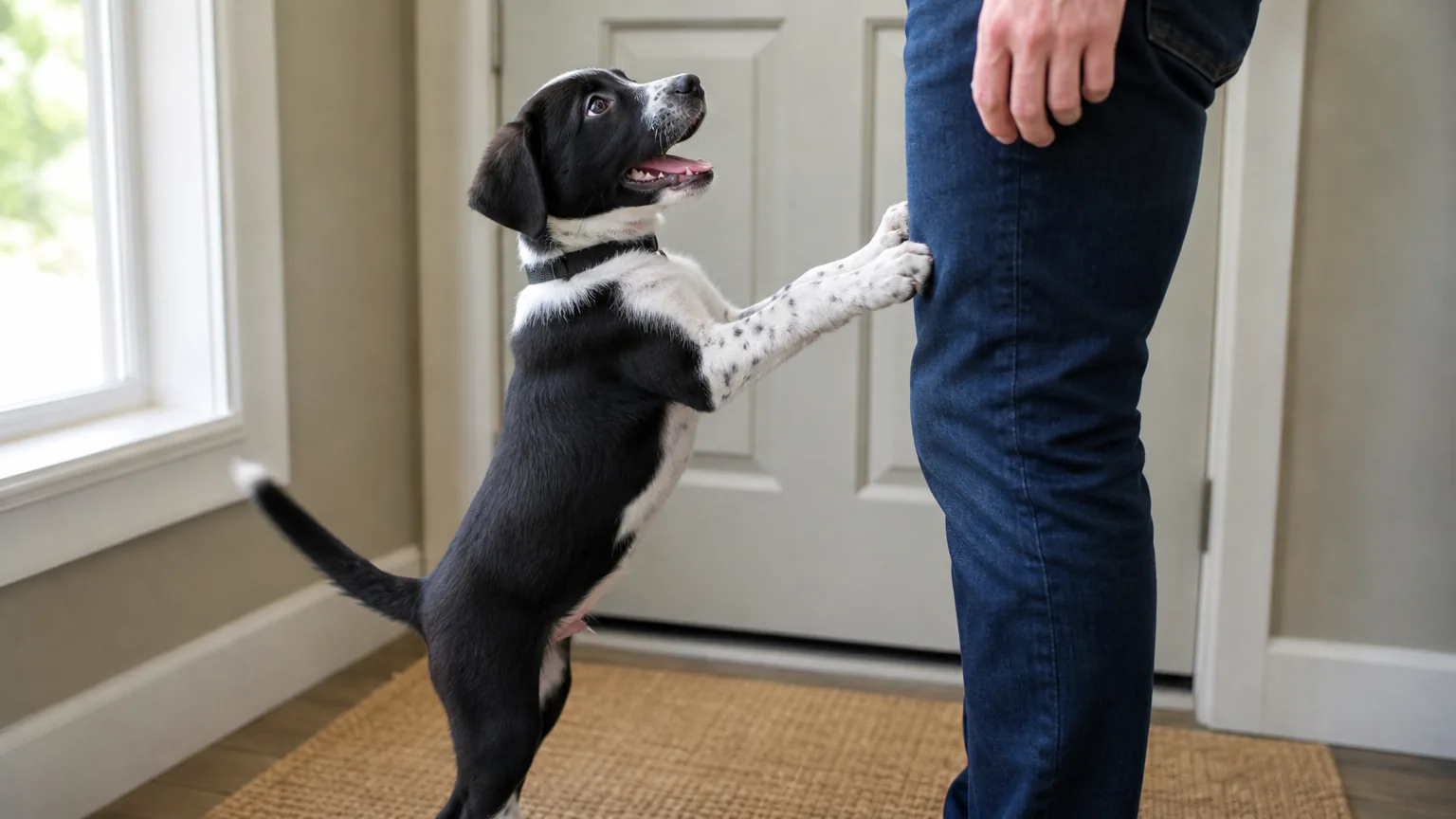
A correction suppresses a behavior. It does not remove the reason for it. Whatever your puppy got out of pulling, jumping or mouthing (the smell on the lamp post, your face up close, the game) is still on offer, and nothing has been taught to replace it yet. Laboratory work found this decades ago. When Hake, Azrin and Oxford stopped punishing a food-rewarded response in squirrel monkeys, the response came back immediately, except where suppression had been complete or prolonged. The food had kept coming the whole time, just as pulling still earns the lamp post. So expect the jumping to reappear in week one. That is not the new method failing. It is the starting line the old method was hiding.
Expect your own timing to be clumsy for a few days, too. The marker comes late, the treat is in the wrong pocket, and your hand still twitches toward the leash. Reward-based work forgives that more easily than corrections do. A late treat costs a little clarity, while a late correction lands on whatever your puppy happened to be doing.
Some puppies go the other way and turn cautious. A puppy who has been corrected for guessing wrong may wait to be told, hover just out of reach, or freeze when you hold out a treat. Trainers call this a crossover dog, and a little of it is common and usually fades once offering behavior starts paying. A puppy who has stopped offering anything at all is a different problem: the quiet puppy who has given up trying needs that rebuild before anything in this plan.
When the old problem comes back, ask what it is for before you reach for a fix. Jamie DeLeeuw, the study’s first author, put it this way to Psychology Today: “Behaviors that look like ‘defiance’ are often rooted in fear, frustration, anxiety, confusion, or a mismatch between the dog’s needs and environment.” Then keep a number rather than an impression. Count jumps on visitors, or how often your puppy glances back at you in five minutes of a walk, and write it down each day. The numbers usually move before your impression does.
The Switch, Step by Step
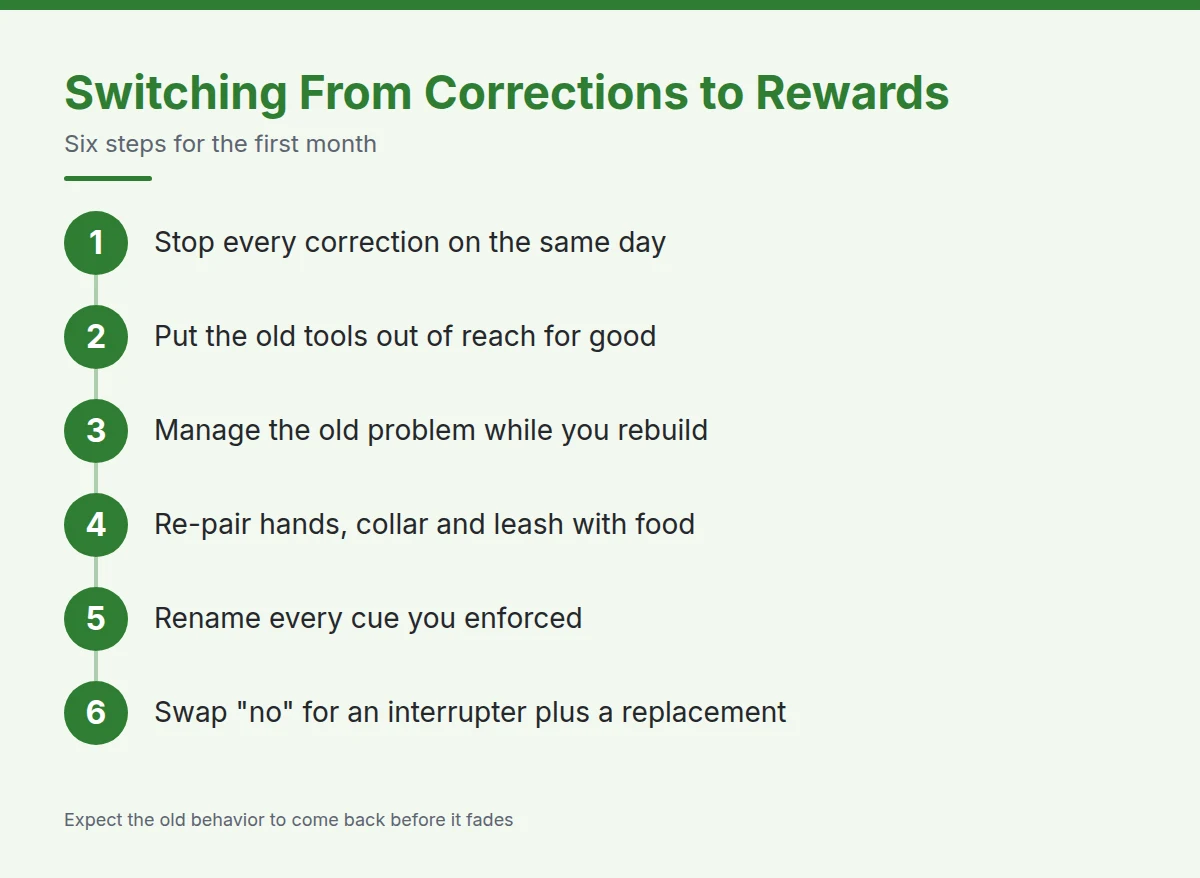
1. Stop everything on the same day. Pick a date and drop every correction at once, including the small ones that do not feel like corrections: the spray bottle, the shaker can, the finger poke, the sharp “ah-ah,” the scruff. Tell everyone in the house, because one person still popping the leash keeps every cue muddy. If inconsistency is part of the cost, as the Casey authors suggest it may be, a slow taper keeps you in the mixed household longest.
2. Retire the tools for good. Take off the prong, choke chain or e-collar and put it somewhere you would have to go looking for it, or get rid of it. On a frustrating walk, the tool within reach is the tool you will use. Use a flat collar for ID tags and a well-fitted harness for the leash, so the leash stops being a lever on the neck, and spend a few days making the harness predict food with the conditioning steps in our loose-leash guide. For a Bulldog, Pug or Frenchie this matters twice over, because neck pressure lands on an airway that is already narrow, and fitting a harness around a barrel chest has its own quirks.
3. Manage what you used to correct. For the next month, the job is to make the old problem hard to practice while its replacement gets built. A baby gate across the kitchen for counter surfing. The leash clipped on before the front door opens for bolting. A long line in open spaces instead of an off-leash recall you would have enforced. Chew toys within reach wherever the nipping happens. Management is not cheating. It holds the line until the new behavior can.
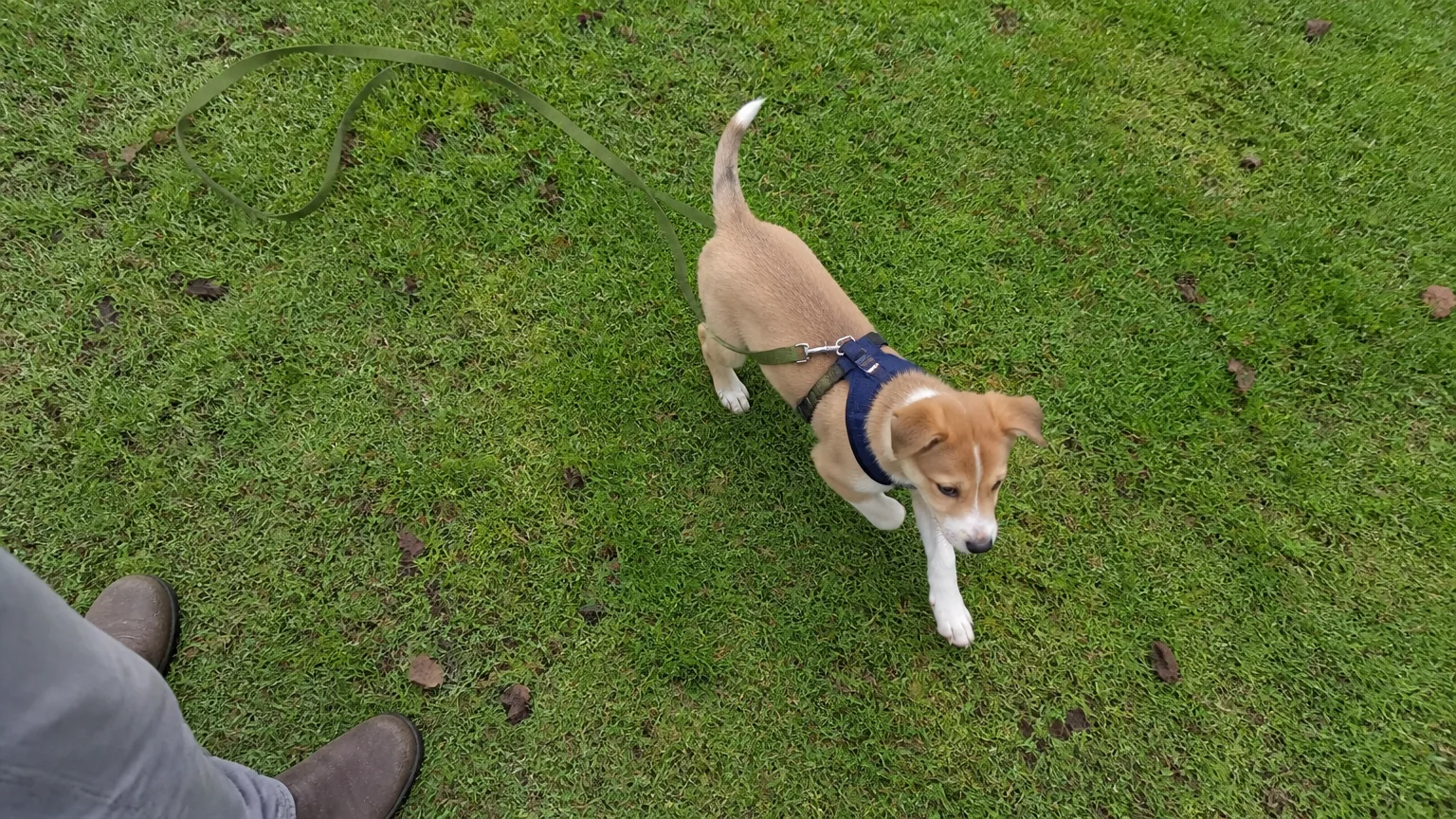
4. Re-pair what the corrections touched. Corrections leave traces on whatever came just before them. If the leash popped, the click of the clip may now predict it. If you grabbed the collar to correct, your hand moving toward the neck may make the puppy duck. Turn each one into a short game: hand toward the collar, a light touch, a treat, let go. Ten repetitions, a few times a day, until the puppy leans into your hand instead of away from it. Then do the same with clipping on the leash and reaching over the head.
5. Rename the cues you enforced. Any cue that was backed by a correction (“heel” with a leash pop, “come” with a tug on the line) now carries two forecasts at once, which is the poisoned cue problem in its plainest form. Pick a new word, teach the behavior from scratch in the kitchen with food, and attach the word only once the behavior is already happening reliably. The old word goes in the drawer with the old collar.
6. Replace “no” with “do this instead.” What most correction-trained households are missing is an interrupter the puppy actually likes. Choose a sound, such as a kissy noise, and spend a few days making it predict a treat every time your puppy turns toward it. Then use it to break off the behavior you want gone, and ask straight away for something incompatible: a sit at the door instead of a jump, four paws on the floor while the visitor says hello. One of the green flags in the American Veterinary Society of Animal Behavior’s guide to choosing a trainer sums up the approach: prevent unwanted behavior and teach a replacement behavior.
If your puppy is still under about fourteen weeks, start this week rather than after the next class block. The socialization window is when a puppy forms lasting impressions of hands, leashes and strangers, and a correction landing inside it is easily filed against whatever the puppy was looking at.
Finding a Class That Will Help You Switch
Tell the instructor what you used and for how long. A good one will not flinch, and at least one professional body has written that help into its standards: the International Association of Animal Behavior Consultants requires members to refrain from using shock and, when a client is already using a shock device, expects them to help that client move to humane, evidence-based alternatives while minimizing the effects on the dog. That is the attitude to look for in any class.
AVSAB’s short guide to choosing a trainer is the quickest screen for a website or social feed. Its red flags read like an inventory of the program you are leaving: prong or shock collars, leash jerks, rattle cans, water spray bottles, rolling a dog onto its back, the phrase “balanced training,” and talk of alpha, pack leader, respect and obey. Its green flags are rewards, communication, and preventing problems while teaching replacements. Its last step is the one worth remembering after you enroll: if you do not feel heard, choose a different trainer.
Then ask any class on your shortlist one question: “My puppy was trained with corrections until recently. What would you change for my puppy?” Listen for a quieter spot at the edge of the room, extra distance from the other puppies, shorter sets, and permission to step out. Dog training is unregulated in most states, so check for CCPDT, KPA or IAABC credentials, and use the six questions for a trainer who calls themselves balanced for the rest.
Be clear about what you are shopping for. A crossover puppy who is simply behind on manners belongs in an ordinary puppy class. A puppy who now worries about hands, leashes or other dogs needs behavior modification, which is a different service, run by a qualified behavior consultant rather than a class instructor.
When It Is More Than a Training Switch
Some puppies come out of a correction-based program with more than rusty cues. Growling or snapping when you reach for the collar, cowering when the leash comes out, freezing under a hand, or any aggression toward people are signs to bring in a professional before you start the plan above. Book a vet check first, because pain makes every one of those worse, then a board-certified veterinary behaviorist or a credentialed behavior consultant. And do not rerun the old correction to see whether it still works. Given how often confrontational methods drew aggression in the Herron survey, that experiment is how people get bitten.
The Bottom Line
Switching does not take a confession, and it does not take a new puppy. In the DeLeeuw study, most of the trainers who now work only with rewards started where you are. Stop every correction on the same day, put the tools out of reach, manage the old problem, re-pair the hands and the leash, rename the cues you enforced, and give your puppy something to do rather than something to stop. Expect the old behavior to come back for a while. It was always there, only quieter, and this time you are building something to replace it.
Further reading (sources)
- DeLeeuw and Williams on why most of the reward-based trainers they interviewed had crossed over
- Zazie Todd in Psychology Today with the study’s first author on what owners should take from it
- Casey and colleagues for a matched-pair judgement bias test of dogs trained with two or more aversive methods
- Herron, Shofer and Reisner on how often confrontational methods provoked an aggressive response
- Hake, Azrin and Oxford for punished responding that recovered once the punishment stopped
- International Association of Animal Behavior Consultants with its standards on helping clients move off shock devices
- American Veterinary Society of Animal Behavior on green and red flags when choosing a trainer