Puppy Hackles Up When Playing: Arousal, Not Aggression, and When to Step In
Published on November 2, 2026
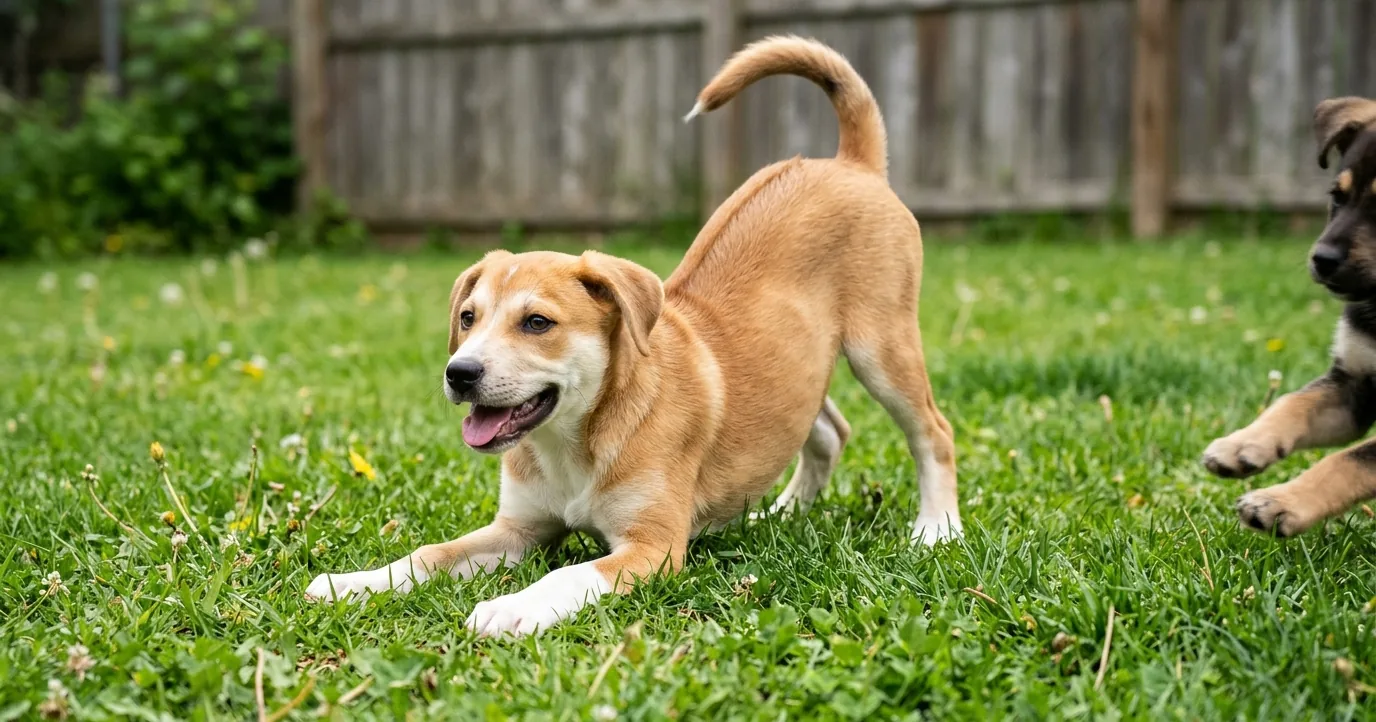
Two puppies are wrestling on the mat at puppy class when a stripe of hair rises along one puppy’s back, from the shoulders almost to the tail. Its owner sees it, says “oh no,” scoops the puppy up and heads for the door. A second earlier, that puppy was play bowing. Just before that, it had flopped onto its back to let the smaller puppy win.
That raised stripe is called piloerection, and it is one of the most misread signals in puppy class. Most owners have absorbed the idea that raised hackles mean a dog is about to fight. What the hair actually tells you is how revved up a puppy is, not whether it is delighted, scared or angry. To find out which, you have to read the rest of the puppy. This guide shows you how, including the handful of moments when stepping in is exactly the right call.
What Raised Hackles Actually Are
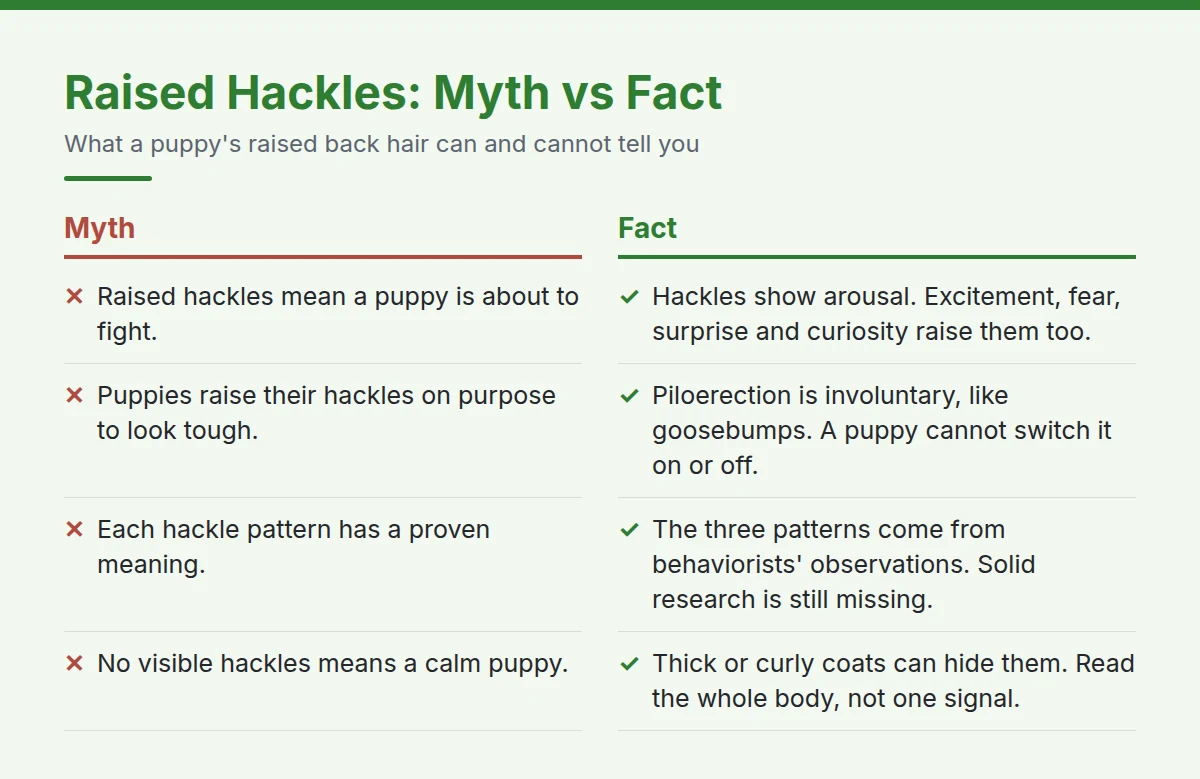
Tiny muscles sit at the base of the hairs in a dog’s coat. When they contract, the hair stands up. Patricia McConnell, a certified applied animal behaviorist, describes this as an involuntary response of the sympathetic nervous system, the branch that revs the body up (its partner, the parasympathetic branch, calms it back down). It is the same reflex that gives people goosebumps. Karen London, also a certified applied animal behaviorist, draws out the practical consequence: dogs cannot control it. A puppy no more decides to raise its hackles than you decide to shiver.
The reflex has an obvious use. Hair standing on end makes an animal look bigger, which helps when it is facing a threat, and that is where the aggression reputation comes from. But the triggers are much broader than threat. In a Whole Dog Journal piece on raised hackles, behavior consultant Debby McMullen lists excitement, stress, fear and even curiosity alongside defensiveness, and describes client dogs whose hackles go up when she arrives for a session simply because they are happy to see her.
The Hair Measures Volume, Not Mood
Researchers who study animal emotion find it useful to pull feelings apart into two separate dimensions. A University of Bristol team set this out in a 2010 framework: valence, meaning whether a feeling is pleasant or unpleasant, and arousal, meaning how strongly activated the animal is. Fear and delight sit at opposite ends of the first dimension, yet they can sit at exactly the same point on the second.
Raised hackles live on the arousal dimension. McConnell puts it plainly: “piloerection is an indicator of arousal, not potential aggression.” Fear, excitement and surprise all come with arousal, and only some of those roads lead to a fight. So think of hackles as a volume knob. They tell you the puppy has been turned up. They cannot tell you which station it is playing.
That is why hackles show up in puppy play so often. Play is supposed to be exciting. A chase, a wrestle, a new puppy in the room, a game that has just got good: all of these turn the volume up, and in plenty of puppies the hair rises with it and lies back down as things calm. A puppy whose hackles are up while it bounces, bows and lets its partner pin it is a puppy having a very good time at high volume.
The Three Hackle Patterns, and How Much to Trust Them
Look closely and raised hackles do not always cover the same ground. London has described three patterns she has noticed in her behavior practice:
- A thin stripe from the shoulders to the base of the tail, a few inches wide at most. She associates it with high confidence, and in her experience these dogs are more likely than others to go on the offense.
- A broad patch across the shoulders, up to eight or so inches wide, running no more than a quarter to a third of the way down the back. She links it with low confidence and often finds these dogs somewhat fearful.
- Two patches, one over the shoulders and one at the base of the tail, with flat hair in between. She calls this the most confusing pattern and ties it to an ambivalent, conflicted state. Many dogs who show it, she writes, are somewhat unpredictable and more reactive than other dogs.
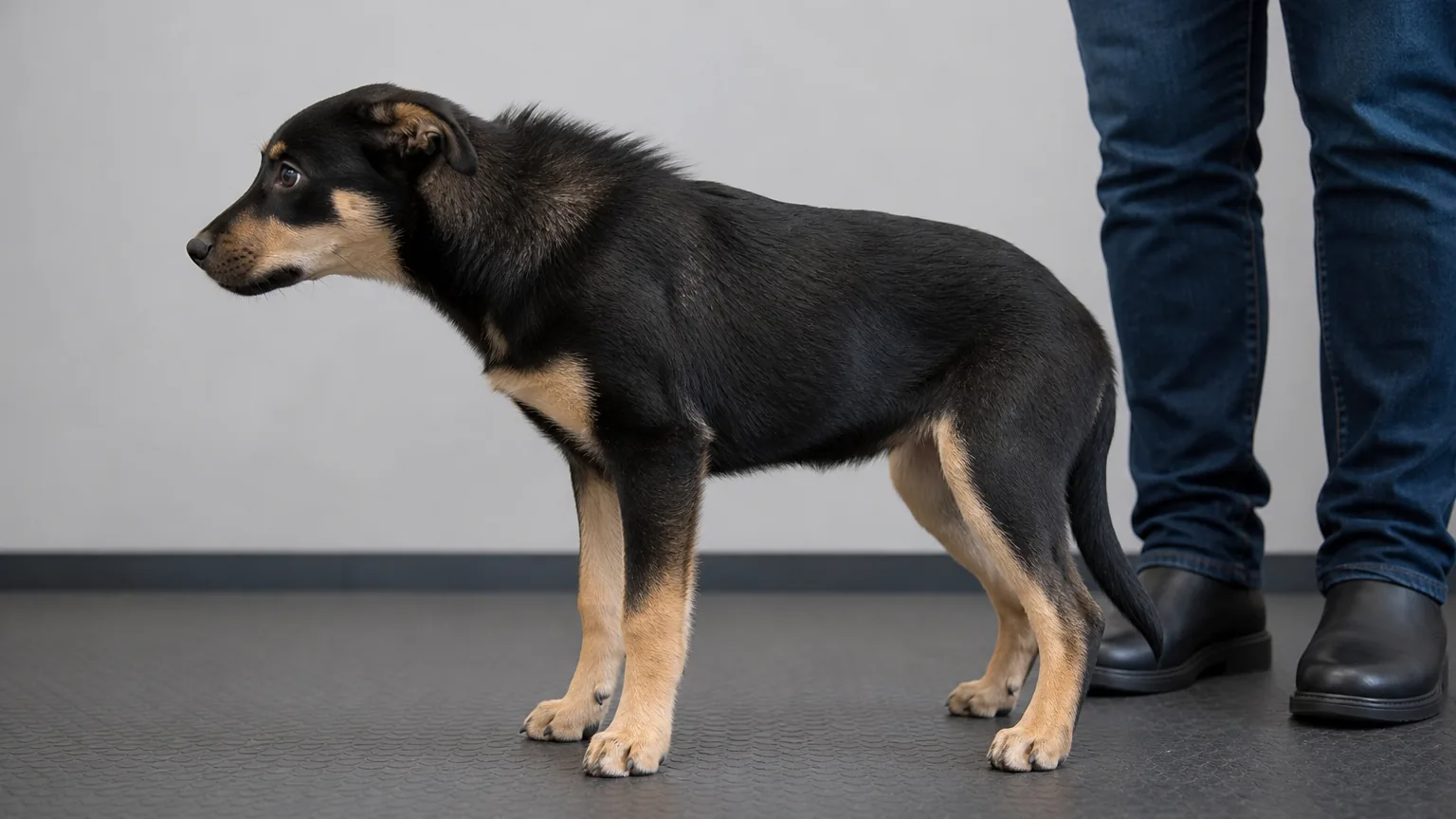
These patterns are useful, but hold them loosely. London herself says data on piloerection are limited, that her patterns come from her own observation, and that there are many exceptions. McConnell, writing about London’s patterns, says what is missing is good research, and that she could not find solid studies either. Remember, too, where London’s observations come from: she specializes in dogs with serious behavior problems, which is not the same population as a room full of 12-week-old puppies.
So treat a pattern as a reason to look harder at the rest of the puppy, never as a verdict. The puppy in our opening scene wore London’s confident stripe while it was busy losing a wrestling match on purpose. A broad shoulder patch on a puppy who keeps bouncing back for more is not a frightened puppy. The same patch on a puppy pressed against its owner’s shins may well be.
No Hackles Does Not Mean No Arousal
Coat type changes what you can see. On a smooth-coated puppy, raised hackles are easy to see. On a curly, long or thick coat (a Poodle, a Doodle, a fluffy Samoyed) they can be hard to spot, or invisible.
Breeds also differ in how much of the old wolf vocabulary they use at all. In a 1997 study of ten breeds, Goodwin, Bradshaw and Wickens counted the ancestral dominance and submission signals each breed showed. The total ranged from two in Cavalier King Charles Spaniels to fifteen in Siberian Huskies, and the more a breed looked like a wolf, the more of the signals it used. A puppy with a small signal vocabulary gives you fewer clues, not necessarily fewer feelings.
And one stripe is not piloerection at all. The ridge on a Rhodesian Ridgeback is a stripe of backward-growing hair on its back, the breed’s hallmark according to the AKC. It is there when the puppy is fast asleep. Hackles come and go with the moment.
Read the Rest of the Puppy: Excited, Uncertain, or Over Threshold
Reading a whole dog is a learnable skill. In a Columbia University study, 2,163 adults watched videos of dogs that a panel of behavior professionals had classed as happy or fearful. Nearly everyone recognized the happy dogs, 90 to 93 percent of the time whatever their background. Fear was another story: people who had never lived with a dog identified it about 30 percent of the time, and dog professionals did so more than 70 percent of the time. The experienced viewers also used more parts of the dog to decide, the ears especially. Hackles invite a different mistake, reading excitement as a threat, but the fix is the same: look at more of the dog.
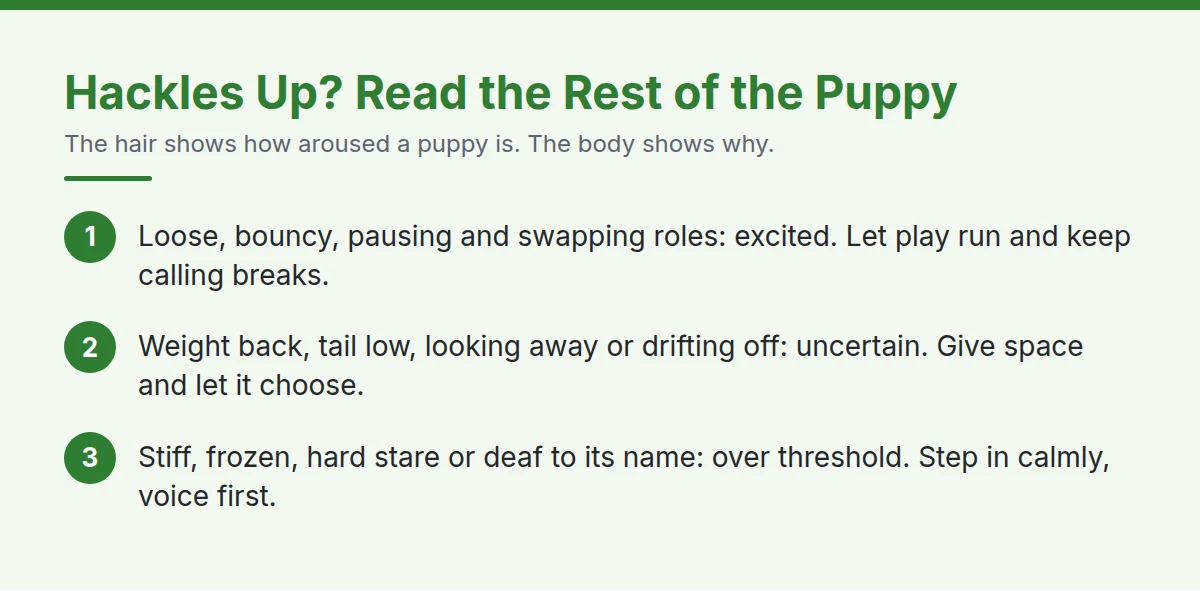
The hair tells you the volume. The rest of the body tells you the station. Run your eyes over the whole puppy, nose to tail, and it usually sorts into one of three pictures.
Excited. The body is loose and wiggly, the mouth open and soft, the tail sweeping at about back level. Movement is bouncy and curved rather than straight-line. You see play bows, role swaps (the chaser becomes the chased, the pinner gets pinned) and self-handicapping, where the bigger puppy flops down to let the smaller one win. Above all, you see pauses. In a University of Michigan study of play between adult pet dogs, play bows came most often right after a brief pause and worked to restart the game. Play that stops and restarts itself is play that is regulating itself. Hackles here are background noise. Let it run, and keep calling breaks.
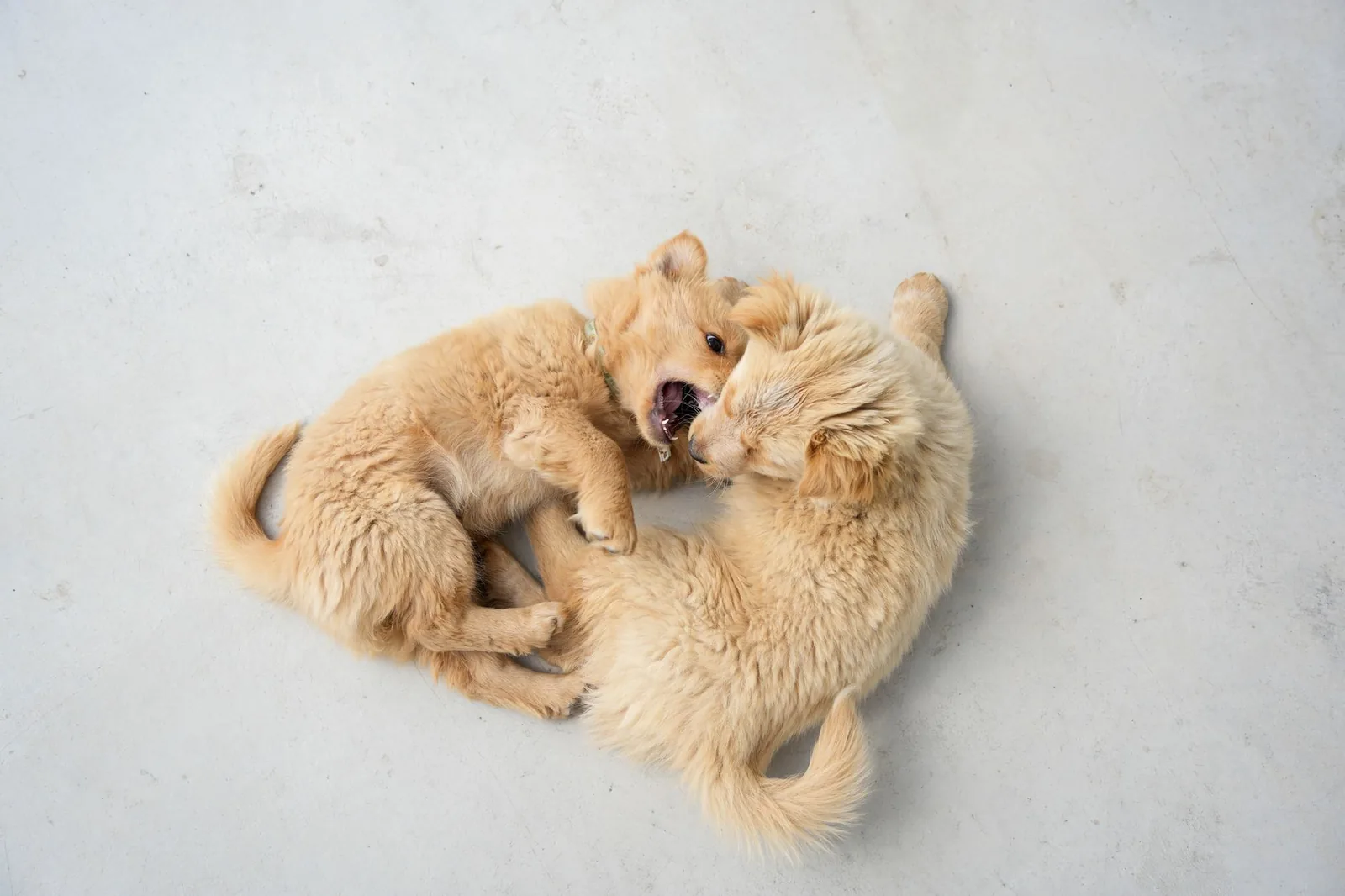
Uncertain. The weight shifts back. The tail drops or tucks, the ears go back, and small appeasement and displacement behaviors appear: a lip lick, a look away, a sudden sniff of the floor, a shake-off. The puppy approaches and retreats, or keeps drifting toward its owner. If London’s observations hold, this is where her shoulder patch and split pattern belong. Do not push this puppy back in. Give it distance and let it choose.
Over threshold. This puppy has stopped playing, whatever its hair is doing. The body goes stiff, the weight rolls forward, the tail rises high and rigid, and a hard fixed stare arrives with a mouth that has snapped shut. The pauses vanish, grabs start to hold, and the puppy no longer hears its name or notices a treat it would normally do anything for. The other face of over threshold is panic: a puppy screaming and scrambling to escape instead of bouncing back in. Either way, it is time to step in.
For the other dog’s side of the conversation, including calming signals and the two-second consent check, our field guide to how puppies read other dogs goes deeper.
When to Step In, and How
Raised hackles alone are never the reason to end a play session. Our complete guide to puppy play does list raised hackles among the signs that a session should end, but look at the company they keep on that list: tense bodies, pinned ears, a dog repeatedly trying to leave. The combination is the message. Step in when you see:
- A freeze: a puppy that goes suddenly still and stiff in the middle of motion
- A hard stare with a closed mouth and weight loaded forward
- No pauses at all, with grabs that hold instead of letting go
- One puppy repeatedly trying to leave, hide behind a person or get under a chair
- Two puppies ganging up on a third
- A puppy that cannot respond to its name or a favorite treat
How you step in matters as much as when. The goal is to lower arousal, not add to it.
- Interrupt with your voice and your feet first. Call your puppy’s name brightly and back away, or clap and jog a few steps in the other direction. A sudden grab or a shout adds arousal to a puppy that already has too much.
- If hands are needed, take the harness, not the scruff. Guide the more forward puppy away by its harness, calmly, and never reach in between two faces.
- Run the consent test. Hold the more forward puppy for two or three seconds and watch the other one. If it bounces straight back in, the play was mutual. If it shakes off, sniffs, walks away or comes to stand behind you, the session is over.
- Give a real break. A minute on a mat, a sniff around the room, a drink of water. Watch the hackles settle along with everything else.
- Restart small or end on a good note. Send them back in only if both puppies are soft and both want it, and finish while it is still going well.
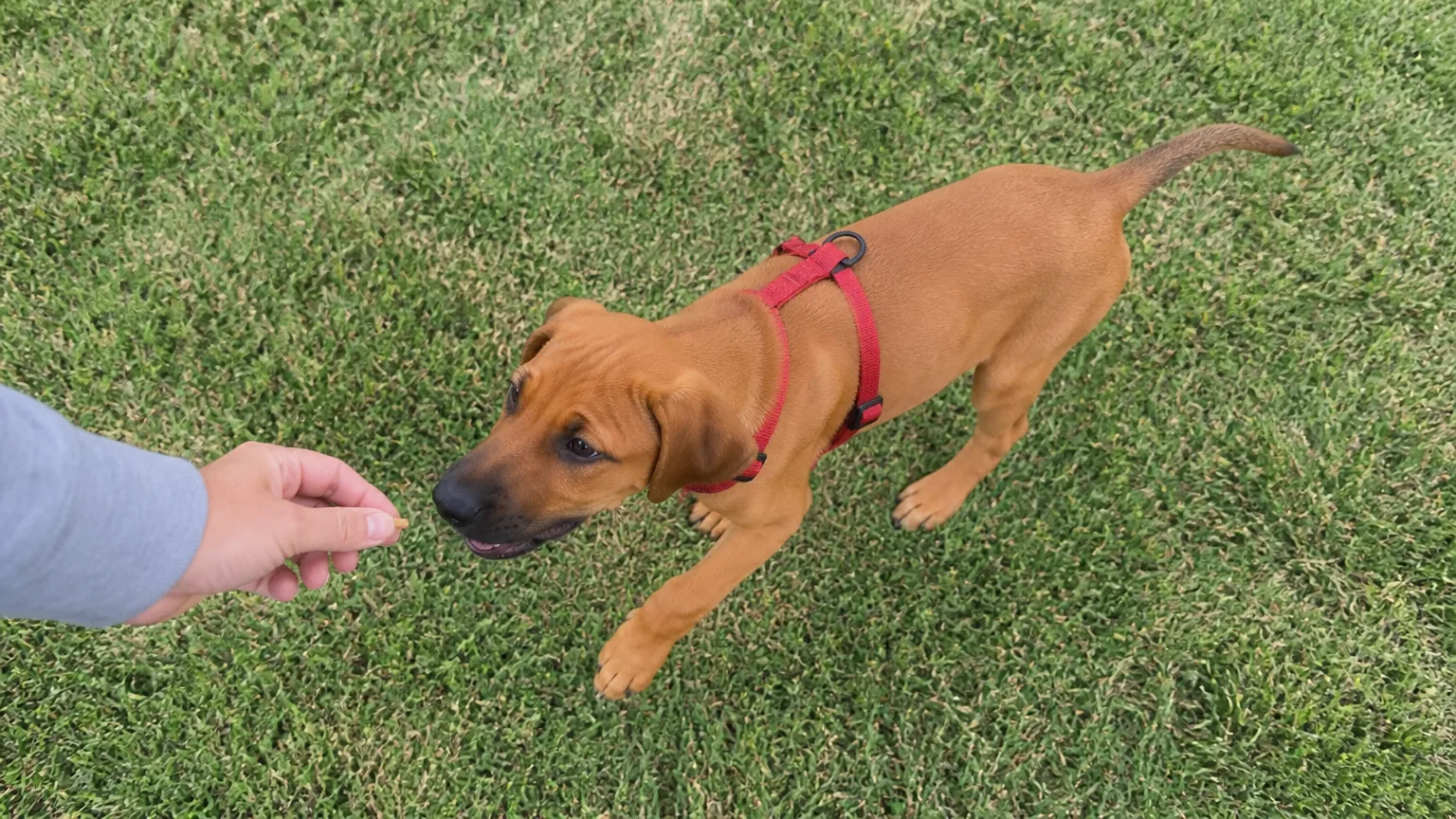
Two habits make all of this easier. Call your puppy out of play every minute or two even when nothing is wrong, pay it well and send it back, so leaving the game predicts good things rather than the end of fun. And skip scolding. A scolded puppy is a more aroused puppy, and a puppy punished for growling can learn to drop the warning and go straight to a snap. If treats come out in a group, separate any puppy that guards food first.
When Hackles Point to Something Worth Working On
In play, hackles are mostly noise. Outside it, they can be useful information. Pay attention when your puppy’s hackles go up:
- At the same trigger again and again (a person in a hat, a garbage bin, the dog next door), especially with barking, backing up or lunging
- Alongside a freeze or a hard stare aimed at a person or at one particular dog
- During a sudden spell of startling at familiar things, which may be a fear period (our guide to puppy fear periods explains how to tell a phase from a problem)
- In a puppy that cannot recover after a break, or that targets the same playmate every session
None of these is a reason to panic, and none is a reason to punish. They are a reason to build distance and a plan, and the graded, food-paired approach in our desensitization and counterconditioning protocol is the place to start. That work is behavior modification, which is a different job from a puppy class. If fear or aggression is intense, frequent or getting worse, ask your veterinarian for a referral to a board-certified veterinary behaviorist. And check credentials before hiring anyone else, because dog training is unregulated in most states and a trainer who reads every raised hackle as aggression is reading from the wrong book.
Misreading hackles costs something in the other direction, too. The American Veterinary Society of Animal Behavior calls the first three months of life the primary window for socialization, the period when “sociability outweighs fear,” and warns that incomplete or improper socialization then can raise the risk of fear, avoidance and aggression later in life. A puppy pulled out of every session the moment its hair stands up loses exactly the practice that window is for. If you are unsure whether your puppy is getting enough, our look at how much socialization a puppy actually needs offers a simple tally.
The Short Version
Raised hackles are an involuntary sign that a puppy is aroused, and excitement raises them as readily as fear. The pattern of the hair may hint at confidence or conflict, but the behaviorists who describe those patterns say the research is not there yet. So read the whole puppy. Loose, bouncy and pausing means let it run. Weight back and trying to leave means give it space. Stiff, frozen or deaf to you means step in, calmly, with your voice before your hands.
Further reading (sources)
- Karen B. London, PhD, CAAB on the three piloerection patterns she sees in her behavior practice
- Patricia McConnell, PhD, CAAB with why piloerection signals arousal rather than aggression
- Whole Dog Journal for the everyday reasons a dog’s hackles go up, excitement included
- Mendl, Burman and Paul on valence and arousal as separate dimensions of animal emotion
- Wan, Bolger and Champagne about how experience with dogs changes who can spot a fearful dog
- Byosiere, Espinosa and Smuts with play bows restarting play after a pause
- Goodwin, Bradshaw and Wickens on how many ancestral signals ten dog breeds still use
- American Kennel Club for the Rhodesian Ridgeback’s ridge of backward-growing hair
- American Veterinary Society of Animal Behavior on the first three months as the primary socialization window