Feed Before Puppy Class or Train Hungry? Appetite, Gurgling Stomachs, and the Treat Budget
Published on October 26, 2026
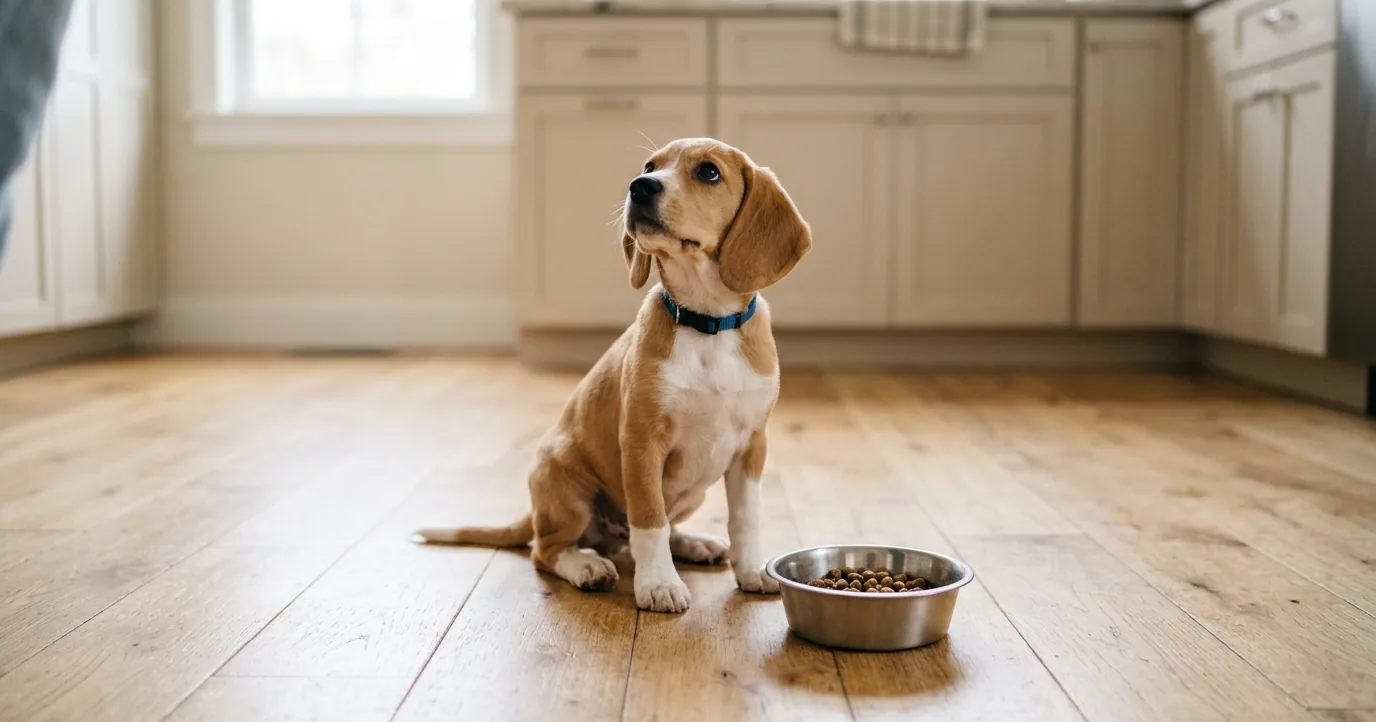
Somebody has probably told you to skip your puppy’s dinner on class night. A hungry puppy works harder, the reasoning goes, so the instructor’s chicken will look like gold. Somebody else, perhaps the breeder, has told you never to train a puppy on an empty stomach. Then class starts, your puppy’s belly makes a noise like a drain clearing, and you start to wonder whether either of them knew what they were talking about.
Each piece of advice is half right, and the halves fit together. Don’t skip the meal. Shrink it, feed it earlier, and carry the rest to class as wages. Your puppy arrives interested in food rather than desperate for it, the treat budget stays honest across the week, and the gurgling usually turns out to be exactly what it sounds like: an empty stomach asking about dinner.
Why “Train Hungry” Is Only Half Right
Hunger really does change what food is worth. Behavior analysts call states like hunger and fullness motivating operations: they teach nothing on their own, but they raise or lower the value of a reward in the moment. A puppy who has just emptied a full bowl has little reason to work for more of the same kibble, which is why a preference test for treats works best when the puppy is a little hungry, not ravenous and not fresh off a meal. Deborah Linder, a board-certified veterinary nutritionist at Tufts, makes the same point about pets who won’t train for their regular food: “If they know they will get it for free later, why work for it?”
The other half is where “train hungry” falls down. In a 2012 study in Behavioural Processes, Miller and Bender fed dogs a breakfast worth half of their daily resting energy requirement and tested them either 30 or 90 minutes later. Each test began with ten minutes of sitting still, followed by a search for hidden food. Tested 30 minutes after breakfast, the dogs searched more accurately than they did when fasted. At 90 minutes, the difference had disappeared. The authors suggested that the meal supplied energy for the thinking, and called the effect beneficial but transient. It is one study of a memory task in a test room, not a puppy class. Still, its shape (hold still, then think) is a fair description of a class, and it is a poor fit for the idea that an empty stomach makes a sharper student.
A starving puppy is also a worse student in ways you can see from across the room. It mugs the treat pouch, can’t settle on a mat, and takes food with its teeth instead of its lips. If your fingers are paying for that, the gentle-take exercise in our bite-inhibition guide is far easier to teach to a puppy who isn’t frantic.
Then there is the physiology of very small puppies. The Merck Veterinary Manual describes low blood sugar as a problem of toy-breed puppies in their first six months, linked to a liver that is not yet mature and usually kept in check with frequent meals of puppy food. Most grow out of it. VCA’s feeding advice for toy and small breeds is at least three small meals a day until four months of age. For a Chihuahua, Yorkie or Maltese puppy, skipping a meal to sharpen class motivation isn’t a training trick. It opens the very gap those frequent meals exist to close.
The Class-Day Plan: Shrink the Meal, Don’t Skip It
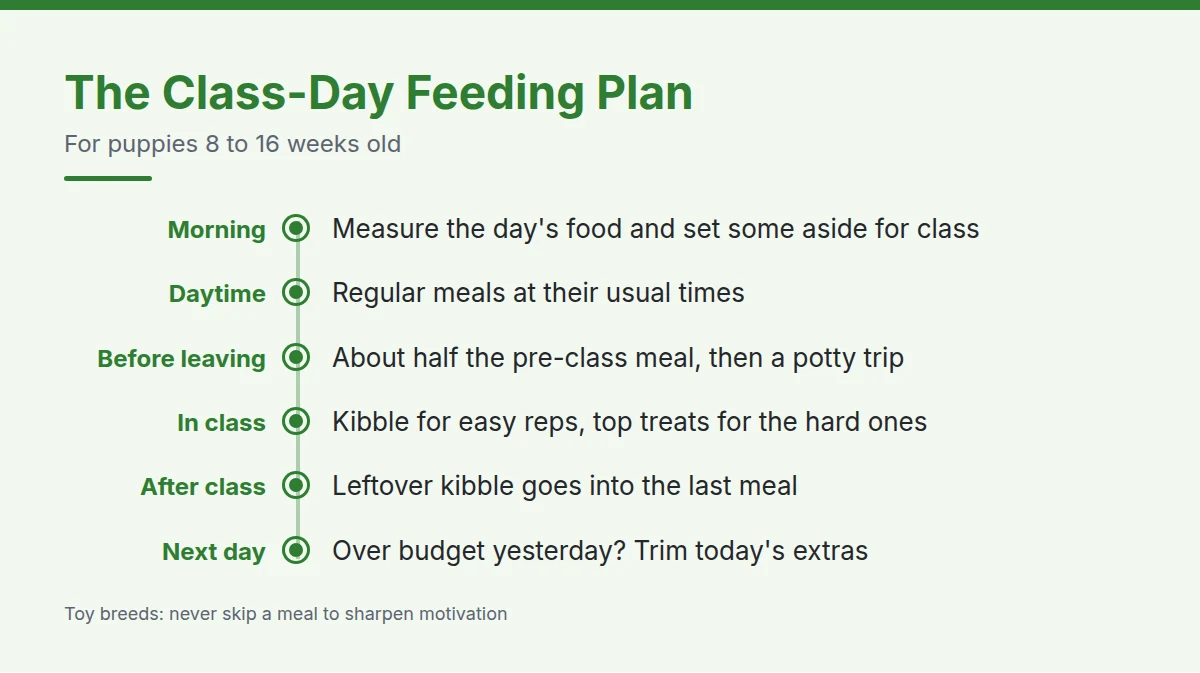
For a puppy between 8 and 16 weeks old, eating three or four meals a day, class day looks like this.
1. Measure the whole day’s food in the morning. Linder recommends setting out the day’s ration at the start of the day and dispensing everything from it, which also keeps anyone in the house from sneaking extras. On class day, set aside part of the meal nearest to class before anyone touches it: some for a small pre-class meal, the rest in a bag for class.
2. Keep mealtimes where they always are. Some dogs’ digestion does best on a strict schedule, veterinarian Debra Eldredge writes in Whole Dog Journal: dinner at 6 p.m. every night, not anywhere from 5:30 to 7. Class day is a bad day to experiment.
3. Feed the smaller meal well before you leave. Roughly half the usual portion is plenty. Feed it early enough to fit in a potty trip before the drive, since a trip outside after every meal is standard housetraining practice. VCA’s guidance for toy and small dogs also says to avoid intense exercise right before or after meals. If your puppy gets carsick, that is one more reason to feed early, because VCA’s motion-sickness advice is built around an emptier stomach for travel. Check with your vet before stretching the gap for a toy breed.
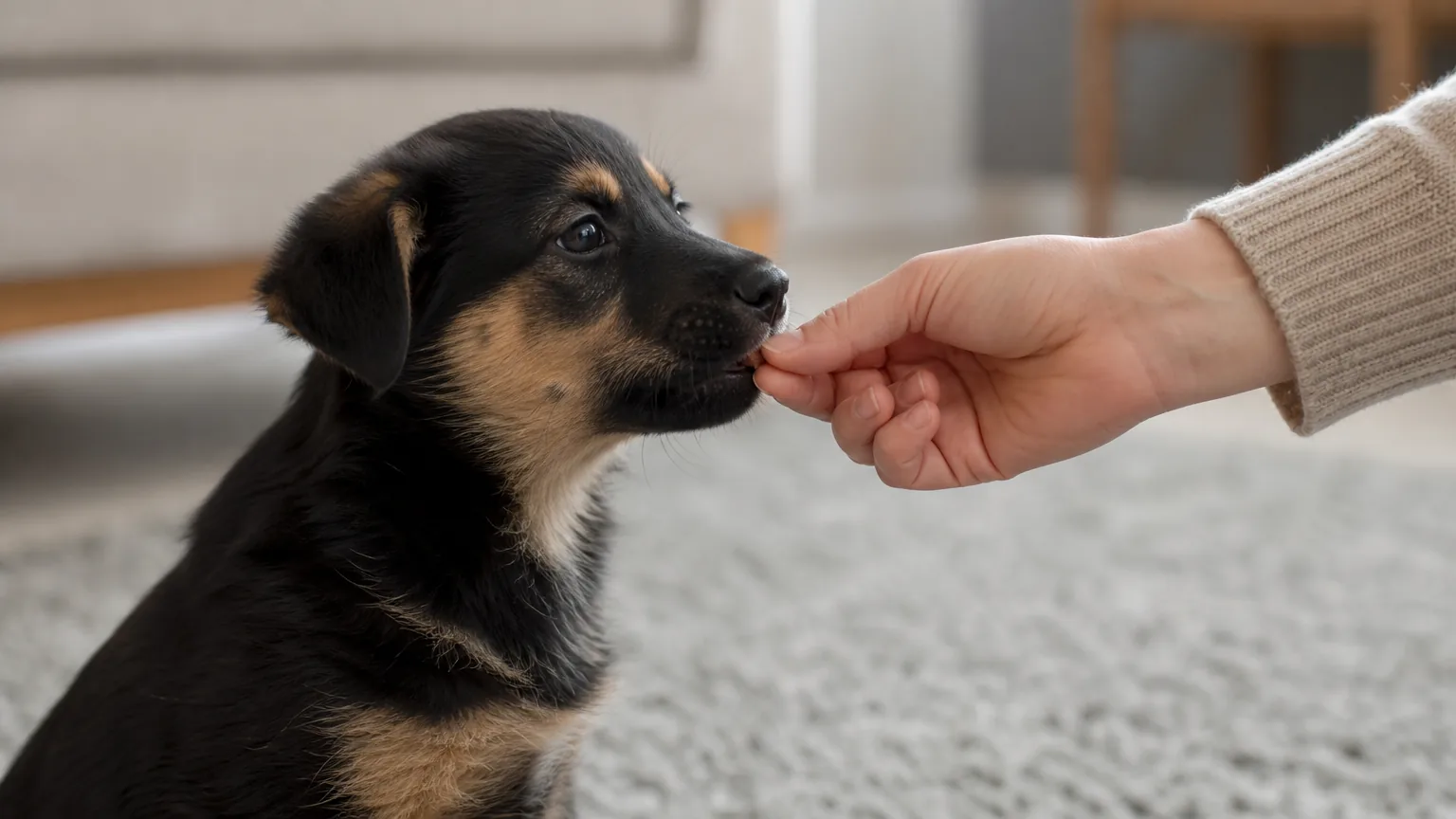
4. Bring the rest of that meal as wages. Kibble pays for the easy work: name games, sits in a quiet corner, settling on a mat between turns. Save the top tier from your puppy’s preference ranking for the expensive moments, such as a recall past another puppy, the first rep of anything new, or a clatter that makes your puppy flinch. Spread across an hour, all those small rewards add up to a slow meal, so a puppy that arrived a little hungry never runs on empty.
5. Settle the account after class. Whatever kibble comes home goes into the last meal of the day. Whatever extras went in come out of tomorrow’s.
Food is half of the class-day routine. The other half is sleep, and timing naps so class lands in a good window matters as much as timing dinner.
Why an Empty Puppy Stomach Gurgles
The noise has a medical name, borborygmi, and it is simply the stomach and intestines at work. In Eldredge’s explainer, making one takes three ingredients: fluid, semisolid food and gas. As they churn through the gut, slow movement stays quiet and fast movement gets loud, the difference between a quiet stream and a river with rapids. A stomach that growls as dinnertime approaches is normal, she writes, just as yours is.
An empty gut has its own reasons to be noisy. Between meals, the stomach and small intestine run a housekeeping cycle: organized bursts of contraction, known as the migrating motor complex, that keep the upper digestive tract clear of leftover food and debris, as Sarna and Otterson explain in their overview of gut motility. With little food left to move, that sweep is pushing mostly fluid and gas, which is a likely reason a hungry belly can be such a loud one.
Class night adds a few triggers of its own:
- Gulped air. A puppy who wolfs a meal takes in extra gas with it. Eldredge suggests a slow feeder, a snuffle mat or scattering the meal to cut down the gas available for noise, and the pre-class meal is a good one to serve that way.
- New food. After a change of diet, new treats or a trash raid, gurgling is a warning sign, Eldredge writes, and diarrhea can follow hours later. Some dogs react to particular foods, and a lactose-intolerant dog may gurgle after a dairy treat. So try any new treat at home in small amounts, days before class, never for the first time on class night. Cheese, a favorite class treat, is dairy.
- Stress. Eldredge lists it as a factor too, and a room full of unfamiliar puppies is stressful for some of them.
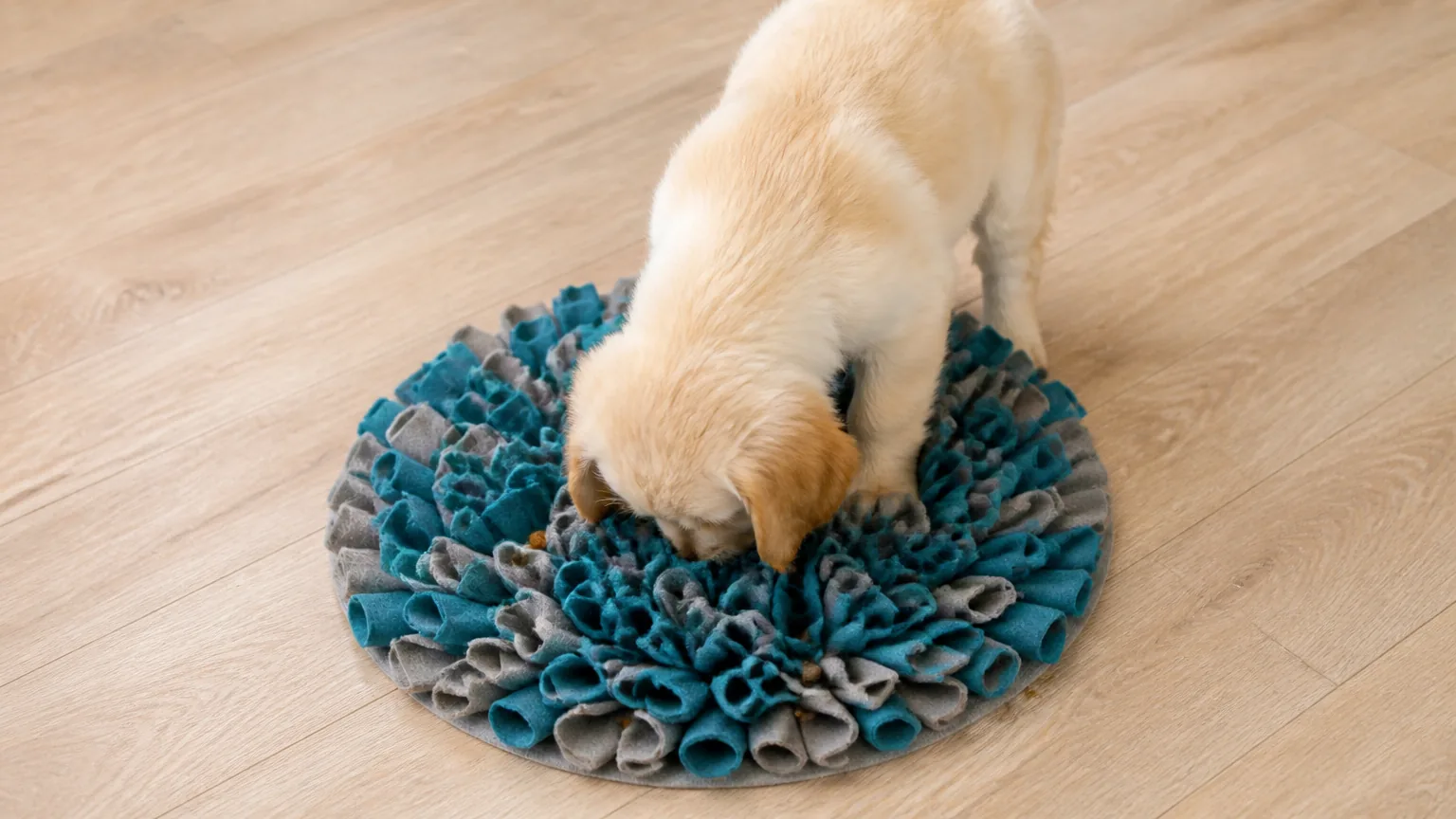
If the noises are frequent, keep notes. Eldredge suggests tracking when they happen, such as after a particular treat or a change in routine, so a pattern has a chance to show itself.
Budgeting the Class Treats So the Week Adds Up
Tufts’ nutritionists put the ceiling at 10 percent: anything that is not the puppy’s complete and balanced food should add up to less than 10 percent of its daily calories. Linder’s version for training contains the wrinkle that makes class night workable. The 10 percent is an average. A heavy training day can run over, as long as you trim the other days so the week comes out near 10 percent.
That is also where overfeeding tends to creep in. The trouble is rarely one generous class night. It is class night plus the daily homework, plus the biscuit at the door and the cheese someone else slipped in, with nobody trimming anything afterward.
What does 10 percent look like? The Merck Veterinary Manual starts from a resting energy requirement of 70 times body weight in kilograms raised to the 0.75 power, and lists healthy puppies under four months at about three times that. A 10-pound (4.5 kg) puppy at 12 weeks comes out near 650 calories a day, leaving about 65 calories for extras. Tufts lists a tablespoon of diced, cooked chicken breast at about 15 calories, so that puppy’s entire daily allowance of extras is a little over four tablespoons of chicken. A 3-pound toy puppy’s allowance is about 26 calories, less than two tablespoons. Merck stresses that any such calculation is only a starting point, and that one animal can need as much as 30 percent more or less than another of the same weight. Use the number to plan, and your vet’s eye to adjust.
Two habits make the budget go much further:
- Pay in kibble first. The puppy’s own food is not a treat. It is the balanced diet, delivered one piece at a time, so it does not count against the 10 percent. Linder suggests putting a pet’s regular food on its reward list alongside everything else, since a food-motivated pet may rank it highly, and subtracting whatever you hand out from the day’s allotment.
- Cut everything small. A dog is as excited by a half-inch piece as by a two-inch one, Linder writes, so break treats into tiny bits. Smaller pieces mean more paychecks for the same calories.
Why bother with arithmetic for a growing puppy? In a lifetime study, Kealy and colleagues paired 48 Labrador Retrievers and fed one dog in each pair 25 percent less than its pair-mate, from 8 weeks of age until death. The leaner dogs lived significantly longer, and the signs of chronic disease generally appeared later. That is not a case for shortchanging a growing puppy. It is a reminder that a lean adult dog is built in puppyhood, at exactly the age when class treats pile up. Ask your vet to check body condition at each puppy visit, and to show you how to feel for ribs at home.
Gurgling Plus: When to Call the Vet Instead of Going to Class
Class during the socialization window is too valuable to skip for a stomach that is only asking about dinner, and too risky to attend with one that is sick. A gurgle on its own, in a puppy who is bright, playful, eating and passing normal stool, is digestion. Eldredge spells out what changes that. Gurgling together with diarrhea, vomiting, loss of appetite or weight loss justifies a thorough veterinary workup. A blockage from a swallowed sock or corn cob can also set off gurgling, and she calls that one of the most serious scenarios. If the noise is new for your puppy, or comes with any of those signs, have the puppy checked. In her words, “Waiting can be a mistake.”
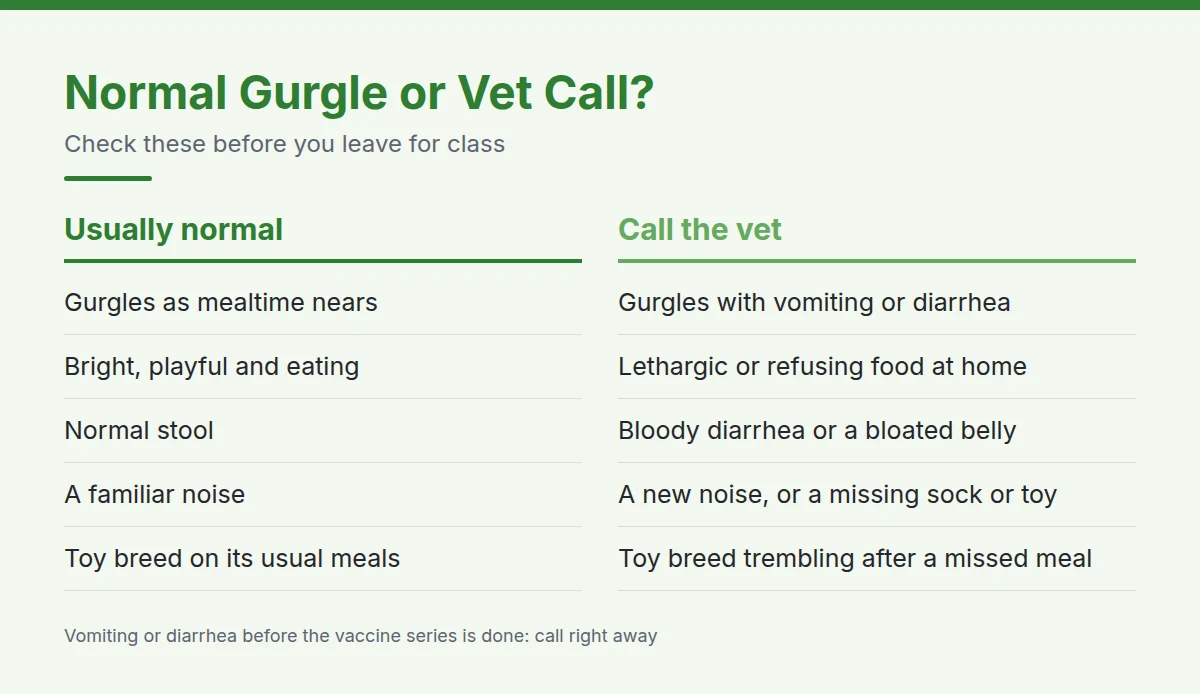
For puppies, three situations move the call up:
- Vomiting or diarrhea before the vaccine series is finished. The American Veterinary Medical Association counts puppies between 6 and 20 weeks old, along with unvaccinated or incompletely vaccinated dogs, among those at greater risk of parvovirus. The signs it lists include lethargy, loss of appetite, vomiting, severe and often bloody diarrhea, and abdominal pain and bloating, and its advice is to contact your veterinarian immediately. A puppy with those signs stays home from class whatever the cause, for its own sake and for every other puppy in the room. If you are unsure where your puppy is in the series, what a class can require in vaccines walks through the core shots.
- A toy breed who missed a meal and seems off. PetMD lists the signs of low blood sugar as loss of appetite, lethargy, vomiting, disorientation or weakness, tremors or seizures, and fainting, and says to contact your veterinarian immediately if you see them.
- A noisy belly that keeps coming back. Eldredge calls a fecal test to rule out intestinal parasites always a good idea. Some of the parasites that circulate at puppy class can reach your family too, so the result matters beyond your puppy.
One thing that is not on this list: a puppy who eats happily at home and refuses food in class. That is usually the room talking, not the stomach. The fix is more distance, a quieter corner or a few minutes to decompress, as the preference-assessment guide explains. If the refusal comes with hiding, trembling or growling, that is fear rather than fussiness, and worth a referral to a board-certified veterinary behaviorist.
The Bottom Line
Feed before class, just less of it and earlier. A light meal before you leave, the rest of it in your pocket, and the best rewards saved for the hardest moments give you a puppy who is interested in food without being frantic for it. Count the extras across the week rather than the night, and pay in kibble first. And treat gurgling as information. On its own, it is dinner talking. With vomiting, diarrhea, lethargy, or a puppy who won’t eat even at home, it is a call to your vet rather than a drive to class.
Further reading (sources)
- Whole Dog Journal on what makes a dog’s stomach gurgle and when it is a warning
- Miller and Bender for dogs that searched more accurately half an hour after breakfast
- Sarna and Otterson with an overview of how the gut moves in fed and fasted states
- Tufts Petfoodology on training with food rewards without unbalancing the diet
- Tufts Petfoodology for low-calorie treat options and what 10 percent of calories looks like
- Merck Veterinary Manual with the formulas behind a growing puppy’s calorie needs
- Merck Veterinary Manual on low blood sugar in toy-breed puppies
- VCA Animal Hospitals for meal frequency and exercise timing for toy and small puppies
- VCA Animal Hospitals about easing motion sickness on car rides
- PetMD with the signs of low blood sugar that need a vet
- Kealy and colleagues for the lifetime effects of keeping Labradors leaner from eight weeks of age
- American Veterinary Medical Association on parvovirus signs and the puppies most at risk