Bite Prevention Starts in Puppyhood: Bite Inhibition, Warning Signals, and Why Punishing the Growl Backfires
Published on October 23, 2026
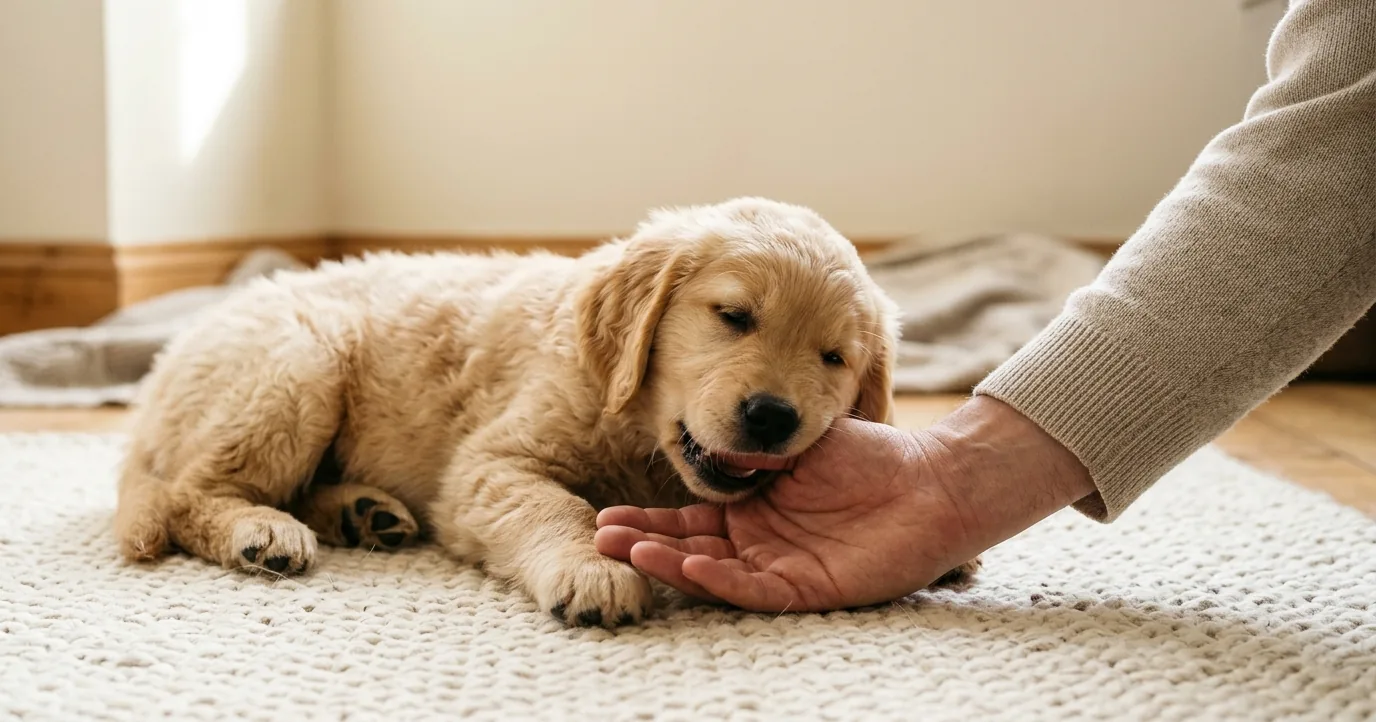
In February the BBC asked a question that resurfaces every time a dog attack makes the news: is better training the answer? Police forces had recorded 31,920 dog attacks on people in England and Wales in 2024, 2% more than the year before. A trainer who works with aggressive dogs told the reporter that force-free training was part of the problem, because owners are told never to correct their dogs. The Dogs Trust, which advocates reward-based training, disagreed. So did a University of Lincoln researcher who has spent five years studying why some dogs behave aggressively. Punishment that a dog finds frightening, intimidating or painful has no place, she said, and the research suggests it is likely (not certain, but likely) to increase aggression.
Most of that argument is about adult dogs that already bite. For a puppy owner, the useful part comes earlier and has little to do with obedience. Two things decide how dangerous a dog is on its worst day: how hard it bites when it does bite, and whether it warns you first. Both are largely shaped in the first months of life, and both can be quietly undone by well-meant punishment. This guide covers how puppies learn a soft mouth, the warning signals that come before a bite, why correcting a growl backfires, and when to call in a veterinary behaviorist.
A Soft Mouth Decides How Bad a Bite Is
Nobody can promise that a dog will never bite. Pain, fear, a toddler tripping over a sleeping dog: on a bad enough day, almost any dog can put its teeth on a person. The American Kennel Club’s puppy guidance says as much. There may come a day, it warns, when your dog puts its mouth on somebody in pain or fear, and a dog that learned early that human skin is delicate will make that bite less forceful.
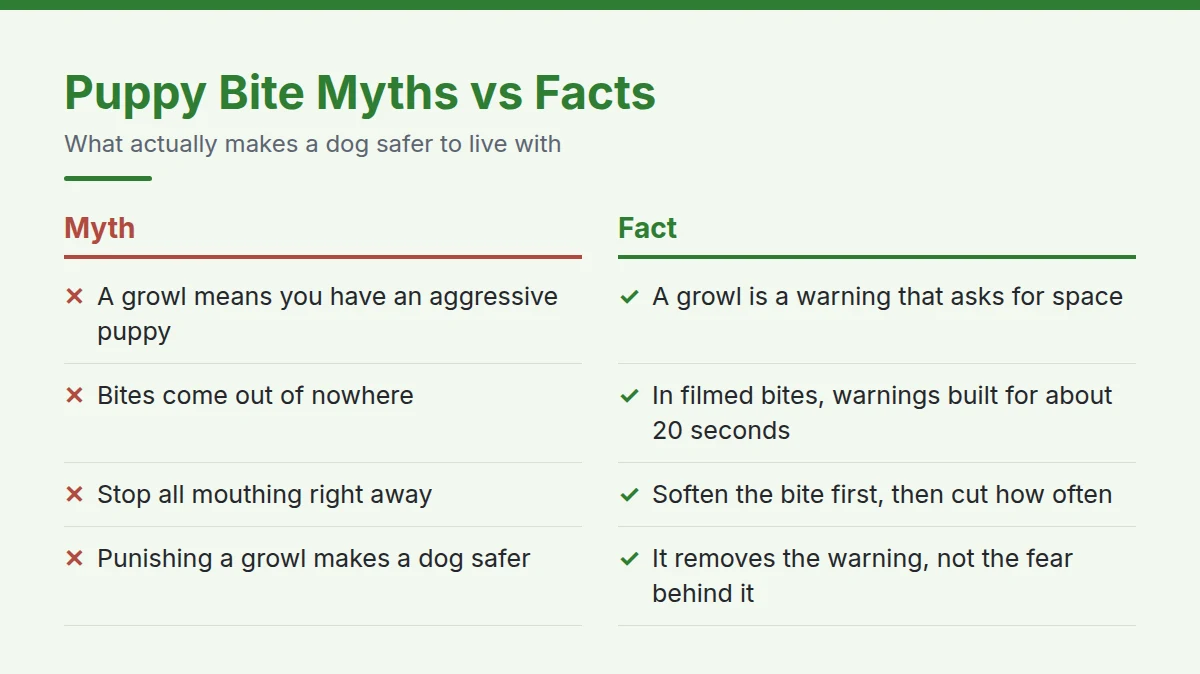
That difference is the backbone of the dog bite scale devised by veterinarian Ian Dunbar. Level 1 is threatening behavior with no tooth contact. Level 2 is teeth touching skin without a puncture. Level 3 is one to four shallow punctures from a single bite, and Level 4 is a single bite with at least one puncture deeper than half the length of the dog’s canine tooth. Levels 5 and 6 are multiple-bite attacks and fatal ones. In Dunbar’s notes on the scale, Levels 1 and 2 make up well over 99% of dog incidents, and the dogs behind them are more likely to be fearful, rambunctious or out of control than dangerous. A Level 4 dog, by contrast, “has insufficient bite inhibition and is very dangerous,” and he rates the outlook as poor because teaching bite inhibition to an adult dog that already bites hard is both difficult and dangerous.
Put those two ideas together and the case for puppy work makes itself. You cannot guarantee the bite will never happen. You can decide, months ahead of time, whether it would be a Level 2 or a Level 4, and the cheapest time to do that is while your puppy still has baby teeth.
How Puppies Learn Bite Pressure
Puppies arrive with some practice already. Littermates squeal and quit the game when a bite lands too hard, and the AKC points out that play with other dogs keeps teaching the same lesson, because other dogs yip or give a time-out when a puppy bites too hard. That is one of the best reasons to choose a class with supervised off-leash play over an hour of sits. Trainer Casey McGee, interviewed by the AKC, favors controlled off-leash play because it gives a puppy real-time feedback from its peers while mistakes are still cheap. “Puppies without adult teeth are incapable of seriously hurting each other,” she says. The supervision is the other half of her point: a shy puppy should be allowed to watch and opt in when ready, not repeatedly rolled, bitten and chased.
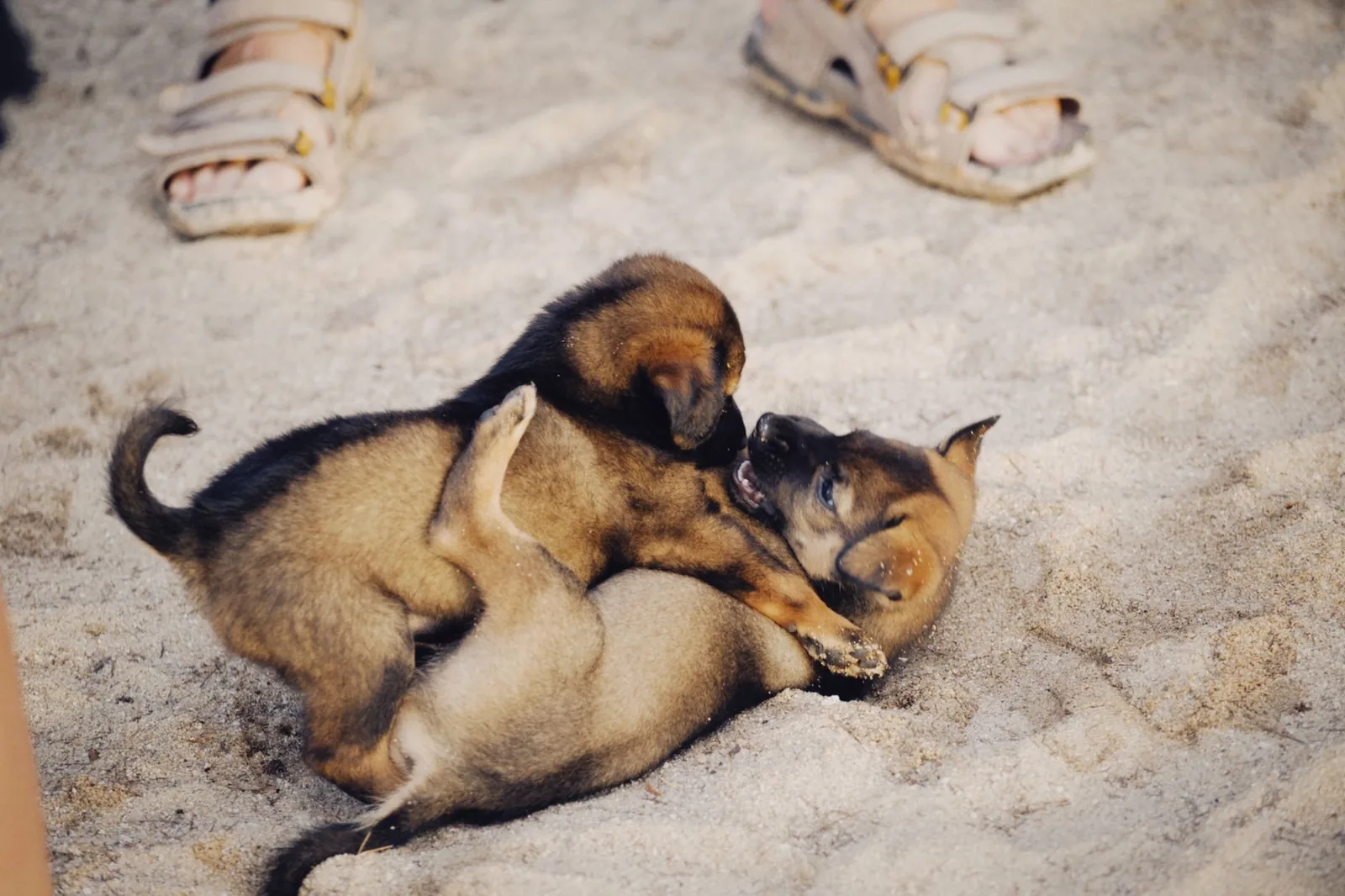
At home, you are the playmate, and the order of the work matters: pressure first, frequency second. The AKC puts it well. The goal “isn’t to immediately stop all biting, but instead to slowly lessen the force of your puppy’s bites.”
1. Allow gentle mouthing, for now. In the first weeks, soft mouthing during calm play is the raw material. A puppy who is never allowed to put a tooth on skin never finds out how much pressure is too much.
2. Let a hard bite end the game. When the teeth press hard, say “ouch” in a flat voice, let your hand go still rather than snatching it away, and stop playing for ten to twenty seconds. The AKC suggests a high-pitched yip, which works for some puppies. If a squeal winds yours up instead, drop the noise and simply stop. Then invite play again.
3. Give the teeth somewhere legal to go. Keep a tug or soft toy within reach and swap it in the moment a bite lands, so there is something your puppy is allowed to bite down on hard.
4. Raise the bar slowly. Over a few weeks, the pressure that ends the game gets lighter, until any real pressure ends it. Only then start working on how often your puppy mouths, with a cue that means “mouth off” and a steady supply of chews.
5. Practice the gentle take. Hand-feed part of some meals and open your fingers only when the mouth is soft. It turns soft-mouth practice into something that happens twenty times a day, without a game at all.
6. Watch the clock. A puppy who keeps coming back at your hands after two redirections is usually overtired, not testing you. The overtired biter needs a nap more than more practice.
What not to do matters just as much. Holding the muzzle shut, scruffing, tapping the nose and pressing the lip into the teeth all teach the same lesson: hands near the face predict pain. That is the opposite of what you want on the day a child grabs your adult dog’s ear.
The Warning Ladder: What Comes Before a Bite
Bite-prevention teaching is often built around a model called the ladder of aggression, credited to Kendal Shepherd. The idea is that a dog’s signals escalate. Small ones come first, such as lip licking, yawning and turning the head away. Then the dog moves away, freezes or stares. The loud ones come last: a growl, a snap and finally a bite. Applied animal behaviorist Kate Mornement sums it up in the Whole Dog Journal: a dog who has yawned, looked away, licked its lips and tried to move away “has run out of options and may need to get louder and harder to miss.” In most cases, she adds, the warning signs were there. They were just not seen or ignored.
Researchers at the University of Liverpool checked the model against real bites. Owczarczak-Garstecka and colleagues collected 143 YouTube videos of dogs biting people, then coded what the dog and the person did beforehand in 56 of them. Head and body turning, staring, stiffening, snapping, growling and frowning all became more common as the bite approached, and the build-up began about 20 seconds before it. The people changed too. In the same window they touched the dog more, and they stood or leaned over it more.
Two honest caveats come with that study. Lip licking, paw raising and sniffing did not follow a clear pattern, and shifts in posture were easier to see than the subtle appeasement signals. The ladder is a teaching model, not a script every dog follows one rung at a time. But the headline finding is the useful one. In those videos, at least, the bite that seemed to come from nowhere had been building for about 20 seconds.
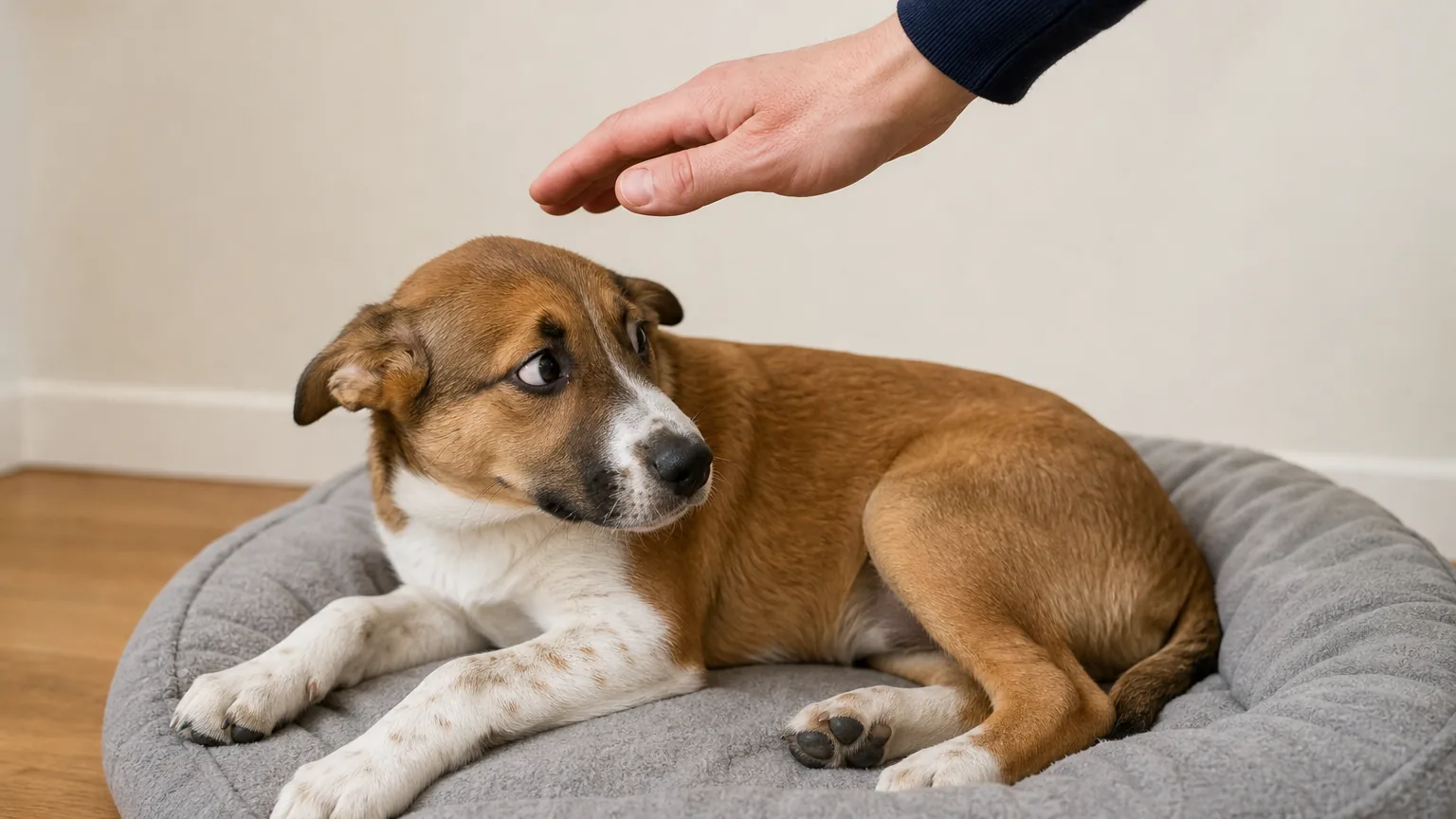
You do not need to memorize every rung. Teach the whole household three: a head or body turned away, a sudden freeze, and the whites of the eyes showing (often called whale eye). The response to all three is the same. Stop what you are doing and give the dog space. Reading these signals can be taught at almost any age. In a study from the University of Lincoln, children aged three to five and their parents got measurably better at interpreting dogs’ distress signals after being taught, and the gains lasted. Puppies have their own version of the ladder around food and toys, too, and the guarding sequence from freeze to bite is worth learning before your puppy’s first bully stick.
Why Punishing the Growl Backfires
A growl sits near the top of the ladder, and it is the rung owners most often punish, because it sounds like defiance. Mornement is blunt about the result: punishing a growl “doesn’t resolve the discomfort and can teach the dog to skip the warning and go straight to a bite instead.” The fear, pain or guarding behind the growl is still there. All the punishment changed was whether the dog tells you about it. That is one well-worn route to the dog who bites “without warning”: a dog whose warnings were trained out of it.
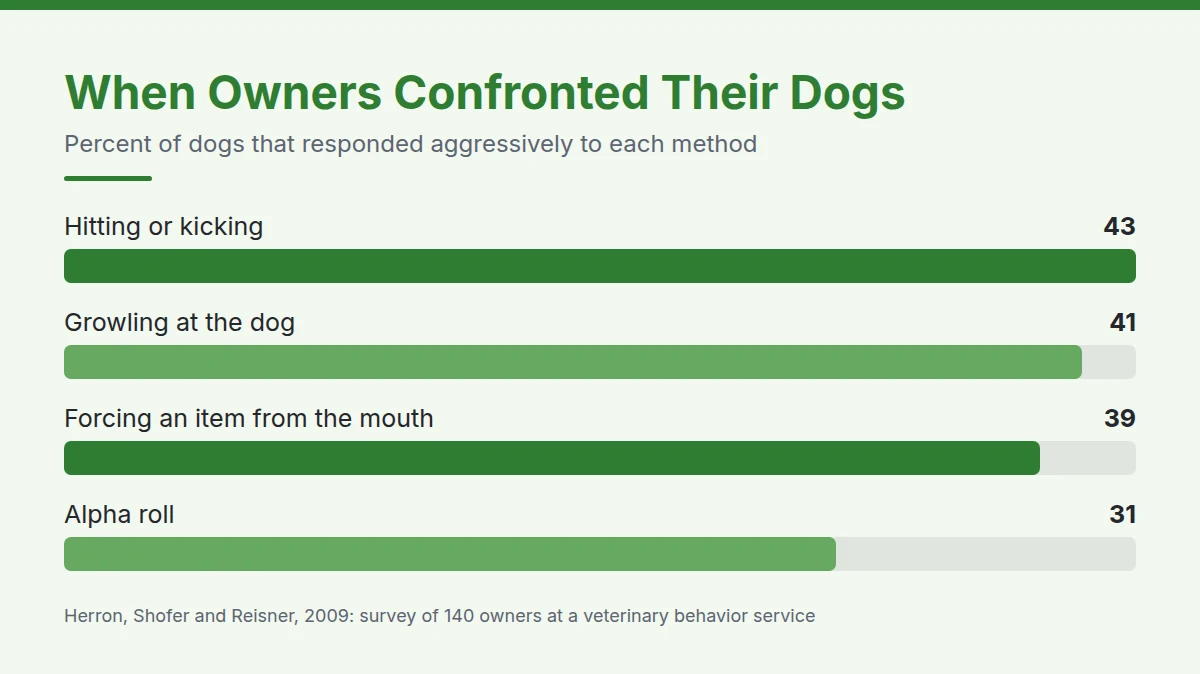
The confrontation itself makes things worse. Herron, Shofer and Reisner asked 140 owners arriving at a veterinary behavior referral service which methods they had already tried. Growling at the dog drew an aggressive response from 41% of the dogs it was tried on. Forcing an item out of the dog’s mouth drew one from 39%, hitting or kicking from 43%, and the alpha roll from 31%. Meet a warning with a threat and a large share of dogs escalate, which is exactly how a growl becomes a bite.
Aversive training also raises the stress underneath the ladder. Vieira de Castro and colleagues filmed 92 dogs at seven training schools and sampled their saliva. Dogs from the schools that relied most on aversive methods showed more stress behaviors during training, lip licks and yawns among them. They also spent more time tense, had bigger rises in cortisol after training, and were more “pessimistic” in a separate cognitive bias test. Notice which behaviors went up: the bottom rungs of the same ladder.
The American Veterinary Society of Animal Behavior is careful about what the survey evidence can show. Surveys link aversive training with aggression toward people and other dogs, its position statement notes, but they cannot separate cause from correlation. On dogs that already show aggression it leaves no room at all: they should be treated with humane methods “rather than with ‘a heavy hand’,” and “there are no exceptions to this standard.” The Dogs Trust’s head of clinical behaviour support made the same point to the BBC in plainer words: “when we’re punishing behaviour that we don’t like, we’re not understanding why they’re doing it in the first place.”
So when your puppy growls:
- Stop and make space. Do not reach in. Step back, or call your puppy away in a cheerful voice and reward it for coming.
- Replay the last 20 seconds. What were you, a visitor or a child doing just before? That is your trigger.
- Change the setup. A gate around the chew zone, no reaching over a sleeping puppy, visitors who wait to be approached.
- Work on the feeling, not the noise. A growl that repeats in the same situation needs a plan built around that trigger, ideally with a qualified professional.
- Know a play growl from a warning. Many puppies growl theatrically in play, with loose, bouncy bodies. A growl that comes with a still body, a closed mouth and a hard stare is the one to listen to.
If you have already been correcting growls, you have not ruined your puppy. Stop today, and use the guide to switching from corrections to rewards for what to expect next.
Where Bites Actually Happen
The stranger-danger picture of dog bites is mostly wrong, at least for young children. When Reisner and colleagues interviewed 203 bitten children (or, for the youngest, their parents) at the Children’s Hospital of Philadelphia, 72% of the children knew the dog. Among children under seven, most bites happened indoors, with a familiar dog that was not moving, during a friendly interaction the child had started, and 70% of the bites in that younger group were to the face. Older children were more often active outdoors, did not know the dog and were not interacting with it.
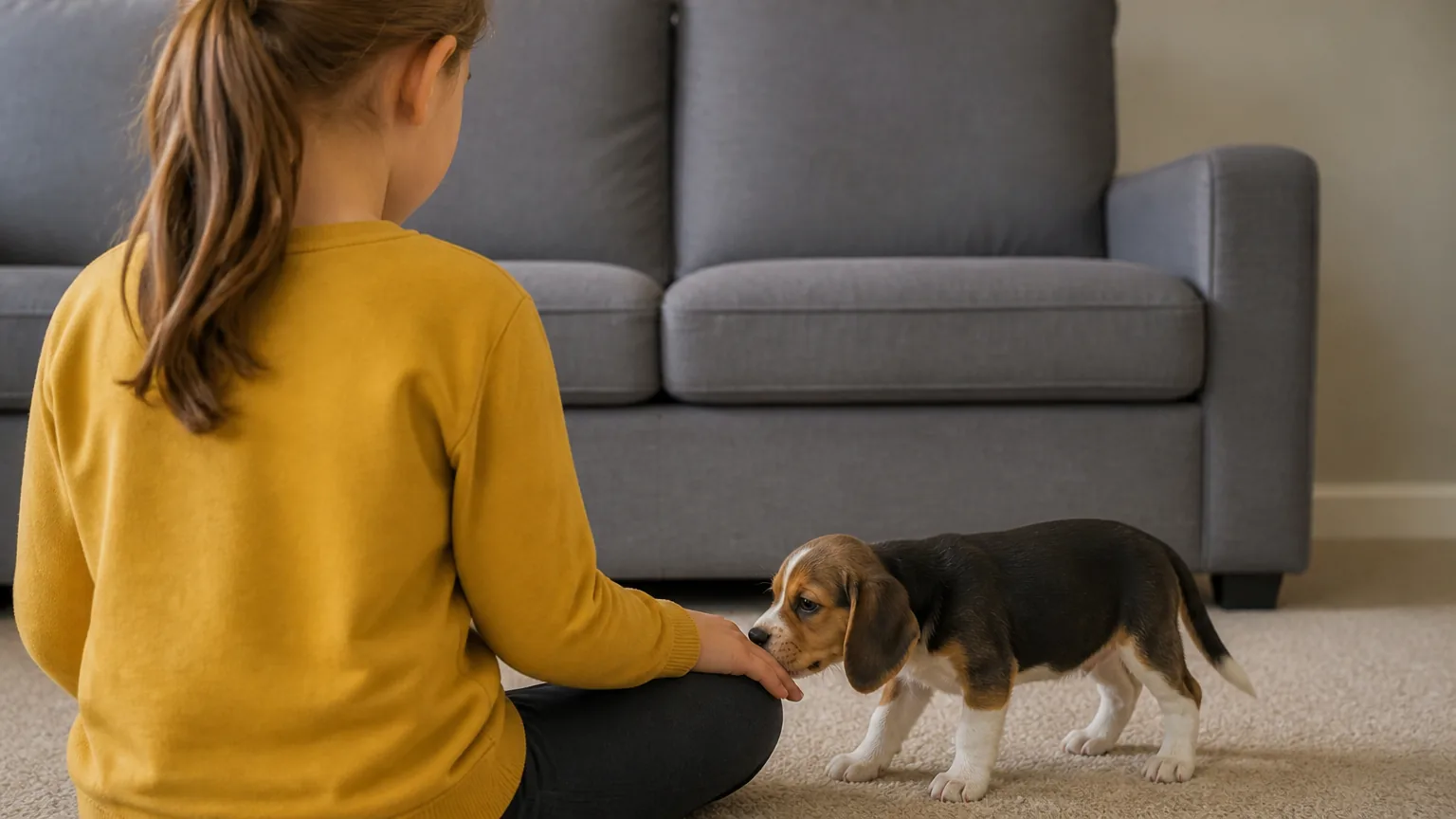
That profile is the family puppy, grown up. The rules that follow are easy to say and hard to keep. Let the dog choose to approach, never the other way round. No hugging, kissing or leaning over the dog. Leave a resting or eating dog alone. And an adult actively supervises every interaction with a young child. The Liverpool team reached the same place from the video evidence: touch, especially petting, should be mutually consensual, started by a person only after the dog has made contact or shown it wants to be petted. Our guide to bringing a puppy home to a family with kids has the age-by-age version.
When to Bring In a Veterinary Behaviorist
A puppy class is the right place to build a soft mouth and practice reading signals. It is not the place to treat aggression. Growling, snapping or biting that keeps happening calls for behavior modification, which is a different service from obedience training, and the person providing it should be qualified for that work. Get help if you see:
- Any bite that breaks the skin, at any age (Level 3 or higher on Dunbar’s scale)
- Growling, snapping or freezing aimed at family members, or during handling, grooming or vet care
- Hard bites that are not getting softer after several weeks of consistent practice
- A puppy who skips the early rungs and goes from stillness straight to a snap
- A sudden change in a puppy who used to be relaxed about being touched
Start with your veterinarian, because pain is common and easy to miss. When Mills and colleagues pooled recent dog cases from several of their own referral caseloads, they put a conservative estimate at around a third of cases involving some painful condition, and in some clinics the figure was close to 80%. AVSAB’s position is the same: a dog with fear or aggression should always be evaluated by a veterinarian so that medical causes can be ruled out, and some will need medication alongside training.
A board-certified veterinary behaviorist (DACVB) is a veterinarian who can diagnose, rule out medical causes and prescribe. A certified applied animal behaviorist or a credentialed behavior consultant can run the training side, ideally alongside your vet. Dog training is unregulated in most states, so check credentials, and walk away from anyone who proposes to correct the aggression out of your puppy. While you wait, manage: gates, leashes, no visitors reaching for the puppy, and a muzzle your puppy has learned to like for vet visits and anything you cannot control.
The Bottom Line
The argument over whether training prevents dog attacks will go on, because it is mostly about adult dogs that already bite. The puppy months are where the outcome is shaped. Teach a soft mouth while the teeth are small. Learn the ladder so the warnings get heard. Treat every growl as information, and never punish it. And when the warnings keep coming, bring in a professional, not a heavier hand.
Further reading (sources)
- BBC News on whether better training is the answer to rising dog attacks
- Association of Professional Dog Trainers with Ian Dunbar’s official dog bite scale
- American Kennel Club for teaching a puppy to use a soft mouth
- American Kennel Club on supervised off-leash play in puppy class
- Whole Dog Journal with how dog warning signals escalate, and why punishing a growl backfires
- Owczarczak-Garstecka and colleagues on dog and human behavior in the seconds before filmed bites
- Meints, Brelsford and De Keuster for teaching young children and parents to read dog distress signals
- Herron, Shofer and Reisner on confrontational methods that provoked aggressive responses
- Vieira de Castro and colleagues with stress behavior and cortisol in dogs at aversive and reward-based schools
- American Veterinary Society of Animal Behavior on humane dog training, including for dogs that show aggression
- Reisner and colleagues for the circumstances of dog bites to children treated in hospital
- Mills and colleagues about how often pain sits behind problem behavior in dogs