Lean for Life: Keeping a Food-Trained Puppy at a Healthy Weight Through the Growth Year
Published on November 25, 2026

Your instructor told you to pay generously, and you did. Kibble for every sit, chicken for every recall, a stuffed chew to get through the evening. Now your puppy is five months old, its outline has gone soft, and someone in the family has started calling it puppy fat. The instructor was right: food is the fastest and kindest way to teach a puppy almost anything. Your worry is right too. The growth year is when the adult body gets built, and a puppy that heads into adolescence round tends to come out the other side that way.
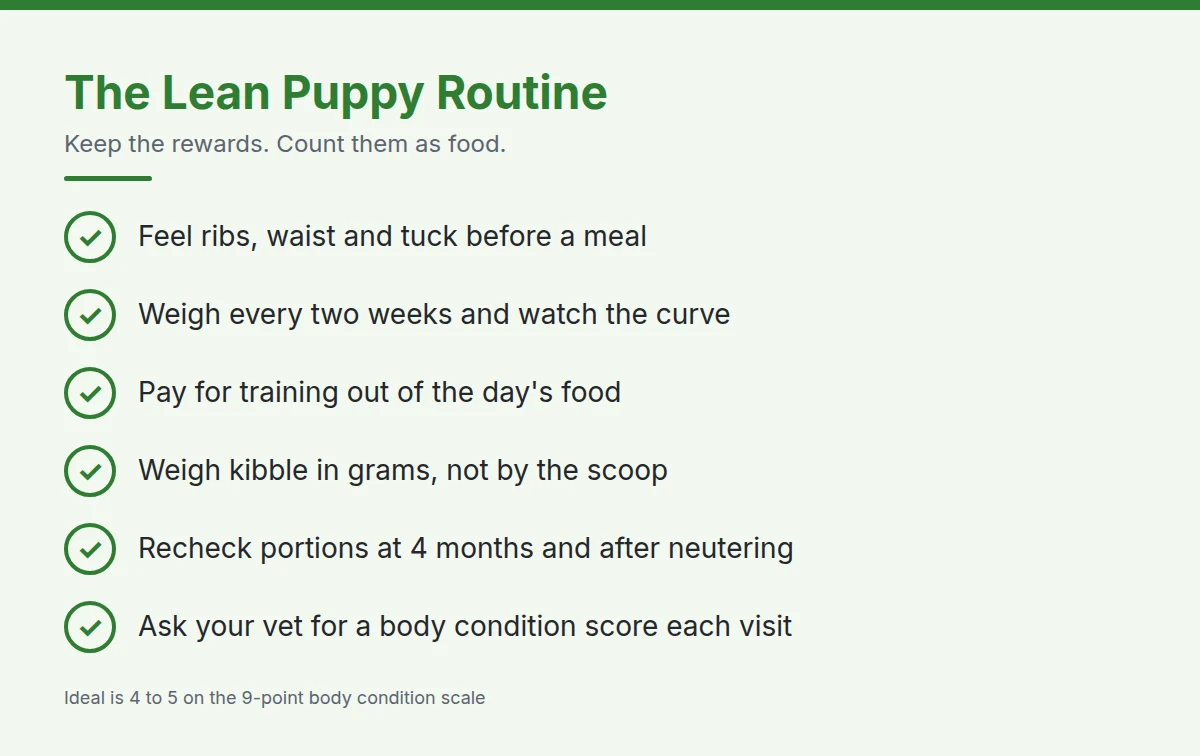
The answer is not fewer rewards. It is learning what lean looks and feels like on a growing puppy, paying for training out of the day’s food instead of on top of it, and adjusting the bowl as your puppy grows, gets spayed or neutered, and changes how much it moves.
Puppy Fat Is Not a Phase
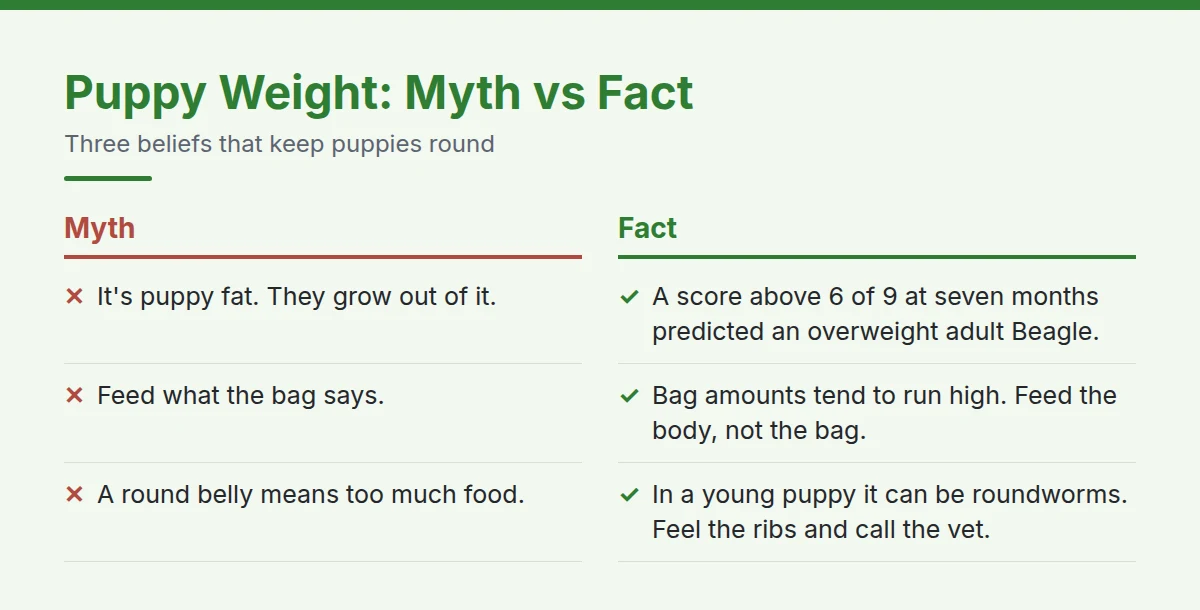
“They grow out of it” is the comforting version, and the research points the other way. Leclerc and colleagues followed 24 female Beagles, all raised under identical conditions, from birth to two years of age. By the end, 15 of the 24 were carrying extra weight. Two early measures predicted which ones: unusually fast growth in the first two weeks of life, and a body condition score above 6 out of 9 at seven months. Seventy percent of the dogs with either marker ended up in the heaviest group, and between 7 and 10 months of age, that group ran a bigger energy surplus than the dogs that stayed lean. That is the adolescent stretch, when plenty of owners are still training with a pocket full of food. It is a small study of one breed and one sex, but it puts a date on the problem.
Growth charts tell the same story. A growth chart draws a fan of curves called centile lines, and a healthy puppy tends to grow along one of them. Salt and colleagues developed growth standards for dogs in five size categories, then checked them against dogs whose adult body condition was known. Healthy dogs rarely changed lanes: fewer than 5 percent crossed more than two centile lines while growing. Among dogs that were obese by three years of age, 68 percent had crossed two or more lines upward on the way. A puppy getting heavier faster than its curve is not catching up to anything. It is heading somewhere.
Joints are where lean growth shows most clearly. In a study that began with 48 Labrador Retrievers at eight weeks of age, Kealy and colleagues let one group eat as much as it wanted and fed the other group 25 percent less of the same food. When the dogs were two years old, the Orthopedic Foundation for Animals scoring method found hip dysplasia in 16 of the 24 freely fed dogs and 7 of the 24 lean ones. In the lifelong follow-up of that cohort, Smith and colleagues found that hip arthritis first showed on X-rays at a median age of 6 years in the freely fed dogs and 12 years in the restricted ones. Notice what the comparison was. The lean dogs were not starved puppies. They ate the same food as the other group, just less of it.
Extra weight costs time, too. Using records from 50,787 neutered pet dogs in 12 breeds, Salt and colleagues compared dogs that were overweight in middle age with dogs in normal body condition. In every breed, the overweight dogs had a shorter median life span. The gap ran from about five months in German Shepherds to two and a half years in Yorkshire Terriers (13.7 years against 16.2).
And most owners cannot see it. When Eastland-Jones and colleagues asked 110 owners at UK veterinary practices to rate their dog’s body condition, 65 percent got it wrong, and roughly nine in ten of the mistakes were underestimates. Handing owners a body condition chart did not help: 64 percent were still wrong with the chart in hand, and owners of overweight dogs misjudged far more often than the rest. Reading about it is not enough. This is a skill for your hands, ideally learned with your vet’s hands next to yours.
How to Score a Growing Puppy’s Body Condition
Veterinarians use a 9-point body condition score, and on the World Small Animal Veterinary Association’s chart, 4 and 5 are ideal. At those scores the ribs are easy to feel under a thin layer of fat, a waist shows behind the ribs when you look down from above, and the belly tucks up when you look from the side. At 6 the ribs can still be felt, but under slightly too much fat, and the waist is visible without being prominent. At 7 the ribs are hard to find under heavy fat, fat pads have built up over the lower back and the base of the tail, and the waist has all but gone.
Feel first, look second. Mary Cope, PhD, a companion animal nutritionist interviewed by Whole Dog Journal, puts the ribs first, because a dog can still have a waist and a tuck and be overweight.
- Score before a meal. Anyone looks round on a full stomach.
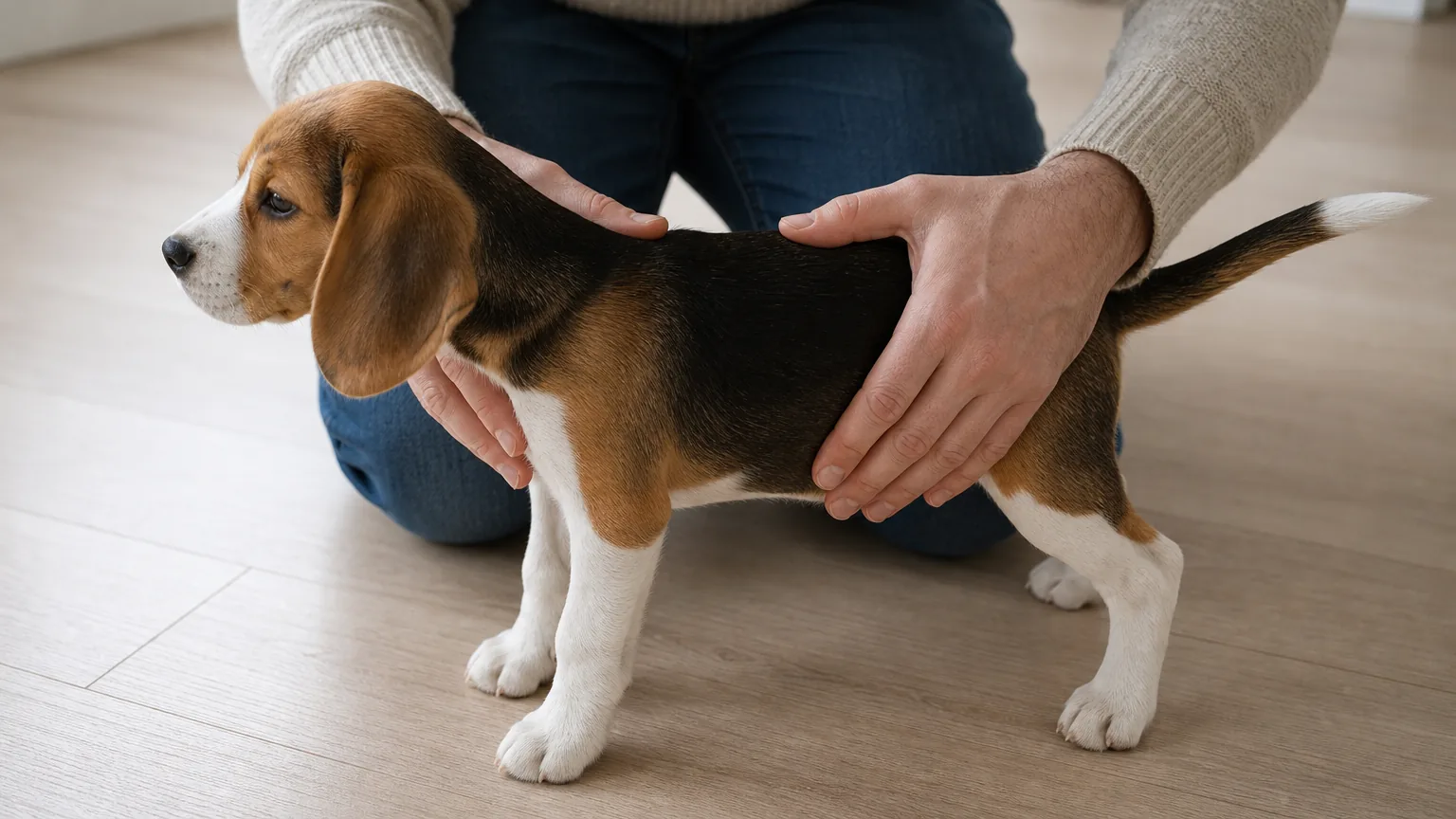
- Ribs. Kneel behind your puppy, rest your hands flat on its sides, and run your fingertips lightly along the ribcage. At an ideal score you can count ribs without pressing. For a rough comparison, lean ribs feel like the back of your hand with the fingers spread flat. Ribs you have to press to find feel more like the fleshy pad at the base of your thumb. Ribs that feel like the knuckles of a clenched fist belong to a puppy that is too thin.
- Waist. Look straight down from above. You want a visible narrowing behind the ribs.
- Tuck. Crouch to puppy height and look from the side. The belly line should rise from the chest toward the back legs.
- Fat pads. Feel along the lower back and the base of the tail. Padding there is a 7, not a growing athlete.
Puppies add three wrinkles.
A pot belly is not always fat. A puppy whose belly sticks out while its ribs, spine or hips feel sharp may have roundworms. The Companion Animal Parasite Council lists ill thrift, failure to gain weight and a poor coat among the signs in puppies infected before birth, and says a pot-bellied appearance is common. That puppy needs a fecal test and a deworming plan, not a smaller dinner.
Coats hide things. A fluffy puppy can carry a surprising amount under the fur, which is one more reason to trust your hands over your eyes. Sighthounds are the opposite case. They are built lean and have a body condition chart of their own, so a Whippet puppy’s visible ribs are not the alarm they would be on a Labrador.
Your eyes adjust. You see your puppy every day, and slow change is the hardest kind to notice. The 2021 American Animal Hospital Association nutrition guidelines say a body condition score and a muscle condition score should ideally be part of every examination, and a young puppy sees the vet often. Ask for the score out loud at each visit, and ask the vet to put your hands where theirs go.
Then bring in the scale. Weigh your puppy every two weeks through the growth year and keep the numbers in one place. Most veterinary offices will let you stop in and use theirs, Cope says. Ask your vet whether they chart puppy weights against growth standards like Salt’s. The weight tells you the trend, and the body condition score tells you whether that trend is frame or fat.
Treats Come Out of the Day’s Food, Not On Top of It
The 10 percent rule for treats, the arithmetic of what 10 percent buys a 10-pound puppy, and the class-day routine of shrinking the meal before you leave are all in our guide to feeding before puppy class, so they are not repeated here. What matters for body condition is the habit underneath them: every reward is part of today’s food.
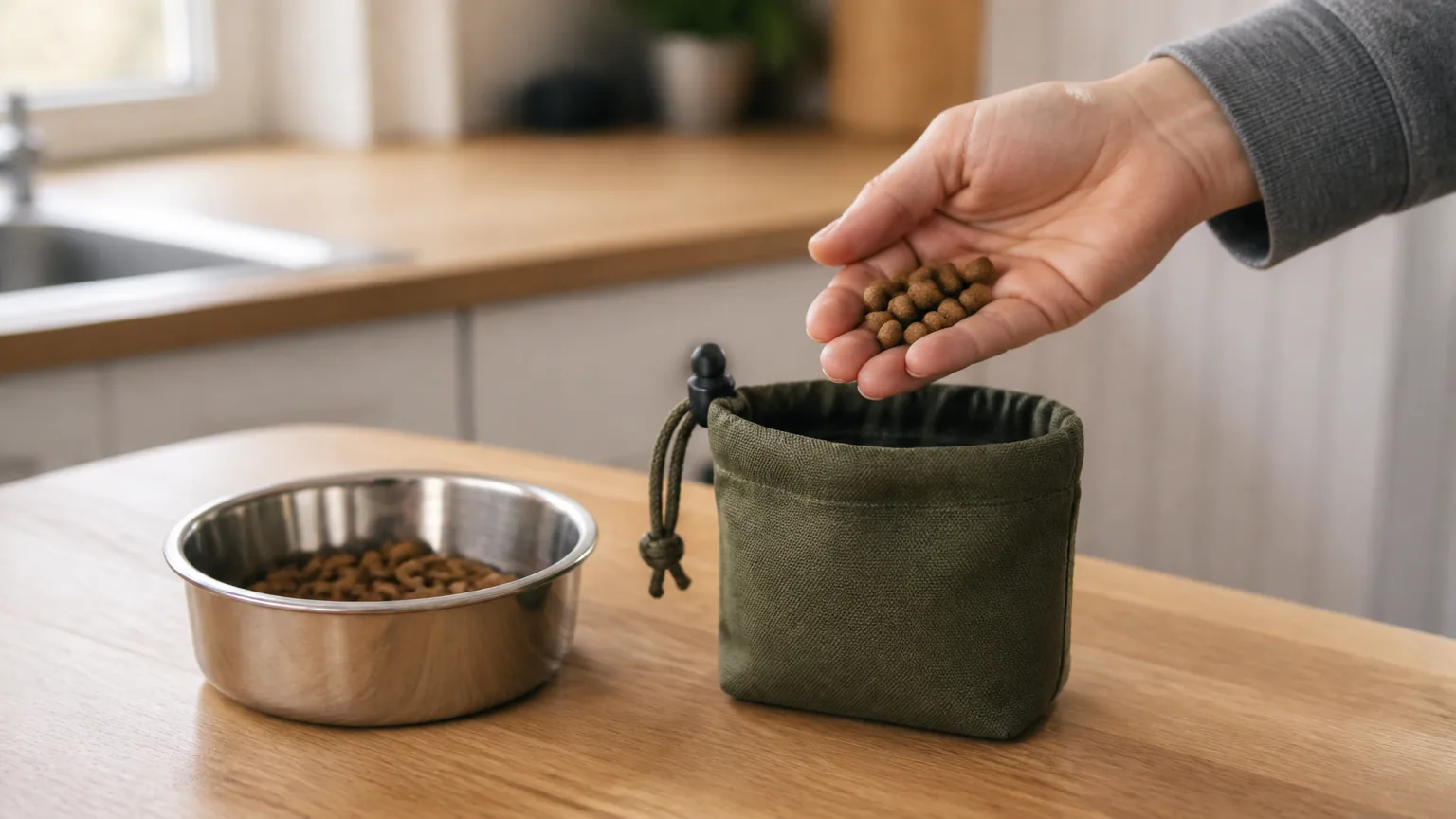
Cope’s version is simple enough to survive a busy week. Keeping treats under 10 percent of calories is hard to track for a small dog, and her fix is to hold back about a quarter of the day’s food and hand that out as treats. For a puppy in class, that quarter is the training pouch. Weigh out the day’s kibble in the morning, move a quarter of it to the pouch, and whatever the pouch does not spend goes into dinner.
Four leaks undo it.
- The scoop. German and colleagues ran 12 studies of people portioning dry kibble with measuring cups. Accuracy ranged from an 18 percent underestimate to an 80 percent overestimate, and the smaller the portion, the bigger the error. Small portions are exactly what puppies eat. A kitchen scale set to grams takes the guesswork out. If you do feed by the cup, use a standard 8-ounce measuring cup. That is the cup a bag’s calories-per-cup figure refers to, Whole Dog Journal points out, not whatever cup is in the cupboard.
- The bag. Many owners of overweight dogs tell Cope they feed exactly what the bag recommends. Those amounts are generalized and tend to run high, she says, so treat them as a starting point and adjust to the dog in front of you.
- The extras nobody counts. Daily dental chews add up quickly, Whole Dog Journal warns. So do peanut butter on the lick mat, cheese in the chew toy and crusts dropped from the high chair. A chew that keeps a teething puppy busy for an hour is still food.
- The rest of the household. One person slipping the dog scraps can undo the plan, Cope says, so everyone has to be on board. One pouch per day, filled in the morning, keeps the count honest.
One saving that backfires is marking without paying. Saying “yes” and then skipping the treat to save calories looks thrifty, but in the small study behind our article on click-then-treat, two dogs got worse, not better, when the marker was followed by food only some of the time. Keep every marker paid and make the payment smaller instead. Cut treats down to a fraction of their size, pay the easy repetitions in kibble, and use play, sniffing and a quick game of chase as rewards wherever your puppy enjoys them.
Adjusting Through the Year: Growth, Size, Neutering and Activity
Calorie Needs Slow Down Before Appetite Does
The Merck Veterinary Manual’s starting-point formula gives a healthy puppy three times its resting energy requirement until four months of age, and twice that afterward. Resting energy itself rises more slowly than body weight, so as growth slows, the daily total climbs far less steeply than the scale does. Feeding more every time the puppy weighs more is how a lean four-month-old turns into a round seven-month-old, and the stretch from 7 to 10 months is when Leclerc’s heaviest Beagles were running a bigger surplus than the lean ones. Merck also cautions that one animal can need as much as 30 percent more or less than another of the same weight. The formula is a place to start, and the body condition score is the judge.
Breed Size
Toy and small breeds. Cope suggests thinking about extra weight as a share of the body, not in pounds: one extra pound is a lot on a Chihuahua and very little on a Great Dane. The largest life span gap in Salt’s study belonged to a toy breed, the Yorkshire Terrier. Small breeds also finish growing months before big ones (our toy versus large breed timeline has the dates), so their portions should stop climbing early. What a toy puppy should not do is skip meals to make room for treats. Very small puppies are prone to low blood sugar, which is why the class-day guide keeps them on frequent small meals.
Large and giant breeds. Big puppies grow for longer, so their growth year can stretch toward two. Merck notes that excess calcium is more of a problem for growing large and giant breed puppies: diets above 3 percent calcium on a dry-matter basis caused more severe osteochondrosis, a developmental joint disease, in rapidly growing large breed puppies than diets with less. Feed a complete food whose label says it is formulated for growth or for all life stages, skip the calcium supplements, and keep the puppy lean. The Association of American Feed Control Officials treats growth, maintenance and all life stages as separate claims on a label, because each needs different quantities and ratios of nutrients. Kealy’s Labradors are the case for lean growth in a big dog.
Labradors and flat-coated retrievers. These two breeds have a genetic thumb on the scale. Raffan and colleagues found a deletion in a gene called POMC in Labradors and in the closely related flat-coated retriever, and it went with higher body weight, more body fat and stronger food motivation. Across their Labradors, 12 percent of copies of the gene carried the deletion. Among 81 dogs kept as assistance dog breeding stock, 45 percent did. The authors point out that assistance dogs are selected for trainability, and that food rewards are a mainstay of their puppy training. In other words, the trait that makes a Lab puppy such an eager student is tangled up with the trait that makes it gain weight. A 2024 follow-up by Dittmann and colleagues found that Labradors with the variant were more driven to get at a sausage sealed in a box three hours after a meal, and that flat-coats carrying two copies burned roughly 25 percent less energy at rest.

If your retriever puppy is headed for the field, all that food drive is an asset in training. Just assume the puppy will always want more than it needs, and let your hands and the scale decide how much it gets.
Spaying and Neutering
Plan for a change after surgery. Lefebvre and colleagues followed 1,930 neutered dogs and 1,669 intact dogs through their veterinary records for at least 10 years, or until a dog was diagnosed as overweight. The neutered dogs were more likely to be diagnosed as overweight, but only during the first two years after surgery, and the age at surgery made no difference. Merck’s starting formula for adults reflects the same shift: 1.8 times resting energy for an intact adult dog, 1.6 times for a neutered one. Whenever the surgery happens, rescore and reweigh your puppy in the weeks after the stitches come out, and trim the portion if the numbers start to creep.
Activity
Merck lists activity alongside age and life stage as a driver of daily energy needs, and a puppy’s activity swings a lot in the first year. A term of classes ends, winter shortens the walks, a sprain means two weeks of crate rest. Cope trims her own dogs’ portions in winter, when they get less exercise, and a puppy deserves the same attention. It works the other way too: a puppy that is genuinely busier and whose ribs are starting to show needs a little more. What does not work is exercising off a surplus. Growing joints set limits on forced running and long jogs, and our guide to how much exercise a puppy needs lays out an honest activity budget by age. For weight, food is the lever, not miles.
When Your Puppy Is Already Round
A 6 caught early is the good news, because it usually responds to small changes. If you catch weight gain early, Cope says, feeding a little less of the regular food can be enough. Start there. Count everything for a week, take the treats out of the ration, swap the scoop for a scale, and see what the next two weigh-ins say.
What you should not do on your own is diet a growing puppy hard. Cutting a food in half also cuts its protein, vitamins and minerals in half, Cope points out, and an adult weight-loss food is formulated for maintenance, not for growth. If your puppy scores 7 or higher, keeps climbing across its growth lanes, or has a belly that seems out of step with its ribs, book a vet visit. Your vet can rule out parasites and other causes, set a target, and choose a food and an amount that slow the gain without shortchanging growth. In a puppy that is still growing, the goal may be a slower climb on the scale while the frame catches up, rather than weight loss.
And skip the guilt. Cope says there is no shame in having a dog who needs to lose a few pounds. A round puppy usually belongs to an owner who took the advice to reward generously. Keep the rewards, and move them into the ration.
The Bottom Line
Lean growth is one of the few things in your control that shows up in the hips by age two and in how long your dog lives. Learn your puppy’s ribs with your vet. Weigh every two weeks and watch the curve, not just the number. Pay for training out of the day’s food, and recheck the portion every time something changes: four months, the slowdown as growth ends, neutering, a quieter season. Your puppy will never be the one to ask for less, so your hands and the scale have to do it.
Further reading (sources)
- World Small Animal Veterinary Association on what each point of the 9-point dog body condition chart looks and feels like
- Whole Dog Journal with a nutritionist’s rib check, treat rule and feeding advice for heavy dogs
- Cline and colleagues for the 2021 AAHA nutrition and weight management guidelines
- Eastland-Jones and colleagues on owners misjudging their dog’s body condition, chart or no chart
- Leclerc and colleagues about body condition at seven months predicting overweight adult Beagles
- Salt and colleagues with how often dogs that became obese crossed growth chart lines as puppies
- Kealy and colleagues for hip dysplasia in limit-fed and freely fed Labrador puppies
- Smith and colleagues on lifelong diet restriction and hip arthritis in the same Labradors
- Salt, Morris and colleagues about life span and body condition in 12 breeds of neutered pet dogs
- German and colleagues with how far off measuring cups are when portioning kibble
- Raffan and colleagues on the POMC gene variant tied to weight and food drive in Labradors
- Dittmann and colleagues for lower resting energy use and stronger food drive in dogs with two copies
- Lefebvre and colleagues on neutering, age at surgery and the risk of becoming overweight
- Merck Veterinary Manual with energy needs by life stage and calcium limits for large breed puppies
- Companion Animal Parasite Council about roundworm signs in young puppies, including the pot belly
- Association of American Feed Control Officials on reading the life stage claim on a pet food label